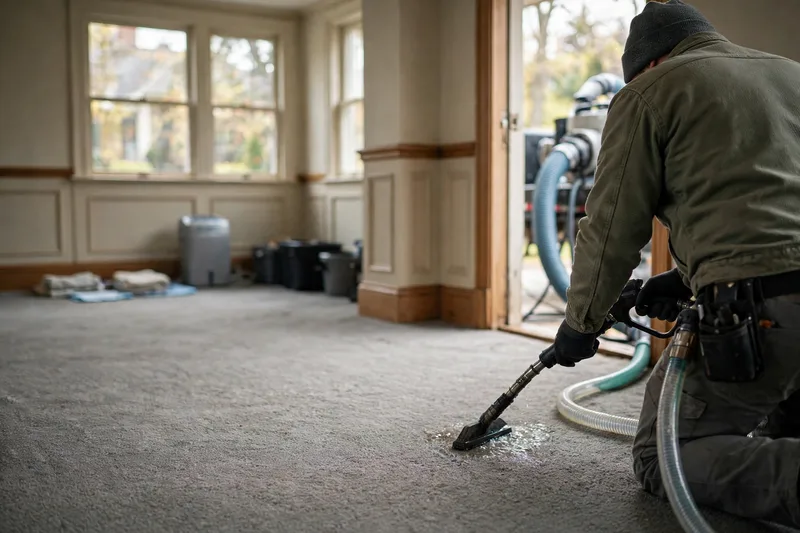
The short answer: water damage restoration wilmette work means stopping the water, extracting it, removing what cannot be saved, and drying the structure to a measured standard, with the whole loss documented for insurance from the first hour. Most Wilmette calls start as sewer backups east of Ridge Road, where the combined sewer surcharges in heavy rain, sump pump failures on the separate sewer west side, or burst pipes in the village's older housing stock. Drying takes about 3 to 5 days once equipment is set, the Village runs stormwater programmes that can support prevention work, and whether insurance pays depends on the kind of water and the endorsements on your policy, which is why the documentation matters as much as the drying. Everything below is that answer in full.

Your first hour in a flooded Wilmette home
The first hour sets the size of everything that follows: the damage, the bill and the insurance claim. Homeowners who have been through it describe the same feeling, a kind of paralysis in front of a spreading pool of water. The way through it is a short list, worked in order. This is the same list we work from when a water damage restoration wilmette call comes in at 2 in the morning.
- Safety before property. If water has reached outlets, appliances, a furnace or the electrical panel, keep people and pets out of it. Switch off power to the wet area only if you can reach the panel without standing in water. Sewage or outside flood water is a health hazard: out of the area entirely.
- Stop the water at its source. A burst pipe or failed water heater means the main shutoff valve, usually near the meter or where the line enters the house. For a sump failure, check the pit: is the pump plugged in, is the breaker on, is the float free to move.
- Document before you touch. Photos and video of every room, the water line on the walls, damaged belongings where they sit, and the source if you can see it. Five minutes of this is worth more to your claim than anything that happens later.
- Move what is dry, lift what is wet. Belongings not yet wet go up and out. Furniture legs can be lifted onto blocks or foil covered wood. Do not throw damaged items away; your adjuster needs to see them or release them first.
- Check the drains, then tell the Village. If water is coming up through more than one drain, or the street outside is holding water behind its inlets, the problem may be on the public side. Note it, photograph it, and report it to the Village of Wilmette as described further down this page: Public Works in working hours, the dispatch line after hours.
- Then call. With the source stopped and the record made, call (773) 570-9869. Tell us where the water is, where it came from and how long it has been there. That decides what the truck carries.
Two things people reach for instinctively make things worse: a rented carpet machine, which moves surface water and leaves the structure wet, and a day of household fans, which dries the air while the walls quietly wick water upward. Both are understandable. Neither is drying, and mold does not grade on effort.
What water damage restoration includes
Restoration is a sequence, and each stage exists because skipping it costs more later. When homeowners ask what they are actually paying for, this is the honest list.
- Assessment and moisture mapping. The crew finds where the water went, even where nothing shows on the surface. Meters and a moisture map of walls, floors and cavities set the whole plan; water travels further than the stain, every time.
- Extraction. Standing water is pumped and extracted, including water pulled from carpet and pad. This is the highest value hour of the job.
- Removal of what cannot be saved. Soaked pad, swollen baseboard, wet insulation and drywall that has wicked water upward are removed cleanly, because material that cannot reach dry standard becomes a mold farm inside your wall.
- Structural drying. Air movers and dehumidifiers are placed from the moisture map and adjusted daily. Drying is finished when readings reach the dry standard of an unaffected part of your home, not when a set number of days has passed.
- Cleaning and antimicrobial treatment of affected surfaces where the water category calls for it.
- The documentation pack. Dated photos, the moisture map, daily readings and the drying record, organized for your insurer and for whoever does your repairs.
The emergency half of this work, stopping and drying, is also called mitigation, and it has its own page: our water mitigation service explains that stage in depth. Restoration is what water damage restoration wilmette covers end to end, from the first call to the file you hand your adjuster.

How the work runs, first call to dry standard
Seven stages, in order. The two that separate restoration from a wet basement with fans in it are the moisture map at the start, and the readings that prove dry at the end.
Call and describe the water
Where it is, where it came from if you know, finished or unfinished space, and how long it has been there. That description decides what the truck carries and how fast we move.
Make it safe and stop the source
Power to wet areas off where it can be done safely, the main water valve closed for plumbing failures, and the sump pit checked. Nothing else matters until the water stops arriving.
Document before anything moves
Photos and video of every affected room, the source, and damaged belongings in place. This record, made in the first hour, is what your insurance claim will stand on later.
Extract the standing water
Pumps and extraction equipment remove the water itself, including water pulled out of carpet and pad. An hour of extraction does what days of evaporation cannot.
Remove what cannot be saved
Soaked pad, swollen baseboard, wet insulation and drywall that has wicked water are cut out cleanly. What stays is what can be verified dry; what goes is what would grow mold.
Set drying and map the moisture
Air movers and dehumidifiers are placed from a moisture map of the structure: meters and a diagram showing exactly what is wet, including inside wall cavities. The map, not guesswork, runs the job.
Monitor daily and hand over the file
Readings are taken daily and equipment adjusted until every material reaches the dry standard. You receive the full documentation pack: photos, readings and drying record, ready for your insurer and your repair contractor.
Where Wilmette water damage starts
Almost every flooded basement in this village traces back to one of six doors the water came through. Naming the door matters, because the cleanup is similar but the fix, and the insurance answer, is different for each.
Sewer backups
Wilmette's signature loss on the east side, and the first door on this list for a reason. East of Ridge Road the sewer is combined, storm water and household sewage in one pipe, and a hard storm can fill it past its capacity and push water back up through basement floor drains. This gets its own full section below, because a backup is a different job from a leak in every way that matters: safety, insurance and prevention.
Sump pump failures
The pit fills during heavy rain, the pump does not run or cannot keep up, and the basement takes the overflow. The storm that fills the pit is usually the same storm that cuts the power. This also gets its own full section below, because west of Ridge Road, where the sewers are separate, the sump system carries the whole ground water load and preventing its failure is worth more than mopping its first one.
Frozen and burst pipes
Chicago area winters split pipes in exterior walls, crawl spaces and unheated corners, and the break is often found by the water, not the sound. A pipe that froze and thawed over a weekend away can run for days. Wilmette's older plumbing, cast iron and galvanized lines in pre-war and early post war homes, adds its own slow version: a joint that lets go after eighty years of service. The shutoff valve is the first tool; the moisture map is the second, because the water rarely stays in the room where the pipe is.
Basement seepage and foundation leaks
Water that arrives through the wall, the floor joint or a crack after rain, with no pipe involved. Wilmette's clay and former lake bed soils hold rain against foundations for days, and near the lake and the North Shore Channel the ground water table itself sits high, which makes this the slow, repeating kind of water damage here, and also the kind insurers most often call upkeep, which is covered in the insurance section below.
Appliance leaks
Water heaters, washing machine hoses, dishwashers, ice maker lines and the HVAC condensate drain. These are clean water at the source and sudden by nature, which makes them the most straightforward insurance cases on this page, and the most destructive when they run all day in an empty house.
Roof leaks and leaks between floors
Water that enters from above: a worn roof valley, flashing that let go, an ice dam forcing meltwater under the shingles, or a shower or tub on an upper floor leaking down through the ceilings below it. The stain on the ceiling is the end of the story, not the start; the wet insulation, plaster and wall cavities above and below it are the part that needs the meter.
The Ridge Road divide: one village, two sewer systems
Ask a Wilmette homeowner which sewer their house drains to and most cannot tell you, yet it is the single most useful fact about their basement's flood risk. The Village describes its own system plainly: homes east of Ridge Road are on a combined sewer, where storm water and household sewage share one pipe, and homes west of Ridge Road are on separate sewers, storm water in one system and sanitary sewage in another. The two sides flood differently, are prevented differently, and argue with insurers differently.
On the combined side, the engineering trade is visible from your front step during a storm. The Village fits the street inlets in that area with restrictors that deliberately hold rainwater in the street, letting the combined sewer carry the load it can handle instead of taking every gallon at once and surcharging into basements. Standing water in an east side street during a hard rain is therefore not, by itself, a broken system; it is the system working as designed, trading a wet street for dry basements.
The failure comes when the rain outlasts the design: the combined flow swells past capacity, pressure builds, and the water looks for the lowest exits first, which are basement floor drains, basement toilets and laundry tubs in the homes along that stretch. That is a sanitary backup, Category 3 water, and it is why a real Wilmette sewage extraction is documented on camera in this village: a basement sewage job here is a known local event, not a freak accident.
On the separate side, the same storm plays out quietly. The storm sewer takes the rain and the sanitary sewer takes the house waste, and backups reach basements by the back door instead: rain water leaking into the sanitary pipes through cracks, joints and old connections, swelling the flow until it behaves like a combined system for a few hours. The west side's more common flood, though, never involves a sewer at all. It is ground water, rising in clay soil, collected by drain tile and carried by the sump pump, which is why the pump section below is written the way it is.
Three facts about a backup decide how the job runs, on either side. First, the water is Category 3 by definition, because it carries whatever the sewer carries. Porous material it touches comes out, the area is disinfected, and nobody works in it barehanded. That is why a sewer backup is run as a sewage cleanup job from the first hour, not as a standard water job with extra mops. Second, restoration starts after the backup, not during it. While the system is still overloaded, extraction is a bucket brigade against a river.
The correct moves then are safety, shutting off power to the wet area, keeping people out, and reporting it to the Village, which is covered in the Village section below. Third, the record matters twice over. Photograph which drains backed up and when, because that record serves both your insurance claim and the Village's own account of where its system struggled in that storm.
The prevention side splits along the same line. On the combined side, the classic fix is a backwater or check valve on your sewer line: your water flows out, the street's water cannot flow in, and Wilmette plumbers install them in this village for exactly the stated cause, heavy rain and an overloaded sewer. The heavier version is an overhead sewer with an ejector pump, which lifts your waste to a line that leaves the house above the level a backup can reach.
On the separate side, prevention is sump redundancy and drainage: a pump that cannot fail silently, downspouts that end away from the foundation, and grading that sends the yard's water somewhere else. The Village's stormwater programmes, and what they can and cannot pay for, are set out in the Village section and the FAQ below, because for a repeat flood address they change the math of the whole decision. It is this loss, more than any other, that homeowners mean when they search flood damage restoration wilmette the morning after a storm.
Sump pump failure: the west side's most common flood
If one machine decides whether a Wilmette basement stays dry, it is the sump pump. Most of the flooded basements we are called to here started the same way: a hard storm, a pump that did not run, and a pit that quietly overflowed while the house slept or sat empty. Owners across the North Shore and the suburbs along the Channel swap the same stories after every big rain: the damage was not the river or the lake, it was the dead pump nobody had tested since spring. The failures themselves are almost never exotic.
| Cause | What happens | The fix |
|---|---|---|
| Power outage | The storm that fills the pit also cuts the power; the pump never runs | A battery backup pump that works through the outage, tested before storm season |
| Tripped breaker or unplugged pump | The pump sits silent while the pit fills | A dedicated circuit, an alarm that sounds when the pit runs high, and a check after any electrical work |
| Stuck float switch | The switch hangs on the pit wall or debris and never tells the pump to start | Switch adjustment or replacement; the most common single cause we find |
| Age and wear | Pumps weaken over years and fail under the one heavy load that matters | Replacement before failure; most pumps earn their keep for roughly five to ten years of service |
| Overwhelmed pump | The pump runs but cannot keep up with the inflow | A correctly sized pump, a clear discharge line, and drainage fixes that reduce the inflow itself |
| Frozen or blocked discharge | Water is pumped against a blocked line and returns to the pit | Discharge line cleared and routed so it drains away from the foundation in every season |
The backup ladder deserves plain words, because it is the difference between an inconvenience and a restoration job. The first rung is a spare pump on a shelf, bought before you need it, because the night the pit overflows is the night every store shelf in the village is empty. The second is a second pump in the same pit, set a little higher than the first, so it only runs when the first has failed or fallen behind.
The third is power: a battery backup that runs the pump through an outage, or a water powered backup where the home's water pressure allows one. Owners across the North Shore say it flatly to each other: a sump pump with a battery backup is basically a must have in this ground. The stories of backups that outlasted both the pump and its battery are the reason the ladder has a fourth rung.
That rung is a high water alarm, a small device that turns a silent 3 a.m. failure into a sound you can act on while there is still time. Each rung is cheap next to one finished basement.
And the warning that belongs with it, stated plainly because so many homeowners learn it a week too late: a sump failure loss is commonly covered only if your policy carries the water backup or sump overflow endorsement. Without it, the same flooded basement that a neighbor's policy pays for can be entirely your cost. The endorsement usually costs little per year next to one restoration bill. Check your policy this week, while the basement is dry; it cannot be added after the water.

The three kinds of water, and why the category runs the job
Restoration crews sort every loss into one of three categories, and the category decides what can be dried in place, what has to come out, and how the area is cleaned. It is the single most useful piece of the trade's language for a homeowner to know, because it explains most of the decisions that follow.
| Category | Typical Wilmette sources | How it is handled |
|---|---|---|
| Category 1: clean water | Supply lines, water heaters, ice maker lines, melting snow and ice | Extract, dry in place where materials allow, verify by readings |
| Category 2: contaminated water | Washing machine and dishwasher overflow, sump water carrying ground water, toilet overflow without waste | Porous materials it soaks usually come out; surfaces cleaned and treated; drying verified |
| Category 3: grossly contaminated | Sewer backups through floor drains on either side of Ridge Road, outside flood water from the Channel or the lake, standing water that has sat and degraded | Porous materials removed, area disinfected, then dried and verified; protective equipment throughout |
One fact about categories surprises people: water degrades. Clean water from a burst pipe that stands in a warm basement for two days, running across floors and picking up whatever it crosses, is no longer treated as clean. This is the technical reason behind the page's repeated point about the clock. Fast extraction is not impatience; it is what keeps a Category 1 job from becoming a Category 2 job while everyone waits.
The do it yourself line, drawn honestly
Some water damage is a reasonable home job: a small clean water spill on a hard floor, caught quickly, dried the same day and checked dry. The line is crossed when any of these show up: water from a drain, a toilet or outside the home; water inside walls, under floors or in a finished basement; a wet area you cannot check dry with anything better than your hand; suspect old materials that predate the 1980s; or a loss you expect to claim, where early cleanup can destroy the evidence. Past that line, the meter and the record are not luxuries. They are the job.
Drying that is proven, not assumed
The difference between a dried home and a home that merely feels dry is a set of numbers. On every job, the crew establishes a dry standard by reading the same materials in an unaffected part of the house, then reads the wet materials daily against it. Wood framing, drywall, subfloor and concrete each have their own normal range, and equipment comes out when the wet readings reach the dry ones, not when a set number of days has passed.
The readings go into a drying log that becomes part of your claim file, which is how professional drying defends itself twice: once against mold, and once against an adjuster asking how anyone knows the structure was really dry. That record is part of every water damage restoration wilmette job we run, not an extra sold at the end.
Different materials dry differently
Carpet can often be dried and kept while its pad, cheap and quick to saturate, usually comes out. Hardwood is the slow negotiation: dried evenly, with the moisture pulled at a steady rate, it can come back flat; dried too fast or from one side only, it cups and stays cupped. Laminate and vinyl plank over a wet subfloor trap moisture underneath and often have to be lifted so the subfloor itself can dry.
Drywall that wicked water a short way can be cut at a clean line or dried in place when readings allow; insulation inside a wet wall cavity does not dry on any useful clock and is the usual reason a flood cut is made. Wilmette adds one local material to the list: plaster, common in the village's older homes, which holds water longer than drywall but often survives a patient, metered dry that modern board would not. None of these calls should be made by habit. They are made by readings, material by material, and a homeowner is entitled to hear the reading behind each one.
The mold connection is direct. Wet materials begin growing mold within 24 to 48 hours, and the growth that matters most is the growth nobody sees, inside the wall cavity and under the floor. A structure verified dry inside that window rarely grows anything. A structure closed back up damp is a mold job waiting for a warm week, which is why the section on the mold clock below exists and why a basement flooding wilmette search so often turns into a mold search a month later.
Why Wilmette homes flood the way they do
Wilmette's water problems are written into its ground. The village sits on flat land over heavy clay and former lake bed soil, between Lake Michigan on the east and the North Shore Channel on the west, with Wilmette Harbor where the Channel meets the lake. Clay does not absorb rain the way sand does; it holds water at the surface and against foundation walls for days after a storm, and on flat ground that water has nowhere fast to go.
Near the lake and the Channel the ground water table sits high enough that some east side basements live close to it all year. And the village was built early: much of its sewer and housing stock predates modern storm practice, which is why the Ridge Road divide even exists, combined sewers being the standard of the era when the east side was laid out.
The record shows what that recipe produces. In April 2013 a major storm flooded the Wilmette Harbor area and the Channel banks, the kind of event that fills the Village's flooding history files street by street.
The Village answered with engineering rather than slogans: inlet restrictors on the combined side that hold storm water in the street by design, a Neighborhood Storage Project and the West Park Storage and Pumping Station to hold water for whole areas, homeowner programmes for the private side of the problem, and a flooding history map so a buyer or an owner can see a street's record instead of guessing at it. That is why Wilmette flooding is a street by street story.
One block backs up in nearly every heavy rain while the next block over has stayed dry for a decade, and any honest answer about a specific house starts with its own history, its disclosure record, and which side of Ridge Road its sewer runs to, not with a village-wide slogan.
The housing stock completes the recipe. Wilmette's colonials, Tudors and other pre-war and early post war homes carry clay laterals that crack and invite roots, cast iron drains at the end of their design life, plaster walls that hide slow leaks for seasons, and finished basements fitted into houses that were not designed for them. Around Gillson Park and the lakefront streets, deep basements sit close to the water table. In CAGE and Indian Hill and the streets west of Ridge Road, the risk profile flips to the sump and the soil.
When a storm drops inches of rain in hours, it tests every weak point at once, and it usually brings a power outage with it. Behind most of our Wilmette calls sits the same combination: the tired sump pump, the clogged gutter, the downspout extension that fell off in June, the clay lateral with a root ball at the joint. That is why the prevention section at the end of this page is written the way it is.
That combination, sump plus lateral plus storm, is what most water damage restoration wilmette jobs are really made of: three small failures arriving on the same night.
When the basement floods and no drain is involved
A large share of Wilmette basement flooding never touches a pipe or a drain. The water comes through the building itself, and finding the door it used is most of the cure. Work the list from the surface down, because the expensive fixes are wasted money when a cheap one was the cause.
- Gutters and downspouts. A clogged gutter pours the whole roof's water down one stretch of foundation wall, and a downspout ending at the base of the house delivers it neatly to the clay. Owners repeat one figure to each other: extensions should carry water six to ten feet away from the foundation where the lot allows.
- Grading. Soil settles along foundations over the years until it slopes toward the house, turning the yard into a funnel aimed at the basement wall. Flat Wilmette lots settle quietly and hold the slope for years.
- Window wells. In a cloudburst a well fills like a bucket against the lowest opening in the wall. Covers and clear well drains end that route.
- The cove joint and floor cracks. Under enough pressure, water rises where the floor meets the wall and through cracks in the slab itself. This is ground water doing what ground water does in clay and old lake bed soil, and it is managed with drain tile and the sump system, not with sealant.
- A sump system that is undersized or untested. In wet ground the pump carries a heavy load; a pump you have never tested is a hope, not a system.
Finished and unfinished basements change the stakes, not the diagnosis. An unfinished basement floods onto concrete and stored boxes, and the loss is mostly what the water touched. A finished lower level floods into pad, drywall or plaster and trim that wick water upward out of sight, which is why the same storm produces a mop up on one side of the street and a restoration job on the other, and why flooded basement cleanup wilmette work is mostly finished basement work.
Insurance: the decisions that are easier before cleanup
Of everything on this page, this is the section homeowners tell us they wish they had read first. In the forums where North Shore owners swap flood stories, the water itself is rarely the worst part. The worst part is the claim: whether to file, what to say, why it was denied, and what the claim did to their premiums afterward. The pattern is consistent enough to write down.
The claim or not decision. Filing is not automatic and skipping is not always smart. The working math: compare the realistic size of the loss with your deductible, and count the claim history you are building. A small loss just over the deductible pays little and still marks your record, and with some carriers even an enquiry about a possible claim can be noted. A finished basement, several rooms, contaminated water or structural drying over days is exactly what the policy exists for. Decide with the damage assessed and sized, not from the doorway at midnight.
Document first, call second. The strongest claims share a file: dated photos and video from before cleanup, a note of when the water was discovered, damaged items kept until the adjuster releases them, and a professional drying record with moisture readings. That file is what our documentation pack is for. Homeowners who clean first and document later spend weeks arguing about what the damage was. Homeowners with the file mostly argue about scheduling. One more habit from the claim stories that end well: get the first estimate in writing and keep every reading, because initial estimates commonly grow by supplement as hidden damage is found, and the paper trail is what carries the increase.
| Kind of water | Usually covered? | Why |
|---|---|---|
| Burst pipe, failed water heater, appliance hose | Yes, in most policies | Sudden and accidental, the core case homeowners insurance is built on |
| Sump pump failure or sewer backup | Only with the water backup endorsement | Standard policies commonly exclude this water unless the endorsement was bought; in Wilmette that exclusion decides most storm claims |
| Lake, Channel, rain or surface water entering from outside | No, under standard policies | Flood water sits under separate flood insurance |
| Slow leak over weeks or months | Usually no | Treated as gradual damage and maintenance, not an accident |
| Seepage through foundation walls or floors | Usually no | Ground water is excluded in most standard policies |
| Damage that grew because help was delayed | Often reduced | Policies expect reasonable steps to limit the loss once it is found |
Why claims get denied follows the same table. The loss turns out gradual, the evidence was cleaned away before anyone recorded it, the water was of a kind the policy excludes, or the endorsement was never on the policy. Read the denial list and the first hour list side by side and the connection is obvious: most denials are won or lost in the first day, by what got documented. Two Wilmette specific traps are worth naming.
The first is the endorsement cap: backup cover is often a modest sub limit, and a big remediation bill can consume it before any rebuilding starts, so know your cap before the adjuster visit. The second is the word flood itself: describe what you saw and where it came in, factually, and let the record speak, rather than reaching for labels your policy treats specially. Illinois homeowners also have a backstop: the Illinois Department of Insurance takes complaints and answers coverage questions when claim handling feels wrong.
We are a restoration crew, not adjusters or lawyers, and we will tell you plainly where our knowledge ends; what we can stand behind is that your file will be complete.

How long it takes: the honest timeline
Two clocks run on every job, and confusing them causes most of the frustration. The drying clock is measured in days and verified by meters. The restoration clock includes repairs, materials and scheduling, and is measured in weeks. Here is the shape of both, from the water damage restoration wilmette il cases we see most.
| Stage | Typical time | What sets it |
|---|---|---|
| Emergency response and extraction | Day 1 | How fast the call comes after the water is found |
| Removal of unsalvageable material | Day 1 to 2 | How much pad, drywall, plaster and insulation stayed wet |
| Structural drying | 3 to 5 days | Materials involved and daily moisture readings, not the calendar |
| Full restoration of a straightforward loss | 1 to 3 weeks total | Repair scope: flooring, drywall, trim, paint and scheduling |
| Severe or sewage losses | 4 to 8 weeks | Cleaning and disinfection stages, inspections, larger rebuild scope |
The fastest lever in the whole table is the first row, and it belongs to the homeowner. Every hour of standing water is absorbed by materials that then take days to dry or have to come out. It is also why our pitch on this page is a phone number answered at 3 a.m. rather than a promise about week three, and why water removal wilmette searches spike the morning after a storm: the first hours are the cheap hours.
The mold clock: why 24 to 48 hours matters
Mold is not a separate disaster that strikes later. It is the same water, given time. On wet drywall, wood and carpet backing, mold growth can begin within 24 to 48 hours, which is why the drying standard is a standard and not a suggestion: a structure verified dry inside that window rarely grows anything.
A structure left damp for a week is a different job entirely, and homeowners searching for mold help in Wilmette a month after a flood are usually looking at a basement that was wiped down, fanned for a day, and closed back up wet. Wilmette's own search numbers tell that story plainly: mold questions here are asked at least as often as water questions. If your water event is recent, the cheapest mold remediation is the drying happening right now.
If the event is old and you can smell the musty result, that is a remediation job with its own process, and the honest move is to have it assessed as one rather than dried and hoped over. That job has its own page: our Mold Remediation Chicago service covers inspection, containment and removal. The cheapest mold job in Wilmette is a water damage restoration wilmette job dried to its readings inside that 48-hour window.
Your line, the Village's line: who to call and who owns which pipe
When water comes up through the drains, the first argument is usually about whose problem it is, and Wilmette gives you one department to start it with. Public Works runs the water and sewer system: the combined sewers east of Ridge Road, the separate systems west of it, the restrictors, the pumping stations and the storage projects. The emergency routing follows office hours, and it is worth saving before you need it.
| Situation | Who to call | Number and hours |
|---|---|---|
| Sewer backup, street flooding or water main problem, weekday working hours | Public Works | (847) 853-7500 |
| The same problems after hours | Village non-emergency dispatch (the Village's own service request page lists this line for active sewer backups, street flooding and water main breaks around the clock) | (847) 256-1200 |
| General Village questions | Village Hall | (847) 251-2700 |
| The water inside your home: extraction, cleanup and drying | Us, any hour | (773) 570-9869, 24/7 |
Report which drains are affected and whether the street and your neighbours are seeing the same water, because that pattern is how the Village separates a public main problem from a house problem, and your report is also how it learns where the system struggled in that storm. On the east side, also say whether the street inlets are holding water: a street ponding behind its restrictors during the peak of a storm is the design working, while water rising in your drains at the same time is the part the Village needs to hear about.
The responsibility line itself is the connection between your home and the public main. The Village maintains its mains, its storm system and its pumping stations. The private sewer lateral, the pipe running from your house to that main, and everything inside the home sit on the homeowner's side: the Village states that the lateral to the main is the owner's responsibility. When neither side is obvious, a camera inspection of the line settles the question before money is spent arguing about it, and the footage doubles as documentation for whichever side the answer lands on. What not to do is wait for the argument to finish while the basement stays wet: the cleanup and drying clock runs the same regardless of whose pipe failed.
The Village flood programmes, in plain terms
Wilmette is one of the suburbs here that puts public effort into the private side of flooding, and a homeowner pricing prevention work should know what exists before paying for all of it alone. The Village's flooding page names two homeowner-facing programmes. The Stormwater Incentive Program supports storm water improvements on private property. The Resident Resource Program is described by the Village as fixed cost support for residents dealing with flooding.
The Village does not publish amounts for either programme on that page, so the honest version of this paragraph is a pointer: the programmes are real, the terms change, and the current eligibility and amounts are a question for the Village, at the numbers above, before you plan a project around the money.
Alongside them sit the shared projects no single homeowner could build: the Neighborhood Storage Project and the West Park Storage and Pumping Station, which hold storm water for whole areas, and the flooding history map, which is the Village telling you your street's record in public. None of it replaces the house level hardware, the backwater valve on the combined side, the sump ladder on the separate side, but it means a Wilmette flood conversation that never mentions the Village is only half a conversation.
What the quote depends on
No honest price for water damage restoration wilmette work exists before someone has seen your basement, and any company giving one over the phone is inventing it. What can be stated exactly is what the number is built from.
- The amount and kind of water. Clean supply water, storm water and sanitary sewer water are three different jobs with three different safety and cleaning loads.
- The space. Finished versus unfinished, square footage under water, and whether wall cavities are involved.
- The time it sat. An hour and a weekend produce different material lists: what dries in place versus what comes out.
- The drying load. Equipment count and days, set by the moisture map and proven by the readings.
- The documentation. A claim ready file, photos, map and readings, is part of the work, not an extra.
And a checklist worth keeping for any quote you are given, ours included. A fair written quote names the scope room by room, says what material comes out and why, states the drying method and how dry will be proven, separates emergency work from repair work, and is firm before the main work starts. A quote that is one round number with no scope is not a quote; it is an opening position.
Keeping the water out: prevention that actually works
More Wilmette homeowners are asking how to stop the next flood than how to clean this one, and they have it right: the cheapest flood is the one that stays outside. Work this list from the surface down, and start with the item that matches your side of Ridge Road.
- East of Ridge Road: the backwater valve. A check valve on your sewer line lets your water out and refuses the street's water in when the combined sewer surcharges. It is the single most targeted fix on the combined side, and the overhead sewer conversion is its heavier form for repeat backup addresses.
- West of Ridge Road: the sump system. Test the pump before storm season, keep the pit clear, and climb the backup ladder in the sump section above: spare pump, second pump set higher, battery or water powered backup, high water alarm.
- Gutters and downspouts. Extensions carry roof water well away from the foundation; the six to ten foot mark is where repeat seepage usually stops being a mystery.
- Grading. Soil should slope away from the house on every side, and settled soil along the foundation should be built back up, especially on the flat lots where settling is hard to see.
- Ask the Village before you pay alone. The Stormwater Incentive Program and the Resident Resource Program exist for this work; confirm what they currently support before pricing a project entirely out of pocket.
- Store for the flood you have already had. Owners of basements that have flooded before keep belongings in sealed totes, off the floor, and appliances raised. It reads as pessimism and pays like insurance.
- French drains and drain tile. The heavier end of the list, for homes where surface fixes are not enough and water arrives through the floor or the wall joint. Worth it when the diagnosis says so, wasted when it does not.
- Foundation cracks. Small cracks are a sealing job; wide, growing or leaking cracks are a structural conversation with a foundation specialist, and we will say so honestly rather than dry the same basement every spring.
Whatever gets in, gets found fast is the other half of prevention. A water alarm on the basement floor costs little and buys the one thing that decides outcomes: time. Every water damage restoration wilmette call that starts with an alarm instead of a soaked carpet is a smaller job in every way.
The slow leak: damage you find late
Not all Wilmette water damage announces itself. A supply line weeping inside a plaster wall, a shower pan failing a drop at a time, a cast iron drain sweating and dripping in a ceiling cavity for a season: these surface as a stain, a smell, a floor that feels soft, long after the damage is done.
Older Wilmette homes hide a particular version of it, because plaster and lath show water late and hold it quietly, and a slow leak on an upper floor travels down inside the wall to appear as a soft spot far from the source. They matter here for two reasons. The materials involved have usually been wet long enough that mold is part of the job from the first look.
And insurers treat them differently from sudden events, which makes early, dated documentation of when you found the problem, and what you did next, worth even more. A soft spot, a bubbling paint line or a musty room that never quite airs out deserves a meter, not another coat of paint. It is the kind of water damage wilmette homeowners find latest and claim hardest, which is exactly why it is on this page.
Choosing who to call in Wilmette
The choice of a water damage restoration wilmette company usually comes down to a national franchise name or a local crew, and the honest answer is that the name matters less than the working method. Wilmette has one advantage most suburbs do not: a restoration company located in the village itself, which sets a local standard anyone else has to meet. The franchise systems run strong logistics and rotating technicians. Local teams run on their own name in a smaller territory.
A third kind sits near the top of Wilmette search results right now, and it is worth one warning. There are websites with Wilmette names and no Wilmette company behind them, built to rank for this village and pass your call to whoever buys the lead. Check the phone number you are dialing, ask who actually shows up at your door, and ask whether the people in the photos do the work.
What separates a good job from a bad one, whoever does it, is the five questions in our FAQ below: documentation you get copies of, a written scope before the main work, honest insurance talk, drying proven by readings, and a phone answered by someone who knows the job. Ask them of us first. A water damage restoration wilmette crew that answers those five questions in writing, before the main work starts, is the one to hire.
Water damage help across Wilmette and the North Shore
We answer calls across the whole village. That runs from the lakefront streets and Gillson Park to the Channel side, through East Wilmette and West Wilmette, CAGE, Indian Hill, McKenzie and the neighbourhoods around Harper and Romona schools, along Ridge Road, Green Bay Road, Lake Avenue, Wilmette Avenue, Sheridan Road and Central Avenue. It also runs into the neighbouring communities that share Wilmette's weather and water: Evanston, Skokie, Glenview, Winnetka, Kenilworth and Northbrook.
Most people find this page after searching water damage restoration wilmette in the middle of the night; others land here from water damage repair wilmette or water damage cleanup wilmette, which are the same emergency wearing shorter names, and some type water damage wilmette with wet hands and find the same crew. A homeowner searching for water removal wilmette after a sump failure, or for a water damage company near me in Wilmette, is usually asking one thing: does the crew know their kind of house?
The pre-war colonial on a clay lateral east of Ridge Road. The Tudor with plaster walls and a finished basement on the separate sewer side. The lakefront home whose basement floor sits close to the water table. That local shape of the work is what this page was written around. Evanston, to the south, has its own water page: water damage restoration in Evanston, Glenview, to the west, has one too: water damage restoration in Glenview, and so does Skokie: water damage restoration in Skokie. The full list of areas is on our service areas page, and the same crew answers at (773) 570-9869.





