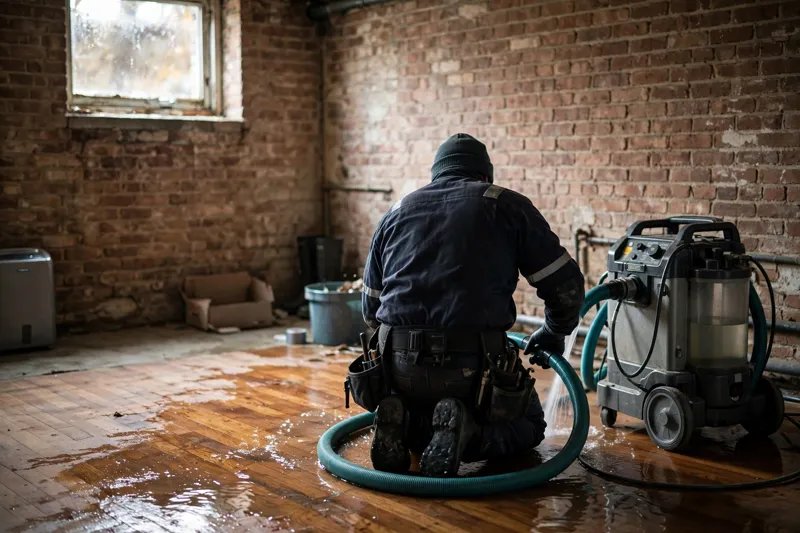
Chicago Water Damage Service, North Center, Chicago, IL 60618
Water Damage Restoration North Center Chicago
Flooded basement in North Center, Chicago? We answer 24/7, arrive fast, extract the water, dry the structure, and help you file the claim.
- 24/7 emergency response, day and night
- Water extraction, structural drying and sewage cleanup
- Moisture readings in a drying log you can see
- We talk to your insurance adjuster for you
Trusted by North Center homeowners, landlords and small businesses, day and night.
Request water damage help in North Center
Tell us where the water is and we will call you back. We answer 24/7.
Water damage restoration in North Center, the short answer
Water damage restoration North Center means one thing: get the water out, get the building dry to a number on a meter, clean what the water touched, remove what cannot be saved, and rebuild what is left. That is the whole job, and it is the same job in a garden unit on Leavitt Street, in a two-flat on Lincoln Avenue, and in a storefront at the Town Square. The difference between a good job and a bad one is not speed alone. It is whether the entry point was found, whether the drying was measured, and whether the record you hand your insurer shows what was wet, what was dry, and what was done.
North Center is a neighbourhood where water arrives quietly. It does not usually come over a riverbank. It comes up through a floor drain in a hard storm, it comes out of a supply pipe that froze in a cold snap, it comes from a sump pump that stopped in the night, and it comes from a clay lateral that cracked under a parkway tree. The houses are old, the basements are deep, and the sewers are combined, so one pipe carries both sewage and stormwater.
When that pipe surcharges, the water has nowhere to go but back up into the lowest room in the building. That is why a North Center basement can flood on a night when the street above looks dry. That is why water damage restoration north center work starts with the entry point, not with the water: find where it came in, then dry what it touched.
Call us first at (773) 570-9869. We answer 24/7 and talk you through the first hour while a crew is on the way. The seven steps below are the same steps we walk every homeowner through on the phone, and they are the steps this page is built around. Do them in order, and do not skip the photographs. Your insurer will ask for them, and a photograph taken before anything moves is worth more than a photograph taken after the room is clean.
What to do in the first hour
- Call us first at (773) 570-9869, day or night. Tell us where the water is, how deep it looks, and whether it smells of sewage.
- Stop the water at the source if you can do it safely. Turn off the main water valve if the water is coming from a pipe, and turn off the water heater as well.
- Stay out of the water while the power is on. Water carries current from a panel, a socket or an appliance, so keep clear until the power is off.
- Do not touch the water with bare hands. Flood water can carry sewage, chemicals and bacteria, so wear rubber boots and gloves.
- Lift what you can save to higher ground, and photograph the water line and every damaged item before you move it.
- Call 311 if the sewer or street flooded, so the city knows the sewer surcharged on your block.
- Let the drying run until the readings say dry. Do not close the walls until a moisture meter says they are dry.
North Center, Chicago: the place this page is for
North Center is Community Area 05, one of the seventy-seven community areas of Chicago, and this page is written for the Northcenter neighbourhood inside it, not for the whole community area, and not for the neighbourhoods that share it. The community area contains Northcenter, Roscoe Village, Horner Park, St. Ben's, Lathrop Homes and Hamlin Park. The community-area bounds are Montrose Avenue to the north, Diversey Parkway to the south, Ravenswood Avenue to the east, and the Chicago River and its North Branch to the west.
The Northcenter neighbourhood itself is narrower: Addison Street to the south, Montrose Avenue to the north, the river to the west, and Ravenswood Avenue to the east. The strip between Addison Street and Diversey Parkway sits inside the community area but is not Northcenter proper, it is Roscoe Village, Hamlin Park and St. Ben's, and Roscoe Village already has its own page on this site.
A page that treats the community area and the neighbourhood as the same place would put the wrong streets, the wrong cases and the wrong advice in front of a homeowner, so this page keeps them apart.
The two published area figures disagree, so this page prints neither as settled: one source gives two point zero five square miles for the community area and another gives two point zero seven. The community-area centre sits at about forty-one point nine five degrees north and eighty-seven point six eight degrees west. The ZIPs are parts of 60613, 60618 and 60657, and 60618 is the main ZIP. The 60625 ZIP does not touch North Center at all, and no number on this page uses it.
The community area had a population of thirty-six thousand and fourteen in 2024, a figure the Chicago Metropolitan Agency for Planning and the North Center article both give, and fourteen thousand eight hundred and sixty-eight households with an average household size of two point four. The 2020 Census counted thirty-five thousand one hundred and fourteen people, and the 2010 Census counted thirty-one thousand eight hundred and sixty-seven, a rise of thirteen percent across the fourteen years.
There is no official population figure for the Northcenter neighbourhood itself, and this page prints none, because a community-area number is not a neighbourhood number.
North Center is served by two wards. The 47th Ward, represented by Alderman Matt Martin since May 20, 2019 and re-elected in 2023, covers the bulk of the area, and its ward office sits at 4243 North Lincoln Avenue, inside North Center. The 32nd Ward, represented by Alderman Scott Waguespack since 2007, covers the rest. The 33rd Ward is not verified as touching North Center, and this page does not claim it. The commercial heart is the Lincoln Avenue corridor, above all the Lincoln, Damen and Irving Park intersection at Northcenter Town Square.
The neighbourhood was settled largely by Germans in the late nineteenth and early twentieth centuries, with Polish, Czech, Romanian, Serbian, Greek, Croatian and French families alongside them, and Chicago Magazine voted it one of the city's best neighbourhoods in 2014.
The landmarks a North Center homeowner will know by sight are Lane Tech College Prep High School and its clocktower, the WGN-TV Studios at 2501 West Bradley Place, opened in June 1961, Northcenter Town Square at Belle Plaine and Damen Avenues, whose redesigned plaza opened in summer 2020 and hosts a farmers market on Saturdays from June to October and is home to Ribfest, Horner Park, Hamlin Park, the Clark Park Boat House, Kerry Wood Cubs Field, the Chicago Fire Soccer Center, and the historic Riverview Park site, an amusement park from 1904 to 1967 that was once the largest in the world in its day, spread across seventy-six acres from Belmont Avenue to Lane Tech and Western Avenue to the river, and today the site of DePaul College Prep, the Area 3 Police Headquarters and Riverview Plaza Center.
The schools are Audubon, Bell, Coonley, North Park, Hamilton and Jahn elementary schools, St. Benedict Elementary and High School, DePaul College Prep, Lane Tech, Pilgrim Lutheran, James Adams Alternative, Chamberlain College of Nursing and DeVry Institute of Technology.
Transit is the Brown Line. Three stations sit inside the community area: Addison at 1818 West Addison Street, Irving Park at 1816 West Irving Park Road, and Montrose at 1817 West Montrose Avenue. Montrose needs a caveat: one source counts it as a stop within the community area, and the list of Chicago L stations locates it in Ravenswood, and since Montrose Avenue is the community area's north boundary, the station sits on the boundary line itself.
Metra has no station inside North Center at all, the nearest are Ravenswood station, reached by a Damen Brown Line transfer just north of Montrose in the Lincoln Square community area, and Clybourn to the south, both nearby only and never claimed as inside. Damen station on the Brown Line is listed as Ravenswood, not North Center, and it is the transfer point for the Metra Ravenswood station, so this page does not claim Damen as a North Center station.
The bordering community areas are Lincoln Square to the north and east, Lake View to the south, Albany Park to the northwest, and Avondale to the southwest.
The Chicago River and its North Branch form the community area's west boundary, and the river sets the neighbourhood's western edge: everything west of the river is Avondale and Logan Square, not North Center. Horner Park, Clark Park and the riverfront trails sit along the river, and the blocks closest to the river and to Horner Park sit closest to the water.
The river is not the usual source of a North Center basement flood, the floods come from the sewers, not from the river, but the river side of the neighbourhood sits lowest, and the park floods before the houses do. The Horner Park trails flooded in the summer of 2023, and the trails were rebuilt, with the work completed in December 2023, and a homeowner on the west side of the neighbourhood should read the park flooding as a warning, not a coincidence.
The city's deep-tunnel system, the Tunnel and Reservoir Plan, stores stormwater underground so the combined sewers do not surcharge, and it is the reason a storm that would once have flooded the whole north side now floods only the lowest rooms. A homeowner who lives near the river should know that the river is the boundary, the park is the warning, and the sewer is the cause.
The place name itself is a ranking hazard. When you type the head phrase into Google, the autocomplete completes it with Jersey City and Boston first, and "north center street jersey city nj" and "north center st" sit among the five completions. There is a North Center street in Jersey City, and a North Center in Boston, and Google falls back to Chicago-wide results when it cannot tell which North Center you mean.
That is why this page hammers "North Center, Chicago" on every section, and why the map packs in the research battery came back distorted, with a Manhattan, New York footer on every search page. A North Center homeowner who searches without the word Chicago can be shown results for another state entirely, and a page that never says Chicago is a page that cannot be found by the person it was written for.
What this page covers, and what it does not claim, matters more than anything else in it. Two verified North Center cases exist in the record, and both belong to the same storm, the supercell of September 11, 2022. The first is the Friend family, a named family in a North Center house whose basement flooded with water at calf height bubbling up from the floor drains, told in a Johns Hopkins University thesis.
The second is a City of Chicago 311 complaint for water in a basement at 4228 North Leavitt Street, second floor, on the same day, a complaint record, not independent confirmation of how deep the water was or what caused it, and the only verified North Center case that carries a street address. A third verified event is the January 2008 water-main break at Montrose Avenue and Wolcott Street, which flooded the street, not a basement.
A fourth, the summer 2023 flood damage to the Horner Park riverfront trails, is park damage, not a home, and it supports the record rather than leading it. No other verified North Center case carries a house-number address, no named resident has been found for a North Center burst pipe, and no North Center case was found on YouTube in two independent live hunts. This page prints the record as it is, and it says so where the record is thin.
How water damage restoration works in North Center
Water damage restoration North Center starts with the entry point, not with the water. A crew that only removes the water has done half the job, and the water will come back through the same opening at the next storm. The seven steps below are the job in order: call, stop the source, stay safe, do not touch the water, lift and photograph, call 311 when the sewer or street flooded, and let the drying run until the readings say dry. The schema on this page carries the same seven steps, and the visible text and the schema say the same thing, because a page whose schema disagrees with its own text is a page Google cannot trust.
Call us first.
Call (773) 570-9869 any time, day or night. Tell us where the water is, how deep it looks, and whether it smells of sewage. We answer 24/7 and talk you through the first hour while a crew is on the way to your North Center home.
Stop the water at the source.
Turn off the main water valve if the water is coming from a pipe, and turn off the water heater as well. If you cannot see the source, say so, a leak can travel ten feet or more from where it enters. Do not climb a ladder or crawl under a house to reach a valve.
Stay out of the water while the power is on.
Water carries current from a panel, a socket or an appliance. Keep clear of the flooded area until the power is off at the main breaker or a technician has cleared it. If the panel sits in the flooded area, call an electrician instead of going in.
Do not touch the water with bare hands.
Flood water is not clean tap water. It can carry sewage, chemicals and bacteria, and a soaked floor is a slip. Wear rubber boots and gloves, wash your hands well, and keep children and pets clear of the room until the water is gone.
Lift what you can save and photograph everything.
Move rugs, boxes and furniture to dry ground, and put furniture legs on blocks so they do not stain the floor. Photograph the water line and every damaged item before you move it, and keep a written list of what was lost, what you moved and what was thrown away.
Call 311 if the sewer or street flooded.
Call 311 when the water came up through a floor drain, when the street filled, or when several houses on the block flooded at once. A 311 report is how the city learns a sewer surcharged, and the report goes into the planning record for your block. From outside Chicago, the CHI311 site footer lists the number in dotted form, 312.744.5000.
Let the drying run until the readings say dry.
Keep the air movers and dehumidifiers running, and do not close the walls until a moisture meter says they are dry. We read every wall and floor each day and write the readings into a drying log you can see. Dry is a number, not a look.
Each step has a reason, and the reason is the same in every North Center job. Step one matters because a crew that arrives in the first hours extracts water before it soaks into the framing. Step two matters because a pipe that keeps running adds gallons every minute, and a supply line at street pressure can fill a basement while you wait for a plumber. Step three matters because a flooded basement with live power is a shock hazard, and the panel is often in the basement itself.
Step four matters because flood water is not tap water, and sewage carries bacteria that can make you sick. Step five matters because your insurer pays on evidence, and evidence is a photograph taken before anything moves. Step six matters because a 311 report is how the city learns a sewer surcharged, and the report goes into the planning record for your block. Step seven matters because dry is a number on a meter, not a look, and a wall that looks dry can still hold water behind the paint.
The six ways water gets into a North Center home
Water gets into a North Center home through the same few openings, and the opening tells you the job. First, a sewer surcharge: in a hard storm the combined sewer fills, and water comes back up through the lowest opening in the building, usually a floor drain or a low toilet. Second, a failed sump pump: the power cuts out, the float switch sticks, or the discharge line freezes, and the pit overflows into the basement.
Third, a frozen discharge line: the sump pump runs, but the water has nowhere to go, so it comes back into the pit. Fourth, a burst supply line: a pipe freezes and splits in a cold snap, and the water runs at street pressure until someone turns off the main valve. Fifth, street water running toward the foundation: a downspout that ends at the wall, a yard that slopes toward the house, or a clogged gutter that spills onto the foundation.
Sixth, a cracked foundation or an old clay lateral: a lateral that cracked under a parkway tree, or a foundation crack that opens after a freeze and thaw, lets groundwater in every time it rains hard. We find the entry point before we start the drying, because drying a basement without closing the entry point is drying a room with the tap still running.
Streets, blocks and buildings
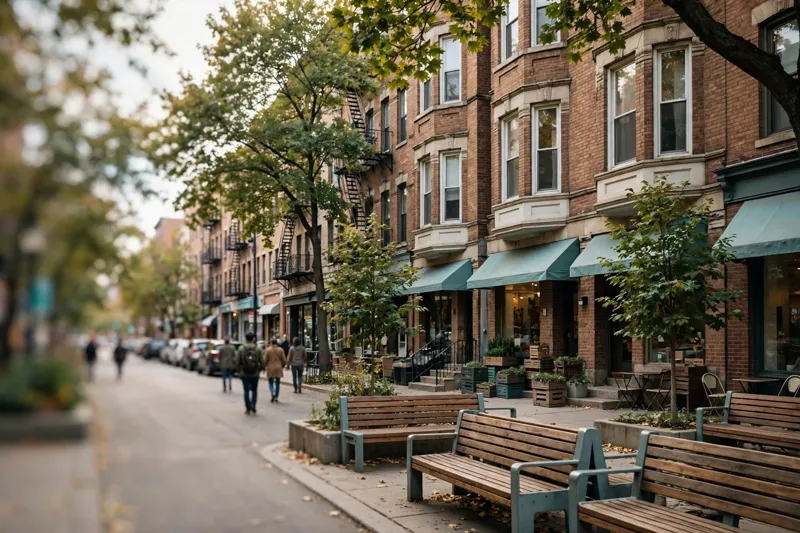
North Center runs on a diagonal. Lincoln Avenue cuts across the grid from the southeast to the northwest, and the neighbourhood's commercial heart follows it, the Town Square at Belle Plaine and Damen, the shops along Lincoln, the restaurants at the Lincoln, Damen and Irving Park intersection. Belle Plaine Avenue runs at forty-one hundred north, Irving Park Road at four thousand north, Addison Street at thirty-six hundred north, Montrose Avenue at forty-four hundred north, Diversey Parkway at twenty-eight hundred north, and Ravenswood Avenue at eighteen hundred west.
The grid numbers matter, because a page that prints Montrose Avenue as forty-eight hundred north has put the neighbourhood four blocks south of where it is, Lawrence Avenue is forty-eight hundred north, Foster Avenue is fifty-two hundred north, and Montrose Avenue is forty-four hundred north, and this page prints it right. The housing is old and mixed: two-flats and three-flats along the side streets, frame houses and brick bungalows, garden units below grade, and storefronts with apartments above them on Lincoln Avenue.
The basements are deep, the laterals are often clay, and the river sits on the west side of the neighbourhood, so the blocks closest to the river and to Horner Park sit closest to the water. The two verified cases sit on that map: the Friend family in a North Center house with no street address in the source, and the 311 complaint at 4228 North Leavitt Street, second floor, in the 60618 ZIP.
The January 2008 water-main break sits at Montrose Avenue and Wolcott Street, on the community area's north boundary, and the Horner Park trails sit along the river on the west side. A homeowner who reads this page should be able to place every case on a street they know.
Sump pumps: the part of the job that fails first
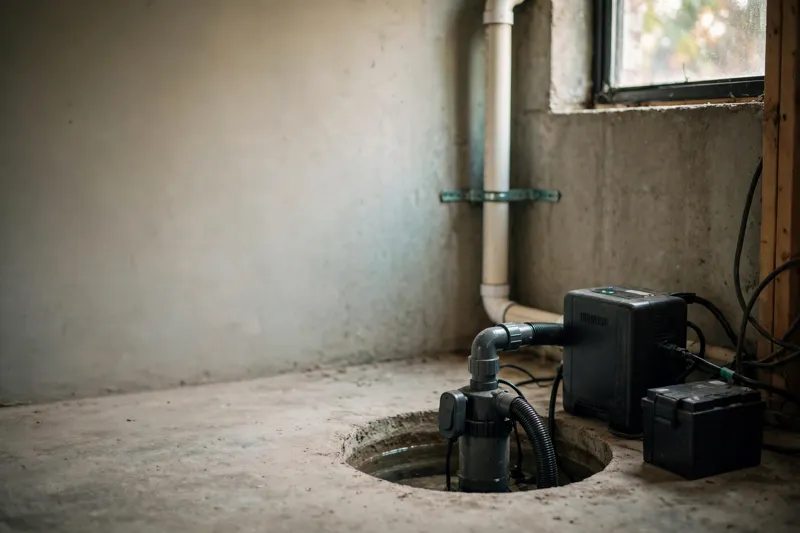
Water damage restoration in North Center depends on the sump pump more than any other single part of the house, and the sump pump is the part that fails first. The usual causes are a power cut, a frozen or blocked discharge line, a stuck float switch, and a pump that is too small for the water coming in. A pump that runs constantly is close to failing, and a pump that never runs may be stuck.
The test takes two minutes: pour a bucket of water into the pit and watch the pump start, run, and stop. Do it every spring and fall, and keep a battery backup ready, because the storm that floods a basement is the same storm that takes out the power. A backwater valve on the building drain stops a sewer surcharge from coming back up through a floor drain, and an overhead sewer makes it impossible, because an overhead sewer lifts the fixtures above the street sewer level.
Both are worth asking a licensed sewer contractor about before the next storm, and both are cheaper than a second flood. The discharge line is the pipe that carries the sump pump's water out of the house, and it freezes in winter, and when it freezes the pump runs and the water comes back into the pit. The line should run to a place where the water drains away from the foundation, not back toward it, and it should be checked before the first freeze.
A line that ends at the wall, or that runs across a walkway, or that discharges onto a neighbour's lot, is a line that will cause a problem. Keep it clear of leaves and ice, and keep the outlet above the ground so it does not freeze shut. A battery backup keeps the pump running when the power cuts out, and the storm that floods a basement is the same storm that takes out the power.
Test the pump and the line together every spring and fall, and pour a bucket of water into the pit and watch the pump start, run, and stop.
The three kinds of water, and why the kind decides the job
Water damage restoration North Center asks one question first: what kind of water is it. Clean water comes from a supply pipe, a water heater or a rain leak, and it is the easiest to clean, because it carries nothing in it but water. Grey water comes from a washing machine, a dishwasher or a sink, and it carries soap and dirt, so everything it touches needs cleaning as well as drying.
Black water comes from a sewer backup or a storm flood, and it carries bacteria and waste, so everything it touches needs removing or sanitising, and no one should stand in it. The kind decides the job: clean water can often be dried and kept, grey water needs cleaning and sometimes removal, and black water needs removal of everything porous it touched.
The Friend family case was black water, dark, fetid water bubbling up from the floor drains with sticks, leaves and dirt in it, and that is why the job was not a drying job but a removal and sanitising job. A crew that treats black water like clean water leaves a health hazard behind, and a homeowner who mops up a sewer backup with a household mop spreads the bacteria across the room.
The combined sewer, and the valve the city built for it
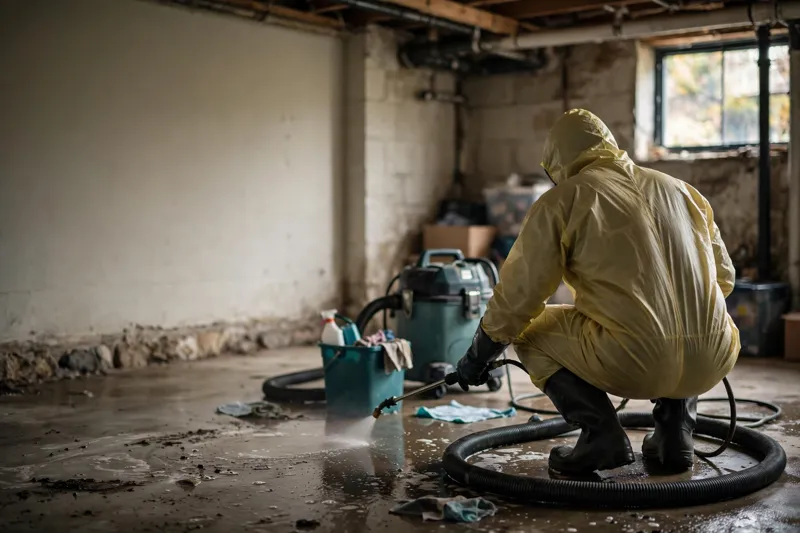
Chicago has a combined sewer system, which means one pipe carries both sewage and stormwater. The system was built for a smaller city and a gentler climate, and in a hard storm it fills faster than it can drain. When it fills, it surcharges, and the water comes back up through the lowest opening in the building. The city knows this, and it built a fix for it: the Rainblocker programme, which fitted inlet restrictor valves at street drains to slow the flow into the sewers.
The caption on the city's own Rainblocker photograph says close to two hundred thousand inlet restrictor valves were installed, and the body text says the programme cost seventy-five million dollars in 1997 dollars, that the August 1997 flood affected more than thirty-five thousand residents, and that the FEMA-funded pilot began in 1998. The caption figure is the caption's figure, not a body-text figure, and the valve dimensions are not printed here, because the live read of the city's page could not verify them legibly.
What matters for a North Center homeowner is simpler: the sewers are combined, the street drains are throttled by design, and in a hard storm the water that cannot get into the street sewer will look for the lowest opening in your building. A backwater valve on your own drain is the same idea, fitted to your house instead of to the street.
What the record actually shows
North Center has a thin record, and this page prints it as it is. Two verified cases, one water-main break, one park item, and a long list of questions from residents who have lived through the water.
Three tables exist in the whole field.
Two of the fifteen carry a form, and both are in the body.
The supercell of September 11, 2022: the Friend family
The storm that defines North Center's flood record arrived on September 11, 2022, a supercell that pummeled the northside with six point one inches of rain in four hours. September's average for the whole month is six point eight inches, so most of a month's rain fell in a single morning.
The storm flooded Lincoln Square, Edgewater, Uptown, Albany Park, Budlong Woods and Logan Square as well as North Center, and the record of it survives in a Johns Hopkins University thesis by Claire Hoy, "Wastewater Finds a Way", in the thesis MISTAKES, published in May 2023. On page thirty-nine, Hoy tells the story of the Friend family: Emily Friend, her husband and their three daughters, in a house in North Center.
On the morning of September 11, at about eight o'clock, her husband went down to the basement and found himself standing in dark, fetid water at calf height, with more water bubbling up from the floor drains, carrying sticks, leaves and dirt. The house had seen only minor seepage before. The source states the house is in North Center, and it gives no street address, so this page prints no street address for the Friend family.
The case is a named family, a named day, a named time, and a named depth, calf height, in the dark, with water still coming up through the drains, and it is the strongest verified North Center case in the record. The same page of the thesis gives the storm's wider damage: a woman and her two children rescued from a car along Ravenswood Avenue, a nursing home on Western Avenue flooding, four cars stranded in viaducts, and water coming out of manholes in arcs taller than the houses nearby.
The thesis does not name North Center for those, and this page does not claim them as North Center cases. They are the storm's context, and they show what six point one inches in four hours does to a combined sewer system. The same storm also produced a figure that belongs to other neighbourhoods, and this page prints it as other neighbourhoods' figure, not as North Center's.
Two thousand five hundred basement-flooding reports came in across Portage Park, Edgewater, Rogers Park, West Ridge and Albany Park, and the National Weather Service counted about two thousand flooded basements across the city. None of those reports is a North Center report, and this page does not claim them. What they prove is the storm's scale: a supercell that dropped six point one inches in four hours flooded basements across the whole north side, and the reports came from five neighbourhoods at once.
The car stuck on the twenty-seven hundred block of Diversey Avenue is a boundary-street report, Diversey is North Center's southern boundary, and the Weather Service attributes no neighbourhood to it, so this page does not claim it either. The storm's North Center record is the Friend family and the 311 complaint at 4228 North Leavitt Street, and the rest of the storm's record is context, not a case.
The second case: a 311 complaint at 4228 North Leavitt Street
The second verified case carries the street address the first one does not. On September 11, 2022, a "Water in Basement Complaint" was filed with the City of Chicago's 311 service for 4228 North Leavitt Street, second floor, North Center, in the 60618 ZIP. The record appears in the event timeline of the building's page on Augrented, which draws its data from City of Chicago 311 records. The building has two units, was built in 1914, and its registered owner is Gina Orlando.
The complaint is a record that a resident called the city about water in a basement on the day of the supercell, and it is not independent confirmation of how deep the water was or what caused it. No resident is named in the complaint, and no depth or cause is given. This page prints it with that caveat, because a complaint record and a confirmed flood are two different things, and a page that treats them as the same thing is a page that invents a case.
What the complaint does prove is that a North Center household on Leavitt Street called the city about water in a basement on the morning the supercell hit, and that is a fact worth more than a dozen vendor anecdotes.
The January 2008 water-main break at Montrose and Wolcott
The third verified event is not a basement flood at all, and this page says so plainly. In the early hours of Monday, January 21, 2008, an eighty-year-old, thirty-six-inch cast-iron water main burst at Montrose Avenue and Wolcott Street, on the community area's north boundary. The rupture ran twenty-five feet, and the deepest water reached about four feet. The Brown Line Montrose station was briefly shut, and several square blocks were closed, Lincoln Avenue to the west, Ravenswood Avenue to the east, Sunnyside Avenue to the north, Berteau Avenue to the south.
The water was shut off at about seven in the morning, and a Department of Water Management spokesman, Tom LaPorte, said a cold-to-warm swing may have been a factor. The source is Wastewater Digest, January 22, 2008, citing the Chicago Tribune. No basement flooding is claimed in the source, and this page claims none.
What the break proves is that North Center's water infrastructure is old, eighty years old, in the case of that main, and that a break on a winter night can close streets, shut a station and put four feet of water on the ground before the city can turn the water off. A homeowner whose basement floods in January should know that the water in the street may be coming from a main, not from their own pipes, and that the first call is to us and the second is to 311.
Summer 2023: the Horner Park riverfront trails
The fourth verified item is park damage, not a home, and it supports the record rather than leading it. In the summer of 2023, the Horner Park riverfront trails were damaged by flooding, and the trails were rebuilt, with the work completed in December 2023, according to the Horner Park Advisory Council. Horner Park sits along the river on the west side of the neighbourhood, and the trails run where the river meets the park. A trail that floods is a different thing from a basement that floods, and this page does not pretend otherwise.
What the trails prove is that the river side of North Center takes water in a storm, and that the blocks closest to the river and to Horner Park sit closest to the water. A homeowner on the west side of the neighbourhood, near the river, should know that the park floods before the houses do, and that the park flooding is a warning, not a coincidence.
What the flood maps say about 60618
The flood maps say something the maps themselves do not show. The Federal Reserve Bank of Chicago, in a 2020 study, found that in ZIP code 60618 there are nineteen thousand eight hundred and thirty-two properties, and that one thousand nine hundred and twenty-eight of them sit in the once-in-one-hundred-year flood zone under First Street Foundation modelling. The Federal Emergency Management Agency's maps put zero point three percent of Chicago properties at risk, and First Street puts twelve point eight percent at risk citywide.
Ninety percent of the flood-damage claims filed between 2007 and 2014 came from properties OUTSIDE the mapped one-hundred-year floodplain, and the overwhelming majority of the claims were for basement flooding from overwhelmed sewers, not from river water. The maps, in other words, do not predict North Center's floods, because North Center's floods come from the sewers, not from the river.
A homeowner who checks the FEMA map and finds their house outside the flood zone has learned nothing about whether their basement will flood, and a page that prints the FEMA map as the answer has misled them.
What residents ask, in their own words
The only one that names North Center is a water-pressure question from January 2018: "Lost Water Pressure in North Center". The rest are the questions every Chicago homeowner asks after a flood. Company wants to instal a 'flood control system' in addition to drain tile.
Is this control system really necessary or will drain tile suffice?", asked in May 2020, about a flood control system and drain tile, and the answer is in the backwater valve section of this page. "Tips for preventing basement unit flooding?", asked in September 2022, a week after the supercell. "Which areas of the city are notorious for basement floods?", asked in April 2026, and the answers name the north side again and again. "Burst pipe in my bathroom ceiling", asked in February 2022. "Freezing Pipes", asked in January 2024.
A burst pipe on Peterson and Western, asked in February 2014, and that corner sits on the Lincoln Square and West Rogers Park border, not in North Center. A pipe burst in Irving Park, asked in December 2022, adjacent to North Center, not inside it.
"Advice Needed - Basement Flooding" from Hyde Park, "Who's basement flooded?" from Bridgeport, "Water backing up into basement" from Ukrainian Village, where tree roots were the cause, "Flooding question" from a homeowner whose house sits at the lowest point on the block, asked in January 2026, and "Stay safe everyone Chicago is flooding" from August 2025.
Google's own "People also search for" list adds "Flooded basement north center today", "Residential mold remediation north center" and "Best mold remediation north center".
The only North Center-specific query wording found in the text-fetch leg comes from a vendor, Six Corners Insurance, whose guide asks "Do I need water backup coverage in North Center?" and "Does homeowners insurance cover flooding from the Chicago River?", vendor wording, not resident wording, and this page labels it as such. The residents' questions are the page's questions now, and the answers are in the FAQ below.
What the record does not show
What the record does not show is as important as what it does. No named resident has been found for a North Center sewer-backup case.
The Sun-Times panel of November 12, 2026, "Why flooding is getting worse in Chicago", hosted by Brett Chase with panellists from Lawndale, the Center for Neighborhood Technology, the Metropolitan Water Reclamation District and the University of Illinois Chicago, was watched and its transcript searched: it contains no mention of North Center, Roscoe Village or Horner Park at all, and its named residents, Pat Quinn and Lauri Johnson, are West Side and Lawndale cases, Lauri Johnson, a United States Navy veteran of fifty-seven, in her house since the age of eight, with fifty years of basement flooding, black mold, lead and a condemnation threat.
The Sun-Times short of November 16, 2026, "Veteran's home threatened with condemnation for flooding damage", is the same West Side veteran, not a North Center case. The November 16 and 17, 2026 storm brought no fresh report naming North Center, Chicago, the heaviest rain fell in northwest Indiana, the flooded basements were in northwest Indiana, and the Chicago reports were street pooling in Rogers Park and West Ridge and a viaduct incident on West Fulton Street in East Garfield Park.
YouTube returned no genuine North Center case video in ten live queries and a channel search. The record is thin, and this page does not fill it with cases from other neighbourhoods.
Water removal: what the crew does first
Water damage restoration North Center starts with water removal, and water removal is a race against the clock. Standing water soaks into drywall, flooring and framing from the moment it arrives, and every hour it sits, the damage spreads further into the material. The crew arrives with pumps for deep water and vacuums for shallow water, and the first job is to get the standing water out of the room. Then the crew lifts the rugs, moves the furniture, and starts the drying equipment.
The drying equipment is air movers and dehumidifiers, and it runs for days, not hours, because a wall that feels dry to the touch can still hold water inside. The crew reads every wall and floor with a moisture meter each day, and the readings go into a drying log you can see. A drying log is the difference between a job that is done and a job that is guessed at, and it is the document your insurer will ask for.
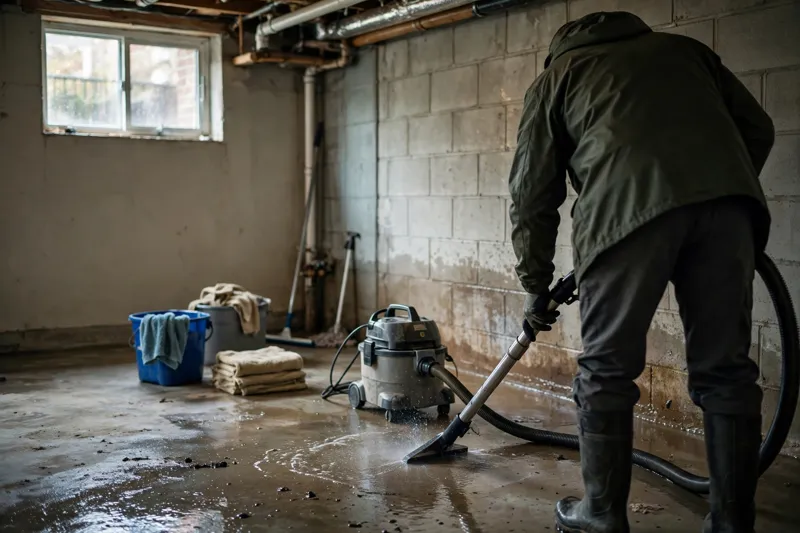
Flood cleanup: what comes out, what stays, what gets cleaned
Flood cleanup is the part of the job where the decisions are made, and the decisions are made by the kind of water. Clean water from a supply pipe can often be dried and kept, and the drywall, flooring and trim can stay. Grey water from a washing machine or a dishwasher needs cleaning as well as drying, and some of what it touched needs removing.
Black water from a sewer backup or a storm flood needs removal of everything porous it touched, carpet, padding, drywall below the water line, insulation, and anything else that soaked it up, and sanitising of everything that stays. The Friend family case was black water, and the job was removal and sanitising, not drying alone. The crew photographs everything before it moves, because the insurer pays on evidence, and a photograph of a soaked carpet pad is evidence that a written list is not.
What cannot be saved is bagged and removed, what can be saved is cleaned and dried, and what stays is sanitised before the drying equipment goes in.
Structural drying: the part of the job you cannot see
Structural drying is the part of the job you cannot see, and it is the part that decides whether the job lasts. A wall can look dry and still hold water behind the paint, a floor can feel dry and still hold water under the boards, and a frame can look sound and still hold water inside the wood. The crew reads the walls and floors with a moisture meter, and the meter gives a number, not an opinion.
The number is compared to a dry wall in the same house, and the drying runs until the wet wall reads the same as the dry wall, and the reading holds for two days. The drying equipment is air movers that push dry air across the wet surfaces and dehumidifiers that pull the moisture out of the air, and they run around the clock until the readings say dry.
Do not close the walls until the meter says dry, because a wall closed over wet framing grows mold in the dark, and mold behind a closed wall is a job that costs more the second time.
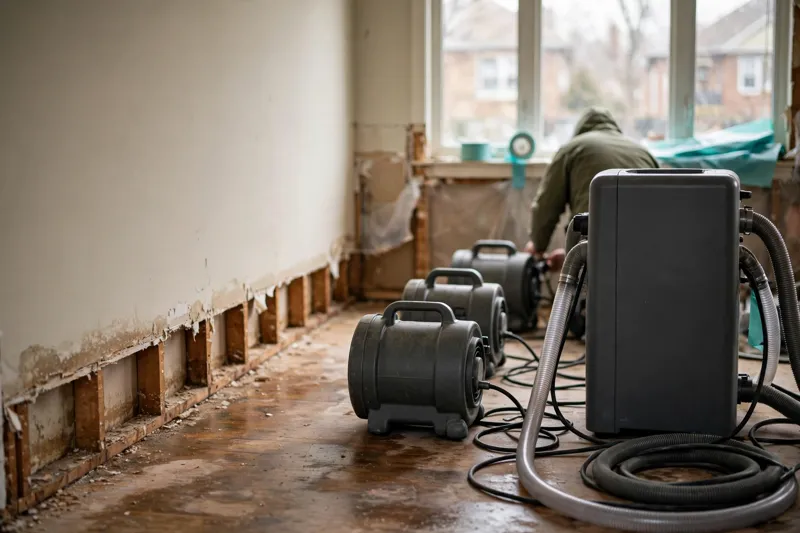
The first 24 hours after the water arrives
The first twenty-four hours decide the job. In the first hour, call us, stop the water at the source if you can do it safely, stay out of the water while the power is on, do not touch the water with bare hands, lift what you can save, photograph everything, and call 311 if the sewer or street flooded. In the first four hours, the crew arrives, extracts the standing water, lifts the rugs and furniture, and starts the drying equipment.
In the first day, the crew reads every wall and floor, photographs everything for the claim, and gives you a written scope of work and the drying log it will keep. The drying runs for three to five days on a clean-water loss in one room, and longer on a sewer backup or a loss that spread across several rooms.
The repairs take one to two weeks after the drying is done, and the whole job takes a few days to several weeks, depending on how much water there is, what kind of water it is, how many rooms got wet, and how long the water sat. A crew that promises a one-day job is a crew that has not measured the walls.
The drying log: the document your insurer wants
The drying log is a written record of every moisture reading, taken every day, in every wall and floor, until the readings say dry. It is the document your insurer will ask for, and it is the document that separates a job that is done from a job that is guessed at. The log shows the starting readings, the daily readings, and the final readings, and it shows that the wet wall reads the same as a dry wall in the same house.
The log also shows what was removed, what was cleaned, and what was dried, and it is signed by the crew that did the work. Ask for the log before you hire anyone, and ask to see it every day while the drying runs. A company that cannot show you a drying log is a company that is not measuring the walls, and a company that is not measuring the walls is a company that is guessing.
The stories that are not North Center
A page that prints other neighbourhoods' stories as North Center stories is a page that lies, so this page names the stories it did not use. The October 2019 report from Fullerton Avenue and Elston Avenue is not North Center, Fullerton Avenue runs at twenty-four hundred north, south of Diversey Parkway, outside the neighbourhood. The October 2026 water-main break on Newland Avenue near Grace Street, with at least six homes affected, is not North Center, it is in Dunning, on the Northwest Side.
The December 2025 Lawrence Avenue water-main break is not North Center, it is in Lincoln Square. The geyser clip from Lawrence Avenue and Pulaski Road is not North Center, it is in Albany Park. The do-it-yourself basement flood of September 11, 2022, told by Casey and Finn, is not printed as a North Center case, because its location is unconfirmed, and a location that is unconfirmed is a location that is not printed.
The two basement-water 311 complaints at 3529 North Bell Avenue, dated January 31 and February 12, 2025, are not printed as verified cases, because they came from a language model and were not checked live, and the model itself flagged inconsistencies in them.
The CBS Chicago burst-pipe clip on Peterson Avenue is not a North Center case, because Peterson Avenue runs at fifty-eight hundred north, north of the neighbourhood. The Root short about a Navy veteran is not a North Center case, because no neighbourhood is named in it. The record is thin, and this page keeps it thin rather than filling it with other people's floods.
Landlords, tenants and condos
A North Center basement flood is often a job that wets several homes at once, and the question of who pays is the question that decides whether the job starts on time. The landlord usually owns the building and its pipes, so the landlord pays for the building repair, and the landlord's insurance usually covers the building. A renter pays when the renter caused the damage, such as an overflowing tub left running, and a renter's own insurance covers the renter's belongings, not the building.
Read your lease and tell your landlord the day the water appears, because a landlord who learns about a flood a week late inherits a mold job as well as a drying job. A condo owner owns the inside of the unit and the association owns the common elements, so a flood that comes through a common drain is the association's job and a flood that comes from inside the unit is the owner's job, and the line between them is in the association's documents.
A garden unit sits below grade, so a sewer surcharge reaches it first, and the water has nowhere to go, because the unit sits below the street and below the sewer line. A garden unit that floods needs extraction the same day, because standing water soaks the walls and grows mold, and a garden unit tenant who waits a week has a mold problem as well as a water problem. Tell your landlord, tell your insurer, and tell the city, in that order, and photograph everything before anything moves.
Through the year
Water damage restoration North Center is a job for every season, and every season brings its own water. Winter brings burst pipes: a pipe freezes in a cold snap, splits, and runs at street pressure until someone turns off the main valve. The January 2008 water-main break at Montrose and Wolcott was a winter break, and the December 2025 break on Lawrence Avenue, in Lincoln Square, was a winter break too. Spring brings the first heavy rain on frozen ground, and the water has nowhere to go but into the lowest room.
Summer brings the supercell: the September 11, 2022 storm dropped six point one inches of rain in four hours, and the summer of 2023 flooded the Horner Park trails. Autumn brings the leaves that clog the gutters and the downspouts, and a clogged gutter spills onto the foundation all winter.
The job changes with the season, and the preparation changes with it: test the sump pump every spring and fall, clean the gutters twice a year, keep the discharge line clear before the first freeze, and ask a licensed sewer contractor to televise an old clay lateral before the next storm. A homeowner who prepares in autumn does not call in January.
What a job costs, and why this page prints no price
This site prints no prices, and this page prints none. The cost of a job depends on how much water there is, what kind of water it is, how many rooms got wet, and how long the water sat, and no page can give you a number without seeing the rooms.
A clean-water loss in one room costs less than a sewer backup across a whole basement, and a job that starts in the first hours costs less than a job that starts a week late, because a week of standing water is a mold job as well as a drying job.
We inspect first, then give you a written scope of work with the cost in it before any repair starts, and the scope is the price, because a price without a scope is a guess.
Insurance: what the policy covers, and what it does not
Water damage restoration North Center is a job the insurer pays for when the damage was sudden and accidental, such as a burst pipe or an appliance failure, and the insurer pays the cost of the drying and the repair, less your deductible, and it does not pay for the pipe that failed. A sewer backup is usually covered only if you hold the endorsement for it, and a standard homeowners policy does not cover flooding from outside at all, flooding from outside needs separate flood insurance.
The insurer pays on evidence, and the evidence is the drying log, the photographs and the written scope of work, so keep every receipt and photograph the water line and every damaged item before you move it. Report a burst the day you find it, because a pipe that leaked slowly for months may be classed as wear and tear, and wear and tear is not covered.
The adjuster will visit, measure, and ask for the drying log, and a crew that talks to the adjuster for you is a crew that knows what the adjuster needs to see. The Six Corners Insurance guide for North Center asks the right questions, whether you need water backup coverage in North Center, and whether homeowners insurance covers flooding from the Chicago River, and the answers are that backup coverage is an endorsement you must hold, and that river flooding is flood insurance, not homeowners insurance.
City programmes: what Chicago will pay for, and what it will not
Three city programmes touch a North Center flood, and only one of them is open to a North Center homeowner. The table below is the whole picture, and the page prints it in full so that no homeowner wastes a week applying for a programme that cannot help them.
| Programme | What it does | North Center |
|---|---|---|
| Private Sewer Drain Program | The city repairs a private sewer drain that is broken under the public way, at no cost to the owner, for private residences of up to four units. The owner first hires a licensed sewer contractor to rod and video-inspect the drain, and the work starts through 311. | Open to North Center homeowners. |
| Disaster Relief Assistance Program (DRAP) | Up to fifteen thousand dollars per household for rent, mortgage and utilities only, not for repair. Eligible period January 21, 2025 to January 21, 2027, income at or below eighty percent of area median income, priority ZIP codes 60644, 60651, 60639, 60641 and 60624. | Not eligible. No North Center ZIP code is a priority ZIP code. |
| Flood Assistance Repair Program (FARP) | Up to twenty-five thousand dollars for basement damage from the 2023 or 2024 floods, for owner-occupied single-family or two-unit homes on the west side of Chicago, income at or below one hundred percent of area median income, registration November 30 to December 11, 2026. | Not eligible. West side only, and North Center is on the North Side. |
DRAP is the Department of Family and Support Services programme, funded through three FEMA declarations: DR-4728-IL for June 29 to July 2, 2023, DR-4749-IL for September 17 to 18, 2023, and DR-4819-IL for July 13 to 16, 2024. It covers rent, mortgage and utilities only, not repair, and its partner is the Northwest Center at 5233 West Diversey Avenue. FARP is administered by the Westside Health Authority, and its registration opens at nine in the morning on Monday, November 30, 2026, and closes at four in the afternoon on Friday, December 11, 2026. Neither programme pays for a North Center repair, and this page says so plainly, because a homeowner who applies to the wrong programme loses the weeks that matter.
The Private Drain Program, step by step
The Private Sewer Drain Program is the one city programme that can pay for a North Center repair, and it works like this. The city may repair sewer drain tiles from private residences of up to four units that are broken under the public way, and the city pays the entire cost, with no lien on the property. The owner first hires a licensed sewer contractor to rod and video-inspect the drain. If the break is in the public way, the city repairs it at no cost.
The steps, as the city's own 311 article gives them, are: the homeowner calls 311, a Department of Water Management crew is dispatched, the homeowner hires a city-licensed sewer contractor, the contractor calls the Permit Section at 312-744-3155, the contractor calls Inspections at 312-744-5503, and the city repairs the drain if the break is in the public way.
The article, published December 12, 2018, says the cost a homeowner avoids is five thousand to ten thousand dollars, and that the programme has been in effect since January 1, 2002, both figures verified fresh in this battery's live run. The city's own two-page flyer says the programme can save on average between ten thousand and twenty thousand dollars in repairs, and that figure conflicts with the article's figure, so this page prints neither as settled.
Two things the programme is often said to include are not in the record: no eligibility condition tied to a year in the nineteen-eighties appears in the live programme page, the flyer or the 311 article, in twelve consecutive live runs, so no such condition is printed here, and no period of seven to ten business days appears in the live programme page in this battery's run, so no such period is printed here either.
When the water comes from the street
When the water comes from the street, the job is different. Street water means the sewer surcharged or a main broke, and the first call is still to us, because the water in your basement does not wait for the city to fix the street. The second call is to 311, because a 311 report is how the city learns a sewer surcharged, and the report goes into the planning record for your block.
Photograph the street as well as the basement, because the insurer will ask where the water came from, and a photograph of a flooded street is evidence that a written list is not. Do not drive through a flooded street, and do not walk through flood water on the street, because flood water carries sewage and chemicals, and a manhole cover can lift in a surcharge.
The November 16 and 17, 2026 storm showed what street water looks like in Chicago: street pooling in Rogers Park and West Ridge, and a viaduct incident on the twenty-seven hundred block of West Fulton Street in East Garfield Park, and no fresh report naming North Center. When the street floods, the basement follows, and the crew that arrives in the first hours is the crew that saves the walls.
The backwater valve and the overhead sewer
A backwater valve on the building drain stops a sewer surcharge from coming back up through a floor drain, and an overhead sewer makes it impossible, because an overhead sewer lifts the fixtures above the street sewer level. Both are worth asking a licensed sewer contractor about before the next storm, and both are cheaper than a second flood.
Drain tile moves groundwater away from the foundation, and a flood control system stops a sewer surcharge from coming back up, and the two do different jobs, so the answer is that drain tile alone does not stop a surcharge, and a flood control system alone does not move groundwater.
A licensed sewer contractor can televise the lateral and tell you which one your house needs, and a contractor who sells you one without televising the lateral has not done the job.
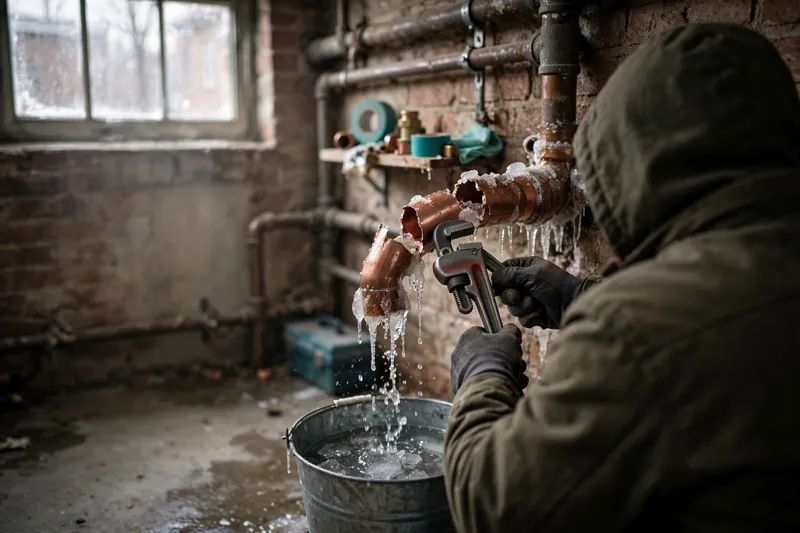
How long the job takes
Drying takes three to five days on a clean-water loss in one room, and repairs take one to two weeks after that. Four things decide the time: how much damage there is, what kind of water it is, what materials got wet, and whether mold is growing. A sewer backup takes longer than a clean-water loss, because everything porous the black water touched must be removed before the drying can start.
A job that spread across several rooms takes longer than a job in one room, because every wall and floor must be read, and every reading must hold for two days. A job that sat for a week takes longer than a job that started in the first hours, because a week of standing water is a mold job as well as a drying job. The whole job takes a few days to several weeks, and a crew that promises a one-day job has not measured the walls.
311: what the city says, and what it does not say
Call 311 when the water came up through a floor drain, when the street filled, or when several houses on the block flooded at once. A 311 report is how the city learns a sewer surcharged, and the report goes into the planning record for your block. The 47th Ward's water page says a basement backup can be extremely costly, disruptive and time-consuming, that an inspector typically visits within forty-eight hours, that "Water in Basement" complaints feed infrastructure planning, and that if the sewer main is clear, the private service line may be at fault. The table below is what the city's own pages say about the 311 service itself, and what they do not say.
| What | What the city says |
|---|---|
| Staffing | The Call Center Operations page says the centre is staffed twenty-four hours a day, seven days a week. |
| Call volume | The city's own pages give two different figures, three point one million and approximately two point eight million, so this page prints neither as settled. |
| The 311 number | The parenthesised form (312) 744-5000 does not appear on the 311 home page or the Call Center Operations page. The footer shows the dotted form, 312.744.5000. |
| Call Tips page | The Call Tips page could not be located in this battery's live run, after three site searches, so its figures are not repeated here. |
The 311 office sits at 2111 West Lexington Street, the director is Dionne A. Tate, and the fax is 312.744.4149. The Department of Water Management's own phone number is not verified on the city's pages, which route water enquiries through 311, and this page prints no DWM phone number.
Mold: what the registration is, and what it is not
Mold grows where water sat, and it grows fast. A wall that stays wet for two days grows mold, and a wall closed over wet framing grows mold in the dark. Remediation means removing the mold growth and the wet material it sits on, cleaning what stays, and drying the space so it cannot grow back, and it cannot work if the leak keeps feeding the wall, so the source comes first.
Illinois now has a mold remediation registration: Part 835 of the Illinois Department of Public Health rules, effective September 23, 2026, with a grace period to September 30, 2027. The registration is operational, and this page uses it only as consumer guidance, ask a company for its registration if mold work is involved, and the site claims no registration itself.
The Environmental Protection Agency's mold cleanup guidance is the standard the work follows, and a company that cannot show you a drying log and a registration is a company that is not measuring the walls and not registered to do the mold work.
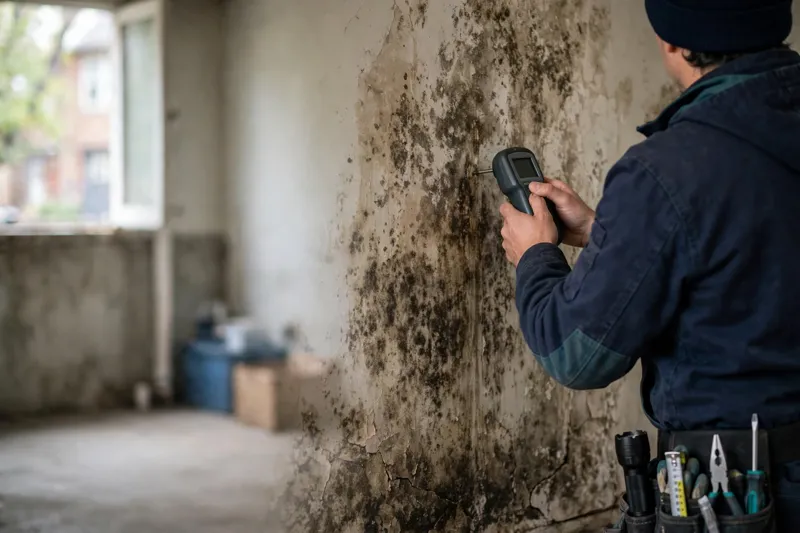
The 50 percent rule, stated correctly
The 50 percent rule is a FEMA rule for homes in a floodplain, and it is the only 50 percent rule that counts. If repairs cost half or more of what the home is worth, the home must be brought up to flood standards.
One language model invented a different rule altogether, an informal fifty-fifty guideline about insurance and restoration, with no FEMA mention, and that invented rule must never be printed, because a homeowner who follows an invented rule makes a decision on a rule that does not exist. There is one 50 percent rule, it belongs to FEMA, and it applies to homes in a floodplain.
Pipe bursting: two different jobs with one name
Pipe bursting means two different things, and pages that mix them up mislead you. Trenchless pipe bursting replaces a broken sewer line by pulling a new pipe through the old one, with no open trench, and it is a sewer-line job. A burst pipe is a supply pipe that split open, usually from freezing, and it is a water-line job.
This page covers both, labelled distinctly, because a North Center homeowner with a split supply pipe needs a plumber, not a trenchless sewer crew, and a homeowner with a broken clay lateral needs the trenchless crew, not a plumber.
The December 2025 break on Lawrence Avenue and the January 2008 break at Montrose and Wolcott were water-main breaks, not pipe-bursting jobs, and the two are not the same thing.
Sewer permits: who may work on the lateral, and what it costs
Only a licensed drainlayer may work on a sewer lateral in the public way, and the licence has been a courtesy licence from the Department of Buildings since January 1, 2022. A repair of twenty feet or less, in kind, is the exception the city's page confirms.
The Sewer Permits page carries no fee amounts and no bond in its body, and the full body read in this battery's live run found no fee amounts, no bond and no unpermitted-work fine on the page, so this page prints no fine and no fee from that page. The drainlayer licence fee for calendar year 2026 is one hundred and fifty dollars, confirmed live in the January 2, 2026 notice "Drainlayer License Changes for 2026", effective January 6, 2026, and the classes are not in that notice.
The Department of Water Management's own drainlayers page still shows a fee of one hundred and twenty-five dollars, which is stale page text, and the 2020 form shows a fee of one hundred and twenty-five dollars, a late fee of seventy-five dollars, a fifty thousand dollar bond and three hundred thousand dollars of insurance. The 2026 application form is listed on the Buildings page but two clicks opened no document in this battery's live run, so it is not retrievable through that link, and no 2024, 2023 or 2022 forms appear on either page.
The contacts are the Department of Buildings at 312-744-3155 and, the Department of Water Management Permit Section at 312-744-3155 or 312-744-3020, Department of Water Management Engineering at 312-744-3133, and inspections at 312-744-5503 for six inches and under and 312-744-5502 for eight inches and above, with as-built drawings at 312-744-3255.
The stormwater regulations set the thresholds at fifteen thousand square feet of land disturbed and seven thousand five hundred square feet of impervious surface, with residential developments excluded, a one-hundred-year control of eight point five seven inches in twenty-four hours, release rates of zero point one five cubic feet per second rising to zero point two five, and volume control of half an inch of runoff.
The plan-review fees are one thousand dollars for under fifty thousand square feet and three thousand dollars for fifty thousand square feet and above, a variance adds fifty percent, an amendment costs five hundred dollars per submission under section 11-18-080(c), and the fine under section 11-18-070(b) is five hundred dollars, all verified live on page sixty-three of the 2026 Stormwater Regulations, eighty pages, March 2026, Mayor Brandon Johnson, Commissioner Randy Conner.
The figure of three hundred and fifty dollars does not appear in the 2024 Manual, the 2026 Regulations or a full-document search, and this page prints no such fee.
Tap water: what the city says about its own water
The Department of Water Management's live home page is at chicago.gov/city/en/depts/water.html, and the old home address is dead. The home page states no headquarters address and no street address at all, and it names no commissioner, so this page prints no headquarters address and no commissioner from the home page. The commissioner is Randy Conner, named on the Leadership page and on the title page of the 2026 Regulations.
The What We Do page says the city maintains about four thousand six hundred miles of sewer mains and about four thousand three hundred miles of water mains, eighty thousand drainage structures, twelve pumping stations, one hundred and fifty thousand manholes, about seven hundred and fifty million gallons of water a day, and about four hundred thousand lead service lines, and it supplies drinking water to Chicago and about one hundred and twenty suburban communities.
The Jardine plant is ranked first among the world's largest conventional water treatment plants, and the Sawyer plant is ranked eighth, and this page prints the ranking, never the bare phrase "the world's largest". The What We Do page carries no combined capacity figure and no hydrant count, and this page prints neither. The Our Structure page says the department has about two thousand one hundred personnel and a budget of about one billion dollars, and that the Administrative Offices sit at the James W.
Jardine Water Purification Plant, 1000 East Ohio Street, Chicago, IL 60611, by appointment only. The Leadership page disagrees with both figures, saying over four thousand four hundred and fifty miles of sewer mains and a budget of one point four billion dollars, and an older figure of four thousand four hundred miles of sewer mains also circulates, so this page prints no single figure for the sewer mains and no single figure for the budget as settled. The home page itself prints no mileage at all.
The flood record, and the storm that did not name North Center
The most recent storm in the record did not name North Center at all. On November 16 and 17, 2026, the heaviest rain fell in northwest Indiana, with about six point five inches near East Chicago, and the flooded basements were in northwest Indiana. The Chicago reports were street pooling in Rogers Park and West Ridge, and a viaduct incident on the twenty-seven hundred block of West Fulton Street in East Garfield Park, and the Metropolitan Water Reclamation District issued an Overflow Action Day and Alert.
No fresh report names North Center, Chicago, and this page says so, because a page that claims a storm hit North Center when the reports say otherwise is a page that invents a case. The flood record for North Center is the supercell of September 11, 2022, the water-main break of January 2008, and the Horner Park trails of summer 2023, and the record is thin. A thin record is not a reason to invent cases.
It is a reason to write the page around the cases that exist, the questions residents actually ask, and the city facts that can be verified on the city's own pages.
Storefronts on Lincoln Avenue
Water damage restoration North Center is a job that closes a shop, and a shop that closes loses the day. The storefronts along Lincoln Avenue, at Northcenter Town Square, and at the Lincoln, Damen and Irving Park intersection sit on the neighbourhood's commercial heart, and a flood in a shop is a flood in a business.
The Town Square at Belle Plaine and Damen Avenues, whose redesigned plaza opened in summer 2020, hosts a farmers market on Saturdays from June to October and is home to Ribfest, and the shops around it are small businesses with stock on the floor, a basement below, and a day's takings at risk. A shop that floods needs extraction the same day, because stock that sits in water is stock that is lost, and a shop that stays closed for a week loses the week's trade.
The crew arrives, extracts the water, dries the structure, photographs everything for the claim, and gives the owner a written scope of work, and the owner can show the scope to the insurer and to the landlord. A shop owner who waits a week has a mold job as well as a drying job, and a mold job in a shop is a shop that stays closed.
Small apartment buildings: the job that wets several homes at once
Water damage restoration North Center is a job that wets several homes at once, because North Center is a neighbourhood of two-flats and three-flats, and a flood in a two-flat is a flood in two homes. The water comes up through the lowest floor drain, soaks the garden unit first, and then rises into the unit above, and the landlord owns the building and its pipes, so the landlord pays for the building repair, and the landlord's insurance usually covers the building.
A renter pays when the renter caused the damage, and a renter's own insurance covers the renter's belongings, not the building. The crew photographs everything, reads every wall and floor, and gives the landlord a drying log and a written scope of work, and the landlord can show the log to the insurer and to the tenants.
A landlord who learns about a flood a week late inherits a mold job as well as a drying job, and a tenant who waits a week to tell the landlord has a mold problem as well as a water problem. Tell the landlord the day the water appears, and tell the insurer the same day.
By building type: what changes, and what does not
Water damage restoration North Center looks different in every building type, and the differences decide the job. A garden unit sits below grade, so a sewer surcharge reaches it first, and the water has nowhere to go, because the unit sits below the street and below the sewer line, and it needs extraction the same day. A two-flat or three-flat has a shared drain, so a surcharge wets every unit on the lowest floor, and the landlord owns the building and the pipes, so the landlord pays for the repair.
A frame house has wood framing that soaks and dries, and a brick bungalow has masonry that holds water longer, and both need the drying log to prove they are dry. A storefront on Lincoln Avenue has stock on the floor and a basement below, and a flood in a shop is a flood in a business, so the job is extraction the same day and a written scope the owner can show the insurer.
A school or a church has a large basement and a large roof, and a flood in a school is a flood in a building the neighbourhood uses, so the job is extraction, drying, and a drying log the board can see. What does not change is the job: get the water out, get the building dry to a number on a meter, clean what the water touched, remove what cannot be saved, and rebuild what is left.
How to choose a company in North Center
Ask for three things before you hire anyone: a drying log with moisture readings, a written scope of work, and proof of Illinois Part 835 registration if mold work is involved. A good company answers 24/7, arrives fast, photographs everything, and talks to your adjuster. Avoid any company that asks you to sign on the spot, and avoid any company that cannot show you a drying log, because a company that cannot show you a drying log is a company that is not measuring the walls.
Ask where the company is based, and ask how long the crew takes to reach North Center, because a company that dispatches from the far side of the city arrives after the water has soaked into the framing. Ask what kind of water the job is, and ask what will be removed, what will be cleaned, and what will be dried, because a company that cannot answer those questions has not looked at the rooms. Ask for the scope in writing before any repair starts, and ask for the drying log every day while the drying runs.
The adjuster: what they need to see
The adjuster will visit, measure, and ask for the drying log, the photographs and the written scope of work, and a crew that talks to the adjuster for you is a crew that knows what the adjuster needs to see. The adjuster pays the cost of the drying and the repair, less your deductible, and does not pay for the pipe that failed, and the adjuster pays on evidence, so keep every receipt and photograph the water line and every damaged item before you move it.
Report a burst the day you find it, because a pipe that leaked slowly for months may be classed as wear and tear, and wear and tear is not covered. The adjuster will ask what caused the water, and the answer is in the entry point, a floor drain during a sewer surcharge, a failed sump pump, a frozen discharge line, or a supply line that split after the first hard freeze, and a crew that found the entry point can tell the adjuster what it was.
A claim that starts with a drying log and a photograph is a claim that moves, and a claim that starts with a guess is a claim that waits.
What a quote should contain
A quote should contain the scope of work, the cost, and the drying log, and it should be in writing before any repair starts. The scope should say what will be removed, what will be cleaned, what will be dried, and what will be rebuilt, and it should say what kind of water the job is, because the kind decides the job. The cost should be in the scope, not in a separate figure, because a price without a scope is a guess.
The drying log should show the starting readings, the daily readings, and the final readings, and it should show that the wet wall reads the same as a dry wall in the same house. A quote that contains none of those things is not a quote, it is a guess, and a guess is not a price. This site prints no prices, and this page prints none, because a price without a scope is a guess, and a guess misleads a homeowner who is already standing in water.
| What the quote must contain | Why it matters |
|---|---|
| Written scope of work | Says what will be removed, cleaned, dried and rebuilt. |
| The kind of water | Clean, grey or black, the kind decides the job. |
| The cost, in the scope | A price without a scope is a guess. |
| The drying log | Proves the walls are dry to a number on a meter. |
| Photographs | Evidence for the insurer, taken before anything moves. |
The repair checklist: what to check before you call
Water damage restoration North Center is finished when the building is dry, clean and rebuilt, and the checklist below is how you know it is finished. Before you call, check where the water is, how deep it looks, and whether it smells of sewage, and tell us when you call. Check whether the power is on in the flooded area, and stay out of the water while it is on.
Check whether you can turn off the main water valve safely, and turn off the water heater as well if the water is coming from a pipe. After the crew arrives, check that the standing water is extracted, that the rugs and furniture are lifted, and that the drying equipment is running. Check that every wall and floor is read with a moisture meter, and that the readings go into a drying log you can see.
Check that everything the water touched is photographed before it moves, and that what cannot be saved is bagged and removed. Check that the drying runs until the readings say dry, and do not close the walls until the meter says dry. Check that the scope of work is in writing before any repair starts, and that the cost is in the scope. Check that the registration is shown if mold work is involved, and that the company talks to your adjuster.
A job that passes every check on this list is a job that is done, and a job that fails one is a job that is not.
After the job: what to watch for
After the job, watch the walls. A musty smell, paint that bubbles, a floor that cups, or a baseboard that pulls away from the wall are all signs that the drying did not finish, and all of them mean the crew should come back and read the walls again. Keep the drying log, because the log is the record of what was wet, what was dry, and what was done, and a buyer who asks about a past flood will want to see it.
Keep the photographs, because the insurer may ask for them again, and a photograph taken before anything moved is worth more than a photograph taken after the room is clean. Keep the scope of work, because the scope is the record of what was removed, what was cleaned, what was dried, and what was rebuilt. A job that is finished is a job with a drying log, a photograph and a scope, and a job without them is a job that is not finished.
Winter: the season that splits pipes
Water damage restoration North Center is a winter job as well as a summer job, and winter brings the burst pipe. A pipe freezes in a cold snap, splits, and runs at street pressure until someone turns off the main valve, and the water fills a basement while the homeowner is at work or asleep. The January 2008 water-main break at Montrose and Wolcott was a winter break, and the December 2025 break on Lawrence Avenue, in Lincoln Square, was a winter break too.
The preparation is simple: keep the heat on in every room, even the rooms you do not use, and keep the cabinet doors open under the sinks on the coldest nights, so warm air reaches the pipes. Insulate the pipes in the unheated spaces, the basement, the garage, the crawl space, and know where the main water valve is before the first freeze, because a homeowner who has to find the valve in the dark, in a flooded basement, has already lost an hour.
If you leave the house for a week in winter, leave the heat on and ask someone to check the house, because a pipe that bursts in an empty house runs for days. A burst pipe is a job the insurer usually pays for when it burst suddenly, and the insurer pays for the water damage the burst caused, not for the pipe itself, so report it the day you find it.
Prepare before the next storm
Prepare before the next storm, and the next storm will cost you less. Keep the gutters clean twice a year and run the downspouts at least five feet from the foundation. Grade the soil so it falls away from the house, and keep plants a foot from the foundation. Test the sump pump every spring and fall, and keep a battery backup ready, because the storm that floods a basement is the same storm that takes out the power.
Ask a licensed sewer contractor to televise an old clay lateral before the next storm, and ask about a backwater valve on the building drain and an overhead sewer, because both are cheaper than a second flood. Know where the main water valve is, and know where the panel is, and keep rubber boots and gloves where you can reach them. Keep the insurer's number in your phone, and keep a camera in your pocket, because the photograph taken before anything moves is the photograph the insurer wants.
A homeowner who prepares in autumn does not call in January, and a homeowner who calls in the first hour does not pay for a mold job as well as a drying job.
Street by street in North Center
Water damage restoration North Center comes to every street in North Center, Chicago, IL 60618, day and night. Lincoln Avenue, from the Town Square at Belle Plaine and Damen to the Lincoln, Damen and Irving Park intersection, and the storefronts and apartments above them. Belle Plaine Avenue, at forty-one hundred north, and the Town Square itself. Damen Avenue, at two thousand west, and the St. Ben's corridor. Irving Park Road, at four thousand north, and the Brown Line station at 1816 West Irving Park Road.
Addison Street, at thirty-six hundred north, and the Brown Line station at 1818 West Addison Street. Montrose Avenue, at forty-four hundred north, and the Brown Line station at 1817 West Montrose Avenue, on the community area's north boundary, and the water-main break at Montrose and Wolcott in January 2008. Diversey Parkway, at twenty-eight hundred north, the community area's south boundary. Ravenswood Avenue, at eighteen hundred west, the community area's east boundary. Western Avenue, at twenty-four hundred west, and the nursing home that flooded on Western Avenue in the September 2022 supercell.
Wolcott Street, and the break at Montrose and Wolcott. Leavitt Street, and the 311 complaint at 4228 North Leavitt Street, second floor, on September 11, 2022. Horner Park, along the river on the west side, and the trails that flooded in the summer of 2023. The WGN-TV Studios at 2501 West Bradley Place, and Lane Tech College Prep and its clocktower. The Clark Park Boat House, Kerry Wood Cubs Field, and the Chicago Fire Soccer Center. Every street, every block, every building type, day and night.
Call now
Water damage restoration North Center starts with a call, and the call is free. Call (773) 570-9869 any time, day or night, and tell us where the water is, how deep it looks, and whether it smells of sewage. We answer 24/7 and talk you through the first hour while a crew is on the way to your North Center home. If the water came from the street or a sewer backup, call 311 as well, so the city knows the sewer backed up on your street.
We extract the water, dry the structure to a number on a meter, clean what the water touched, remove what cannot be saved, and rebuild what is left, and we give you the drying log, the photographs and the written scope of work your insurer wants to see. A North Center basement can flood on a night when the street above looks dry, and the crew that arrives in the first hours is the crew that saves the walls.
Frequently asked questions
What is water damage restoration in North Center?
Water damage restoration work in North Center is the full job of getting a home dry and rebuilt after water gets in. It starts with extraction, then drying to moisture readings, then cleaning, then removing what cannot be saved, then repair. We do it for homes across North Center, Chicago, IL 60618, day and night.
How long does water damage restoration take in North Center?
Water damage restoration in North Center takes a few days to several weeks. Drying takes three to five days on a clean-water loss in one room, and repairs take one to two weeks after that. Four things decide the time: how much damage there is, what kind of water it is, what materials got wet, and whether mold is growing.
What does water damage restoration include in North Center?
Water damage restoration in North Center usually includes five parts, done in order. First, inspection: we find the source and measure how far the water spread. Second, extraction: standing water is removed with pumps and vacuums. Third, drying: air movers and dehumidifiers dry the walls, floors and framing. Fourth, cleaning and sanitizing. Fifth, restoration and repairs.
What should I do first when my basement floods in North Center?
Call us first at (773) 570-9869, then stop the water at the source if you can do it safely. Stay out of a flooded basement while the power is on, and do not touch the water with bare hands. Lift what you can save to higher ground, and photograph the water line and every damaged item before you move it.
How much does a plumber charge to fix a burst pipe?
This site prints no prices, so no figure here can mislead you. The charge depends on where the pipe is, how hard it is to reach, whether the wall or ceiling must be opened, and whether the call is an emergency at night. We inspect first, then give you a written scope of work with the cost in it.
How do I know if my walls are dry after water damage?
Walls are dry when a moisture meter reads the same as a dry wall in the same house, and the reading holds for two days. A wall can look dry and still hold water behind the paint, so we do not call a wall dry from how it looks. We write the readings into a drying log you can see.
Will my basement flood again?
It can, unless the entry point is found and closed. North Center basements flood through the same few openings: a floor drain during a sewer surcharge, a failed sump pump, a frozen discharge line, or a supply line that split after the first hard freeze. We find the entry point and tell you what will stop the next flood.
What is the 50/50 rule for water damage?
The 50 percent rule is a FEMA rule for homes in a floodplain, and it is the only 50 percent rule that counts. If repairs cost half or more of what the home is worth, the home must be brought up to flood standards. No other 50 percent rule exists, and no engine or page should invent one.
How much does water damage restoration cost in North Center?
This site prints no prices, so no figure here can mislead you. The cost depends on how much water there is, what kind of water it is, how many rooms got wet, and how long the water sat. We inspect first, then give you a written scope of work with the cost in it before any repair starts.
Does homeowners insurance cover water damage restoration in North Center?
It usually does if the damage was sudden and accidental, such as a burst pipe or an appliance failure. A sewer backup is usually covered only if you hold the endorsement for it. Flooding from outside needs separate flood insurance, because a standard homeowners policy does not cover it at all.
How much does insurance pay for water damage?
No page can give you a number, because the payment depends on your policy, your deductible, the cause of the loss, and the limits you bought. The insurer pays the cost of the drying and the repair, less your deductible, and it does not pay for the pipe that failed. Keep every receipt and photograph.
Does homeowners insurance cover burst pipes?
It usually does when the pipe burst suddenly, such as a pipe that froze and split in a cold snap. The insurer pays for the water damage the burst caused, not for the pipe itself. A pipe that leaked slowly for months may be classed as wear and tear, so report a burst the day you find it.
What is pipe bursting, and how much does it cost?
Pipe bursting means two different things, and pages that mix them up mislead you. Trenchless pipe bursting replaces a broken sewer line by pulling a new pipe through the old one, with no open trench. A burst pipe is a supply pipe that split open, usually from freezing. This site prints no prices for either job.
Are renters responsible for water damage in North Center?
It depends on who caused the water and what the lease says. The landlord usually owns the building and its pipes, so the landlord pays for the building repair. A renter pays when the renter caused the damage, such as an overflowing tub left running. Read your lease and tell your landlord the day the water appears.
Can mold be fully remediated?
Yes, when the water source is fixed first and the drying is finished to moisture readings. Remediation means removing the mold growth and the wet material it sits on, cleaning what stays, and drying the space so it cannot grow back. It cannot work if the leak keeps feeding the wall, so the source comes first.
How much does mold remediation cost in North Center?
This site prints no prices, so no figure here can mislead you. The cost depends on how much mold there is, how far it spread, what material it sits on, and whether the water source is fixed. We inspect first, then give you a written scope of work with the cost in it before any repair starts.
How do I choose a water damage restoration company in North Center?
Ask for three things before you hire anyone: a drying log with moisture readings, a written scope of work, and proof of Illinois Part 835 registration if mold work is involved. A good company answers 24/7, arrives fast, photographs everything, and talks to your adjuster. Avoid any company that asks you to sign on the spot.
What is the difference between water mitigation and water damage restoration?
Mitigation is the emergency response: stop the water, remove it, and dry the building so the damage stops growing. Restoration is the rebuild that follows: replace the drywall, flooring and trim that could not be saved, and return the rooms to how they were. Mitigation comes first, and restoration starts only when the drying log says dry.
Do I need a permit for water damage repair in North Center?
It depends on what is being repaired. Drying and cleaning need no permit. Replacing drywall, flooring and trim usually needs no permit either, but any work on the sewer lateral in the public way needs a permit, and only a licensed drainlayer may do it. We tell you on the first visit whether your repair needs one.
What should I do if sewage backs up into my basement?
Stay out of the water and call us, because sewage carries bacteria that can make you sick. Do not run water in the house, do not flush toilets, and do not try to mop it up yourself. Call 311 too, so the city knows the sewer backed up on your street. We extract it, clean it, and dry the space.
What causes a sump pump to fail?
The usual causes are a power cut, a frozen or blocked discharge line, a stuck float switch, and a pump that is too small for the water coming in. A pump that runs constantly is close to failing, and a pump that never runs may be stuck. Test it every spring and fall, and keep a battery backup ready.
How can I prevent basement flooding in North Center?
Keep the gutters clean twice a year and run the downspouts at least five feet from the foundation. Grade the soil so it falls away from the house, and keep plants a foot from the foundation. Test the sump pump every spring and fall, and ask a licensed sewer contractor to televise an old clay lateral before the next storm.
What happens during the first visit?
We find the water source, measure how far the water spread, and take moisture readings in the walls and floors. We photograph everything for your claim, then we start extraction and set up the drying equipment. Before we leave, we give you a written scope of work and the drying log we will keep.
Do North Center garden units flood differently?
Yes, in one way that matters. A garden unit sits below grade, so a sewer surcharge reaches it first, and the water has nowhere to go, because the unit sits below the street and below the sewer line. A garden unit that floods needs extraction the same day, because standing water soaks the walls and grows mold.
Why does water come up through my floor drain when it rains?
Because the city has a combined sewer system, and one pipe carries both sewage and stormwater. In a hard storm the combined sewer surcharges, and the water comes back up through the lowest opening in the building, which is usually the floor drain. A backwater valve on the building drain stops it, and an overhead sewer makes it impossible.
How do I get help now?
Call (773) 570-9869 any time, day or night, and tell us where the water is. We answer 24/7 and talk you through the first hour while a crew is on the way. If the water came from the street or a sewer backup, call 311 as well, so the city knows the sewer backed up on your street.
Sources
- Claire Hoy, "Wastewater Finds a Way", in the thesis MISTAKES (Johns Hopkins University, MA in Science Writing, May 2023), the Friend family case and the September 11, 2022 storm, printed page 39.
- Augrented building page, 4228 North Leavitt Street, Chicago (data from City of Chicago 311), the September 11, 2022 "Water in Basement Complaint".
- Wastewater Digest, "Water Main Breaks on Chicago's North Side", January 22, 2008, citing the Chicago Tribune, the January 2008 Montrose Avenue and Wolcott Street water-main break.
- Horner Park Advisory Council, "Natural Area" page, the summer 2023 Horner Park riverfront trails flood damage and rebuild.
- Chicago Sun-Times and WBEZ, "Why flooding is getting worse in Chicago", panel discussion, November 12, 2026 (transcript searched), no North Center mention; named residents Pat Quinn and Lauri Johnson, West Side and Lawndale.
- Chicago Sun-Times, "Veteran's home threatened with condemnation for flooding damage", November 16, 2026, the same West Side veteran, not a North Center case.
- City of Chicago, Department of Water Management home page, What We Do page, Our Structure page and Leadership page, chicago.gov, November 17, 2026.
- City of Chicago, Sewer Permits page and "Drainlayer License Changes for 2026" notice, January 2, 2026, chicago.gov, November 17, 2026.
- City of Chicago, Stormwater Management Regulations, March 2026 (eighty pages, Mayor Brandon Johnson, Commissioner Randy Conner), page sixty-three, plan-review fees, variance, amendment fee and fine.
- City of Chicago, Private Drain Repair programme page and Department of Water Management flyer, chicago.gov, November 17, 2026.
- CHI 311, "Private drains program overview", December 12, 2018, 311.chicago.gov, the five thousand to ten thousand dollar homeowner-cost figure and the January 1, 2002 effective date.
- City of Chicago, 311 Call Center Operations page, chicago.gov, November 17, 2026, staffing and call volume.
- City of Chicago, Rainblocker page, chicago.gov, November 17, 2026, the caption figure, the seventy-five million dollar cost, the August 1997 flood, and the 1998 FEMA pilot.
- City of Chicago, Flood Assistance Repair Program page and Disaster Relief Assistance Program page, chicago.gov, November 17, 2026, eligibility, priority ZIP codes and registration dates.
- Illinois Department of Public Health, Part 835 mold remediation registration, dph.illinois.gov, November 13, 2026, effective September 23, 2026, grace period to September 30, 2027.
- Chicago Metropolitan Agency for Planning, North Center Community Data Snapshot, June 2026 Release (American Community Survey 2020-2024), population thirty-six thousand and fourteen, fourteen thousand eight hundred and sixty-eight households.
- Federal Reserve Bank of Chicago, "More Chicago Properties at Risk for Flooding Than Flood Maps Suggest", 2020, the 60618 property count and the First Street Foundation modelling.
- Six Corners Insurance, North Center home-insurance guide, the water backup coverage and Chicago River flooding questions.
- Alderman Matt Martin, 47th Ward water page, basement backup guidance and the forty-eight-hour inspector visit.
- Chicago Transit Authority, Brown Line Addison, Irving Park and Montrose stations, station addresses.
- Wikipedia, "North Center, Chicago", community-area and neighbourhood bounds, ZIP codes, population, landmarks, schools and transit.
- United States Environmental Protection Agency, mold cleanup guidance.
Water damage restoration near North Center
We serve every North Center street and every neighbourhood around it, day and night.
More Restoration Services Near North Center
Every service below is one tap away. Pick the one that matches your problem.

Water Damage Restoration
Fast water extraction, structural drying, and full repair after burst pipes, leaks, and floods.
Learn more →
Water Mitigation
Emergency water removal, structural drying, and mold prevention to stop the damage fast, 24/7.
Learn more →
Mold Remediation
Safe, contained mold remediation that removes contamination and fixes the moisture source.
Learn more →
Sewage Cleanup
Safe removal and disinfection of dangerous sewage backups and black water.
Learn more →
Flood Cleanup
Water pumped out, structure dried, and debris cleared fast after storms and flooding.
Learn more →
Hardwood Floors Water Damage
Cupped, buckled or stained hardwood after a leak? How we dry it, when sanding saves it, and when the boards have to go.
Learn more →