Home › Service Areas › Water Damage Restoration Logan Square IL | 24/7 Help
Chicago Water Damage Service, Logan Square, Chicago, IL 60647
Water Damage Restoration Logan Square IL
Flooded basement in Logan Square? We answer 24/7, arrive fast, extract the water, dry the structure, and help you file the claim.
Call (773) 570-9869What to do first
- We answer 24/7
- Local Chicago team
- Insurance documentation help
- Straight answers, no pressure
Request water damage help in Logan Square
If your basement is wet now, call (773) 570-9869 first. If you can wait for a call back, send the form below and we will call you. Tell us where the water is, how deep it is, and when it started.
Short answer
Water damage restoration logan square crews answer 24/7. Call (773) 570-9869 now and tell us where the water is. We talk you through the first hour while a crew is on the way, and we dry the house to readings you can see.
Your first hour in Logan Square: what to do now
Water damage restoration logan square jobs are won or lost in the first hour. Water soaks into drywall and flooring in minutes, and mold can start to grow within 24 to 48 hours. The work you do before we arrive decides how much of your home survives.
- Call us first at (773) 570-9869. We answer 24/7 and talk you through the first hour while a crew is on the way.
- Stop the water at the source. If a pipe burst, shut off the main water valve. If you suspect a water main break, call 311.
- Stay out of a flooded basement while the power is on. Water and electricity together can kill. If the water is near the electrical panel, call us and stay out until we tell you it is safe.
- Do not touch the water with bare hands. Assume all floodwater is contaminated, especially water that came from a sewer. Wear rubber boots and gloves if you must walk through it.
- Lift what you can save and photograph everything. Move dry boxes, papers and electronics to higher ground. Photograph the water line on the walls and each damaged item before you move it. These photos are the start of your insurance claim.
Logan Square is a neighbourhood on the North West Side of Chicago, Illinois, with the main ZIP code 60647. It runs along Milwaukee Avenue from the Kennedy Expressway west to the city line, and it is centred on Logan Boulevard and the square itself, with the Blue Line Logan Square station at its heart. The homes here are mostly greystones, two-flats and three-flats, courtyard buildings and six-flats, many of them built in the 1890s to the 1920s, with garden units below street level.
That mix is why Logan Square basements flood the way they do: a heavy rain falls faster than the drains can take it, a sump pump fails in a power cut, a frozen discharge line backs up in January, or a sewer surcharge pushes water up through a basement floor drain. In February 2026, a leaking water main froze over on North Avers in Logan Square, and the Chicago Water Department came out to fix it, according to NBC Chicago.
Your basement may be dry for years, then one storm pushes too much rain through the neighbourhood at once, or one sump pump fails, and the water is in before you know it. We work in Logan Square every week, and we know the homes, the sewers and the streets.
If the water came from the street or a sewer backup, call 311 as well, or file a report at 311.Chicago.gov, so the City of Chicago Department of Water Management knows the sewer backed up on your street. If you are outside Chicago, call 312-744-5000 instead of 311. Then call your insurer and start the claim. For any emergency, call 911. The City publishes no separate after-hours water or sewer emergency number, and the Department of Water Management publishes no street address, main phone number or office hours on its own pages, so after hours call us first and we will tell you what to do.
What water damage restoration in Logan Square IL includes
Water damage restoration logan square work is one job with five parts. We extract the water, we dry the structure to readings you can see, we clean and disinfect, we remove what cannot be saved, and we rebuild what was removed. No step is skipped, and no step is started before the one before it is done.
| Step | What happens | What you get |
|---|---|---|
| 1. Water extraction | We pump and vacuum the standing water out of the basement, rooms and floors. | The water is out of the house, usually the same day. |
| 2. Structural drying | We set air movers and a dehumidifier and take moisture readings every day. | A drying log with readings that show when the house is dry. |
| 3. Cleaning and disinfection | We clean and disinfect the hard surfaces and remove anything the water ruined. | A clean, safe space ready for repair. |
| 4. Damage removal | We cut out wet drywall and remove ruined carpet pad, flooring and insulation. | A list of what was removed, photographed for your claim. |
| 5. Repair and rebuild | We replace the drywall, flooring and trim that was removed, and repaint. | Your rooms back the way they were, dry to the readings. |
Every step is photographed and written into a log. Your insurer will ask for the photos, the drying log and the scope of work, and we give you all three. That is what water damage restoration means on this page: the water out, the house dry to readings, the damage documented, and the rooms rebuilt.
Third, drying and dehumidification: air movers and industrial dehumidifiers dry the walls, floors and framing, and we take moisture readings every day. Fourth, cleaning and sanitizing: the affected areas are cleaned and disinfected to stop mold growth and remove contaminants. Fifth, restoration and repairs: damaged drywall, flooring and structural parts are repaired or replaced. Every step is photographed and written into a drying log, and you get a copy you can hand to your insurer.
How water removal works in Logan Square: seven steps
Water damage restoration logan square work follows the same seven steps on every job, whether the water came from a burst pipe or a flooded basement. Do them in order, and do not skip one.
Call us first.
Call (773) 570-9869. We answer 24/7. Tell us what happened, where the water is and how deep it is. We talk you through the first hour while a crew is on the way.
Stop the water at the source.
If a pipe burst, shut off the main water valve. If an appliance failed, turn off the water to that appliance. If you suspect a water main break, call 311. If the water came from the sewer or the street, do not try to stop it yourself.
Stay out of the water while the power is on.
Do not enter a flooded basement while the power is on. Water and electricity together can kill. If the water is near the electrical panel, call us and stay out until we tell you it is safe.
Do not touch the water with bare hands.
Assume all floodwater is contaminated, especially water that came from a sewer. Wear rubber boots and gloves if you must walk through it, and wash your hands and any skin that touched the water.
Lift what you can save and photograph everything.
Move dry boxes, papers and electronics to higher ground. Photograph the water line on the walls, the wet floor and each damaged item before you move it. These photos are the start of your insurance claim.
Call 311 if the sewer or street flooded.
If the water came from the street or a sewer backup, call 311, or file a report at 311.Chicago.gov, so the City of Chicago Department of Water Management knows the sewer backed up on your street. If you are outside Chicago, call 312-744-5000 instead of 311. Then call your insurer and start the claim.
Let the drying run until the readings say dry.
We extract the water, set air movers and a dehumidifier, and take moisture readings every day. We stop the drying only when the readings are back to dry, and we show you the numbers. Do not switch the equipment off early, because the walls will stay wet inside.
Six ways water gets into a Logan Square home
Water damage restoration logan square crews see the same six entry points again and again. Find which one let the water in, because the fix depends on it. Drying a basement without fixing the entry point is a repair that will be needed again in the next storm.
Burst pipe
A pipe that froze in a cold snap, or an old pipe that split at a joint. The water is clean, but there is a lot of it, and it fills a basement fast. Shut off the main water valve and call us.
Sewer backup
Heavy rain fills the sewer and the water comes back through a floor drain or a toilet. The water is contaminated. Do not touch it with bare hands, and call 311 as well as us, so the City of Chicago Department of Water Management knows the sewer backed up on your street.
Sump pump failure
The pump stopped, the float switch stuck, or the power went out in the storm. The pit overflows and the basement floods from the floor up. A battery backup would have kept it running.
Roof leak
Wind-driven rain or ice dams push water under the shingles and down through the ceiling. The stain on the ceiling is usually far from the leak, so we trace it with a moisture meter before we repair anything.
Appliance leak
A washing machine hose, a dishwasher supply line or a water heater that split. The water is clean to start with, but a slow leak behind a wall can soak a floor for weeks before anyone notices.
Storm flooding
Heavy rain falls faster than the ground and the drains can take it, and the water runs to the lowest point and finds your basement window or door. In February 2026, a leaking water main froze over on North Avers in Logan Square, and the Chicago Water Department came out to fix it, according to NBC Chicago.
Logan Square streets and buildings: where the risk sits
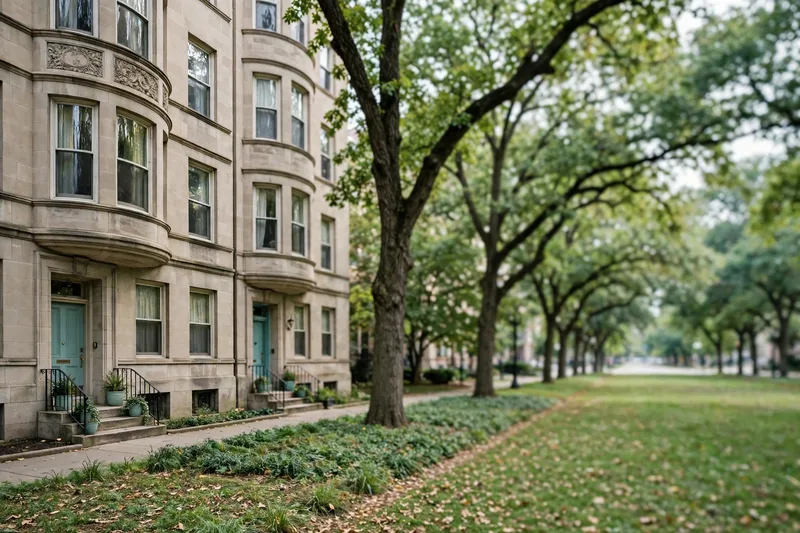
Water damage restoration logan square risk is not the same on every block. Logan Square runs along Milwaukee Avenue from the Kennedy Expressway west to the city line, and it is centred on Logan Boulevard and the square itself. The boulevards, Logan, Kedzie and Humboldt, are the spine of the neighbourhood, and the streets off them, Diversey, Fullerton, Armitage, North Avenue, Wrightwood, Dickens, Cortland, Sawyer, Mozart, Leavitt, Kedzie, California and Sacramento, are where the homes sit. Palmer Square, at the west end of the boulevards, is one of the oldest parts of the neighbourhood. The Blue Line Logan Square station brings people through the neighbourhood at all hours, and the commercial streets around it, Milwaukee Avenue, Kedzie Avenue and Fullerton Avenue, are the busiest parts of Logan Square.
The homes here are mostly greystones, brick two-flats and three-flats, courtyard buildings and six-flats, many of them built in the 1890s to the 1920s, with garden units below street level. Greystones have limestone facades and old masonry, and the mortar joints and window openings are the weak points in a driving rain. Two-flats and three-flats have shared walls and shared plumbing, so a burst pipe on the second floor can soak the first floor and the garden unit below it.
Courtyard buildings have flat roofs and shared drains, and a clogged drain on a courtyard roof can send water down through the top floor. The older homes sit on brick and rubble footings, with vitrified clay laterals, cast iron stacks and copper supply lines, and solid oak and maple hardwood floors. Old clay sewer laterals crack and shift, and tree roots find the cracks. If your lateral is old clay, ask a licensed sewer contractor to televise it before the next storm, not after it.
Garden units are the first to take water, because they sit below street level and their windows are at grade. A heavy rain fills the window wells, and the water comes through the window or the wall. Poured concrete full basements are the next most exposed, because the water finds the joint where the wall meets the floor. Condo and HOA buildings add one more problem: the water may come from a common element, such as a roof, a riser or a shared drain, and the association and the unit owner will need to agree on who pays for what. That is why the landlord, tenant and condo section on this page matters, and why we document the source of the water in writing.
The streets matter too. A basement on a low side street near the boulevards will take water before a basement on a higher street. If your street has flooded before, it will flood again, and the fix is to find the entry point and close it, not to hope the next storm is smaller. Call us at (773) 570-9869 and we will walk the property with you and show you where the water came in.
The main ZIP code for Logan Square is 60647. If your address is in 60647, we serve you from the same number, (773) 570-9869. We answer 24/7.
Sump pumps in Logan Square: the one machine that has to work
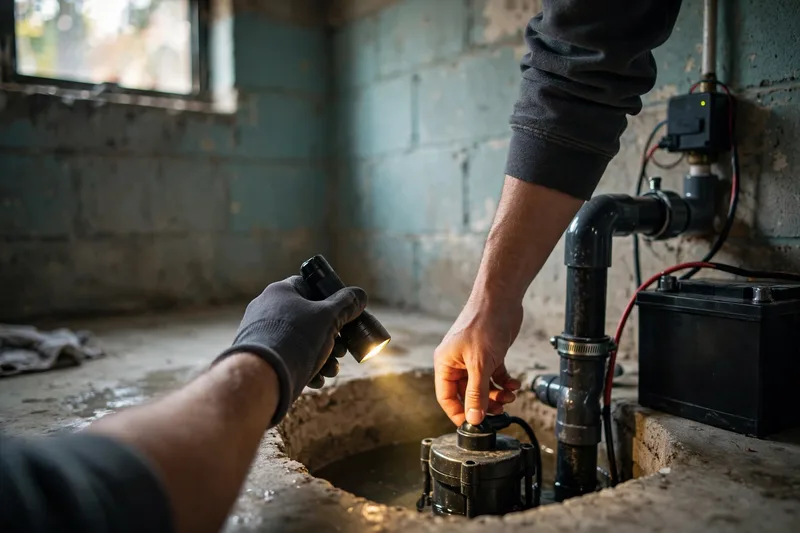
Most Logan Square basements have a sump pump, and most Logan Square basement floods start with a sump pump that stopped. The pump is a simple machine, and it fails in simple ways: the float switch sticks, the discharge line freezes, the check valve wears out, or the power goes out in the very storm that fills the pit. A pump that has not been tested in a year is a pump you do not know about.
Test the pump every few months. Pour a bucket of water into the pit and watch the pump run. If it does not run, call us before the next storm, not after it. A battery backup is the cheapest insurance a basement has. It keeps the pump running through a power cut, and it is the one upgrade we recommend to every Logan Square homeowner we meet. A second pump in the same pit is the next step up, and it covers the day the first pump dies.
Watch the discharge line in winter. A discharge line that freezes shut will back the water into the pit and flood the basement, even with a working pump. Make sure the line drains to a place where the water will not freeze and run back. If the pump runs constantly in dry weather, the check valve may be bad, and the water is running back into the pit as fast as the pump pushes it out. Garden units are the most exposed, because the pump is the only thing between the garden unit and the street water, so a garden unit without a working pump and a battery backup is a flood waiting for a storm.
Three kinds of water, three kinds of cleanup
Not all water is the same. Clean water from a burst pipe is safe to touch. Grey water from a washing machine or a dishwasher is dirty but not sewage. Black water from a sewer is contaminated and dangerous. The kind of water decides what we clean, what we throw out, and how we protect your family.
| Category | Where it comes from | What it means for your home |
|---|---|---|
| Category 1: clean water | A burst pipe, a supply line, a water main break, rain through a roof leak. | Safe to touch. Dry fast and most materials can be saved. |
| Category 2: grey water | A washing machine, a dishwasher, a toilet overflow without solids, a sump pump overflow. | Dirty, and it can carry bacteria. Carpet pad and soft goods usually have to go. |
| Category 3: black water | A sewer backup, a toilet backup with solids, flood water from the street. | Contaminated. Do not touch it with bare hands. Porous materials usually have to go. |
The category can change while the water sits. Clean water left for two days becomes grey water, because bacteria grow in it. Grey water left for two days becomes black water. That is why the first day matters so much, and why we extract fast and dry fast on every job.
Flooded basement in Logan Square? Why it floods here
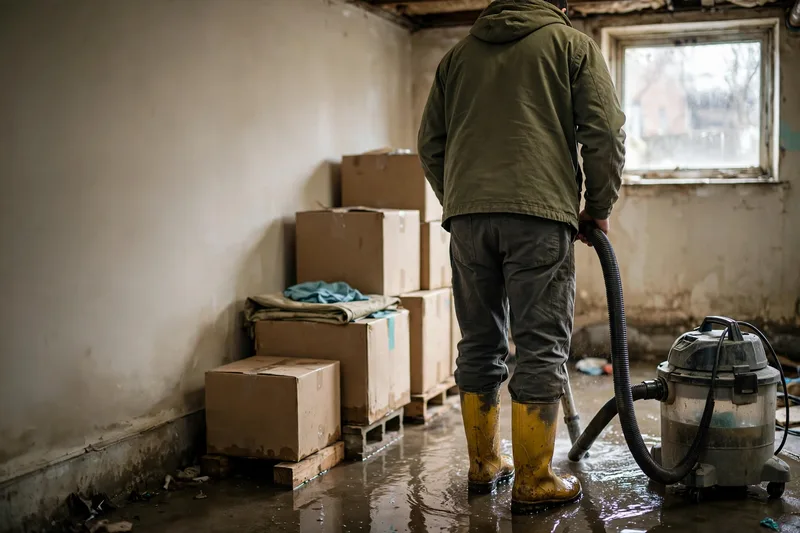
Water damage restoration logan square calls about flooded basements usually have one of four causes, and each one needs a different fix. First, the sump pump failed, the float switch stuck, or the power went out in the storm. Second, the sewer backed up through a floor drain or a toilet. Third, heavy rain fell faster than the ground and the drains could take it, and the water found the basement windows, the door, or a crack in the wall. Fourth, a burst pipe or a failed appliance filled the basement from the inside.
In February 2026, a leaking water main froze over on North Avers in Logan Square, and the Chicago Water Department came out to fix it, according to NBC Chicago. The report named the street, North Avers, and quoted Alderman Felix Cardona of the 31st Ward and a landlord, Maria Rivera. No numbered address was given, and no restoration company was named, so this page names none.
The sign beside it, reading Linden Falls, was a joke and an art project by Derek Erdman, and the water was said to come from a bookstore basement at about six gallons a minute. No address and no restoration company were named, so this page names none. Around 2011, a resident of western Logan Square filmed a flooded street in front of her house, a deep bubbling sinkhole, and a Water Department truck on site. No street address was named, and no restoration company appeared, so this page names none.
In February 2022, burst pipes at the Comfort Station in Logan Square destroyed a piano, and about one thousand eight hundred dollars was raised to replace it, according to Block Club Chicago. There is no named Logan Square flood event with a date, street or damage figure on the City of Chicago's own site, so this page names none from the City. If your basement is wet now, call us at (773) 570-9869. Do not wait to see if it dries on its own, because a wet basement does not dry on its own.
The water soaks into the drywall, the flooring and the framing, and the moisture left inside is what grows mold. We extract the water the same day, set the drying equipment, and take moisture readings every day until the house is dry.
One more thing to know about a flooded basement in Logan Square: the water that came from the sewer is not the same as the water that came from a burst pipe. Sewer water is contaminated, and anything porous it touched usually has to be thrown out. Clean water caught fast can often be dried in place. If you are not sure which kind of water you are standing in, stay out of it and call us. We test before we touch, and we tell you what we find before we start.
Stay out of a flooded basement while the power is on. Do not touch the water with bare hands. Lift what you can save to dry ground, photograph everything before you move it, and then call the City if the sewer or street flooded: call 311, or file a report at 311.Chicago.gov. Then call your insurer and start the claim.
In February 2026, a leaking water main froze over on North Avers in Logan Square, and the Chicago Water Department came out to fix it, according to NBC Chicago. Garden units and lower-level flats are the first to take water, because they sit below street level. The fix depends on which of these let the water in, so we find the entry point first and then dry the basement.
A City crew checks the street main first. If the main is fine, the homeowner hires a licensed sewer contractor to rod and televise the line with a Department of Water Management House Drain Inspector present, and the contractor calls 312-747-4591 to schedule the inspector. If the break is on private property, the homeowner pays a licensed contractor, including the full restoration. If the break is in the public way and the guidelines are met, the Department of Water Management schedules and pays for the repair.
The programme is for existing homes with up to four units that are not commercial or mixed use, and the private sewer drain must have been installed prior to 1988. New construction, rehabbed buildings and commercial or mixed-use buildings do not qualify. The City says the programme can save on average between ten thousand and twenty thousand dollars in repairs, and it recommends getting at least three estimates from licensed contractors. Ask the City for the current terms before you start work, and call 312-744-3155 to check that a contractor is licensed.
Water removal in Logan Square: fast, complete and documented
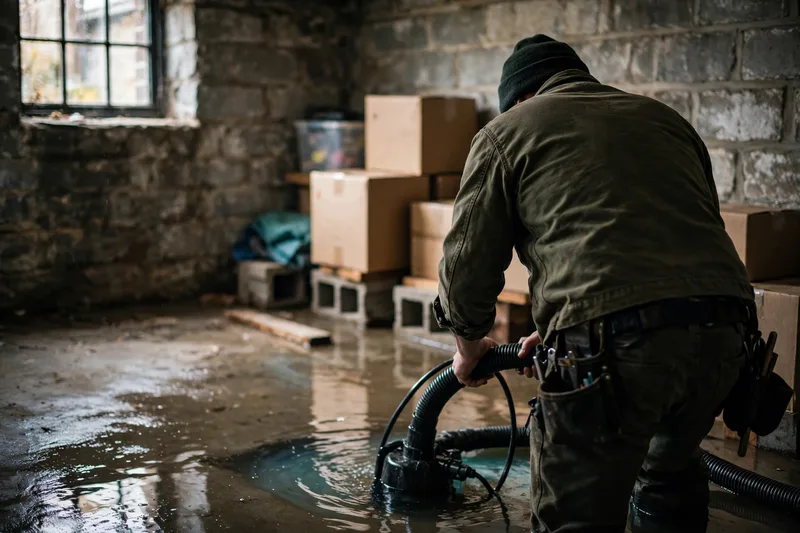
Water damage restoration logan square removal is the first step, and it is the step that decides how much of your home survives. We pump the standing water out with a truck-mounted extractor, then we vacuum the floors and pull the water out of the carpet and the pad. On a sewer backup we use sealed equipment, because the water is contaminated and we do not want it in the air of your house.
We photograph the water line on the walls, the wet floor and each damaged item before we move it. These photos are the start of your insurance claim, and they are the proof your adjuster will ask for. We also write down what we found, where the water came from, and how deep it was. The written record is part of the job, not an extra.
Do not try to remove a deep flood yourself with a household wet vacuum. A household vacuum cannot move the volume of water in a flooded basement, and it cannot lift the water out of the carpet pad or the subfloor. Call us, and let the truck-mounted equipment do the work. If the basement is still taking on water, do not wait for it to stop: call us while the water is still coming in, and we will tell you what to shut off and what to stay away from.
If you are outside Chicago, call 312-744-5000 instead of 311. Third, call your insurer and start the claim. For any emergency, call 911. There is no separate after-hours water or sewer emergency number published by the City, so after hours call us first and we will tell you what to do.
Flood cleanup in Logan Square: what we clean, and what we throw out
Flood cleanup starts with the water out, and then it splits into two lists: what we clean and what we throw out. Hard surfaces can usually be cleaned and disinfected. Porous materials usually cannot, once the water was sewage or sat for more than a day or two.
We clean and disinfect the floors, the lower walls, and any hard surface the water touched. We remove the carpet pad, the insulation, and any drywall that stayed wet. We bag the waste and take it out of the house, so it does not sit in your garage and grow mold. We do not throw anything away before we photograph it, because your insurer needs the photos and you need the list.
If the water came from the sewer, the cleanup is different. We extract with sealed equipment, wash the hard surfaces with a disinfectant, and remove anything porous the water touched. Call 311 as well, or file a report at 311.Chicago.gov, so the City of Chicago Department of Water Management knows the sewer backed up on your street. The City is the right call for a sewer backup, because the Department of Water Management handles all water service requests through the 311 system, including flooding, broken pipes outside your home and water on the street.
We test with a moisture meter before we cut anything, and we show you the readings so you can see why. We do not throw anything away without showing you first, and we do not throw anything away before we photograph it, because your insurer needs the photos and you need the list.
Drying by readings: how we know the house is dry
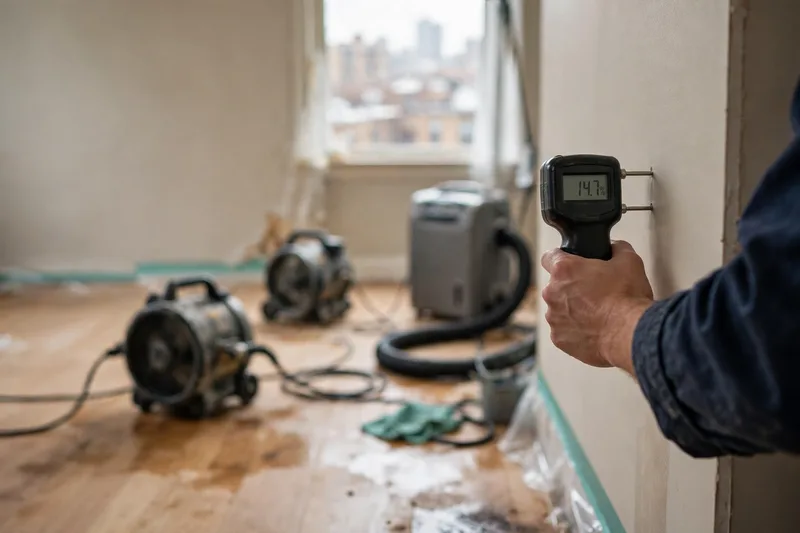
Water damage restoration logan square drying is done by readings, not by feeling. We set air movers to push dry air across the wet surfaces, and a dehumidifier to pull the moisture out of the air. Then we take moisture readings every day with a meter, and we write the numbers into a drying log. We stop the drying only when the readings are back to dry, and we show you the numbers.
As a general guide, most homes dry in three to seven days once the water is out and the equipment is running. A deep soak into hardwood, plaster or a finished basement can take a week or more. Plaster walls need the same care as drywall: plaster can feel dry on the face while the lath behind it is still wet, so the meter decides, not your hand. Greystones and old three-flats have plaster and lath walls, and the plaster holds water longer than new drywall, so the drying takes longer and the readings matter more. Do not switch the equipment off early, because the walls look dry long before they are dry inside, and the moisture left inside is what grows mold.
| Material | General guide | What the meter tells us |
|---|---|---|
| Carpet and pad, clean water | Two to four days | The pad is dry through, not just the carpet face. |
| Drywall, clean water | Three to five days | The wall cavity is dry, not just the surface. |
| Plaster and lath, clean water | Five to seven days | The lath behind the plaster is dry. |
| Hardwood floor, clean water | Five to ten days | The boards are flat again and the subfloor is dry. |
| Finished basement, any water | One week or more | Every wall and floor is dry to the readings. |
| Sewage water, any material | Longer, and the porous material is removed first | The hard surfaces are clean and the readings are dry. |
These are general guides, not promises. The meter decides on your house, and the drying log is the proof. Your insurer will ask for the log, and we give you a copy.
If you see any of these signs, call a professional to assess the damage. Water damage can lead to structural problems and health risks if it is left untreated. We test with a moisture meter before we open a wall, and we show you the readings so you can see why. A wall that feels dry on the face can still be wet inside, so the meter decides, not your hand. Do not paint over a water stain and call it fixed, and do not lay new flooring over a wet subfloor.
The electrical risks are real too: water in contact with electrical systems can cause shocks or fires. The structure is at risk as well: water left standing can weaken the foundation and the framing. And mold can begin to grow within 24 to 48 hours of water exposure. If your basement is flooded, stay out of the water, turn off the electricity if you can do so safely without stepping into standing water, and call a professional water damage restoration company at once. Call us at (773) 570-9869. We answer 24/7.
If you have asthma, allergies or a weak immune system, talk to your doctor first and tell us what they said. The drying equipment is loud at night, so call us if the noise bothers you and we will talk about it. Do not solve it by unplugging the dehumidifier.
Water mitigation in Logan Square: stop the damage from spreading
Water mitigation means stopping the damage from spreading while the drying runs. We stop the water at the source, we extract the water, we move the wet materials out of the way, and we set the drying equipment. The goal is simple: nothing that is dry now should be wet tomorrow.
Mitigation starts in the first hour. We shut off the main water valve if a pipe burst. We lift the furniture, the boxes and the electronics to dry ground. We pull the wet carpet pad and the wet insulation out of the house, so they do not feed mold. We set the air movers and the dehumidifier, and we take the first moisture readings, so the drying log starts on day one.
Mitigation is not the repair. The repair comes after the drying, when the readings say dry. A repair started on wet walls will fail, and the paint will peel, the flooring will buckle, and the mold will come back. We do not start the repair until the meter says the house is dry.
The words water mitigation and water damage restoration are often used as if they mean the same thing, but mitigation is the first part of the job, stopping the damage from spreading, while restoration is the whole job, from extraction through drying to repair. Water damage repair is the word people use when the focus is on fixing damaged structures. Water damage cleanup is the general word for removing the water and cleaning up. Flood damage restoration is used when the damage was caused by flooding.
Water damage repair in Logan Square: what gets fixed
Water damage repair starts only when the drying is done. We replace the drywall that was cut out, we replace the flooring that could not be saved, we replace the trim and the baseboards, and we repaint. The rooms go back the way they were, dry to the readings.
Some materials can be saved, and some cannot. Drywall that stayed wet for more than a day or two usually has to be cut out above the water line. Carpet that was wet with clean water can often be dried in place, but carpet pad that was wet with sewage usually has to go. Hardwood floors that cupped may need sanding and refinishing, or they may need to be replaced. We test with a moisture meter before we cut anything, and we show you the readings so you can see why.
Every repair is photographed and written into the log. Your insurer will want the photos, the drying log and the scope of work, and we give you all three. If the repair needs a permit, we tell you before the work starts. Sewer work in Chicago needs a permit, and the permit is only issued to a licensed drainlayer licensed with the Department of Buildings, through the online Dynamic Portal. All of the work is inspected by the Department of Water Management, and you can ask for an inspection through the Dynamic Portal or through the Sewer Permit Section at 312-744-3155 or 312-744-3351.
Burst pipe in Logan Square: what to do in the first hour
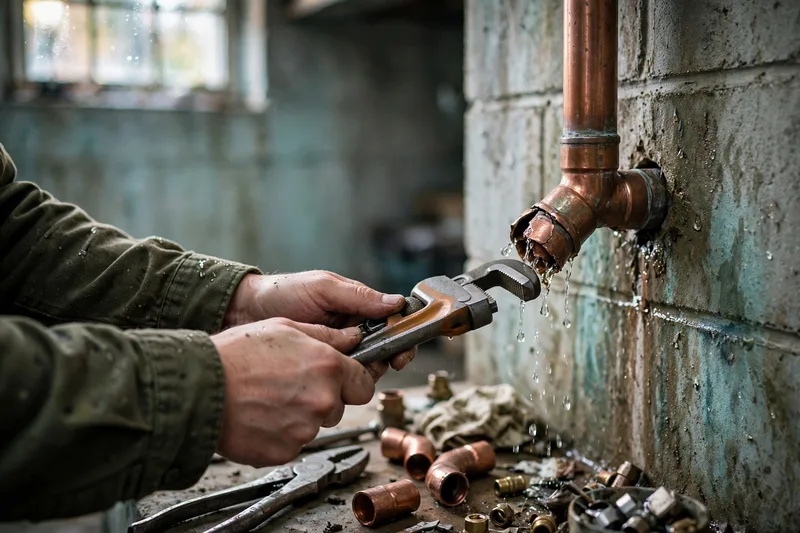
A burst pipe can fill a basement in an hour. Shut off the main water valve first, then turn off the power to any room with standing water. Call us at (773) 570-9869. Move what you can save to dry ground and photograph everything before you move it. Do not wait for the water to stop on its own.
When do pipes burst in Logan Square? In a hard freeze, when the cold lasts for days and the pipes sit in an unheated wall, a cold basement or a crawl space. Old cast iron and galvanized pipes split at the joints first, and the joints are the first place to check in a freeze. You can tell a pipe burst by the sound of running water when no tap is open, by water coming through a ceiling or a wall, by a sudden drop in water pressure, or by a puddle where there was none. A pipe that froze once will freeze again in the next cold snap unless the pipe is insulated or the cold air is stopped.
Prevent the next one. In a hard freeze, leave the taps on a slow drip and keep the heat on, even in rooms you do not use. Open the cabinet doors under the sinks on outside walls so warm air can reach the pipes. Insulate the exposed pipes in the basement and the crawl space. If you leave the house empty in winter, shut off the main and drain the pipes, or have someone check the house.
Do you call a plumber for a burst pipe? A plumber can fix the pipe, and we can dry the house and repair the damage. Call us first if the water is already in the house, because the drying has to start in the first hours, and the pipe fix alone will not dry the walls. If the water is near the electrical panel, turn off the power to that room and stay out until we tell you it is safe. For any emergency, call 911.
Sewage cleanup in Logan Square: the City, the 311 call and the cleanup
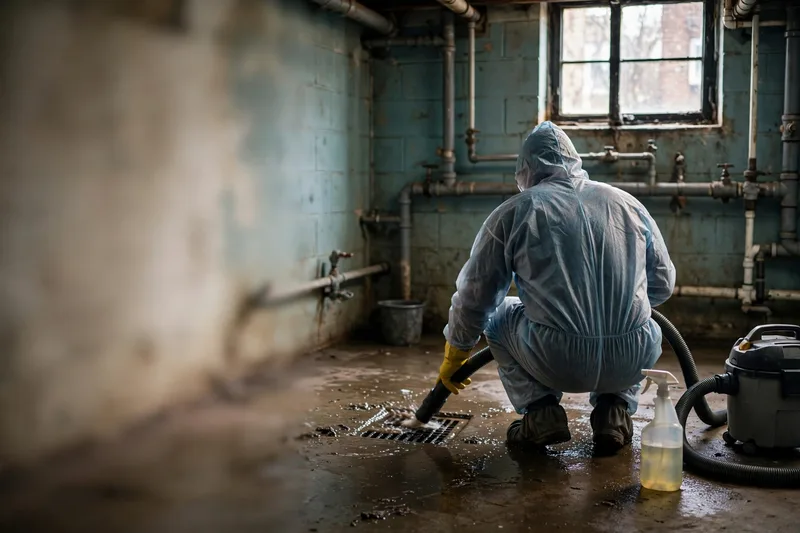
A sewer backup in Logan Square is sewage water, and sewage water is contaminated. Do not touch it with bare hands. Call us at (773) 570-9869, and call 311 as well, or file a report at 311.Chicago.gov, so the City of Chicago Department of Water Management knows the sewer backed up on your street. The Department handles all water service requests through the 311 system, including flooding, broken pipes outside your home and water on the street.
We extract the sewage with sealed equipment, wash the hard surfaces with a disinfectant, and remove anything porous the water touched, including the carpet pad and any drywall it soaked. We bag the waste and take it out of the house. We dry the space with the same readings we use on every job, and we do not stop until the readings say dry.
If the water is in your basement when it rains, or your toilets back up, the City runs a Private Sewer Drain Program that can repair a break in the public way if the guidelines are met. The route starts with a Water in Basement service request through 311 or 311.Chicago.gov, which goes to the Department of Water Management. A City crew checks the street main first.
If the main is fine, the homeowner hires a licensed sewer contractor to rod and televise the line with a Department of Water Management House Drain Inspector present, and the contractor calls 312-747-4591 to schedule the inspector. If the break is on private property, the homeowner pays a licensed contractor, including the full restoration. If the break is in the public way and the guidelines are met, the Department of Water Management schedules and pays for the repair.
The programme is for existing homes with up to four units that are not commercial or mixed use, and the private sewer drain must have been installed prior to 1988. The City recommends getting at least three estimates from licensed contractors. Ask the City for the current terms before you start work, and call 312-744-3155 to check that a contractor is licensed.
Emergency water damage in Logan Square: your first hour
Water damage restoration logan square jobs start the same way, day or night: you call, we talk you through the first hour, and a crew comes to you. The first hour is when the water is shallowest, the walls are driest, and the most can be saved. The second hour is already harder, and the third day is when the mold starts. Call us first at (773) 570-9869, any hour of the day or night, and tell us where the water is and how deep it is.
If a pipe burst, shut off the main water valve. If the water came from the street or a sewer backup, call 311 as well, or file a report at 311.Chicago.gov, so the City of Chicago Department of Water Management knows the sewer backed up on your street. If you are outside Chicago, call 312-744-5000 instead of 311. If the water is near the electrical panel, turn off the power to that room and stay out until we tell you it is safe. For any emergency, call 911. There is no separate after-hours water or sewer emergency number published by the City, so after hours call us first and we will tell you what to do.
We answer 24/7. When you call at night, you get a person, not a machine, and the person you get will talk you through the first hour while a crew is on the way. We do not ask you to wait until morning, because the water does not wait until morning either.
What caused it? A decision tree for Logan Square water damage
Four causes bring water into a Logan Square home, and each one needs a different first call. Work through the questions in order, and you will know who to call first, who pays, and what to do differently.
| What you see | Likely cause | Who to call first | Who usually pays |
|---|---|---|---|
| Water coming up through a floor drain or a toilet, with a bad smell, when it rains | Sewer backup, from the combined sewer surcharging in wet weather | Us at (773) 570-9869, and 311 for the City record | Your insurer if you hold sewer backup cover; the City only if the break is in the public way and the programme guidelines are met |
| Water on the street and in the basement after a heavy rain, no smell | Storm flooding, rain falling faster than the drains can take it | Us at (773) 570-9869, and 311 if the street flooded | Usually you, unless you hold separate flood insurance; standard homeowners insurance does not cover flooding from outside the house |
| A sudden flood of clean water, a hissing pipe, water through a ceiling | Burst pipe or split supply line | Us at (773) 570-9869, after you shut off the main water valve | Your homeowners insurance, if the burst was sudden and accidental |
| A slow damp patch, a stain growing over weeks, a musty smell | Appliance leak or slow pipe leak behind a wall | Us at (773) 570-9869, for the drying and the moisture readings | Your insurer may pay for the damage but not for the worn hose or pipe itself; gradual damage is usually not covered |
If you are not sure which cause it is, call us and describe what you see. We test with a moisture meter before we open a wall, and we tell you what we find before we start. Do not guess the cause and start the wrong fix. A backflow valve will not fix a burst pipe, and a new sump pump will not fix a sewer backup.
Landlord, tenant or condo: who pays in Logan Square
Logan Square has two-flats, three-flats, six-flats and courtyard buildings, and in a multi-unit building the water may cross the line between one home and another. Who pays depends on who owns the pipe and who caused the damage.
If you are a landlord, you are responsible for fixing the physical pipe and the structural damage. If a pipe bursts because of age, rust or normal wear, the property owner must cover the repair. If a tenant turned off the heat in a freeze, or left the windows open in a cold snap, the tenant can be held liable. Landlords are not responsible for replacing a renter's damaged personal property, such as furniture, electronics or clothing.
If you are a tenant, your landlord must fix the building, and your renters insurance is what covers your belongings and any temporary living costs. If you rent in Logan Square and a pipe bursts, call your landlord at once, photograph the damage, and call us at (773) 570-9869 for the drying. We document the loss, and we give the drying log to whoever needs it, landlord or tenant.
If you own a condo, pipes that serve only one unit and sit inside the walls are usually the responsibility of that unit owner. Pipes that serve more than one unit, such as vertical risers and horizontal mains, are usually common elements that the association maintains. The exact split depends on the association's declarations and bylaws, so read them before you argue about it. We document the source of the water in writing, so the association and the insurer can see where the water came from and what it damaged.
If a tenant turned off the heat in a freeze, or left the windows open in a cold snap, the tenant can be held liable for the repair. Landlords are not responsible for replacing a renter's damaged personal property, such as furniture, electronics or clothing. Personal property and temporary living costs are covered only if the renter holds an active renters insurance policy. If you rent in Logan Square and a pipe bursts, call your landlord at once, photograph the damage, and call us at (773) 570-9869 for the drying. We document the loss, and we give the drying log to whoever needs it, landlord or tenant.
Winter in Logan Square: the freeze and burst pipe calendar
Most Logan Square burst pipes happen in the cold months, and most of them could have been prevented in the autumn. Work through this calendar before the first hard freeze, and again in the spring.
October: before the cold
Insulate the exposed pipes in the basement and the crawl space. Check the sump pump discharge line and make sure it drains to a place where the water will not freeze and run back. Test the sump pump by pouring a bucket of water into the pit and watching it run. Drain the outdoor taps and put the hoses away.
November to December: the first freeze
Keep the heat on in every room, even rooms you do not use. Open the cabinet doors under the sinks on outside walls so warm air can reach the pipes. Leave the taps on a slow drip on the coldest nights. Check the basement windows and the window wells, and keep the wells clear.
January to February: the hard freeze
This is when pipes burst in Logan Square. In February 2022, burst pipes at the Comfort Station in Logan Square destroyed a piano. In February 2026, a leaking water main froze over on North Avers. If you leave the house empty in winter, shut off the main and drain the pipes, or have someone check the house. If a pipe freezes, do not try to thaw it with an open flame. Call us at (773) 570-9869 and we will tell you what to do.
March to April: the thaw
Thawing is when the burst shows up. A pipe that froze in January may not leak until the ice melts in March. Walk the basement, the kitchen and the bathrooms after the first warm week, and look for a damp patch, a stain, or a musty smell. Test the sump pump again, because the spring rain is coming, and the pump has to work.
Pipes on the city side of the water meter belong to the municipal water system, while lines on your side of the meter belong to you. In a rental, the landlord is generally responsible for repairing the burst pipe and fixing the structure, while the tenant is responsible only if the tenant caused the burst through carelessness, such as turning off the heat in a freeze. Personal property belongs to the renter's own renters insurance.
In a condo, pipes that serve only one unit and sit inside the walls are usually the responsibility of that unit owner, while pipes that serve more than one unit, such as vertical risers and horizontal mains, are usually common elements that the association maintains. The exact split depends on the association's declarations and bylaws, so read them before you argue about it. We document the source of the water in writing, so the landlord, the association and the insurer can see where the water came from.
Check for electrical safety: if water is near outlets, appliances or the service panel, turn off the electricity at the main breaker only if you can do so safely without stepping into standing water. Drain the lines: open a low-floor or outdoor faucet to drain the water left in the plumbing. Document the damage: take clear photos and videos of the water and the affected areas before you start cleaning, because you will need them for the claim. Call a professional: contact a plumber for the pipe repair and call us at (773) 570-9869 for the drying, and reach out to your insurance company right away. For any emergency, call 911.
What water damage restoration costs in Logan Square: the factors
We never quote a price before we see the loss, and we never print prices on this site. The price of a job depends on four things: how much water there is, what kind of water it is, how far it spread, and how long it sat. A small clean-water leak in one room costs far less to fix than a sewer backup across a finished basement. A loss caught in the first hour costs far less than the same loss found three days later, because the drying is shorter and less material has to be removed.
After the first visit you get a written scope of the work and a drying plan, and we work with your insurer on the claim. If a company quotes you a price over the phone before it has seen the water, be careful. That company is guessing, and the guess will change when it arrives. The scope of work is the document that matters: it says what will be extracted, what will be dried, what will be removed and what will be rebuilt, and it is the document your adjuster will ask for.
There is no City rebate, grant or cost-share for water damage restoration, flood proofing, backflow valves or sump pumps in Logan Square, and this page prints none. The City of Chicago Private Sewer Drain Program is a repair programme, not a rebate or a grant, and it only pays for a break in the public way that meets the programme guidelines. Ask the City for the current terms before you start work.
We never quote a price before we see the loss, and we never print prices on this site. After the first visit you get a written scope of the work and a drying plan, and we work with your insurer on the claim. If a company quotes you a price over the phone before it has seen the water, be careful. That company is guessing, and the guess will change when it arrives. The scope of work is the document that matters: it says what will be extracted, what will be dried, what will be removed and what will be rebuilt, and it is the document your adjuster will ask for.
Insurance after water damage in Logan Square: what usually pays
Water damage restoration logan square claims usually start with three calls: to us, to 311 if the sewer or street flooded, and to your insurer. Call your insurer in the first hour, not the first week, because the claim needs the photos, the drying log and the scope of work, and all three are made in the first days.
Sudden and accidental water damage, such as a burst pipe or a failed appliance hose, is usually covered. Flooding from outside the house, such as street flooding or lake water, usually needs separate flood insurance. Sewer backup is often a separate add-on with its own limit. Waterproofing and flood proofing are usually seen as maintenance, and most policies do not pay for them. Read your policy, call your insurer early, and keep every photo and receipt. We document the loss the way adjusters ask for it, with photos, moisture readings and a drying log, and we give you a copy you can hand to your adjuster.
If your insurer asks for a second opinion, or if the claim is disputed, the drying log is the document that settles it. The log shows the readings day by day, and it shows when the house was dry. A claim without a drying log is a claim without proof, and a claim with a drying log is a claim with a record. We write the log on every job, and we give you a copy.
Coverage depends on your policy and on what caused the damage. Gradual damage, such as a slow leak or poor maintenance over months, is usually not covered. Flooding from outside the house, such as street flooding or heavy rain, is not covered by a standard homeowners policy. You would need a separate flood insurance policy for that. Sewer backup is often a separate add-on with its own limit. Before you hire anyone, read your policy, document the damage with photos and videos, and contact your insurer as soon as possible to start the claim. We document the loss the way adjusters ask for it, with photos, moisture readings and a drying log.
Before you meet the adjuster, document the damage with photos and videos, keep a list of what was damaged, save every receipt, and keep a short log of who you called and when. We photograph the loss, write a drying log with moisture readings, and give you a copy you can hand to the adjuster. The log is the proof that the drying was done properly, and it is the document adjusters ask for first.
Flooding from outside the house, such as heavy rain or rising water, is usually not covered by a standard homeowners policy. You would need a separate flood insurance policy for that. Gradual damage, such as a slow leak or poor maintenance, is usually not covered either. Before you file a claim, document the damage with photos and videos, and contact your insurer as soon as possible. We document the loss the way adjusters ask for it, with photos, moisture readings and a drying log.
It does not cover flooding from outside the house, such as heavy rain or street flooding. You would need a separate flood insurance policy for that. Sewer backup is often a separate add-on with its own limit. The amount also depends on how much of the basement was damaged and what materials have to be removed and rebuilt. Before you file a claim, document the damage with photos and videos and contact your insurer to understand your coverage. We give you the photos, the drying log and the scope of work, and we give you a copy for your adjuster.
How long does water damage restoration take in Logan Square?
Water damage restoration logan square jobs follow the same order on every loss: extract, dry, document, then repair. As a general guide, most homes dry in three to seven days once the water is out and the equipment is running. A deep soak into hardwood, plaster or a finished basement can take a week or more. Greystones and old three-flats have plaster and lath walls, and the plaster holds water longer than new drywall, so the drying takes longer and the readings matter more. The repair starts only when the moisture readings say dry, and a repair started on wet walls will fail.
The claim runs on its own clock too. Your insurer will want the photos, the drying log and the scope of work, and we give you all three. The repair can take one to four weeks after the drying, depending on how much material was removed and how much has to be rebuilt. A small job in one room can be repaired in a few days. A finished basement with a sewer backup can take a month or more from the first call to the last coat of paint. Call your insurer in the first hour, not the first week, because the claim starts when the loss starts.
Repairs and rebuilding take one to two weeks after the drying. Larger or more complex jobs can take several weeks to a month or more. Four things decide the time: how much damage there is, what kind of water it is, what materials got wet, and whether mold is growing. Clean water dries faster than sewage water, which needs extra cleaning. Hardwood floors, drywall and insulation soak up water and take longer to dry. If mold is present, it has to be dealt with before the rebuilding starts, which adds time.
The drying is the part that cannot be rushed. The repair starts only when the moisture readings say dry, and a repair started on wet walls will fail. Call your insurer in the first hour, not the first week, because the claim runs on its own clock too.
We take moisture readings every day and we stop the drying only when the readings are back to dry. You see the numbers, so you know when the job is done. Do not switch the equipment off early, because the walls look dry long before they are dry inside, and the moisture left inside is what grows mold.
Mold remediation in Logan Square: the 24 to 48 hour rule
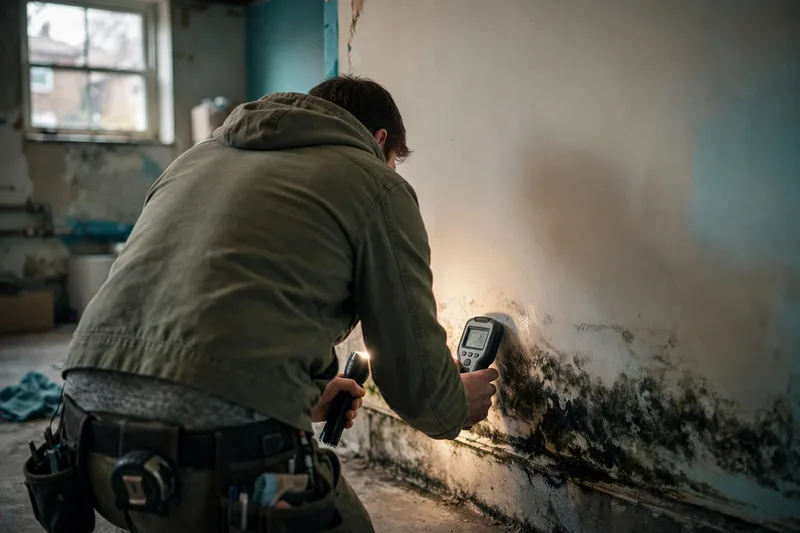
As a general guide, mold can start to grow within 24 to 48 hours on a wet surface, and it can become visible within 48 to 72 hours. That is why the first day matters more than any other. The US EPA guidance is to dry water-damaged materials within 24 to 48 hours. If the water sat for more than two days, or if the room smells musty, we look for mold during the drying and tell you what we find.
If you see mold, do not scrub it dry and do not bleach it and call it done. Bleach does not fix mold in drywall or wood, and dry scrubbing spreads the spores through the house. In Illinois, mold remediators register with the Illinois Department of Public Health under Part 835, and you can ask any company for its registration before you hire it. We do not claim a registration for ourselves. Ask us and we will tell you plainly. The City of Chicago publishes no mold guidance page and no IDPH reference for mold on its own site, so this page prints none.
Mold after water damage is usually found in the same places the water went: behind the baseboards, under the flooring, in the wall cavity, and in the insulation. We test with a moisture meter before we open a wall, and we show you the readings so you can see why. If mold is found, the affected material is removed, the area is cleaned, and the drying continues until the readings say dry. The mold job and the water job are one job, and they are done together, not one after the other.
If the water sat for more than two days, or if the room smells musty, we look for mold during the drying and tell you what we find. If you see mold, do not scrub it dry and do not bleach it and call it done. In Illinois, mold remediators register with the Illinois Department of Public Health under Part 835, and you can ask any company for its registration before you hire it. We do not claim a registration for ourselves. Ask us and we will tell you plainly.
Flood damage in Logan Square: the record
There is no named Logan Square flood event with a date, street or damage figure on the City of Chicago's own site, so this page names none from the City. What follows is the record we could verify, with each fact labelled by its source.
| Date | What happened | Source |
|---|---|---|
| 6 February 2026 | A leaking water main froze over on North Avers in Logan Square, and the Chicago Water Department came out to fix it. Alderman Felix Cardona of the 31st Ward and a landlord, Maria Rivera, were quoted. No numbered address was given, and no restoration company was named. | NBC Chicago, video report |
| February 2022 | Burst pipes at the Comfort Station in Logan Square destroyed a piano, and about one thousand eight hundred dollars was raised to replace it. | Block Club Chicago, 27 April 2022 |
| About 2011 | A resident of western Logan Square filmed a flooded street in front of her house, a deep bubbling sinkhole, and a Water Department truck on site. No street address was named, and no restoration company appeared. | YouTube, resident footage |
| Not found | No named Logan Square flood event with a date, street or damage figure on the City of Chicago's own site. | City of Chicago site, chicago.gov, checked 16 November 2026 |
If your basement flooded, call us at (773) 570-9869 and we will add your loss to the drying log, not to this page. We do not name addresses, homeowners or companies on this page, because we could not verify any of them.
Found it late? What to do when the water sat for days
If you found the water late, the first day is already gone, and the job is different. The water has soaked into the drywall, the flooring and the framing, and mold may already be growing. Do not try to fix it yourself with a household fan and a bucket. Call us at (773) 570-9869 and tell us how long the water sat.
We extract what is left, we test with a moisture meter, and we open the walls where the meter says the water went. We look for mold, and we tell you what we find. We photograph everything before we remove it, because your insurer needs the photos and you need the list. The drying takes longer when the water sat, because the materials are soaked through, and the repair takes longer too, because more material has to be removed. That is the cost of finding it late, and it is why we say call in the first hour, not the first week.
If the water sat for more than two days, do not scrub the mold dry and do not bleach it and call it done. Bleach does not fix mold in drywall or wood, and dry scrubbing spreads the spores through the house. Let us look first, and we will tell you what needs to be removed and what can be saved.
Who to call in Logan Square: City contacts
Keep this table on your fridge. The City numbers below are the numbers the City of Chicago itself publishes on chicago.gov. There is no separate after-hours water or sewer emergency number published by the City, and the Department of Water Management publishes no street address, main phone number or office hours on its own pages, so this page prints none of them.
| Who | Number | When and where |
|---|---|---|
| Chicago Water Damage Service | (773) 570-9869 | 24 hours a day, 7 days a week. Call us first for water damage in your home. |
| Chicago 311 | 311 | Call for non-emergency City services, including water service requests, flooding, broken pipes outside your home and water on the street. You can also file a report at 311.Chicago.gov. |
| 311 from outside Chicago | 312-744-5000 | Use this number instead of 311 if you are calling from outside Chicago. |
| Department of Water Management | Via 311 | All water service requests, including flooding, broken pipes outside your residence and water on the street, are processed through the 311 system. The Department publishes no street address, main phone number or office hours on its own pages. |
| Department of Finance, water billing | 312-744-2204 | Water billing questions. 121 North LaSalle Street, 7th Floor, Chicago, IL 60602. |
| Department of Buildings | 312-744-3449 | Building permits, including the Express Permit Program, which issues many permits the same day. 121 North LaSalle Street, Room 900, Chicago, IL 60602. |
| Sewer Permit Section | 312-744-3155 or 312-744-3351 | Sewer permits and inspections. A permit is required before construction, repair, adjustment, rodding or cleaning of any subsurface structure, and permits are only issued to a licensed drainlayer licensed with the Department of Buildings, through the online Dynamic Portal. |
| Emergencies | 911 | For any emergency, call 911. |
Two more numbers to keep. To schedule a Department of Water Management House Drain Inspector for the Private Sewer Drain Program, the contractor calls 312-747-4591. To check that a sewer contractor is licensed, call 312-744-3155.
The Private Sewer Drain Program: what the City does and does not do
The City of Chicago runs one programme for basement flooding, and it is a repair programme, not a rebate or a grant. The Private Sewer Drain Program is for water in the basement when it rains, or toilets backing up. If the break is in the public way and the guidelines are met, the Department of Water Management schedules and pays for the repair. If the break is on private property, the homeowner pays a licensed contractor, including the full restoration.
The route starts with a Water in Basement service request through 311 or 311.Chicago.gov, which goes to the Department of Water Management. A City crew checks the street main first. If the main is fine, the homeowner hires a licensed sewer contractor to rod and televise the line with a Department of Water Management House Drain Inspector present, and the contractor calls 312-747-4591 to schedule the inspector. The City recommends getting at least three estimates from licensed contractors, and you can call 312-744-3155 to check that a contractor is licensed.
The programme is for existing homes with up to four units that are not commercial or mixed use, and the private sewer drain must have been installed prior to 1988. New construction, rehabbed buildings and commercial or mixed-use buildings do not qualify. The City says the programme can save on average between ten thousand and twenty thousand dollars in repairs. That is the City's own flyer claim, in words, and it is the only programme amount this page prints. Ask the City for the current terms before you start work.
Do not confuse this programme with a rebate. There is no flood, sewer-backup, backflow or sump-pump rebate, grant or cost-share published by the City that we could find, so this page prints none. The programme pays for a repair in the public way, and nothing else. It does not pay for a sump pump, a backflow valve, waterproofing, or a repair on private property.
The permit rules are separate from the programme. A permit is required before construction, repair, adjustment, rodding or cleaning of any subsurface structure that collects or transports storm or sanitary wastewater, on private property or in the public way. Permits are only issued to a licensed drainlayer licensed with the Department of Buildings, through the online Dynamic Portal. All of the work is inspected by the Department of Water Management. You can ask for an inspection through the Dynamic Portal or through the Sewer Permit Section at 312-744-3155 or 312-744-3351.
Why Logan Square floods: the combined sewer
The City of Chicago says, on its own pages, that the City of Chicago has a combined sewer system. One set of pipes carries both storm water and sewage. In dry weather the flow goes to the treatment plants. In wet weather, when the rain falls faster than the pipes can take it, the flow is diverted into the Metropolitan Water Reclamation District Deep Tunnel, and the water can push back through a basement floor drain. That is why a heavy rain in Logan Square can flood a basement even when nothing in the house is broken.
The City has been working on this for decades. In 1997, a citywide flood affected more than thirty five thousand residents. In 1998, a federal grant of seven point eight million dollars paid for Rainblocker valves, which stop water from coming back up through the sewer into a basement. The City has spent more than seventy five million dollars on the programme, and more than one hundred thousand Rainblocker valves have been installed across Chicago. A Rainblocker valve is not a backflow valve, and it is not a cure for every basement, but it is the City's own answer to the combined sewer problem, and it is worth asking the City about if your basement floods when it rains.
New building work in Chicago must meet the Stormwater Ordinance, chapter 11-18, which has been in force since the first of January 2016. It applies to developments that create fifteen thousand or more square feet of impervious area, or disturb seven thousand five hundred or more square feet of land, and also to work that creates one thousand five hundred or more square feet of impervious area in a combined sewer area. If you are planning a large renovation, an addition, or a new building in Logan Square, ask the Department of Buildings about the stormwater rules before you start, at 312-744-3449.
The private sewer drain is wholly owned by the homeowner, not the City, and the homeowner is responsible for all general maintenance of the line, including cleaning, rodding and televising the entire line. Only breaks in the public way that meet the programme guidelines are repaired by the City, under the Private Sewer Drain Program. If you are unsure where your line runs, call 312-744-3155 and ask.
In wet weather the flow is diverted into the Metropolitan Water Reclamation District Deep Tunnel. That is why a heavy rain can push water back through a basement floor drain in Logan Square. What the City also says, on its Private Sewer Drain flyer, is that the private sewer drain is wholly owned by the homeowner, and that only breaks in the public way that meet the programme guidelines are repaired by the City. If you need to know what kind of sewer serves your street, call 312-744-3155 and ask.
Preventing the next flood in Logan Square
The best time to prevent the next flood is while the basement is dry. Start with the entry point, because the fix depends on it.
- Find the entry point. If the water came back through the sewer, a backflow valve or an overhead sewer is the strongest fix. If the break is in the public way, the City's Private Sewer Drain Program can repair it if the guidelines are met, and the route starts with a Water in Basement service request through 311.
- Keep the sump pump working. Test it every few months by pouring a bucket of water into the pit and watching it run. A battery backup keeps it running through a power cut, and a second pump in the same pit covers the day the first pump dies.
- Keep the discharge line clear in winter. A discharge line that freezes shut will back the water into the pit and flood the basement, even with a working pump.
- Grade the soil away from the house and keep the gutters clean. Water that runs away from the house does not come through the walls.
- Check the window wells. Garden units are the first to take water, and the window wells are the first entry point. Keep them clear and make sure the drains work.
- Ask about a backflow prevention valve with a bypass pump. It stops sewer water from coming back into the house, and the bypass pump keeps the house draining while the valve is closed.
There is no City rebate or grant for any of this, so plan the cost yourself and ask us for a prevention visit. We check the entry points, the pump, the discharge and the grading, and we write down what we find, in order of what matters most.
Older homes in Logan Square: greystones
Most Logan Square homes are old, and old homes flood in old ways. Greystones have limestone facades and old masonry, and the mortar joints and window openings are the weak points in a driving rain. Two-flats and three-flats have shared walls and shared plumbing, so a burst pipe on the second floor can soak the first floor and the garden unit below it. Courtyard buildings have flat roofs and shared drains, and a clogged drain on a courtyard roof can send water down through the top floor.
Plaster and lath walls hold water longer than new drywall, so the drying takes longer and the readings matter more. A plaster wall can feel dry on the face while the lath behind it is still wet, so the meter decides, not your hand. Old cast iron and galvanized pipes split at the joints in a cold snap, and the joints are the first place to check in a freeze. Old clay sewer laterals crack and shift, and tree roots find the cracks.
If your lateral is old clay, ask a licensed sewer contractor to televise it before the next storm, not after it. Some Logan Square homes still have lead service lines, and the City ran a Lead Service Line Program in 2015. If you are unsure what your service line is made of, ask the City, and ask a licensed plumber before you dig.
Condo and HOA buildings add one more problem: the water may come from a common element, such as a roof, a riser or a shared drain, and the association and the unit owner will need to agree on who pays for what. We document the source of the water in writing, and we give you the drying log, the photos and the scope of work, so the association and the insurer can see where the water came from and what it damaged.
Room by room: where water hides in a Logan Square home
Water hides in the rooms you do not look at every day. Walk the house with this list after a flood, and check each room with a moisture meter, not just your eyes.
The basement
The basement is where the water goes first, because it is the lowest point in the house. Check the water line on the walls, the floor, the carpet pad, and the baseboards. Garden units are the most exposed, because they sit below street level and their windows are at grade.
The kitchen
The kitchen hides water under the sink, behind the dishwasher, and under the refrigerator. A slow leak behind a wall can soak a floor for weeks before anyone notices. Check the supply lines and the drain lines, and look for a stain on the ceiling below.
The bathroom
The bathroom hides water under the tub, behind the toilet, and in the wall behind the shower. A toilet overflow without solids is grey water. A toilet backup with solids is black water, and it is contaminated.
The laundry room
The laundry room hides water in the washing machine hoses and the drain. A washing machine hose that splits can fill a room in an hour. Replace the hoses every five years, and use braided steel hoses, not rubber.
The attic
The attic hides water in the roof leak you cannot see from the street. Wind-driven rain or ice dams push water under the shingles and down through the ceiling. The stain on the ceiling is usually far from the leak, so we trace it with a moisture meter before we repair anything.
The garage and the crawl space
The garage and the crawl space hide water in the slab and the framing. A garage that floods will soak the drywall at the base of the walls, and a crawl space that floods will soak the insulation and the subfloor. Check both after a storm, even if the house looks dry.
How to choose a water damage company in Logan Square
Water damage restoration companies in Logan Square all say the same thing on their websites, so ask for the things that prove it. The company you hire should answer the phone 24/7, arrive the same day, extract the water, dry the house to readings you can see, photograph everything, and give you a drying log and a written scope of work. If a company will not do all of that, do not hire it.
- Do they answer 24/7? Call them at night and see who answers. If you get a machine, call someone else.
- Do they dry by readings? Ask for the drying log. The log is the proof that the drying was done properly, and it is the document your insurer will ask for.
- Do they photograph everything? Ask for the photos before the work starts. The photos are the start of your claim.
- Do they quote a price over the phone? If they do, be careful. No honest company quotes a price before it has seen the water.
- Do they ask about mold? If the water sat for more than 48 hours, or if you can see or smell mold, ask for the company's Illinois Department of Public Health registration under Part 835. If a company says it is registered and cannot show you the registration, do not hire it for mold work.
- Do they know the City rules? Sewer work in Chicago needs a permit, and the permit is only issued to a licensed drainlayer licensed with the Department of Buildings. Ask who holds the permit before the work starts.
- Do they pressure you? A good company explains the work, shows you the readings, and lets you decide. A company that pressures you to sign now is a company to avoid.
Call us at (773) 570-9869 and ask us these questions. We will answer them plainly, and we will tell you what we do not know as well as what we do.
Call us first at (773) 570-9869. We answer 24/7 and talk you through the first hour while a crew is on the way. Call at once if the water is extensive, if it has been standing for more than a day, if it came from a sewer, or if it has soaked walls, floors and ceilings. If the water came from the street or a sewer backup, call 311 as well, or file a report at 311.Chicago.gov, so the City of Chicago Department of Water Management knows the sewer backed up on your street. Then call your insurer and start the claim. For any emergency, call 911.
Any restoration company you hire should do the same five things: extract the water, dry the structure to readings you can see, clean and disinfect, remove what cannot be saved, and rebuild what was removed, and give you photos and a drying log for your insurer. Ask for the drying log. Ask for the photos. Ask who holds the permit if sewer work is needed. Call us at (773) 570-9869 and ask us these questions. We will answer them plainly, and we will tell you what we do not know as well as what we do.
We also serve these Chicago-area suburbs
- Water damage restoration in Lakeview
- Water damage restoration in Barrington
- Water damage restoration in Hinsdale
- Water damage restoration in Oak Brook
- Water damage restoration in Des Plaines
- Water damage restoration in Forest Park
- Water damage restoration in Elmwood Park
- Water damage restoration in Park Ridge
- Water damage restoration in Highland Park
- Water damage restoration in Deerfield
- Water damage restoration in Northbrook
- Water damage restoration in Glenview
- Water damage restoration in Wilmette
- Water damage restoration in Evanston
- Water damage restoration in Skokie
- Water damage restoration in Oak Park
- Water damage restoration in Lake Forest
The first week after water damage in Logan Square: a day-by-day
Day 1: stop the water and call for help
Call us at (773) 570-9869, shut off the main water valve if a pipe burst, and stay out of a flooded basement while the power is on. Photograph everything before you move it. Call 311 if the sewer or street flooded, and call your insurer and start the claim.
Days 2 to 3: extraction done, drying running
The water is out and the air movers and dehumidifier are running. We take the first moisture readings and start the drying log. Do not switch the equipment off, even at night, because the walls look dry long before they are dry inside.
Days 4 to 7: readings every day, damage out of the house
We take moisture readings every day and write them into the drying log. The wet drywall, carpet pad and insulation are out of the house. If mold is found, we tell you what we found and what needs to be removed.
Week 2: dry to the readings, then rebuild
The readings say dry, so the drying stops and the repair starts. We replace the drywall, flooring and trim that was removed, and repaint. You get the photos, the drying log and the scope of work, and we give you a copy for your insurer.
What to photograph for your insurance claim in Logan Square
Your insurer will ask for the photos, the drying log and the scope of work. The photos are the start of the claim, and they are the proof that the damage happened when you say it happened.
The water line on every wall
Photograph the water line on every wall, in every room, before you move anything. The water line shows how deep the water was, and it is the photo your adjuster will ask for first.
Every room, wide and close
Photograph every room from the door, wide enough to see the whole room, and then photograph the wet areas close up. The wide photo shows the room, and the close photo shows the damage.
Every damaged item, with its label
Photograph every damaged item, with its brand and label if you can see it. Keep a list of what was damaged, with the brand and age if you know it. Do not throw anything away before you photograph it.
The cause, and the work
Photograph the cause, if you can see it: the burst pipe, the failed hose, the sump pump that stopped, the floor drain that backed up. Photograph the work as it happens, too: the extraction, the drying equipment, the readings, and the removal. We photograph the work as well, and we give you a copy.
When the job is done right
Good water damage restoration logan square work ends with dry walls, dry floors, and readings that prove the house is dry, not just a room that looks dry. The crew should walk you through the numbers before they pack up, and the rooms should go back the way they were, with the damage fixed and the cause dealt with. If a company will not show you its readings, or will not put the plan in writing, keep looking.
What Logan Square homeowners ask
Who do I call first when my basement floods in Logan Square?
Call us first at (773) 570-9869. We answer 24/7 and talk you through the first hour while a crew is on the way. If the water came from the street or a sewer backup, call 311 as well, or file a report at 311.Chicago.gov, so the City of Chicago Department of Water Management knows the sewer backed up on your street. Then call your insurer and start the claim.
Will my insurance pay for water damage in Logan Square?
Sudden and accidental water damage, such as a burst pipe or a failed appliance hose, is usually covered. Flooding from outside the house, such as street flooding or lake water, usually needs separate flood insurance. Sewer backup is often a separate add-on with its own limit. Waterproofing and flood proofing are usually seen as maintenance, and most policies do not pay for them. Read your policy, call your insurer early, and keep every photo and receipt.
How long does it take to dry a house in Logan Square?
As a general guide, most homes dry in three to seven days once the water is out and the equipment is running. A deep soak into hardwood, plaster or a finished basement can take a week or more. Greystones and old three-flats have plaster and lath walls, and the plaster holds water longer than new drywall, so the drying takes longer and the readings matter more. The meter decides, not your hand.
Can I stay in the house while it dries?
In most clean-water jobs, yes. The air movers and dehumidifiers are loud, but the house is safe to live in while they run. If the water was sewage, or if mold is growing, or if the power is off, we will tell you to stay out until the space is safe. If you have asthma, allergies or a weak immune system, talk to your doctor first and tell us what they said.
Do I need a plumber or a restoration company?
A plumber can fix the pipe, and we can dry the house and repair the damage. Call us first if the water is already in the house, because the drying has to start in the first hours, and the pipe fix alone will not dry the walls. If the water is near the electrical panel, turn off the power to that room and stay out until we tell you it is safe.
Is the water safe to touch?
No. Assume all floodwater is contaminated, especially water that came from a sewer. Do not touch it with bare hands. Wear rubber boots and gloves if you must walk through it, and wash your hands and any skin that touched the water.
Who owns my sewer lateral in Logan Square?
You do. The City of Chicago's own Private Sewer Drain flyer says the private sewer drain is wholly owned by the homeowner, not the City, and the homeowner is responsible for all general maintenance of the line, including cleaning, rodding and televising the entire line. Only breaks in the public way that meet the programme guidelines are repaired by the City, under the Private Sewer Drain Program.
Where does Logan Square's drinking water come from?
From the City of Chicago Department of Water Management, which provides drinking water for Chicago and one hundred twenty suburban communities. The Department maintains more than four thousand three hundred miles of water mains and more than four thousand four hundred miles of sewers, with forty four thousand manholes, sixty thousand catch basins and more than nine hundred thousand customers. Water billing is handled by the Department of Finance, not by the Department of Water Management. For water billing questions, call the Department of Finance at 312-744-2204.
What number do I call after hours in Logan Square?
Call us first at (773) 570-9869. We answer 24/7. For a water main break, a sewer backup or a flooded street, call 311, or file a report at 311.Chicago.gov. If you are outside Chicago, call 312-744-5000 instead of 311. For any emergency, call 911. There is no separate after-hours water or sewer emergency number published by the City.
How do I stop mold after water damage in Logan Square?
Dry the water-damaged materials within 24 to 48 hours, which is the US EPA guidance. If the water sat for more than two days, or if the room smells musty, we look for mold during the drying and tell you what we find. If you see mold, do not scrub it dry and do not bleach it and call it done. In Illinois, mold remediators register with the Illinois Department of Public Health under Part 835, and you can ask any company for its registration before you hire it. We do not claim a registration for ourselves.
Will the City pay for my water damage in Logan Square?
The City of Chicago Private Sewer Drain Program is a repair programme, not a rebate or a grant, and it only pays for a break in the public way that meets the programme guidelines. The route starts with a Water in Basement service request through 311 or 311.Chicago.gov. If the break is on private property, the homeowner pays a licensed contractor, including the full restoration. There is no flood, sewer-backup, backflow or sump-pump rebate, grant or cost-share published by the City that we could find.
What if I found the water days later in Logan Square?
Call us at (773) 570-9869 and tell us how long the water sat. We extract what is left, we test with a moisture meter, and we open the walls where the meter says the water went. We look for mold, and we tell you what we find. We photograph everything before we remove it, because your insurer needs the photos and you need the list. The drying takes longer when the water sat, because the materials are soaked through.
Does Logan Square have combined or separate sewers?
A combined sewer carries storm water and sewage in the same pipes. A separate sewer carries them in different pipes. The City of Chicago says, on its own pages, that the City of Chicago has a combined sewer system, so Logan Square has combined sewers. In wet weather the flow is diverted into the Metropolitan Water Reclamation District Deep Tunnel. That is why a heavy rain can push water back through a basement floor drain in Logan Square. What the City also says, on its Private Sewer Drain flyer, is that the private sewer drain is wholly owned by the homeowner, and that only breaks in the public way that meet the programme guidelines are repaired by the City.
For water damage work, the safety question that matters most is whether your home is safe to enter after a flood. Do not enter a flooded basement while the power is on. Do not touch floodwater with bare hands, and assume it is contaminated, especially if it came from a sewer. If the water is near the electrical panel, turn off the power to that room and stay out until we tell you it is safe. For any emergency, call 911.
If you are new to the neighbourhood, walk the main streets in daylight first, and ask neighbours about your block. For water damage work, the safety question that matters is the safety of the house itself: do not enter a flooded basement while the power is on, do not touch floodwater with bare hands, and call us at (773) 570-9869 if you are not sure the house is safe to enter. For any emergency, call 911.
Logan Square water damage: questions and answers
How long does restoration take after water damage in Logan Square?
Restoration in Logan Square usually takes a few days to several weeks, and most jobs finish in three to seven days for the drying, with repairs after that. Water extraction and drying take three to five days on a small clean-water loss in one room.
What does water damage restoration include in Logan Square?
Water damage restoration in Logan Square usually includes five parts, done in order. First, inspection and assessment: we find the source of the water and measure how far it spread. Second, water extraction: standing water is removed with pumps and vacuums.
When should I call a water restoration company in Logan Square?
Call as soon as you find the water. Do not wait to see if it dries on its own, because a wet basement does not dry on its own, and mold can start to grow within 24 to 48 hours.
What is water damage restoration called?
Water damage restoration is also called water mitigation, water damage repair, water damage cleanup, or flood damage restoration. On this page, water damage restoration means the whole job: the water out, the house dry to readings, the damage documented, and the rooms rebuilt.
Does insurance pay for water restoration in Logan Square?
Yes, homeowners insurance usually pays for water damage restoration if the damage was sudden and accidental, such as a burst pipe or a broken appliance hose. Sudden and accidental damage, such as a burst pipe, a broken appliance hose, or a roof leak caused by a storm, is usually covered.
How can I tell if water damage is permanent in my Logan Square home?
Look for signs of structural damage: warped or buckled flooring, sagging ceilings, and drywall that is soft, crumbling or stained in a way that does not fade. You may also notice a musty smell that stays even after cleaning, visible mold growth, and stains or colour changes that do not fade.
How expensive is it to fix water damage in a Logan Square house?
It depends on how much water there is, what kind of water it is, how far it spread and how long it sat. A small clean-water leak in one room costs far less to fix than a sewer backup across a finished basement.
What should I ask the insurance adjuster for water damage in Logan Square?
Ask what is covered under your policy, what your deductible is, what documentation you need to provide, how long the claims process will take, whether you need to get more than one estimate, whether you can choose your own contractor, what the process is for filing the claim, and what happens if the damage is more extensive than first thought.
Can I file a claim if my basement is flooded in Logan Square?
Yes, you can file a claim if your basement is flooded, but whether your insurance will cover the damage depends on the cause of the flooding and your policy. Sudden and accidental damage, such as a burst pipe or an appliance failure, is usually covered.
Is Logan Square a safe part of Chicago?
Logan Square is generally seen as a busy, moderately safe urban neighbourhood by day, and like much of Chicago, safety varies a lot by block and by time of day. The main commercial streets, such as Milwaukee Avenue and the boulevards, are active and full of foot traffic during the day.
How much will insurance pay for a flooded basement in Logan Square?
It depends on the cause of the flooding, your policy, your limits and your deductible. Standard homeowners insurance usually covers sudden and accidental damage, such as a burst pipe, and it usually pays for water extraction, drying and repairs up to your policy limits.
Is it safe to live in a house with a flooded basement in Logan Square?
No, it is not safe to live in a house with a flooded basement. Floodwater can contain sewage, bacteria and chemicals, and it can also carry electrical hazards and lead to mold growth. The health risks are real: floodwater can contain sewage, bacteria and chemicals that can make you ill.
Are renters responsible if pipes burst in Logan Square?
Generally, landlords are responsible for fixing the physical pipe and the structural damage, while renters are only responsible if their own carelessness caused the freeze or the burst. If a pipe bursts because of age, rust or normal wear, the property owner must cover the repair.
Is Logan Square a safe neighborhood in Chicago?
Logan Square is a busy North West Side neighbourhood, and like much of Chicago, safety varies by block and by time of day. The main streets, such as Milwaukee Avenue, Logan Boulevard and Kedzie Avenue, are active and full of foot traffic during the day, and the Blue Line Logan Square station brings people through the neighbourhood at all hours.
Who is responsible for a burst water pipe in Logan Square?
Responsibility for a burst water pipe depends on the property type, where the pipe sits, and whether carelessness was involved. In a single-family home, you are responsible for repairing a burst pipe and any water damage inside your home, and your homeowners insurance usually covers a sudden and accidental burst.
Is a burst pipe considered an emergency in Logan Square?
Yes, a burst pipe is a plumbing emergency. It can release hundreds of gallons of water in a short time, causing severe flooding, structural damage to walls and floors, electrical hazards, and mold growth. What to do at once: turn off the main water supply, usually a wheel or lever, and turn it fully off to stop the flow.
What should I do first when I find water damage in my basement in Logan Square?
Call us first at (773) 570-9869. We answer 24/7 and talk you through the first hour while a crew is on the way. If a pipe burst, shut off the main water valve. If the water came from the sewer or the street, do not try to stop it yourself.
Who should I call first for water damage in Logan Square IL?
Call us first at (773) 570-9869. We answer 24/7 and talk you through the first hour while a crew is on the way. Second, if the water came from the street or a sewer backup, call 311, or file a report at 311.Chicago.gov, so the City of Chicago Department of Water Management knows about it.
How fast does mold grow after water damage in a basement?
As a general guide, mold can start to grow within 24 to 48 hours on a wet surface, and it can become visible within 48 to 72 hours. That is why the first day matters more than any other. The US EPA guidance is to dry water-damaged materials within 24 to 48 hours.
Why does my basement keep flooding in Logan Square?
Logan Square basements flood for the same reasons most North West Side basements flood: a heavy rain that falls faster than the drains can take it, a sump pump that fails in a power cut, a frozen discharge line in January, and a sewer backup on the wrong night.
How long does it take to dry a house after water damage?
As a general guide, most homes dry in three to seven days once the water is out and the equipment is running. A deep soak into hardwood, plaster or a finished basement can take a week or more. We do not guess.
Can I stay in my house while the drying runs?
In most clean-water jobs, yes. The air movers and dehumidifiers are loud, but the house is safe to live in while they run. If the water was sewage, or if mold is growing, or if the power is off, we will tell you to stay out until the space is safe.
Do I need to throw out wet carpet and drywall?
It depends on the water and how long it sat. Clean water caught fast can often be dried in place. Sewage water means the carpet pad and any drywall it touched usually have to go. Drywall that stayed wet for more than a day or two often has to be cut out above the water line.
What is a combined sewer, and does Logan Square have one?
A combined sewer carries storm water and sewage in the same pipes. A separate sewer carries them in different pipes. The City of Chicago says, on its own pages, that the City of Chicago has a combined sewer system, so Logan Square has combined sewers.
Is there a City programme that helps with basement flooding in Logan Square?
Yes, one programme exists, and it is a repair programme, not a rebate or a grant. The City of Chicago Private Sewer Drain Program is for water in the basement when it rains, or toilets backing up. The route starts with a Water in Basement service request through 311 or 311.Chicago.gov, which goes to the Department of Water Management.
Sources
- City of Chicago, Department of Water Management, official site
- City of Chicago, 311, official site
- City of Chicago, Department of Finance, official site
- City of Chicago, Private Sewer Drain Program flyer, 2023, chicago.gov
- City of Chicago, Department of Water Management, Sewer Permits, chicago.gov
- City of Chicago, Department of Water Management, Combined Sewer Overflows, chicago.gov
- City of Chicago, Department of Buildings, permits and Express Permit Program, chicago.gov
- Mold, US Environmental Protection Agency
- Illinois Department of Public Health, Part 835, Mold Remediation Registration
- National Flood Insurance Program, FEMA
- NBC Chicago, Logan Square water main break leaves icy mess, 6 February 2026
- Block Club Chicago, Comfort Station burst pipes, 27 April 2022
- YouTube, resident footage of flooding in western Logan Square, about 2011
More Restoration Services Near Logan Square
Every service below is one tap away. Pick the one that matches your problem.

Water Damage Restoration
Fast water extraction, structural drying, and full repair after burst pipes, leaks, and floods.
Learn more →
Water Mitigation
Emergency water removal, structural drying, and mold prevention to stop the damage fast, 24/7.
Learn more →
Mold Remediation
Safe, contained mold remediation that removes contamination and fixes the moisture source.
Learn more →
Sewage Cleanup
Safe removal and disinfection of dangerous sewage backups and black water.
Learn more →
Flood Cleanup
Water pumped out, structure dried, and debris cleared fast after storms and flooding.
Learn more →
Hardwood Floors Water Damage
Cupped, buckled or stained hardwood after a leak? How we dry it, when sanding saves it, and when the boards have to go.
Learn more →