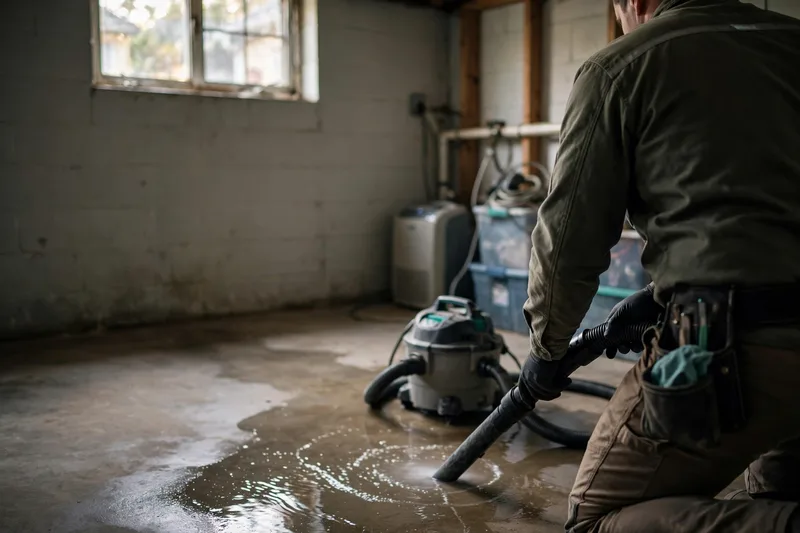
Chicago Water Damage Service, Elmwood Park, IL 60707
Water Damage Restoration Elmwood Park IL
Flooded basement in Elmwood Park? We answer 24/7, arrive fast, extract the water, dry the structure, and help you file the claim.
Call (773) 570-9869What to do first
- We answer 24/7
- Local Chicago team
- Insurance documentation help
- Straight answers, no pressure
Get a Free Elmwood Park Water Damage Assessment
Tell us where the water is and where it came from if you know. We will call you back, ask the right questions, and document the loss properly from the first visit.
The short answer
Water damage restoration elmwood park crews answer 24/7. Call (773) 570-9869 now and tell us where the water is. We talk you through the first hour while a crew is on the way, and we dry the house to readings you can see.
Your first hour in Elmwood Park: what to do now
Water damage restoration elmwood park homes need most often begins in the basement, and it begins with one call. You do not need to know what caused the water. You need to stop it, stay safe and get the drying started. This section is the short version. The rest of the page is the full version.
- Call us first at (773) 570-9869. We answer 24/7. Tell us where the water is and how deep it is. We talk you through the first hour while a crew is on the way.
- Stop the water if you can do it safely. If a pipe burst, shut off the main water valve. If an appliance failed, turn off the water to that appliance. If the water came from the sewer or the street, do not try to stop it yourself.
- Stay out of a flooded basement while the power is on. Water and electricity together can kill. If the water is near the electrical panel, stay out until we tell you it is safe.
- Do not touch floodwater with bare hands. Assume it is contaminated, especially if it came from a sewer. Wear rubber boots and gloves if you must walk through it.
- Photograph everything before you move it. The water line on the walls, the wet floor, each damaged item. These photos are the start of your insurance claim.
If the water came from the street or a sewer, call the Village of Elmwood Park Public Works at 708-452-3945 as well. The Village needs to know the sewer is surcharging on your street. Then call your insurer and start the claim. The call order is simple: us first, the Village second if the sewer is involved, your insurer third.
Elmwood Park, IL 60707 is a village of about twenty-five thousand people in about two square miles, and most of its homes have basements. The village was incorporated in April 1914. That is a lot of basements on old combined sewers, and it is why the same streets flood in the same storms. The rest of this page explains why it floods here, what we do about it, and what you can change so the next storm does not do the same thing again.
What water damage restoration in Elmwood Park IL includes
Water damage restoration elmwood park IL homeowners get from us covers the whole loss, from the first call to the last reading. It is not one job. It is five jobs in a row, and each one has to be done before the next one starts.
| Step | What happens | What you get |
|---|---|---|
| 1. Emergency call | We answer 24/7, talk you through the first hour, and send the nearest crew. | An arrival window and plain advice while the crew is on the way. |
| 2. Water extraction | We pump and vacuum the standing water out, then measure how deep it was and where it came from. | Photos of the water before we touch it, and a written note of the source. |
| 3. Removal | We take out what cannot be saved, such as carpet pad and wet insulation, and we show you each item first. | A list of what was removed, photographed before it left the house. |
| 4. Structural drying | We set air movers and a dehumidifier and take moisture readings every day until the walls, floor and studs read dry. | A drying log with daily readings you can hand to your adjuster. |
| 5. Documentation and prevention | We write the scope of the repair, give you the full file for the claim, and tell you what to change so it does not happen again. | A written scope, the drying log, and a prevention list in order of what matters most. |
We do not sell you a new basement. We dry the one you have, we fix what the water broke, and we tell you what to change so the next storm does not do the same thing again. If a company offers you a price over the phone before it has seen the water, be careful. No honest company can price a loss it has not seen.
How water removal works in Elmwood Park: seven steps
Nothing is hidden and nothing is skipped. If you follow them in order, the loss stays small. If you skip one, the loss grows.
Call us first.
Call (773) 570-9869. We answer 24/7. Tell us what happened, where the water is and how deep it is. We talk you through the first hour while a crew is on the way.
Stop the water at the source.
If a pipe burst, shut off the main water valve. If an appliance failed, turn off the water to that appliance. If the water came from the sewer or the street, do not try to stop it yourself. Call the Village of Elmwood Park Public Works at 708-452-3945 and tell them the sewer is backing up.
Stay out of the water while the power is on.
Do not enter a flooded basement while the power is on. Water and electricity together can kill. If the water is near the electrical panel, call us and stay out until we tell you it is safe.
Do not touch the water with bare hands.
Assume all floodwater is contaminated, especially water that came from a sewer. Wear rubber boots and gloves if you must walk through it, and wash your hands and any skin that touched the water.
Lift what you can save and photograph everything.
Move dry boxes, papers and electronics to higher ground. Photograph the water line on the walls, the wet floor and each damaged item before you move it. These photos are the start of your insurance claim.
Call the Village if the sewer or street flooded.
If the water came from the street or a sewer backup, call the Village of Elmwood Park Public Works at 708-452-3945. The Village needs to know the sewer is surcharging on your street. Then call your insurer and start the claim.
Let the drying run until the readings say dry.
We extract the water, set air movers and a dehumidifier, and take moisture readings every day. We stop the drying only when the readings are back to dry, and we show you the numbers. Do not switch the equipment off early, because the walls will stay wet inside.
The step people skip most is the last one. The walls look dry long before they are dry inside, and the moisture left inside is what grows mold. We take the readings every day and we show you the numbers, so you can see for yourself when the job is done.
Six ways water gets into an Elmwood Park home
Water damage restoration elmwood park calls come through six doors. Yours will be one of them, and the fix depends on which door the water used. Tell us what the water looks like and where it came in, and we will know which of the six it is before we arrive.
Burst pipe
A supply line at full pressure can fill a basement in an hour. The water is clean and it comes fast. The first move is always the same: shut off the main water valve, then call us. In a hard freeze, leave the taps on a slow drip and keep the heat on, even in rooms you do not use.
Sewage backup
When a hard rain fills the combined sewers, sewage mixed with storm water can push back through house sewers into basements. The water is dark, it smells, and it is contaminated. Do not touch it with bare hands. Call us, and call the Village of Elmwood Park Public Works at 708-452-3945 as well.
Sump failure
The sump pump is the one machine that has to work in a storm, and it fails most often when the power goes out. A dead pump, a stuck float switch, a frozen discharge line or a bad check valve all leave the same result: water rising in the pit with nowhere to go. Test the pump every few months.
Roof leak
A roof leak shows up as a stain on the ceiling, often far from where the water got in. The water runs along the roof deck and the joists before it finds a way down. We find the entry point, dry the ceiling and the insulation above it, and tell you what the roofer needs to fix.
Appliance leak
A washing machine hose, a dishwasher line, a refrigerator water line or a water heater can fail without warning. The water is clean at first, but it spreads fast under flooring and behind baseboards. Shut off the water to the appliance, then call us. Photograph the appliance and the water line before you move anything.
Storm flooding
Street flooding and river water come from outside the house, through doors, window wells and the lowest points of the foundation. This is the water that homeowners insurance usually does not cover without separate flood insurance. Photograph it, call us, and call your insurer early.
Water damage elmwood park: combined sewers and the Des Plaines River
Elmwood Park runs on combined sewers across the village. One set of pipes carries both sewage and storm water. In a hard rain the pipes fill up, the pressure rises, and combined sewage can push back through house sewers into basements that have no backflow prevention. That is the Village's own explanation, from its flood proofing guide, and it is the single most important fact on this page.
The village sits low near the Des Plaines River, and the river is where the storm water ends up. The Village's mitigation project moves storm water through the Oak Park Country Club to a fourteen acre reservoir, then pumps it to the Des Plaines River. When the rain falls faster than the pipes and the pumps can move it, the water has nowhere to go but back, and the lowest place it finds is a basement.
This is the answer to the question Elmwood Park residents ask most. One lifelong resident said the sewers were primarily fixed and the village had dug up old drains and pipes a few years ago. Another resident answered in June 2024 that the flooding has not been fixed. A third said sewer backups are common because of the Des Plaines River, and a lift station solved it for his home.
We do not take sides in that argument. The Village's own guide settles the mechanism: combined sewers, hard rain, pressure, backflow. The argument is about how much the fixes have helped, and the honest answer is that the worst storms still flood basements.
One resident reported a flood-damaged car at 73rd Avenue and Altgeld. That is a street corner, not a home, and we print it only as a resident's report. No Elmwood Park homeowner has published a named flood case with a street address and a date that we could verify, so this page names no homeowner case. The flood record below is the village record, not one family's story.
One more fact the Village publishes, and one it does not. The Village publishes that the sewers are combined. It does not publish who owns the sewer lateral, the pipe that runs from the house to the street. We do not state it on this page, because the Village site does not state it. If a company tells you the lateral is yours or the Village's, ask it to show you where the Village says so.
Sump pumps in Elmwood Park: the one machine that has to work
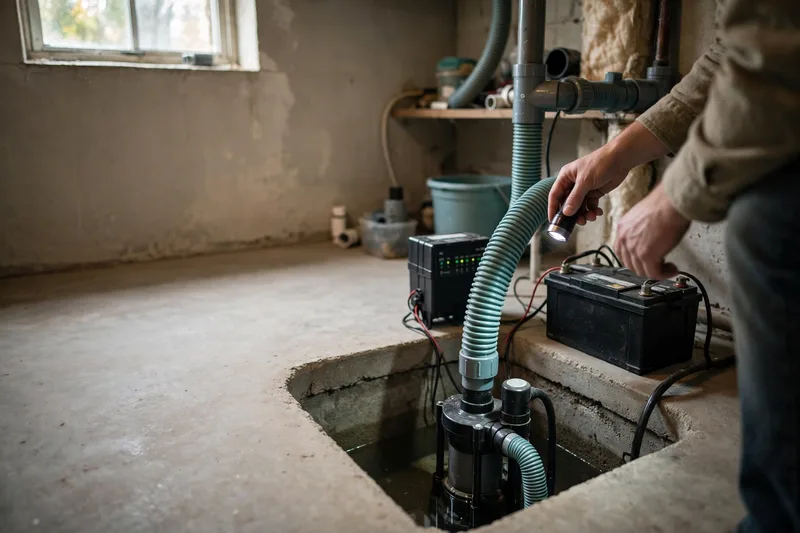
A sump pump sits in a pit in the lowest corner of the basement. Ground water and seepage collect in the pit, the float switch rises with the water, the pump starts, and the water is pushed out through a discharge line away from the house. When it works, you never think about it. When it fails, the water rises in the pit and then across the floor, and by the time you notice it the basement is wet.
The pump fails in four ways. The power goes out in a storm, and the pump stops with it. The float switch sticks, and the pump never starts. The discharge line freezes in winter, clogs with debris, or comes loose, and the pump runs but the water goes nowhere. Or the check valve fails, and the water the pump pushed out runs straight back into the pit. Each failure looks different, and each one has a different fix, so we check all four before we say the pump is the problem.
The fix for a power cut is a battery backup, and the fix for a pump that cannot keep up is a second pump. A lift station is the stronger fix: it lifts the whole house sewer above the street sewer, so a backup in the street cannot reach the basement at all. The Village's flood proofing programme pays toward a lift station, a backflow valve, an overhead sewer and new drain tile with a sump pump. The programme section below gives the terms, with the warning that the form on the Village site is dated 2011.
That is a resident's claim, and it matches what we see: a working sump pump with a battery backup is the cheapest insurance a basement has. The problem is the pump that has not been tested in three years. Test yours every few months by pouring a bucket of water into the pit and watching it run. If it does not run, call us before the next storm, not after it.
Three kinds of water, three kinds of cleanup
Water has three categories, and the category decides how we clean it. Category one is clean water, from a supply line or rainwater. Category two is gray water, from a dishwasher, a washing machine or a sump pump overflow. It looks clean but it carries some contaminants. Category three is black water, from a sewer backup or river water, or any water that has sat long enough for microbes to grow in it. Black water is treated as contaminated from the start.
The category can change while the water sits. Clean water left for two days becomes gray water, and gray water left longer becomes black water. That is one more reason the first day matters. We test the water, we tell you the category, and we clean to that category, not to a guess. A job cleaned as category one when the water was category three is a job that grows mold.
The category also decides what gets thrown out. Clean water caught fast can often be dried in place. Gray water means the carpet pad usually has to go. Black water means the carpet pad, the wet insulation and the bottom of the drywall usually have to go. We show you each item before we remove it, and we photograph it first, because your insurer needs the photos and you need the list.
Flooded basement in Elmwood Park? Why it floods here
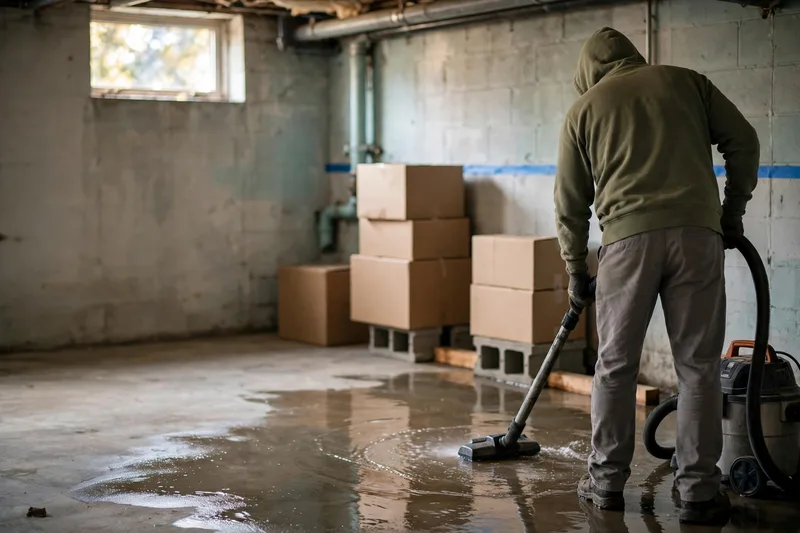
A flooded basement in Elmwood Park usually starts at the floor drain or the lowest point of the basement floor. The water comes up through the drain, or it seeps in at the joint where the wall meets the floor, or it comes through a window well. In a combined sewer backup the water is dark and it smells. In a sump failure the water is clear and it rises slowly. In a burst pipe the water is clean and it comes fast. Tell us what the water looks like and where it came in, and we will know which of the three it is before we arrive.
The question residents ask first is why it floods here and not in the next suburb. The short answer is that it floods in the next suburb too. Oak Park, River Forest, Forest Park and the other villages around Elmwood Park run on the same old combined sewers and sit on the same low ground near the Des Plaines River. Elmwood Park gets asked about more because its residents talk about it openly. The long answer is the sewer section above: combined pipes, hard rain, pressure, backflow.
The July 2011 floods and the April 2013 floods are the anchors of the village record. Heavy rain in July 2011 flooded streets and basements across the village. On April 18 and 19, 2013, flood water covered streets and sewers overflowed, and residents filmed the water on their phones. The flood table near the bottom of this page gives the full record, and the programme section below gives what the Village did next.
When your basement floods, lift what you can save first. Boxes go up on blocks or onto tables. Papers and electronics go to higher ground. Then photograph the water line on the walls and the wet floor before you move anything else. Then call us. The lifting and the photos take ten minutes, and they are worth more than any other ten minutes in the whole job.
Water removal in Elmwood Park: fast, complete and documented
Water removal is the first physical job. We extract the standing water with a truck-mounted extractor or a submersible pump, then we vacuum what is left with a wet vacuum. The goal is to get the water out in hours, not days, because every hour the water sits is an hour the walls and floors soak it up.
We photograph the water before we touch it, we measure how deep it is, and we write down where it came from. Those notes go into the drying log, and the drying log goes to your insurer. A fast extraction with no record is only half a job. Your adjuster will ask how deep the water was, where it came in, and when it started. The log answers all three.
The extraction does not end when the floor looks dry. Water hides under the baseboards, behind the drywall and under the flooring. We check those places with a moisture meter before we say the water is out. If the meter says the wall cavity is wet, we open it and dry it from the inside. A floor that looks dry and a wall that is wet inside is the most common way a small loss becomes a mold job.
Flood cleanup in Elmwood Park: what we clean, and what we throw out
Flood cleanup is the second job, and it is the one where the decisions get hard. Anything porous that touched sewage water usually has to go: carpet pad, wet insulation, cardboard boxes and the bottom of drywall. Hard surfaces get washed and disinfected. Furniture gets moved, cleaned and dried where it can be saved.
We do not throw anything away without showing you first, and we do not throw anything away before we photograph it. Your insurer needs the photos, and you need the list. If an item can be saved, we save it. If it cannot, we tell you why, in plain words, and we write it down. The list goes into the claim file, and the claim file is what your adjuster works from.
Cleaning after a flood is not the same as cleaning a house. Floodwater carries dirt, bacteria and whatever the sewer carried with it. We wash hard surfaces with a disinfectant, we clean the equipment after every job, and we wear gloves and boots for the whole job. Do not clean sewage water with a household vacuum and then use that vacuum in the rest of the house. Do not wash flood-soaked clothes with the family laundry. Bag them, photograph them, and ask us what to do with them.
Drying by readings: how we know the house is dry
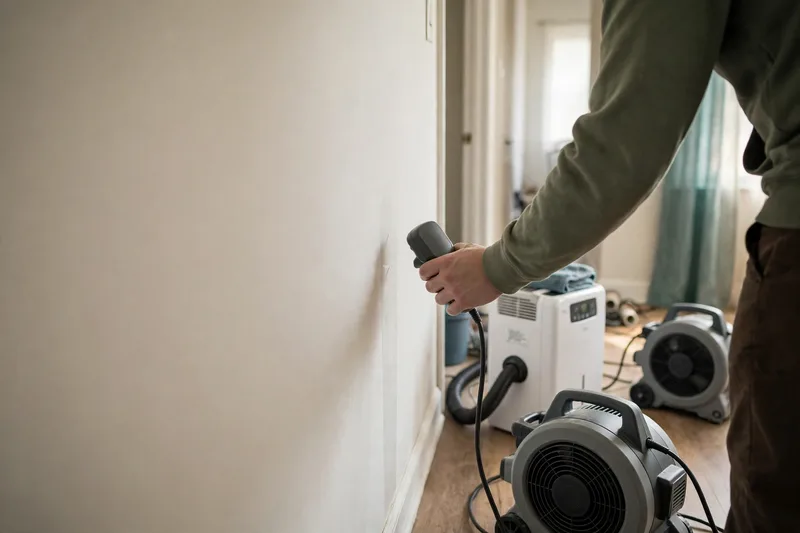
Water damage restoration elmwood park drying work is proven by readings, not by a calendar. We set air movers and a dehumidifier, then we take moisture readings every day with a meter pressed to the wall, the floor and the studs. The readings go into the drying log. We stop the drying only when the readings are back to dry, and we show you the numbers.
As a general guide, most homes dry in three to five days once the water is out and the equipment is running. A deep soak into hardwood, plaster or a finished basement can take a week or more. That is a general guide, not a promise. The meter decides, not the clock. A wall that reads wet on day five stays on the equipment until it reads dry, even if the calendar says the job should be done.
Do not switch the equipment off early. The walls look dry long before they are dry inside, and the moisture left inside is what grows mold. If the noise bothers you at night, call us and we will talk about it. Do not solve it by unplugging the dehumidifier. And do not open the windows while the dehumidifier is running, because the damp air from outside will undo the work the machine is doing.
We dry the walls without tearing them all out where we can. We drill small holes near the base of the wall and push dry air into the wall cavity, or we pull the baseboard and dry from the bottom up. We cut drywall only when the meter says the wall will not dry on its own, or when the water was sewage. Every cut is marked, photographed and written into the drying log.
Water mitigation in Elmwood Park: stop the damage from spreading
Water mitigation is the work that stops the damage from getting worse while the drying runs. We move furniture off wet floors, we lift curtains, we pull the baseboards so air can reach the wall cavity, and we set containment where the water was dirty. Mitigation is not the repair. It is the work that keeps a small loss small.
The most common mitigation mistake is waiting. A homeowner waits a day to see if the basement dries on its own, and by then the drywall has wicked water a foot up the wall and the carpet pad is soaked through. Call in the first hour and the mitigation is a vacuum and a fan. Call on the third day and it is a demolition. The difference between those two calls is the difference between a drying job and a rebuild.
Mitigation also means protecting what the water has not touched yet. We move dry boxes out of the basement before the damp air reaches them. We cover the furnace and the water heater if the water is rising toward them. We shut off the power to wet rooms before anyone walks through them. None of this is dramatic work. It is careful work, and it is what keeps the bill from growing while the drying runs.
Water damage repair in Elmwood Park: what gets fixed
Water damage repair starts only when the drying is done and the readings say dry. We replace the drywall we cut, we refit the baseboards, we repair the flooring, and we repaint what the water marked. The repair is scoped from the drying log, so nothing the water touched is missed and nothing that stayed dry is torn out.
Some things cannot be repaired. Particle board that swelled, carpet pad that soaked up sewage water, insulation that stayed wet: these get replaced, not dried. We tell you which is which before the work starts, and we write it into the scope so your insurer can see it. A repair scoped from a guess will miss something. A repair scoped from the drying log will not.
The repair also includes the thing that caused the loss, where it is ours to fix. A burst pipe gets repaired. A failed appliance hose gets replaced. A sump pump that failed gets repaired or replaced, and a battery backup gets fitted if you want one. The sewer and the street are the Village's work, not ours, and we will tell you that plainly if the cause sits on the Village side of the line.
Burst pipe in Elmwood Park: what to do in the first hour
A burst pipe in Elmwood Park is the fastest water loss a home can have. A supply line at full pressure can fill a basement in an hour. The first move is always the same: shut off the main water valve, then turn off the power to any room with standing water. Then call us at (773) 570-9869. Do not wait for the water to stop on its own, because it will not.
There is no published Elmwood Park burst pipe case with a street address and a date that we could verify, so this page names none. Burst pipes happen in Elmwood Park the same way they happen everywhere: a pipe freezes in a cold snap, or a fitting fails, or a pipe in an unheated wall gives way in January. The fix is the same in every case: stop the water, extract it, dry the structure, and repair the pipe and the damage.
In a hard freeze, leave the taps on a slow drip and keep the heat on, even in rooms you do not use. Open the cabinet doors under the sinks on outside walls so warm air can reach the pipes. If you leave the house empty in winter, shut off the main and drain the pipes, or have someone check the house. A frozen pipe that bursts while you are away can run for days, and by the time you come home the basement is full.
Can you call the fire department for a burst pipe? Yes, if the water is a safety risk, for example if it is near the electrical panel or if the ceiling is sagging with water. Fire crews can shut off the water and help make the house safe. They do not dry the house or repair the pipe. Call us as well, because the drying and repair still have to be done, and the first hours matter most.
Sewage cleanup in Elmwood Park: the combined sewer problem
Sewage cleanup in Elmwood Park starts with the combined sewer. When a hard rain fills the pipes, sewage mixed with storm water can push back through house sewers into basements that have no backflow prevention. The water is dark, it smells, and it is contaminated. Do not touch it with bare hands, and do not try to clean it with a household vacuum.
We extract sewage water with sealed equipment, we wash the hard surfaces with a disinfectant, and we remove the porous materials it touched. Carpet pad, wet insulation and the bottom of drywall usually have to go. We dry the space with the same readings we use on every job, and we photograph everything for the claim. The drying log for a sewage job is the same as for any other job, and your adjuster gets the same file.
Call the Village of Elmwood Park Public Works at 708-452-3945 as well, so the Village knows the sewer backed up on your street. The Village tracks where the sewers surcharge, and your call is part of that record. If the backup happens again, the record is what the Village looks at first. Then call your insurer and start the claim, and keep the photos of the water before you move anything.
Emergency water damage in Elmwood Park: your first hour
Emergency water damage in Elmwood Park follows one call order. First, call us at (773) 570-9869. We answer 24/7 and we talk you through the first hour while a crew is on the way. Second, if the water came from the street or a sewer, call the Village of Elmwood Park Public Works at 708-452-3945. Third, call your insurer and start the claim. Do not enter a flooded basement while the power is on, and do not touch floodwater with bare hands.
The first hour is when the loss is decided. Water that is extracted in the first hours leaves walls that can be dried. Water that sits for a day leaves walls that have to be cut. The call costs nothing. The wait costs the basement. If you are reading this page with water on the floor right now, stop reading and call (773) 570-9869. The rest of the page will still be here when the crew leaves.
An emergency call is not a sales call. We ask where the water is, how deep it is, and what it looks like. We tell you what to do in the next ten minutes. We give you an arrival window. We do not ask you to sign anything over the phone, and we do not quote a price before we see the loss. The assessment is free, and the first hour of advice is free with it.
What water damage restoration costs in Elmwood Park: the factors
The cost depends on five factors, and no two losses have the same five. How much water there is. What kind of water it is. How far it spread. How long it sat. And how much of the house is finished. A small clean-water leak in one unfinished room is the cheapest loss there is. A sewer backup across a finished basement is the most expensive.
We never quote a price before we see the loss, and we never print prices on this site. After the first visit you get a written scope of the work and a drying plan. We work with your insurer on the claim, and we give you the photos, the readings and the log your adjuster asks for. If a company quotes you a price over the phone before it has seen the water, be careful. That company is guessing, and the guess will change when it arrives.
The drying is the part of the bill that surprises people most, because it runs for days and the equipment is loud. It is also the part that cannot be skipped. A house dried to readings is a house that will not grow mold. A house dried by guesswork is a house that will. The readings are the proof, and we show them to you every day the equipment runs.
Insurance after water damage in Elmwood Park: what usually pays
Water damage restoration elmwood park insurance claims succeed when the loss is documented from the first hour. Photograph everything before you move it. Keep a list of what was damaged. Save every receipt. Keep a short log of who you called and when. We photograph the loss, we write a drying log with moisture readings, and we give you a copy you can hand to your adjuster.
Most policies cover sudden and accidental water damage, such as a burst pipe or a failed appliance hose. Most do not cover flooding from outside the house, such as river water or street flooding, unless you hold separate flood insurance. Sewer backup is often a separate add-on with its own limit. Waterproofing and flood proofing are usually seen as maintenance, and most policies do not pay for them. Read your policy, call your insurer early, and ask what your cover actually says.
For flood insurance, the federal programme is the National Flood Insurance Program. You can call 1-877-336-2627 for flood insurance questions, and 1-800-621-FEMA for general flood help. The State of Illinois flood contact is the Department of Natural Resources at 217-782-6302. If your basement flooded from the street or the river, ask your insurer whether you hold flood cover before you assume the claim will pay.
Three things make a claim go smoothly. Call the insurer in the first hour, not the first week. Photograph everything before you move it. And keep the drying log. The log is the proof that the drying was done properly, and it is the document adjusters ask for first. We give it to you without being asked, and we keep a copy ourselves.
How long does water damage restoration take in Elmwood Park?
A small clean-water loss in one room can be extracted and dried in three to five days. A finished basement with a sewer backup can take a week or more to dry, and the repair after the drying can take another week or two. The drying is the part that cannot be rushed. The repair starts only when the readings say dry, and a repair started on wet walls will fail.
The claim runs on its own clock. Your insurer will want the photos, the drying log and the scope of work. We give you all three. The faster the documentation is complete, the faster the claim moves. Call your insurer in the first hour, not the first week, and keep a short log of who you called and when.
The prevention work runs after the repair, and it is the part that pays for itself. An overhead sewer, a backflow valve, a lift station or a battery backup for the sump pump: each one is a one-time job that protects the basement in every storm after it. The Village's flood proofing programme may help pay for the bigger fixes, and the programme section below gives the terms.
Mold remediation in Elmwood Park: the 24 to 48 hour rule
Mold remediation in Elmwood Park starts with a clock. As a general guide, mold can start to grow within 24 to 48 hours on a wet surface. That is why the first day matters more than any other. If the water sat for more than two days, or if the room smells musty, we look for mold during the drying and tell you what we find.
If you see mold, do not scrub it dry and do not bleach it and call it done. Bleach does not reach mold inside drywall, and dry scrubbing spreads spores through the house. Ask us what the next step is. If the mold covers a large area, or if anyone in the house has asthma or allergies, get a mold inspection before the repair starts.
In Illinois, mold remediators register with the Illinois Department of Public Health under Part 835, and you can ask any company for its registration before you hire it. We do not claim a registration for ourselves. Ask us and we will tell you plainly. The registration is there so you can check, and you should use it. If a company says it is registered and cannot show you the registration, do not hire it for mold work.
The mold clock is also the reason we dry to readings and not to a calendar. A wall that reads dry has no moisture left for mold to grow on. A wall that looks dry and reads wet is a wall that will grow mold behind the paint. The readings are the only proof that matters, and we show them to you every day the equipment runs.
Flood damage in Elmwood Park: the record
Flood damage in Elmwood Park has a short public record, and this table is the whole of it. There is no named homeowner case in the record, because no Elmwood Park homeowner has published a flood case with a street address and a date that we could verify. What follows is the village record: storms, a project, and what the Village did next.
| When | What happened | Source |
|---|---|---|
| July 2011 | Heavy rain flooded streets and basements across Elmwood Park. | Chicago Tribune, February 28, 2017 |
| April 18 and 19, 2013 | Flood water covered streets and sewers overflowed. Residents filmed the water on their phones. | YouTube, Elmwood Park Flood 4-18-2013 and Flooding in Elmwood Park IL-Cemetery 4-19-13 |
| December 2015 | The Village finished its flood mitigation project: forty thousand linear feet of new pipe, storm water routed through the Oak Park Country Club to a fourteen acre reservoir, then pumped to the Des Plaines River. | Chicago Tribune, February 28, 2017 |
| February 28, 2017 | The mitigation project was named the 2017 Public Works Project of the Year. The project removed flood plain status for sixty to seventy homeowners. | Chicago Tribune, February 28, 2017 |
The project helped, but it did not end basement flooding in the worst storms. Residents still report flooded basements, and the Village still publishes its flood proofing programme. That is the honest state of it: better than 2011, not fixed. The prevention section below is what to do about it, and the programme section is what the Village pays toward.
Found it late? What to do when the water sat for days
Water damage restoration elmwood park homeowners call for most often is the repair after water that sat for days. A leak behind a wall, a slow sump failure while you were away, a basement you do not visit in winter: the water sat, the walls soaked it up, and now there is a smell. Do not panic. Call us and tell us how long it has been wet.
Water that sat for more than two days is treated as a different job. The category rises, the drywall usually has to be cut, and we look for mold before the repair starts. The drying takes longer, because the water is deep in the structure, not on the surface. The documentation matters more, because your insurer will ask when the loss started and what you did about it. Tell them the truth, and show them the photos.
The one thing not to do is cover it up. Do not paint over a water stain and call it fixed. Do not lay new flooring over a wet subfloor. The moisture stays, the mold grows, and the next buyer or the next adjuster finds it. Dry it first, to readings, then repair it. The drying log is the proof that it was dried, and the proof is what the next buyer and the next adjuster both want to see. That is what water damage restoration elmwood park means in practice: dry it to readings first, then repair it, and keep the log as proof.
Elmwood Park, IL 60707: who to call, and when
Water damage restoration elmwood park homeowners need starts with the right phone call. This table is every number the Village of Elmwood Park publishes for flooding, water and sewers, from the Village's own site. Nothing here is guessed.
| Who | Number | When to call |
|---|---|---|
| Village of Elmwood Park Public Works | 708-452-3945 | Sewer backup, street flooding, storm water |
| Village Hall | 708-452-7300 | General Village questions, 9am to 5pm |
| Elmwood Park Police, non-emergency | 708-453-2137 | Police matter that is not an emergency, 24 hours |
| Water Billing | (708) 452-3908 | Water bill questions |
| Emergency | 911 | Any emergency |
The Village publishes no after-hours Public Works number, so after hours call us first at (773) 570-9869 and we will tell you what to do. Village Hall is open 9am to 5pm. The police non-emergency number is staffed 24 hours. The Village Hall address is 11 Conti Parkway, Elmwood Park, IL 60707.
The Village flood proofing programme: what it pays toward
The Village of Elmwood Park publishes a Flood Proofing Assistance Program. It reimburses fifty percent of the cost, up to one thousand five hundred dollars per option, for four options. One, an overhead sewer, which the Village calls the greatest protection available under all weather conditions and storm events. Two, a backflow prevention valve with a bypass pump. Three, a lift station. Four, new drain tile with a sump pump.
You need at least two contractor quotes, and no work can start until the Village approves it. Applications are first come, first served, and the programme is limited to the money set aside for it. The applicant must be the property owner. The form on the Village site is dated 2011, so confirm the current terms with the Village before you plan around it. We print the programme as the Village publishes it, not as a promise that it is open today.
The Village also lists a rain barrel programme run by the Metropolitan Water Reclamation District. A rain barrel catches roof water and keeps it out of the sewer. It is a small help, not a flood fix, and it is not a rebate. The Village's flood proofing programme is the one that pays toward the real fixes: the overhead sewer, the backflow valve, the lift station and the drain tile.
Basement flooding in Elmwood Park: stop the next one
Basement flooding in Elmwood Park is a problem you can reduce, even if you cannot end it. Start with the entry point. If the water came back through the sewer, an overhead sewer or a backflow prevention valve with a bypass pump is the strongest fix. If the sump pump failed, a battery backup and a second pump cover the power cut. If the water came through the walls, grade the soil away from the house and keep the gutters clean.
Test the sump pump every few months by pouring a bucket of water into the pit and watching it run. Check the discharge line where it leaves the house. Keep the floor drain clear. If your basement has flooded twice, ask us for a prevention visit. We check the entry points, the pump, the discharge and the grading, and we write down what we find, in order of what matters most.
The Metropolitan Water Reclamation District publishes a flood response guide that the Village hosts on its own site. It says three things every Elmwood Park homeowner should know. Do not enter a flooded basement if the power is on. Assume all floodwater is contaminated, especially water from a sewer backup. And mold can begin to grow within 24 to 48 hours. Those three lines are the whole first hour, in short.
How to choose a water damage company in Elmwood Park
Choose a company the way you would choose any contractor: on what it shows you, not what it promises. Ask how it dries, and ask to see the readings. Ask what it removes and why. Ask how it documents the loss for your insurer. Ask for its Illinois Department of Public Health mold registration if the job involves mold. A company that cannot show you a reading, a photo or a log is guessing.
Do not hire on price alone, and do not hire the company that quotes a price over the phone before it has seen the water. Do not hire a company that asks you to sign before the drying plan is written down. And do not hire on reviews alone. Reviews tell you how a company treats its customers. They do not tell you whether it dries to readings. Ask for the readings.
We do not compare ourselves to other companies on this page, and we do not name them. The companies that work in Elmwood Park are real firms with real crews, and the search results will show you who they are. Judge them the way this section says to judge us: on the readings, the photos and the log.
We also serve the suburbs around Elmwood Park
We serve Elmwood Park, IL 60707 and the suburbs around it, including Park Ridge, Des Plaines, Oak Park, River Forest, Forest Park and River Grove, from the same number, (773) 570-9869. We answer 24/7. If your basement is wet and you are in Elmwood Park, call us first and we will talk you through the first hour while a crew is on the way.
What Elmwood Park homeowners ask
How to price water damage restoration?
No honest company prices water damage restoration by the room or by the square foot. The price depends on how much water there is, what kind of water it is, how far it spread and how long it sat. A company that quotes a price over the phone before it has seen the water is guessing. We scope the work after the first visit, in writing, and we work with your insurer on the claim.
Will insurance pay for basement waterproofing?
Usually not. Waterproofing and flood proofing are seen as maintenance, and most policies do not pay for them. What insurance usually pays for is the damage from a sudden event. The Village's flood proofing programme is the route that helps with the cost of prevention, not your insurer.
Why is my basement floor wet but no leak?
The water is coming from below or from the wall, not from a pipe. In a combined sewer backup the water comes up through the floor drain. In a high water table the water seeps in at the joint where the wall meets the floor. In a heavy rain the water comes through a window well or a crack in the wall. Find the entry point first, because the fix depends on where the water came in.
Can you call the fire department for a burst pipe?
Yes, if the water is a safety risk, for example if it is near the electrical panel or if the ceiling is sagging with water. Fire crews can shut off the water and help make the house safe. They do not dry the house or repair the pipe. Call us as well, because the drying and repair still have to be done.
Can I write off mold remediation on my taxes?
We do not give tax advice, and this page does not either. Whether mold remediation is deductible depends on your situation, your income and the tax year. Ask a tax professional before you spend on the strength of a deduction. We can give you the receipts and the scope of work your tax professional asks for.
What are signs you are sick from black mold?
We are not doctors and this page is not medical advice. People report coughing, sneezing, a runny nose, itchy eyes and a sore throat around mold, and people with asthma or allergies often feel it first. If you feel ill in a house with mold, see a doctor and tell them about the mold. Then call us and we will deal with the house.
How long does it take for a floor to rot from water damage?
It depends on the wood, the water and the air. A hardwood floor that stays wet for days will cup and warp. A subfloor that stays wet for weeks will soften and rot. The honest answer is that rot starts when the wood stays wet long enough for fungi to grow, and that can be days in a warm, damp basement. Dry it fast and the floor survives. Leave it wet and it does not.
Can you live in a house with water damage?
In most clean-water jobs, yes. In a sewer backup, or where mold is growing, or where the power is off, we will tell you to stay out until the space is safe. If anyone in the house has asthma, allergies or a weak immune system, talk to your doctor first. The drying equipment is loud, but the house is safe to live in while it runs.
What are the four classes of water damage?
Water damage is classed by how much water there is and how far it spread. Class one is a small area with little absorption. Class two is a whole room with carpet and walls wet. Class three is water from above, soaking ceilings and walls. Class four is deep water in hardwood, plaster and concrete, the materials that hold water longest. The class decides how much equipment the drying needs, not whether the house can be saved.
What does water damage restoration include?
Five jobs in a row. The emergency call and first-hour advice. Water extraction. Removal of what cannot be saved. Structural drying to readings. And documentation for insurance, plus prevention advice. A company that skips the readings or the documentation has not finished the job.
How long does it take for mold to grow after water damage?
As a general guide, mold can start to grow within 24 to 48 hours on a wet surface. That is why the first day matters more than any other. If the water sat for more than two days, or if the room smells musty, we look for mold during the drying and tell you what we find.
Does homeowners insurance cover water damage in Elmwood Park?
It usually covers sudden and accidental water damage, such as a burst pipe or a failed appliance hose. It usually does not cover flooding from outside the house unless you hold separate flood insurance. Sewer backup is often a separate add-on with its own limit. Read your policy and call your insurer early.
How do I stop my basement from flooding again?
Start with the entry point. An overhead sewer or a backflow valve for sewer backups. A battery backup and a second pump for sump failures. Clean gutters and soil graded away from the walls for seepage. Test the sump pump every few months. The Village's flood proofing programme may help pay for the bigger fixes, and we check all of it on a prevention visit.
Elmwood Park water damage: questions and answers
Why does my basement keep flooding in Elmwood Park?
Most Elmwood Park basements flood because the village runs on combined sewers. One set of pipes carries both sewage and storm water, and in a hard rain the pipes fill up and push water back through house sewers into basements that have no backflow prevention. The Village's own flood proofing guide says exactly that. A sump pump that fails in a power cut, a floor drain tied to the sewer, and low ground around the house make it worse. The fix depends on which of these let the water in, so we find the entry point first and then dry the basement.
Who do I call first when my basement floods in Elmwood Park?
Call us first at (773) 570-9869. We answer 24/7 and talk you through the first hour while a crew is on the way. If the water came from the street or a sewer backup, call the Village of Elmwood Park Public Works at 708-452-3945 as well, so the Village knows the sewer is surcharging. Then call your insurer and start the claim. Do not enter a flooded basement while the power is on.
How fast can you get to Elmwood Park?
We answer 24/7 and send the nearest crew as soon as you call. Elmwood Park sits just west of Chicago, so most calls reach us in under an hour in normal traffic. The exact time depends on the hour, the weather and how many crews are already out. When you call we give you a straight arrival window and we keep you posted if it moves.
What does water damage restoration cost in Elmwood Park?
It depends on how much water there is, what kind of water it is, how far it spread and how long it sat. A small clean-water leak in one room costs far less to fix than a sewer backup across a finished basement. We never quote a price before we see the loss, and we never print prices on this site. After the first visit you get a written scope of the work and a drying plan, and we work with your insurer on the claim.
Does homeowners insurance cover water damage in Elmwood Park?
It usually covers sudden and accidental water damage, such as a burst pipe or a failed appliance hose. It usually does not cover flooding from outside the house, such as river water or street flooding, unless you hold separate flood insurance. Sewer backup is often a separate add-on with its own limit. Read your policy, call your insurer early, and keep every photo and receipt. We document the loss the way adjusters ask for it.
How long does it take to dry a house after water damage?
As a general guide, most homes dry in three to five days once the water is out and the equipment is running. A deep soak into hardwood, plaster or a finished basement can take a week or more. We do not guess. We take moisture readings every day and we stop the drying only when the readings are back to dry. You see the numbers, so you know when the job is done.
Can I stay in my house while the drying runs?
In most clean-water jobs, yes. The air movers and dehumidifiers are loud, but the house is safe to live in while they run. If the water was sewage, or if mold is growing, or if the power is off, we will tell you to stay out until the space is safe. If you have asthma, allergies or a weak immune system, talk to your doctor first and tell us what they said.
Do I need to throw out wet carpet and drywall?
It depends on the water and how long it sat. Clean water caught fast can often be dried in place. Sewage water means the carpet pad and any drywall it touched usually have to go. Drywall that stayed wet for more than a day or two often has to be cut out above the water line. We test with a moisture meter before we cut anything, and we show you the readings so you can see why.
How do you dry the walls without tearing them all out?
We drill small holes near the base of the wall and push dry air into the wall cavity, or we pull the baseboard and dry from the bottom up. A moisture meter tells us where the water is and when the wall is dry. We cut drywall only when the meter says the wall will not dry on its own, or when the water was sewage. Every cut is marked, photographed and written into the drying log.
What if the water came from the sewer?
Treat it as contaminated and do not touch it with bare hands. Sewer water carries bacteria, and anything porous it touched usually has to be thrown out. We extract it with sealed equipment, wash the hard surfaces with a disinfectant, and dry the space with the same readings we use on every job. Call the Village of Elmwood Park Public Works at 708-452-3945 as well, so the Village knows the sewer backed up on your street.
How do I know if my sump pump failed?
Look in the sump pit. If the water is high and the pump is silent, the pump has failed, the float switch is stuck, or the power is out. If the pump runs but the water does not drop, the discharge line may be frozen, clogged or disconnected. If the pump runs constantly in dry weather, the check valve may be bad. Test the pump every few months by pouring a bucket of water into the pit and watching it run.
What should I do if a pipe bursts in Elmwood Park?
Shut off the main water valve first, then turn off the power to any room with standing water. Call us at (773) 570-9869. Move what you can save to dry ground and photograph everything before you move it. Do not wait for the water to stop on its own, because a burst pipe can fill a basement in an hour. In a hard freeze, leave the taps on a slow drip and keep the heat on, even in rooms you do not use.
Can you call the fire department for a burst pipe?
Yes, you can call the fire department for a burst pipe if the water is a safety risk, for example if it is near the electrical panel or if the ceiling is sagging with water. Fire crews can shut off the water and help make the house safe, but they do not dry the house or repair the pipe. Call us as well, because the drying and repair still have to be done, and the first hours matter most.
How soon can mold start after water damage?
As a general guide, mold can start to grow within 24 to 48 hours on a wet surface. That is why the first day matters more than any other. If the water sat for more than two days, or if the room smells musty, we look for mold during the drying and tell you what we find. If you see mold, do not scrub it dry and do not bleach it and call it done. Ask us what the next step is.
Do I need a mold inspection after water damage?
If the water sat for more than 48 hours, or if you can see or smell mold, yes. A mold inspection finds growth you cannot see, such as mold behind drywall or under flooring. In Illinois, mold remediators register with the Illinois Department of Public Health under Part 835, and you can ask any company for its registration before you hire it. We do not claim a registration for ourselves. Ask us and we will tell you plainly.
What is the Village of Elmwood Park Flood Proofing Assistance Program?
It is the Village's published programme to help homeowners pay for flood proofing. It reimburses fifty percent of the cost, up to one thousand five hundred dollars per option, for four options: an overhead sewer, a backflow prevention valve with a bypass pump, a lift station, or new drain tile with a sump pump. You need at least two contractor quotes, and no work can start until the Village approves it. The form on the Village site is dated 2011, so confirm the current terms with the Village before you plan around it.
Who do I call at the Village of Elmwood Park for sewer flooding?
Call Public Works at 708-452-3945. That is the number the Village publishes for sewer and street flooding. For general Village questions, call Village Hall at 708-452-7300. For water billing, call (708) 452-3908. For a police matter that is not an emergency, call 708-453-2137. For any emergency, call 911. The Village publishes no after-hours Public Works number, so after hours call us first and we will tell you what to do.
What is a combined sewer, and why does it matter in Elmwood Park?
A combined sewer carries sewage and storm water in the same pipes. Elmwood Park runs on combined sewers across the village. In a hard rain the pipes fill with rainwater, the pressure rises, and sewage mixed with storm water can push back through house sewers into basements that have no backflow prevention. That is the Village's own explanation, from its flood proofing guide. An overhead sewer or a backflow valve is the fix the Village's programme pays toward.
Has Elmwood Park flooded before?
Yes. Heavy rain in July 2011 flooded streets and basements across the village. On April 18 and 19, 2013, flood water covered streets and sewers overflowed, and residents filmed the water on their phones. After those floods the Village built a flood mitigation project that finished in December 2015, with forty thousand linear feet of new pipe, and the project was named the 2017 Public Works Project of the Year. The project took sixty to seventy homes out of the flood plain. Basements still flood in the worst storms, which is why the Village still publishes its flood proofing programme.
What did the Village do about flooding after 2011?
The Village built a flood mitigation project that finished in December 2015. It laid forty thousand linear feet of new pipe, and it moves storm water through the Oak Park Country Club to a fourteen acre reservoir, then pumps it to the Des Plaines River. The Chicago Tribune reported in February 2017 that the project was named the 2017 Public Works Project of the Year and that it removed flood plain status for sixty to seventy homeowners. The project helped, but it did not end basement flooding in the worst storms.
How do I prevent my basement from flooding again?
Start with the entry point. If the water came back through the sewer, an overhead sewer or a backflow prevention valve with a bypass pump is the strongest fix, and the Village's flood proofing programme may help pay for it. If the sump pump failed, a battery backup and a second pump cover the power cut. Keep the gutters clean, grade the soil away from the walls, and test the sump pump every few months. We check all of this on the prevention visit and write down what we find.
Will my insurance pay for basement waterproofing?
Usually not. Waterproofing and flood proofing are seen as maintenance, and most policies do not pay for them. What insurance usually pays for is the damage from a sudden event, such as a burst pipe or a sewer backup if you hold that cover. The Village's flood proofing programme is the route that helps with the cost of prevention, not your insurer. Read your policy before you spend, and call your insurer if you are unsure.
What should I not do after a basement flood?
Do not enter a flooded basement while the power is on. Do not touch floodwater with bare hands, and assume it is contaminated, especially if it came from a sewer. Do not run a wet vacuum on sewage water and then use it in the house. Do not bleach mold and call it fixed. Do not throw anything away before you photograph it for the claim. And do not wait. The first day is when the drying works best and mold has the least time to start.
How do I document water damage for an insurance claim?
Photograph everything before you move it, including the water line on the walls, the wet floor, and each damaged item. Keep a list of what was damaged, with the brand and age if you know it. Save every receipt for the cleanup, the drying and the repairs. Keep a short log of who you called and when. We photograph the loss, write a drying log with moisture readings, and give you a copy you can hand to your adjuster.
Do you serve Elmwood Park, IL 60707?
Yes. We serve Elmwood Park, IL 60707 and the suburbs around it, including Park Ridge, Des Plaines, Oak Park, River Forest, Forest Park and River Grove, from the same number, (773) 570-9869. We answer 24/7. If you are in Elmwood Park and your basement is wet, call us first and we will talk you through the first hour while a crew is on the way.
Why do Elmwood Park basements flood when other suburbs stay dry?
It is not only Elmwood Park. The suburbs around it flood in the same storms, because the whole area runs on old combined sewers and sits low near the Des Plaines River. The Village's own guide is clear: in a hard rain the combined sewers fill up and push water back into basements. That is the problem to fix, not the suburb.
Water in the basement, a sump that failed in the night, or a stain that keeps growing: water damage restoration elmwood park starts with one call, (773) 570-9869, while the evidence is fresh.
Sources and standards referenced
- Village of Elmwood Park Public Works: the sewers, the water system, and the Flood Proofing Assistance Program. Village of Elmwood Park Public Works.
- Village of Elmwood Park Flood Proofing Assistance Program application form, revised September 13, 2011: the programme terms. Flood Proofing Assistance Program form.
- Village of Elmwood Park, How Do I: Village phone numbers. How Do I.
- Metropolitan Water Reclamation District, Flood Response Resource Guide, hosted on elmwoodpark.org: stay out of a flooded basement while the power is on, assume floodwater is contaminated, mold can begin within 24 to 48 hours.
- Chicago Tribune, February 28, 2017: the Elmwood Park flood mitigation project named the 2017 Public Works Project of the Year, forty thousand linear feet of new pipe, flood plain status removed for sixty to seventy homeowners.
- US EPA mold guidance: mold growth timelines on wet materials and cleanup safety. EPA, A Brief Guide to Mold, Moisture and Your Home.
- Illinois Department of Public Health, Mold Remediation Registration Code, 77 Ill. Adm. Code Part 835, under the Mold Remediation Registration Act, 410 ILCS 105. IDPH mold FAQs.
- Illinois Department of Insurance: consumer guidance on homeowners claims and the complaint process.
- Federal Emergency Management Agency, National Flood Insurance Program.
More Restoration Services Near Elmwood Park
Every service below is one tap away. Pick the one that matches your problem.

Water Damage Restoration
Fast water extraction, structural drying, and full repair after burst pipes, leaks, and floods.
Learn more →
Water Mitigation
Emergency water removal, structural drying, and mold prevention to stop the damage fast, 24/7.
Learn more →
Mold Remediation
Safe, contained mold remediation that removes contamination and fixes the moisture source.
Learn more →
Sewage Cleanup
Safe removal and disinfection of dangerous sewage backups and black water.
Learn more →
Flood Cleanup
Water pumped out, structure dried, and debris cleared fast after storms and flooding.
Learn more →
Hardwood Floors Water Damage
Cupped, buckled or stained hardwood after a leak? How we dry it, when sanding saves it, and when the boards have to go.
Learn more →