Trusted by Albany Park homeowners, landlords and small businesses, day and night.
Request water damage help in Albany Park
Tell us where the water is and we will call you back. We answer 24/7, and a crew is on the way while we talk.
24/7Live answer, day and night
12Restoration services, one team
6Step documented process
Every jobPhotos and readings logged
Water damage restoration in Albany Park, in short
Water damage restoration in Albany Park means one job, done in order: stop the water, remove it, dry the building to moisture readings, clean what can be cleaned, remove what cannot be saved, and repair the rooms. We do it for flooded basements, burst pipes, sump pump failures, sewer backups and storm water across Albany Park, Chicago, IL 60625, day and night. The page below gives you the whole job, step by step, with the Albany Park facts that decide it: the river, the sewers, the five floods residents remember, and the city rules that apply to your street.
Water damage restoration albany park jobs are won or lost in the first hour. Water that sits for a day soaks through drywall and under flooring, and water that sits for two days starts to grow mold. The call you make in the first hour decides whether you are drying a room or rebuilding it. Call (773) 570-9869 now and we will talk you through the first hour while a crew is on the way.
Your first hour in Albany Park: what to do now
Call us first at (773) 570-9869. Tell us where the water is, how deep it looks, and whether it smells of sewage. We answer 24/7 and talk you through the first hour while a crew is on the way.
Stop the water at the source if you can do it safely. Turn off the main water supply if a pipe burst, and shut off the appliance that failed. If the water is coming up through a floor drain, do not run water anywhere in the house.
Stay out of a flooded basement while the power is on. Water and electricity do not mix. Do not touch the water with bare hands when sewage is in it, and keep children and pets out of the wet rooms.
Lift what you can save and photograph everything. Move rugs, boxes and furniture to higher ground, and photograph the water line and every damaged item before you move it. Your adjuster needs those photos.
Call 311 if the sewer or street flooded. The city takes water-in-basement reports through 311, any time of day or night. Give the address, say whether the water is dirty or clean, say where it is coming from, and say how many inches of water there are.
Albany Park is Community Area 14, one of the 77 community areas of Chicago, and it also holds Mayfair, North Mayfair and Ravenswood Manor inside it. About 45,538 people live here, on the 2024 estimate from the Chicago Metropolitan Agency for Planning, and the 2020 Census counted 48,396.
The North Branch of the Chicago River bounds the neighbourhood on the north and the east, Montrose Avenue bounds it on the south, and the west edge is where the sources split: the community area as Albany Park proper runs west to Pulaski Road, while the wider guide published by City Colleges runs west to Cicero Avenue, which takes in Mayfair and North Mayfair. We do not print one settled western boundary, because the sources do not agree, and a page that pretends they do is a page that misleads you.
Get the place right and the rest follows. Albany Park is not a suburb, and it is not a single ZIP code. It sits in parts of two ZIP codes, 60625 and 60630, and neither one belongs to Albany Park alone. The 60625 streets cover most of the neighbourhood, and the 60630 streets cover Mayfair and North Mayfair on the west side.
The neighbourhood is a mix of courtyard buildings, two-flats and three-flats, bungalows and single-family homes in Ravenswood Manor and Mayfair, and many of those homes were built between 1910 and the 1940s, with galvanised supply pipes, cast-iron drains and old clay sewer laterals that tree roots love. Lawrence Avenue runs east to west through the middle of it, and the stretch from Kedzie Avenue to Pulaski Road is known as Seoul Drive, the Korean commercial heart of the neighbourhood.
The Brown Line runs through it too, with stops at Francisco, Kedzie and Kimball, and Kimball is the Brown Line terminus at Lawrence and Kimball, serving Albany Park. The Montrose Blue Line stop sits nearby on the Lincoln Square side, and it is not an Albany Park station, whatever a map that drops a pin on it might say.
Albany Park speaks more languages than any other neighbourhood on this site, and a flood does not wait for a translator. About forty-three in every hundred residents are Hispanic, about thirty-four are White, about fifteen are Asian, and about three and a half are Black, on the 2024 count. Six in ten residents do not speak English at home, and more than forty languages are spoken in the public schools. Lawrence Avenue carries the Korean commercial heart of the neighbourhood, and Spanish is the first language of many homes on the side streets.
We explain the job in plain words, we write the scope and the drying log in plain words, and a family member is welcome to translate on the first visit. A flooded basement is frightening enough without a language barrier on top of it, and a company that cannot explain the job in words you understand is a company you should not hire.
Water damage restoration albany park means one job, done in order: stop the water, remove it, dry the building to moisture readings, clean what can be cleaned, remove what cannot be saved, and repair the rooms. The order matters more than the tools. A crew that starts repairs before the drying log says dry is a crew that will be back in six months, cutting out the same wall again. A crew that skips the source and dries the room is a crew that will be back after the next storm. This page follows the order, and it tells you where the water in Albany Park usually comes from, so you can judge whether the crew in your basement is following it too.
What water damage restoration includes
Water damage restoration includes five parts, and they run in order on every job we do. First, inspection: we find the source and measure how far the water spread, with a moisture meter in the walls and floors. Second, extraction: standing water is removed with pumps and vacuums, and the wet material that cannot be saved comes out with it. Third, drying: air movers and dehumidifiers dry the walls, floors and framing, and the readings go into a drying log you can see. Fourth, cleaning and sanitizing: the surfaces that stay are cleaned, and sewage water is treated as a health risk from the start. Fifth, restoration and repairs: drywall, flooring and trim go back, and the rooms return to how they were.
If you are reading this page with wet feet, skip to the first-hour table below and call us first. The rest of the page will still be here when the water is out. If you are reading it before the next storm, start with the six ways water gets in, then read the section that matches your house, and then test the sump pump and televise the lateral. A page you read before the flood is worth ten pages you read during it, and the fixes on this page are the fixes that have held in Albany Park for more than a decade.
How water removal works in Albany Park: seven steps
The seven steps below are the job, in order. Print them out if you like, and ask any company you hire to walk them with you. A company that cannot explain the order is a company that does not follow it.
1
Call us first.
Call (773) 570-9869 any time, day or night. Tell us where the water is, how deep it looks, and whether it smells of sewage. We answer 24/7 and talk you through the first hour while a crew is on the way to your Albany Park home.
2
Stop the water at the source.
Turn off the main water supply if a pipe burst, and shut off the appliance that failed. If the water is coming up through a floor drain, do not run water anywhere in the house, and do not flush a toilet until the line is clear.
3
Stay out of the water while the power is on.
Water and electricity do not mix. Stay out of a flooded basement while the power is on, and call an electrician if the panel is out of reach or under water. Do not touch the water with bare hands when sewage is in it.
4
Do not touch the water with bare hands.
Wear rubber gloves and boots before you touch anything wet. Sewage water carries bacteria that can make you sick, and even clean water can hide sharp debris and live wires. Keep children and pets out of the wet rooms.
5
Lift what you can save and photograph everything.
Move rugs, boxes and furniture to higher ground before the water rises. Photograph the water line on the wall and every damaged item before you move it. Your adjuster needs those photos, and a photo taken after the cleanup is too late.
6
Call 311 if the sewer or street flooded.
Call 311 any time of day or night, because the city takes water-in-basement reports through 311. Give the address, say whether the water is dirty or clean, say where it is coming from, and say how many inches of water there are. The city can then check the sewer on your street.
7
Let the drying run until the readings say dry.
Do not switch off the air movers or the dehumidifier early. Drying takes three to five days on a clean-water loss in one room, and repairs start only when the moisture readings match a dry wall in the same house. We write every reading into a drying log you can see.
Six ways water gets into an Albany Park home
Most Albany Park basements flood through the same few openings. Learn them and you will know, on the night it happens, whether you are looking at a plumbing job, a sewer job or a storm job, and who to call first.
Sewer surcharge through the floor drain
When a big storm fills the combined sewer faster than it can drain, the water comes back up through the lowest opening in the house, and that is usually a floor drain. This is the Albany Park story. The Rosensteins in Ravenswood Manor lived it again and again before 2009, and Carina Hoyer lived it in September 2022, when about six inches of water came up through her floor drains.
Sump pump failure
A sump pump fails for four reasons: the power goes out, the discharge line freezes or blocks, the float switch sticks, or the pump is too small for the water coming in. A pump that runs constantly is close to failing, and a pump that never runs may be stuck. Test it every spring and fall.
Frozen discharge line
A sump pump can be working perfectly and still flood your basement, because the water it pumps out has nowhere to go. When the discharge line freezes at the wall, the pump runs, the water comes back, and the basement fills. The fix is a discharge line that drains clear of the house and a check valve that works.
Burst pipe
A pipe that freezes splits open, and when it thaws the water runs until someone shuts it off. Soliz Rodriguez on North Harding Avenue lived it in September 2022, when an underground pipe burst at about seven in the morning and more than a foot and a half of water backed into the basement. Shut off the main and call us.
Cracked foundation wall and tree roots
Many Albany Park homes are a century old, and their foundations crack, their clay sewer laterals crack, and tree roots find both. A root that gets into a clay lateral grows until the line blocks, and a blocked line sends water back into the house. A licensed sewer contractor can televise an old lateral before the next storm.
Roof, gutters and ice dams
Water that cannot leave the roof finds its way inside. Gutters that are full of leaves spill water down the wall, downspouts that end at the foundation soak the soil against it, and ice dams in winter push meltwater under the shingles. Keep the gutters clean twice a year and run the downspouts at least five feet from the house.
Streets and buildings in Albany Park
Lawrence Avenue is the spine of Albany Park. It runs east to west through the middle of the neighbourhood, and the stretch from Kedzie Avenue to Pulaski Road is known as Seoul Drive, the Korean commercial heart of the area, with restaurants, markets and storefronts that have served the neighbourhood for decades. A storefront on Lawrence Avenue floods differently from a house: the water comes in under the front door, it soaks the stockroom first, and the business loses a day of trade for every day the floor stays wet. We dry storefronts the same way we dry houses, but we start at the front door and work back, so the shop can open again while the back rooms are still drying.
That split, shopfronts on Lawrence and houses on the side streets, is the first thing water damage restoration albany park work has to read: a flooded shop and a flooded garden apartment two streets over are different jobs from the first minute.
Kedzie Avenue runs north to south through the east side of the neighbourhood, and it carries the Brown Line stop of the same name. Pulaski Road runs north to south on the west side, and the 17th District police station stands at 4650 North Pulaski Road. Foster Avenue runs east to west along the north edge, past the Albany Park Branch Library at 3401 West Foster Avenue and the Mayfair Branch at 4400 West Lawrence Avenue.
Montrose Avenue bounds the south edge, and the North Branch of the Chicago River bounds the north and the east, with River Park on the river at the tunnel outlet and Eugene Field Park at the tunnel intake. Roosevelt High School and Von Steuben Metropolitan High School stand in the neighbourhood, and the Metra Milwaukee District North line stops at Mayfair, just west of the river.
The buildings tell you what the water will do. A courtyard building has a shared basement, a shared drain and a shared decision, and one flooded unit can mean a dozen wet ones. A two-flat or three-flat has a landlord upstairs and a tenant downstairs, and the tenant is usually the one who finds the water first. A bungalow has a shallow basement and a floor drain that sits low, and a single-family home in Ravenswood Manor or Mayfair has the same old clay lateral as the rest of the street.
The age of the house matters more than the type: a home built between 1910 and the 1940s has galvanised supply pipes that corrode from the inside, cast-iron drains that scale and narrow, and a clay sewer lateral that tree roots can break. None of that is a reason to panic. It is a reason to televise the lateral before the next storm, and to test the sump pump every spring and fall.
Sump pumps in Albany Park
Water damage restoration albany park crews see the same failures again and again, and the sump pump is at the top of the list. The pump sits in a pit in the basement floor, it lifts the water that gathers under the house, and it sends it out through a discharge line. When it works, you never think about it. When it stops, the basement fills from the bottom up, and the first sign is often a wet carpet at the foot of the stairs.
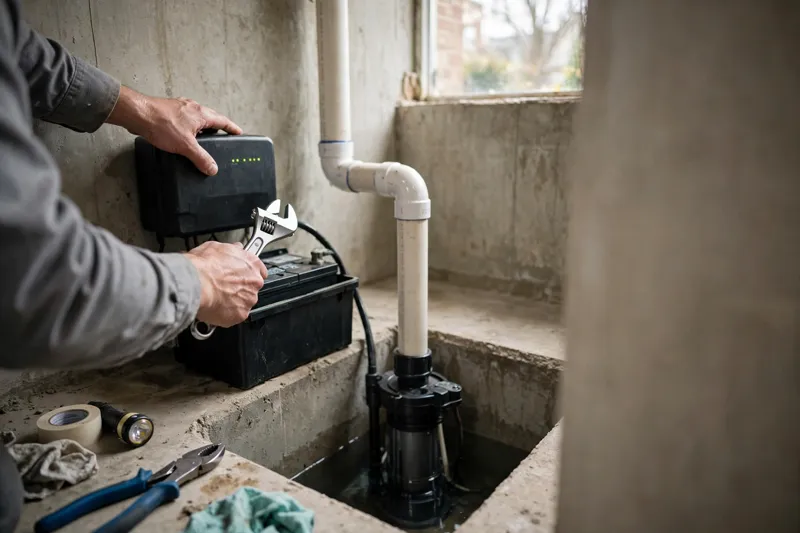
Four things kill a sump pump. The first is a power cut, and a storm that floods a basement is the same storm that takes the power out, so a battery backup is not a luxury in Albany Park, it is part of the pump. The second is a frozen or blocked discharge line, and the fix is a line that drains clear of the house with a check valve that works.
The third is a stuck float switch, and the fix is a test every spring and fall: pour a bucket of water into the pit and watch the pump start, run and stop. The fourth is a pump that is too small for the water coming in, and the fix is a pump sized to the house, not to the shelf price. A pump that runs constantly is close to failing, and a pump that never runs may be stuck. Either way, find out before the next storm, not during it.
Three kinds of water, three kinds of job
Not all water is the same water, and the kind decides the job. Clean water comes from a supply pipe or a rain leak, and it is the simplest job: extract it, dry the building, and repair what got wet. Grey water comes from a washing machine, a dishwasher or a shower drain, and it carries soap and dirt, so the cleaning step matters more. Black water is sewage, and it is a health job before it is a drying job: stay out of it, do not touch it with bare hands, do not mop it up yourself, and call us. We extract it, clean it, and dry the space, and we treat everything it touched as contaminated until it is cleaned.
The kind of water also decides what you can save. Clean water on a hardwood floor can often be dried and saved, if the drying starts in the first hours. Grey water on carpet usually means the carpet pad comes out and the carpet is cleaned or replaced. Black water means the wet material comes out, full stop: carpet, pad, drywall up to the water line, and anything porous that soaked it up. That is not us being cautious. That is the rule, and it is the rule because sewage carries bacteria that can make you sick.
Mold is the clock that runs behind every job. Mold starts to grow on wet drywall and wood in about a day to two days, and it grows fastest in a warm, damp basement with no air moving through it. That is why the drying log matters: it is the proof that the building is dry, not the guess. Drying takes three to five days on a clean-water loss in one room, and it takes longer when the water is deep, when the building is cold, or when the water sat for a day before anyone found it. After a severe flood, drying can take several days to two weeks. No honest page promises you a dry house in two days, and this one does not.
The combined sewer system under Albany Park
Chicago has a combined sewer system, and that one fact explains most of the flooding in Albany Park. One pipe carries the sewage from your house and the rainwater from your street, and in a big storm the pipe fills faster than it can drain. When it fills, the water looks for the lowest opening it can find, and that is usually a floor drain in a basement. The water that comes up is not rainwater. It is a mix of sewage and stormwater, and it is a health risk from the moment it appears.
The city built deep tunnels under the streets to hold the overflow, and the tunnels are called TARP, the Tunnel and Reservoir Plan. They hold the water until the storm passes, and then they send it to the treatment plants. The tunnels help, and the neighbourhood floods less than it did, but a tunnel cannot hold every storm, and the supercell of September 2022 filled the sewers faster than the tunnels could take the water. That is the night about two thousand five hundred basement-flood reports came in from five North Side neighbourhoods, Albany Park among them.
The city also fitted restrictor valves into the street catch basins, in a programme called Rainblocker, and the valves slow the flow of water into the sewer by eighty percent. A valve is a horizontal six-inch diameter stainless steel pipe, eleven inches long, fitted into the inlet of a catch basin, and it holds the rainwater on the street for a little longer so the sewer can take it. The city's own maintenance plan prints nearly two hundred thousand inlet restrictor valves as body text, installed at ninety to a hundred and twenty a day.
The programme began after the flood of 1997, when about thirty-five thousand residents were affected and the damage ran to about seventy-five million dollars in 1997 money, and a grant of seven point eight million dollars from the Federal Emergency Management Agency paid for the work in 1998. The valves are the largest programme of their kind in the nation, and a twenty-four hour sewer crew keeps them working.
None of that changes what you do on the night it happens. The sewers are the city's job, and the basement is yours. Call us, stay out of the water, do not run water in the house, and call 311 so the city knows the sewer backed up on your street. The fix that protects your house is not a tunnel and not a valve in the street. It is a backflow device on your own line, fitted by a licensed sewer contractor, and a sump pump that works when the power goes out.
Flooded basement in Albany Park: what the evidence says
Albany Park floods, and the record is stronger here than in any other neighbourhood we have covered. Five cases are verified, with names, dates and sources, and they are the only cases on this page. We do not invent a sixth, and we do not print a house-number address for any of them, because no source gives one. Read them in order and you will see the pattern: the river floods the neighbourhood, the sewers flood the basements, and the fixes that work are the fixes that stop the water at the entry point.
September 2008: the North Branch overflows
On the 13th and 14th of September 2008, the remnants of Hurricane Ike brought more than seven inches of rain to parts of the area, and the North Branch of the Chicago River overflowed in Albany Park. About 340 homes flooded, and 40 people were evacuated by boat. Resident Aaron Gadiel waded through knee-high water to get home, and the National Weather Service recorded the event in its Storm Data, with the Congressional Record carrying the account too. The river set a record that day, a crest of 7.86 feet at Albany Avenue, and that record stood for five years.
April 2013: the record breaks
On the 18th of April 2013, the North Branch flooded again, and this time the water came over three feet into homes and basements. The river crested at 8.57 feet at Albany Avenue, beating the 2008 record of 7.86 feet. Named residents Vilente Grutinez, Mathai Thomas and David Gordon were photographed in the flood, and the photographs sit in the National Archives, taken by the Federal Emergency Management Agency on the 29th of April 2013. The Salvation Army ran a canteen at Albany Street and Lawndale Avenue, and a shelter opened at the Mayfair Community Corps Center. The city cleaned up, the river went down, and the record went into the books.
Before 2009: the Rosensteins fix it for good
Bette and John Rosenstein live in Ravenswood Manor, and their basement flooded again and again with sewage-contaminated stormwater before 2009. They fixed it in 2009 with a double backflow device, a check on the check, plus a pump, and the basement has not flooded since. That is the strongest Albany Park-specific backflow voice we have, and it is the model for the fix: stop the water at the entry point, and it stops coming in.
A backflow device is a valve that lets water flow out of your house and stops it flowing back in, and a double one gives you a second valve if the first one fails. It is the fix that works in Albany Park, and it is the fix we recommend when the water comes up through a floor drain.
September 2022: Carina Hoyer and the floor drains
On the 11th of September 2022, a supercell storm brought about five inches of rain in a matter of hours to the North Side, and about two thousand five hundred basement-flood reports came in from Rogers Park, West Ridge, Edgewater, Albany Park and Portage Park. That count is an aggregate across five neighbourhoods, not an Albany Park count, and this page does not print it as one. What is Albany Park in that storm is Carina Hoyer, whose rowhouse basement took about six inches of water through the floor drains.
She was filmed for a Borderless Magazine video, and the mold followed the water, as it always does when the drying starts late. Her case is the Albany Park story in miniature: the storm fills the combined sewer, the sewer surcharges, and the water comes up through the lowest opening in the house.
September 2022: Soliz Rodriguez and the pipe burst
On the same day, the 11th of September 2022, Soliz Rodriguez on North Harding Avenue had an underground pipe burst at about seven in the morning, and more than a foot and a half of water backed into the basement. Electronics and photographs were lost. The burst happened during the same storm, and the article does not say whether the water was burst water, rain or sewer backup, or all three, so this page does not claim more than the source says. What it does say is that a pipe can burst on a storm day too, and that the first call is the same: shut off the main, stay out of the water while the power is on, and call us.
Those are the five cases, and they are enough. Albany Park does not need a sixth case to prove it floods, and the neighbourhood does not need a page that dresses up a rumour as a case. The record also shows what works: the Rosensteins fixed a recurring flood with a double backflow device and a pump, and it has held for more than a decade and a half. The city built a diversion tunnel that takes the river water away from the neighbourhood, and it has held too, in the storms since 2018. The fixes that work are the fixes that stop the water at the entry point, and the rest of this page tells you how to do that in your own house.
Water removal in Albany Park
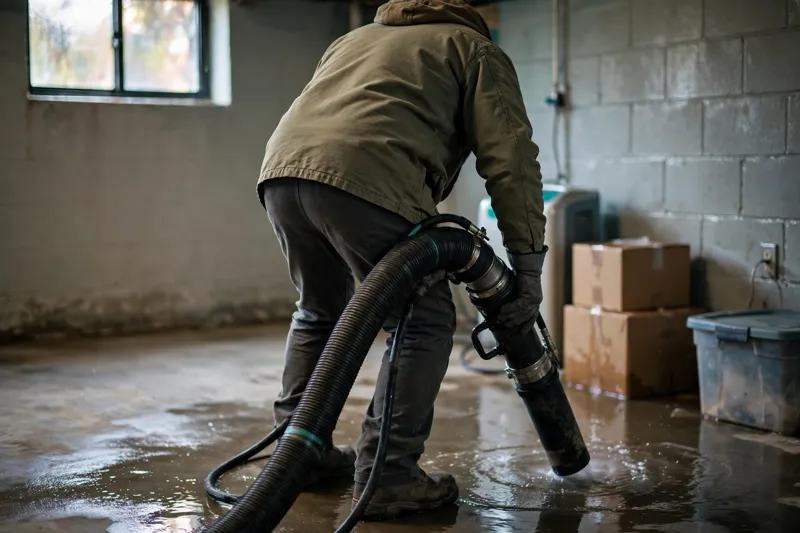
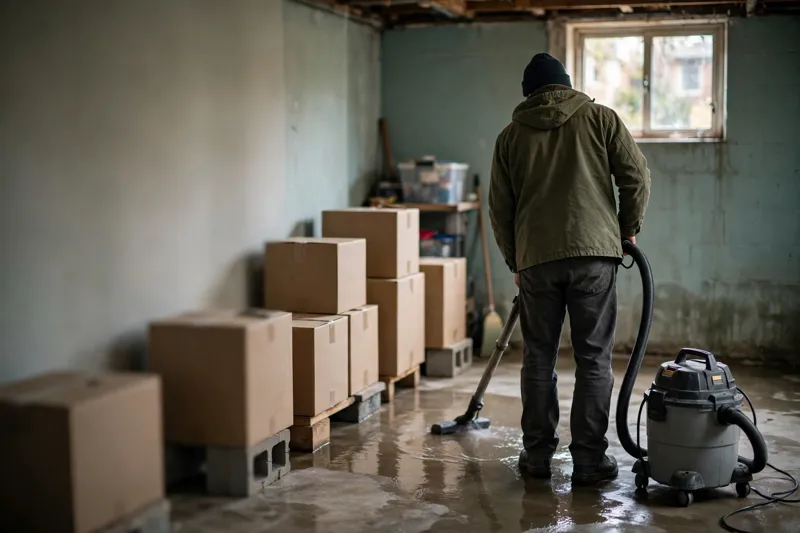
Water damage restoration albany park basement jobs start the same way every job starts: we find the water, we measure how far it spread, and we photograph everything before we move it. Then the extraction starts, with pumps for standing water and vacuums for what the pumps leave behind. We do not wait until tomorrow, because water that sits for a day soaks through drywall and under flooring, and water that sits for two days starts to grow mold.
The first visit is also the first record. We take moisture readings in the walls and floors, we photograph the water line and every damaged item, and we write the readings into a drying log. Your adjuster needs that record, and a record made after the cleanup is no record at all. We also tell you, on the first visit, whether you can stay in the house. You can usually stay upstairs while we dry a basement, but you should leave if sewage is in the water, if the power is off, or if the damage covers the rooms you sleep and cook in.
Flood cleanup in Albany Park
Flood cleanup is the step that follows extraction, and it is the step that decides whether the house stays healthy. The wet material that cannot be saved comes out: carpet and pad that soaked up sewage, drywall up to the water line, insulation that sat in water, and anything porous that cannot be cleaned. The surfaces that stay are cleaned and sanitized, and the air movers and dehumidifiers go in. We do not promise you a dry house in two days, because no honest page can.
Drying takes three to five days on a clean-water loss in one room, and it takes longer when the water is deep, when the building is cold, or when the water sat for a day before anyone found it. After a severe flood, drying can take several days to two weeks.
The tunnel matters here, and it matters in a way that pages get wrong. The Albany Park Stormwater Diversion Tunnel runs about five thousand seven hundred feet under Foster Avenue, eighteen feet wide and about a hundred to a hundred and fifty feet down, from an intake at Eugene Field Park just east of Pulaski Road to an outlet at River Park, where it empties into the North Shore Channel.
It takes river water away from the neighbourhood during a hundred-year storm, and it has relieved more than three hundred residential structures from the hundred-year floodplain. What it does not do is fix a sewer backup. The tunnel addresses river flooding only, and a page that sells it as a sewer fix is a page that misleads you. Your floor drain is a sewer problem, and the fix for it is a backflow device, not a tunnel.
Structural drying in Albany Park
Structural drying is the part of the job that takes the longest and matters the most, and it is the part that pages skip because it is slow and boring. Air movers push dry air across the wet surfaces, dehumidifiers pull the moisture out of the air, and the moisture meter tells us when the building is dry. A wall can look dry and still hold water behind the paint, so we do not call a wall dry from how it looks. A wall is dry when a moisture meter reads the same as a dry wall in the same house, and the reading holds for two days.
Do not switch off the equipment early. Every hour the air movers run is an hour the building gets drier, and every hour they sit off is an hour the mold gets a head start. Use the air conditioner to dry, not the heat: warm air holds more moisture, and a hot room dries slower than a cool one with the dehumidifier running. Keep the doors and windows closed while the equipment runs, so the dehumidifier is drying your house and not the street. And keep the drying log: it is the proof your adjuster wants, and it is the proof the next buyer will ask for too.
The diversion tunnel: what it does and what it does not do
Water damage restoration albany park crews talk about the tunnel more than any other single fact in the neighbourhood, and most of what they say about it is wrong. The Albany Park Stormwater Diversion Tunnel runs about five thousand seven hundred feet under Foster Avenue, eighteen feet wide and about a hundred to a hundred and fifty feet down. It starts at an intake in Eugene Field Park, just east of Pulaski Road, and it ends at an outlet in River Park, just south of Foster Avenue, where it empties into the North Shore Channel.
During a hundred-year storm it diverts up to about two thousand to two thousand three hundred cubic feet of water a second away from the neighbourhood, and it has relieved more than three hundred residential structures from the hundred-year floodplain.
Construction began in April 2016, the tunnel was first used on the 3rd of May 2018, and it was substantially complete in August 2018. The cost is the one fact no source agrees on: one source prints fifty-five million dollars, another prints sixty-two point eight million, and a third prints about seventy million. This page does not pick one, because the sources do not agree, and a page that prints one settled cost is a page that guesses. What is settled is that the tunnel works. The engineers who built it wrote that the neighbourhood did not flood in the storms of May and June 2018, and the tunnel has held in the storms since.
What the tunnel does not do is fix a sewer backup, and this is the point that pages get wrong. The tunnel takes river water away from the neighbourhood. It does not take sewage out of your basement, and it does not stop a floor drain from surcharging when the combined sewer fills. Your floor drain is a sewer problem, and the fix for it is a backflow device on your own line, not a tunnel under Foster Avenue. The Rosensteins proved it in Ravenswood Manor: a double backflow device and a pump, fitted in 2009, and the basement has not flooded since. That is the fix that works in Albany Park, and it is the fix we recommend when the water comes up through a floor drain.
Read the tunnel as river insurance, not as sewer insurance. It protects the neighbourhood from the North Branch, and it has done that job well since 2018. It does not protect your basement from the sewer, and no page should tell you that it does. If a company tells you the tunnel means your basement will never flood again, ask them to show you the backflow device they fitted, and ask them to show you the sump pump they tested. Those are the two things that protect a basement in Albany Park, and the tunnel is not one of them.
Water damage mitigation in Albany Park
Water damage restoration albany park mitigation is the emergency response that stops the damage from growing. Mitigation means three things: stop the water, remove it, and dry the building. Restoration is the rebuild that follows: replace the drywall, flooring and trim that could not be saved, and return the rooms to how they were. Mitigation comes first, and restoration starts only when the drying log says dry. A company that starts repairs before the drying is done is a company that will be back in six months, cutting out the same wall again.
The difference matters for your claim too. Your insurer pays for the mitigation and the repair, less your deductible, and it does not pay for the pipe that failed. It pays for the water damage the burst caused, not for the pipe itself. A pipe that leaked slowly for months may be classed as wear and tear, so report a burst the day you find it, and keep every receipt and photograph. The drying log is part of that record, and we write it on every job.
Repair after water damage in Albany Park
Repair starts only after the drying log says the house is dry, and it starts with the scope of work: a written list of what comes out, what goes back, and in what order. Drywall goes back to the water line and no further, unless the reading says otherwise. Flooring goes back on a subfloor that reads dry, not on one that feels dry. Trim goes back last, after the paint has had time to cure. A repair that follows the scope is a repair that lasts, and a repair that skips it is a repair that peels, buckles and grows mold behind the new paint.
Small repairs and big repairs follow the same order. A one-room clean-water loss takes a few days to dry and a week or two to repair. A whole-basement sewage loss takes longer, because the wet material comes out, the space is cleaned and sanitized, and the drying runs until the readings hold for two days. A house that flooded in a storm takes longer still, because the adjuster has to visit, the scope has to be agreed, and the materials have to be ordered. None of that is a reason to rush the drying. The drying is the job, and the repair is the reward for doing it right.
Burst pipe repair in Albany Park
Water damage restoration albany park water removal starts the moment we arrive, not the next day. A burst pipe is the fastest flood a house can have: a pipe that freezes splits open, and when it thaws the water runs until someone shuts it off. The first step is always the same, and it is yours, not ours: turn off the main water supply. Then call us, and stay out of the water while the power is on. We extract the water, dry the building, and repair the pipe and the damage it caused, in that order.
Winter is the season for burst pipes in Albany Park, and the pipes that burst are the ones you forget: the supply line to an outdoor tap, the pipe in an unheated garage, the line that runs along an outside wall in a cold snap. Insulate them before winter, and drain the outdoor taps when the cold comes. A pipe that leaked slowly for months is a different job, and your insurer may call it wear and tear, so report a burst the day you find it.
And remember the two meanings of pipe bursting, because pages mix them up: trenchless pipe bursting replaces a broken sewer line by pulling a new pipe through the old one, with no open trench, while a burst pipe is a supply pipe that split open, usually from freezing. They are two different jobs, and this site prints no prices for either one.
Sewage cleanup in Albany Park
Sewage cleanup is a health job before it is a drying job. Stay out of the water and call us, because sewage carries bacteria that can make you sick. Do not run water in the house, do not flush toilets, and do not try to mop it up yourself. Call 311 too, so the city knows the sewer backed up on your street. We extract it, clean it, and dry the space, and we treat everything it touched as contaminated until it is cleaned.
Do not try to do this job yourself. The guides that tell you to mop up a sewage backup with a bucket and a mop are the guides that get people sick, and the rule on this page is simple: do not do it yourself when the water is sewage, and do not do it yourself when the mold covers more than ten square feet. Call a company that does it every day, with the equipment and the protective gear to do it safely.
The Rosensteins fixed their recurring sewage flooding with a double backflow device and a pump in 2009, and it has held since. That is the fix that works in Albany Park, and it is the fix we recommend when the water comes up through a floor drain.
Your first hour, in a table
Keep this table on the fridge. It is the whole first hour, in five lines, and it is the difference between a room you dry and a room you rebuild.
Step
What to do
Why it matters
Call us
Call (773) 570-9869, any time, day or night
We talk you through the first hour while a crew is on the way
Stop the water
Turn off the main if a pipe burst, shut off the failed appliance
Every minute the water runs is another minute of damage
Stay safe
Stay out of a flooded basement while the power is on
Water and electricity do not mix, and sewage carries bacteria
Save and photograph
Lift what you can save, photograph the water line and every damaged item
Your adjuster needs photos taken before the cleanup
Call 311
Call 311 if the sewer or street flooded, any time of day or night
The city can check the sewer on your street
Services on every water damage restoration job in Albany Park
Service
What it covers
When you need it
Emergency water extraction
Pumps and vacuums remove standing water
The night it happens, not the next day
Structural drying
Air movers and dehumidifiers dry walls, floors and framing to moisture readings
Every job, until the drying log says dry
Sewage cleanup
Extraction, cleaning and sanitizing after a sewer backup
Any time the water smells of sewage or comes up through a floor drain
Burst pipe repair
Repair the split pipe and the damage it caused, in that order
Winter, and any day a pipe splits open
Mold inspection
Find the growth, find the water feeding it, and remove both
When the water sat for a day or more, or the smell stays after drying
Sump pump service
Test, repair and replace the pump, the float switch and the discharge line
Every spring and fall, and the day it stops
Flood cleanup
Remove what cannot be saved, clean what stays, and dry the space
After any storm flood, river or sewer
How to decide what your water needs
What you see
What it usually is
What to do first
Water up through a floor drain after a storm
Sewer surcharge, the combined sewer backing up
Do not run water, do not flush, call us and call 311
Water rising from the bottom of the basement, no storm
Sump pump failure, or a frozen discharge line
Check the power and the discharge line, then call us
Water spraying from a pipe or a wall
Burst supply pipe, usually from freezing
Turn off the main water supply, then call us
Water staining a ceiling or a wall, no flood
Slow leak, roof leak or ice dam
Find the source, photograph the stain, and call us
Water at the front door of a storefront
Street flooding or a failed drain at the door
Move stock to higher ground, photograph everything, call us
Landlords, tenants and condos in Albany Park
Albany Park has more renters than most neighbourhoods, and a flooded basement in a rented home is a shared job. The landlord usually owns the building and its pipes, so the landlord pays for the building repair. A renter pays when the renter caused the damage, such as an overflowing tub left running. Read your lease, tell your landlord the day the water appears, and photograph everything before you move it. A tenant who waits a week to tell the landlord is a tenant who will be blamed for the mold.
A condo is the same job with more people in it. The association usually owns the common pipes and the building structure, and the unit owner owns what is inside the unit. A burst pipe in a common wall can flood three units at once, and the first call is still the same: shut off the water if you can, call us, and call the association. The drying log matters even more in a condo, because three adjusters will want to see it, and none of them will take your word for dry.
Through the year in Albany Park
Winter is the season for burst pipes, and the pipes that burst are the ones you forget: the supply line to an outdoor tap, the pipe in an unheated garage, the line that runs along an outside wall in a cold snap. Insulate them before winter, drain the outdoor taps when the cold comes, and keep the heat on in a vacant unit. Spring is the season for sump pumps, and the test is simple: pour a bucket of water into the pit every spring and fall, and watch the pump start, run and stop.
Summer is the season for storms, and the supercell of September 2022 is the one residents remember. Autumn is the season for gutters, and the job is simple: clean them twice a year, and run the downspouts at least five feet from the foundation.
Ice dams deserve a line of their own, because they are the winter flood that does not look like a flood. Snow melts on a warm roof, the water runs down to a cold eave, it freezes, and the ice dams the water behind it. The water has nowhere to go but under the shingles and into the house. The fix is insulation and ventilation in the attic, not a hotter roof, and the drying rule is the same: use the air conditioner to dry, not the heat, because warm air holds more moisture and a hot room dries slower than a cool one with the dehumidifier running.
Storm season is the season to be ready, not the season to find out. The storm of September 2022 came in a matter of hours, and the basements that flooded that night were the basements whose pumps had not been tested, whose laterals had not been televised, and whose floor drains had no backflow device. Test the pump in spring, clean the gutters in autumn, and fit the backflow device before the summer storms, not after them.
A community flooding meeting was held on Wednesday the 2nd of September 2026 at Movement on Montrose, 2951 West Montrose Avenue, with the North River Commission and the Center for Neighborhood Technology, and the room was full because the neighbourhood knows the risk. The fixes are known, and the time to do them is before the next storm, not during it.
What water damage restoration costs in Albany Park
This site prints no prices, so no figure here can mislead you. The cost depends on how much water there is, what kind of water it is, how many rooms got wet, and how long the water sat. A one-room clean-water loss costs less than a whole-basement sewage loss, and a loss found in the first hour costs less than a loss found after a week. We inspect first, then give you a written scope of work with the cost in it before any repair starts. No page can give you a number, because the payment depends on your policy, your deductible, the cause of the loss, and the limits you bought, and a page that prints a number is a page that guesses.
Insurance in Albany Park
Water damage restoration albany park insurance claims turn on one distinction: the cause. It usually covers damage that was sudden and accidental, such as a burst pipe or an appliance failure. A sewer backup is usually covered only if you hold the endorsement for it, so check your policy before the next storm, not after it. Flooding from outside needs separate flood insurance, because a standard homeowners policy does not cover it at all. The insurer pays the cost of the drying and the repair, less your deductible, and it does not pay for the pipe that failed. Keep every receipt and photograph, and keep the drying log, because it is the proof your adjuster wants.
Two city programmes sit next to insurance, and neither one is insurance. The first is the Private Sewer Drain Program, and it is the one that can save you the cost of a sewer repair. The second is the Flood Assistance Repair Program, and it is the one that does not cover Albany Park. Read both, and do not mix them up. A third programme, the Disaster RELIEF Assistance Program, pays rent, mortgage and utility bills for households hit by three named federal disaster declarations, but it pays for rent, mortgage and utilities only, not for repair, and the 60625 and 60630 ZIP codes are not among its priority ZIP codes.
The Private Sewer Drain Program
The City of Chicago may repair the sewer drain tile from a private home of up to four units when it breaks under the public way, from the sidewalk to the centre of the street, and the city pays the whole cost of the repair. The owner first hires a licensed sewer contractor to rod and video-inspect the line, to find where the break is. If the break is in the public way, the city repairs it at no cost to the owner, and the Department of Water Management oversees the work. Start the job through CHI 311, and the contractor calls the Permit Section on 312-744-3155 for a permit to rod and videotape, then calls Inspections on 312-744-5503 to have a house drain inspector present.
Two things about this programme are often printed wrong, and this page prints neither of them. The first is a year that no live city page states, and this page does not state it either. The second is a contact time of seven to ten business days, which does not appear on the live programme page or on the 311 article, and this page does not print it either. What the programme does say is that the only date on the 311 article is the first of January 2002, when the programme took effect, and that the homeowner pays nothing for a repair in the public way. The maintenance, the televising and the rodding stay the homeowner's, and new construction, rehabbed buildings and commercial properties are excluded.
Reporting a flood to 311
The city takes water-in-basement reports through 311, any time of day or night, three hundred and sixty-five days a year. Call 311 and give the address, say whether the water is dirty or clean, say where it is coming from, and say how many inches of water there are. Say whether the water is in a basement, a crawl space or at ground level, and say whether it came through the floor drain, through a wall, or from the street. The city can then check the sewer on your street, and a crew can be sent to find whether the problem is in the main or in your private drain.
Call from outside Chicago on 312-744-5000, and use TTY 311 if you need it. The 311 office stands at 2111 West Lexington Street, Chicago, IL 60612, and the director is Dionne A. Tate. The fax number is 312-744-4149. The call itself costs nothing, and the report costs nothing, and the report is the record that the city has of your flood. Keep the reference number the operator gives you, and give it to your adjuster, because it is proof that the flood was reported on the day it happened.
What happens after you call is a short chain, and it is worth knowing. The city sends a crew to look at the sewer, and the crew decides whether the problem is in the main or in your private drain. If the problem is in the main, the city fixes it. If the problem is in your private drain, you hire a licensed sewer contractor to rod and video-inspect the line, and if the break is under the public way, the city repairs it at no cost under the Private Sewer Drain Program.
The contractor calls the Permit Section on 312-744-3155 for a permit to rod and videotape, and then calls Inspections on 312-744-5503 to have a house drain inspector present. That is the chain, and it starts with your call to 311.
Do not report water that came through a window or a door as a sewer flood, because the city will not treat it as one. Water through a window or a door is a building problem, and it needs a roofer or a window contractor, not a sewer crew. Report what you see, in plain words, and let the crew decide what it is. And call 311 on the day it happens, not a week later, because a report made a week later is a report the city cannot act on.
How long does water damage restoration take in Albany Park?
Water damage restoration albany park jobs take a few days to several weeks. Drying takes three to five days on a clean-water loss in one room, and repairs take one to two weeks after that. Four things decide the time: how much damage there is, what kind of water it is, what materials got wet, and whether mold is growing. A whole-basement sewage loss takes longer, because the wet material comes out, the space is cleaned and sanitized, and the drying runs until the readings hold for two days. After a severe flood, drying alone can take several days to two weeks. No honest page promises you a dry house in two days, and this one does not.
Mold after water damage in Albany Park
Mold starts to grow on wet drywall and wood in about a day to two days, and it grows fastest in a warm, damp basement with no air moving through it. That is why the drying log matters: it is the proof that the building is dry, not the guess. Remediation means removing the mold growth and the wet material it sits on, cleaning what stays, and drying the space so it cannot grow back. It cannot work if the leak keeps feeding the wall, so the source comes first.
Two rules decide whether you do this job yourself. Do not do it yourself when the water is sewage, and do not do it yourself when the mold covers more than ten square feet. Call a company that does it every day. And ask for proof of Illinois Part 835 registration when mold work is involved: the Illinois Department of Public Health runs a registration for mold remediation, and it is operational, with a grace period to the 30th of September 2027. That is consumer guidance, not a claim about this site, and this site claims no registration. The registration is live, and you should ask for it.
The 50/50 rule, stated once and correctly
The 50 percent rule is a FEMA rule for homes in a floodplain, and it is the only 50 percent rule that counts. If repairs cost half or more of what the home is worth, the home is substantially damaged, and it must be brought up to flood standards before it can be rebuilt. That is the rule, and no engine or page should invent another one. Some answers online give a different 50 percent rule, about repairing an appliance instead of replacing it, and that is a different concept, not the water-damage rule.
If a page tells you about a 50 percent saturation threshold or a 50 percent replacement cost rule for water damage, it is inventing a rule, and you should not trust the rest of that page either.
Pipe bursting, in both meanings
Pipe bursting means two different things, and pages that mix them up mislead you. Trenchless pipe bursting replaces a broken sewer line by pulling a new pipe through the old one, with no open trench. The old pipe breaks apart as the new one goes in, and the yard stays intact. A burst pipe is a supply pipe that split open, usually from freezing, and the water runs until someone shuts it off. The first is a sewer job, the second is a plumbing emergency, and the cost of each depends on the pipe, the length and the access. This site prints no prices for either job, and a page that prints a price for either one is a page that guesses.
Sewer permits and the drainlayer licence
Work on a sewer lateral in the public way needs a permit, and only a licensed drainlayer may do it. The city issues sewer permits through the Department of Buildings, and the contacts are the permit desk on 312-744-3155 and, with inspections on 312-744-5503 for lines up to six inches and 312-744-5502 for lines of eight inches and more. A repair of twenty feet or less, in kind, with the same pipe material, needs no permit when it stays on private property, but a repair that runs further, or that enters the public way, does need one. The Sewer Permits page states no fee amounts, and this page does not invent any.
The drainlayer licence changed in 2026, and the two years must not be mixed. The fee for the calendar year 2026 is one hundred and fifty dollars, confirmed in the notice headed Drainlayer License Changes for 2026, published on the 2nd of January 2026 and effective on the 6th of January 2026. The classes of licence are not stated in that notice, and the 2026 application form is still not retrievable from the city site.
The 2020 form is the only one that can be read, and it states a fee of one hundred and twenty-five dollars, a renewal late fee of seventy-five dollars, classes A, B1, B2 and C, a fifty thousand dollar bond and a three hundred thousand dollar insurance minimum. Those are 2020 figures, and they are not the 2026 figures. The city page states an exam fee of one hundred and twenty-five dollars, a licence valid for one calendar year, and renewal by the 31st of January each year.
Tap water in Albany Park
Albany Park tap water comes from Lake Michigan, treated at the Jardine Water Purification Plant and the Sawyer Water Purification Plant, with a combined capacity of one point four billion gallons a day. The Jardine plant stands at 1000 East Ohio Street, Chicago, IL 60611, by appointment only, and it is the largest conventional water treatment plant in the world. The Department of Water Management does not publish a headquarters address on its home page, and this page does not invent one. What the city does publish is the workforce behind the water: about two thousand one hundred people, and a budget of about one billion dollars a year.
Two figures about the water system are often printed as settled, and this page does not print either of them as settled. The home page of the Department of Water Management prints no mileage at all for the water or sewer mains, and the What We Do page prints four thousand three hundred miles of water mains and four thousand six hundred miles of sewer mains. Those two pages do not agree, and this page does not pick a winner. What is settled is the scale: twelve pumping stations, thirteen thousand fire hydrants, a hundred and fifty thousand manholes, about seven hundred and fifty million gallons a day, about four hundred thousand lead service lines, and water for two point seven million residents and a hundred and twenty suburban communities.
The flood record, and what it means for your street
Albany Park has flooded three times in living memory in a way the record can prove: in September 2008, in April 2013, and in September 2022. The river set a record in 2008 and broke it in 2013, and the sewers surcharged in 2022. The city answered the river with a diversion tunnel, and the tunnel has held in the storms since 2018. Residents answered the sewers with backflow devices, and the Rosensteins' double device has held since 2009.
The neighbourhood is one of the four highest flood-risk neighbourhoods in the city, on the count of a University of Chicago policy lab, and a community flooding meeting was held on Wednesday the 2nd of September 2026 at Movement on Montrose, 2951 West Montrose Avenue, with the North River Commission and the Center for Neighborhood Technology. The conversation is live, and the fixes are known.
What is left is the work in your own house: test the sump pump, televise the old clay lateral, fit a backflow device if the water comes up through a floor drain, and call us the night it happens.
Storefronts on Lawrence Avenue
Water damage restoration work in a storefront on Lawrence Avenue is a different job from a house, and the difference is time. A house can wait a day for the adjuster. A shop cannot, because every day the floor stays wet is a day of trade lost. We start at the front door and work back, so the shop can open again while the back rooms are still drying. The stockroom comes first, because that is where the water pools, and the front of the shop comes next, because that is where the customers walk.
Lawrence Avenue from Kedzie Avenue to Pulaski Road is known as Seoul Drive, and the storefronts there are restaurants, markets and small shops that have served the neighbourhood for decades. Many of them sit in buildings as old as the houses around them, with the same old clay laterals and the same floor drains, and a storm that floods a basement on Kedzie Avenue will flood a stockroom on Lawrence Avenue too. A shop owner who knows the entry point can stop the water before it reaches the stock, and a shop owner who does not will be mopping at midnight. Call us the night it happens, and we will talk you through the first hour while a crew is on the way.
Small apartment buildings in Albany Park
Water damage restoration albany park work in a small apartment building is a shared job, and it starts with a shared decision. A two-flat or three-flat has a landlord upstairs and a tenant downstairs, and the tenant is usually the one who finds the water first. A courtyard building has a shared basement, a shared drain and a shared decision, and one flooded unit can mean a dozen wet ones. The first call is the same in both: shut off the water if you can, call us, and call the landlord or the association. The drying log matters even more in a shared building, because every adjuster will want to see it, and none of them will take your word for dry.
The landlord usually owns the building and its pipes, so the landlord pays for the building repair. A renter pays when the renter caused the damage, such as an overflowing tub left running. Read your lease, tell your landlord the day the water appears, and photograph everything before you move it. A tenant who waits a week to tell the landlord is a tenant who will be blamed for the mold, and a landlord who waits a week to call us is a landlord who will be paying for a rebuild instead of a drying.
The adjuster visit
Your adjuster will visit, and the visit will go better if you are ready for it. Photograph the water line and every damaged item before you move it, keep every receipt, and keep the drying log. The adjuster will ask three questions: what caused the water, how far did it spread, and what did you do in the first hour. The cause decides the cover, the spread decides the scope, and the first hour decides whether the damage is a drying job or a rebuild. We talk to your adjuster for you, and we give them the readings, the photographs and the scope of work, in writing.
Do not sign anything on the spot, and do not let anyone start repairs before the drying log says dry. A company that asks you to sign on the spot is a company that wants your claim, not your house. A company that starts repairs on wet walls is a company that will be back in six months, cutting out the same wall again. The order is the job, and the job is the order: stop the water, remove it, dry the building, clean what can be cleaned, remove what cannot be saved, and repair the rooms.
How to read a restoration quote
A restoration quote is a scope of work, and a scope of work is a list of what comes out, what goes back, and in what order. Ask for it in writing before any repair starts, and read it before you sign it. A good scope names the rooms, names the materials, names the drying equipment and the days it will run, and names the readings that will decide when the drying is done. A bad scope says the whole job in one line, and a bad scope is a promise that no one can keep.
Ask for three things before you hire anyone: a drying log with moisture readings, a written scope of work, and proof of Illinois Part 835 registration if mold work is involved. A good company answers 24/7, arrives fast, photographs everything, and talks to your adjuster. A good company tells you, on the first visit, whether you can stay in the house, and a good company tells you what will stop the next flood. A company that cannot show you a drying log is a company that does not keep one, and a company that does not keep one is a company that guesses when the building is dry.
Do not sign anything on the spot. A company that asks you to sign on the spot is a company that wants your claim, not your house. Take the scope home, read it, and call us if you want a second opinion. We will read it with you, and we will tell you what is missing, in plain words. The order is the job, and the job is the order: stop the water, remove it, dry the building, clean what can be cleaned, remove what cannot be saved, and repair the rooms. Any quote that starts with the repair and skips the drying is a quote that will cost you twice.
Repair checklist: before you rebuild
Do not rebuild on wet walls. Work through this checklist first, and tick every line before the first sheet of drywall goes back.
Check
What it means
Done
Source found and stopped
The pipe, the pump or the drain that let the water in is fixed
Water extracted
No standing water anywhere, including under the flooring
Wet material removed
Carpet, pad, drywall and insulation that cannot be saved are out
Surfaces cleaned and sanitized
Everything that stays is cleaned, and sewage water is treated as a health risk
Moisture readings match a dry wall
The meter reads the same as a dry wall in the same house, and holds for two days
Drying log complete
Every reading is written down, with dates, and you have a copy
Scope of work agreed
A written list of what comes out, what goes back, and in what order
Adjuster visited
The adjuster has seen the photographs, the readings and the scope
Frozen discharge lines and ice dams
A sump pump can be working perfectly and still flood your basement, because the water it pumps out has nowhere to go. When the discharge line freezes at the wall, the pump runs, the water comes back, and the basement fills. The fix is a discharge line that drains clear of the house, a check valve that works, and a test every spring and fall. Pour a bucket of water into the pit and watch the pump start, run and stop. If it does not, find out before the next storm, not during it.
Ice dams are the winter flood that does not look like a flood. Snow melts on a warm roof, the water runs down to a cold eave, it freezes, and the ice dams the water behind it. The water has nowhere to go but under the shingles and into the house. The fix is insulation and ventilation in the attic, not a hotter roof. Keep the gutters clean twice a year, run the downspouts at least five feet from the foundation, and keep the heat on in a vacant unit.
Winter is the season for burst pipes too, and the pipes that burst are the ones you forget: the supply line to an outdoor tap, the pipe in an unheated garage, the line that runs along an outside wall in a cold snap.
Check the discharge line the same way you check the pump. Walk outside in winter and look at where the line ends: if it ends at the wall and the ground slopes back toward the house, the water it pumps out will run back in. Extend the line so it drains clear of the house, and keep the end clear of leaves and ice. A discharge line that ends in a bucket, a planter or a pile of leaves is a discharge line that will fail on the coldest night of the year, and the coldest night of the year is the night the pump matters most.
Street by street in Albany Park
Water damage restoration albany park risk is not the same on every block, and the street you live on tells you where your water will come from. Read the line that matches your street, and call us when you are ready.
Lawrence Avenue: the spine of the neighbourhood, and the Seoul Drive stretch from Kedzie Avenue to Pulaski Road. Storefronts flood at the front door, and the stockroom fills first. The Brown Line terminus at Lawrence and Kimball serves the whole neighbourhood.
Kedzie Avenue: the north-to-south corridor on the east side, with the Brown Line stop of the same name. The houses here are a century old, with old clay laterals that tree roots love, and a floor drain that sits low.
Pulaski Road: the north-to-south corridor on the west side, and the 17th District station stands at 4650 North Pulaski Road. The tunnel intake sits at Eugene Field Park just east of Pulaski Road.
Montrose Avenue: the southern edge of the neighbourhood, and the line between Albany Park and Lincoln Square and Irving Park. The community flooding meeting of September 2026 was held at Movement on Montrose, 2951 West Montrose Avenue.
Foster Avenue: the northern edge, past the Albany Park Branch Library at 3401 West Foster Avenue. The tunnel runs under Foster Avenue, eighteen feet wide and about a hundred to a hundred and fifty feet down.
North Branch of the Chicago River: the bound on the north and the east, and the source of the floods of 2008 and 2013. River Park sits on the river at the tunnel outlet, and the river crested at 8.57 feet at Albany Avenue in April 2013.
River Park: the park on the river at the tunnel outlet, just south of Foster Avenue, where the tunnel empties into the North Shore Channel.
Eugene Field Park: the park at the tunnel intake, just east of Pulaski Road, where the river water enters the tunnel during a hundred-year storm.
Kimball Avenue: the Brown Line terminus at Lawrence and Kimball, serving Albany Park, with the station at 4755 North Kimball Avenue. The neighbourhood's main ZIP code, 60625, covers the streets around it.
The Brown Line runs through the neighbourhood on a raised track, with stops at Francisco, Kedzie and Kimball, and all three opened on the 14th of December 1907. Kimball is the terminus, at Lawrence and Kimball, and it serves the whole neighbourhood. The Metra Milwaukee District North line stops at Mayfair, just west of the river, and the Montrose Blue Line stop sits nearby on the Lincoln Square side, not in Albany Park. If you are coming to us by train, get off at Kimball and walk south, and if you are coming by car, the station at 4755 North Kimball Avenue is the landmark to aim for.
Mayfair and North Mayfair sit on the west side of Albany Park, in the 60630 streets, and they are the reason the west edge of the neighbourhood is a matter of dispute. The community area as Albany Park proper runs west to Pulaski Road, and the wider guide runs west to Cicero Avenue, which takes in Mayfair and North Mayfair. The Mayfair Branch Library stands at 4400 West Lawrence Avenue, and the Metra Milwaukee District North line stops at Mayfair, just west of the river.
The houses here are single-family homes and two-flats, many of them built in the same decades as the rest of the neighbourhood, with the same old clay laterals and the same tree roots. The water does not care which guide you read, and the fixes are the same on both sides of Pulaski Road: test the sump pump, televise the old clay lateral, and fit a backflow device if the water comes up through a floor drain.
Albany Park sits in ZIP codes 60625 and 60630, and neither one belongs to Albany Park alone. The 60625 streets cover most of the neighbourhood, from the North Branch in the north and east to Montrose Avenue in the south, and the 60630 streets cover Mayfair and North Mayfair on the west side. The page badge and the postal address use 60625, because that is the ZIP code of the Kimball station and of most of the neighbourhood, and 60630 is named here as the second ZIP code. A page that prints one ZIP code as the Albany Park ZIP code is a page that misleads you, and this one does not.
That is the whole job, and it is the whole neighbourhood. Five verified cases, seven steps, twenty-six questions answered, and the city rules that apply to your street. If your basement is wet right now, stop reading and call (773) 570-9869. We answer 24/7, we arrive fast, and we talk you through the first hour while a crew is on the way.
Frequently asked questions about water damage restoration in Albany
What is water damage restoration in Albany Park?
Water damage restoration work in Albany Park is the full job of getting a home dry and rebuilt after water gets in. It starts with extraction, then drying to moisture readings, then cleaning, then removing what cannot be saved, then repair. We do it for homes across Albany Park, Chicago, IL 60625, day and night.
How long does water damage restoration take in Albany Park?
Water damage restoration in Albany Park takes a few days to several weeks. Drying takes three to five days on a clean-water loss in one room, and repairs take one to two weeks after that. Four things decide the time: how much damage there is, what kind of water it is, what materials got wet, and whether mold is growing.
What does water damage restoration include in Albany Park?
Water damage restoration in Albany Park usually includes five parts, done in order. First, inspection: we find the source and measure how far the water spread. Second, extraction: standing water is removed with pumps and vacuums. Third, drying: air movers and dehumidifiers dry the walls, floors and framing. Fourth, cleaning and sanitizing. Fifth, restoration and repairs.
What should I do first when my basement floods in Albany Park?
Call us first at (773) 570-9869, then stop the water at the source if you can do it safely. Stay out of a flooded basement while the power is on, and do not touch the water with bare hands. Lift what you can save to higher ground, and photograph the water line and every damaged item before you move it.
Can I stay in my home during water damage restoration?
It depends on how much water there is and where it went. You can usually stay upstairs while we dry a basement, but you should leave if sewage is in the water, if the power is off, or if the damage covers the rooms you sleep and cook in. We tell you on the first visit whether staying is safe.
How do I know if my walls are dry after water damage?
Walls are dry when a moisture meter reads the same as a dry wall in the same house, and the reading holds for two days. A wall can look dry and still hold water behind the paint, so we do not call a wall dry from how it looks. We write the readings into a drying log you can see.
Will my basement flood again?
It can, unless the entry point is found and closed. Most Albany Park basements flood through the same few openings: a floor drain during a sewer surcharge, a failed sump pump, a frozen discharge line, or a cracked foundation wall. We find the entry point on every job and tell you what will stop the next flood.
What is the 50/50 rule for water damage?
The 50 percent rule is a FEMA rule for homes in a floodplain, and it is the only 50 percent rule that counts. If repairs cost half or more of what the home is worth, the home must be brought up to flood standards. No other 50 percent rule exists, and no engine or page should invent one.
How much does water damage restoration cost in Albany Park?
This site prints no prices, so no figure here can mislead you. The cost depends on how much water there is, what kind of water it is, how many rooms got wet, and how long the water sat. We inspect first, then give you a written scope of work with the cost in it before any repair starts.
Does homeowners insurance cover water damage restoration in Albany Park?
It usually does if the damage was sudden and accidental, such as a burst pipe or an appliance failure. A sewer backup is usually covered only if you hold the endorsement for it. Flooding from outside needs separate flood insurance, because a standard homeowners policy does not cover it at all.
How much does insurance pay for water damage?
No page can give you a number, because the payment depends on your policy, your deductible, the cause of the loss, and the limits you bought. The insurer pays the cost of the drying and the repair, less your deductible, and it does not pay for the pipe that failed. Keep every receipt and photograph.
Does homeowners insurance cover burst pipes?
It usually does when the pipe burst suddenly, such as a pipe that froze and split in a cold snap. The insurer pays for the water damage the burst caused, not for the pipe itself. A pipe that leaked slowly for months may be classed as wear and tear, so report a burst the day you find it.
What is pipe bursting, and how much does it cost?
Pipe bursting means two different things, and pages that mix them up mislead you. Trenchless pipe bursting replaces a broken sewer line by pulling a new pipe through the old one, with no open trench. A burst pipe is a supply pipe that split open, usually from freezing. This site prints no prices for either job.
Are renters responsible for water damage in Albany Park?
It depends on who caused the water and what the lease says. The landlord usually owns the building and its pipes, so the landlord pays for the building repair. A renter pays when the renter caused the damage, such as an overflowing tub left running. Read your lease and tell your landlord the day the water appears.
Can mold be fully remediated?
Yes, when the water source is fixed first and the drying is finished to moisture readings. Remediation means removing the mold growth and the wet material it sits on, cleaning what stays, and drying the space so it cannot grow back. It cannot work if the leak keeps feeding the wall, so the source comes first.
What does homeowners insurance pay for after water damage in Albany Park?
Yes, homeowners insurance usually pays for water damage restoration work in Albany Park if the damage was sudden and accidental, such as a burst pipe or an appliance failure. A sewer backup is usually covered only if you hold the endorsement. Flooding from outside needs separate flood insurance, because a standard policy does not cover flooding from outside.
How do I choose a water damage restoration company in Albany Park?
Ask for three things before you hire anyone: a drying log with moisture readings, a written scope of work, and proof of Illinois Part 835 registration if mold work is involved. A good company answers 24/7, arrives fast, photographs everything, and talks to your adjuster. Avoid any company that asks you to sign on the spot.
What is the difference between water mitigation and water damage restoration?
Mitigation is the emergency response: stop the water, remove it, and dry the building so the damage stops growing. Restoration is the rebuild that follows: replace the drywall, flooring and trim that could not be saved, and return the rooms to how they were. Mitigation comes first, and restoration starts only when the drying log says dry.
Do I need a permit for water damage repair in Albany Park?
It depends on what is being repaired. Drying and cleaning need no permit. Replacing drywall, flooring and trim usually needs no permit either, but any work on the sewer lateral in the public way needs a permit, and only a licensed drainlayer may do it. We tell you on the first visit whether your repair needs one.
What should I do if sewage backs up into my basement?
Stay out of the water and call us, because sewage carries bacteria that can make you sick. Do not run water in the house, do not flush toilets, and do not try to mop it up yourself. Call 311 too, so the city knows the sewer backed up on your street. We extract it, clean it, and dry the space.
How do I dry a flooded basement myself?
Shut off the power first, and call an electrician if the panel is out of reach. Wait until the water outside is lower than the water in the basement, then pump at the same rate it falls, because pumping too fast can damage the walls. Move items out, ventilate for two days, and run a dehumidifier.
What causes a sump pump to fail?
The usual causes are a power cut, a frozen or blocked discharge line, a stuck float switch, and a pump that is too small for the water coming in. A pump that runs constantly is close to failing, and a pump that never runs may be stuck. Test it every spring and fall, and keep a battery backup ready.
How can I prevent basement flooding in Albany Park?
Keep the gutters clean twice a year and run the downspouts at least five feet from the foundation. Grade the soil so it falls away from the house, and keep plants a foot from the foundation. Test the sump pump every spring and fall, and ask a licensed sewer contractor to televise an old clay lateral before the next storm.
What happens during the first visit?
We find the water source, measure how far the water spread, and take moisture readings in the walls and floors. We photograph everything for your claim, then we start extraction and set up the drying equipment. Before we leave, we give you a written scope of work and the drying log we will keep.
Do you serve the whole of Albany Park?
Yes. We serve every street in Albany Park, Chicago, IL, from the North Branch of the Chicago River in the north and east to Montrose Avenue in the south, and from Pulaski Road in the west to the river again in the east. That covers the 60625 streets and the 60630 streets in Mayfair and North Mayfair.
How do I get help now?
Call (773) 570-9869 any time, day or night, and tell us where the water is. We answer 24/7 and talk you through the first hour while a crew is on the way. If the water came from the street or a sewer backup, call 311 as well, so the city knows the sewer backed up on your street.
Sources
City of Chicago, Department of Water Management, home page and What We Do page, read live on chicago.gov, 17 November 2026.
City of Chicago, Department of Water Management, Our Structure page, read live on chicago.gov, 17 November 2026.
City of Chicago, Sewer Permits page and Drainlayer License Changes for 2026 notice, read live on chicago.gov, 17 November 2026.
City of Chicago, Stormwater Management Regulations, March 2026, read live on chicago.gov, 17 November 2026.
City of Chicago, Private Drain Repair programme page and CHI 311 article, read live on chicago.gov, 17 November 2026.
City of Chicago, 311 Call Tips page, read live on chicago.gov, 17 November 2026.
City of Chicago, Rainblocker page, read live on chicago.gov, 17 November 2026.
City of Chicago, Flood Assistance Repair Program page, read live on chicago.gov, 17 November 2026.
City of Chicago, Disaster RELIEF Assistance Program page, read on chicago.gov, 2026.
Illinois Department of Public Health, Part 835 mold remediation registration, verified live on dph.illinois.gov, 13 November 2026.
National Weather Service, Storm Data, September 2008, and Congressional Record, Volume 154, Number 147, on the North Branch overflow of 13-14 September 2008.
National Archives and Federal Emergency Management Agency, photographs of the North Branch flood of 18 April 2013, 29 April 2013.
Metropolitan Water Reclamation District of Greater Chicago, republished piece on the Rosenstein backflow fix, 17 November 2026.
Borderless Magazine, video and report on the September 2022 North Side flooding, 20 December 2022.
Fox Weather, report on the North Harding Avenue pipe burst of 11 September 2022, 12 September 2022.
Chicago Metropolitan Agency for Planning, Albany Park Community Data Snapshot, June 2026.
Chicago Transit Authority, Brown Line, Kimball station, and Metra, Milwaukee District North, Mayfair station.
Chicago Public Library, Albany Park Branch and Mayfair Branch.
United States Environmental Protection Agency, mold cleanup guidance.
WikiHow, how to dry out a wet basement, read in full.