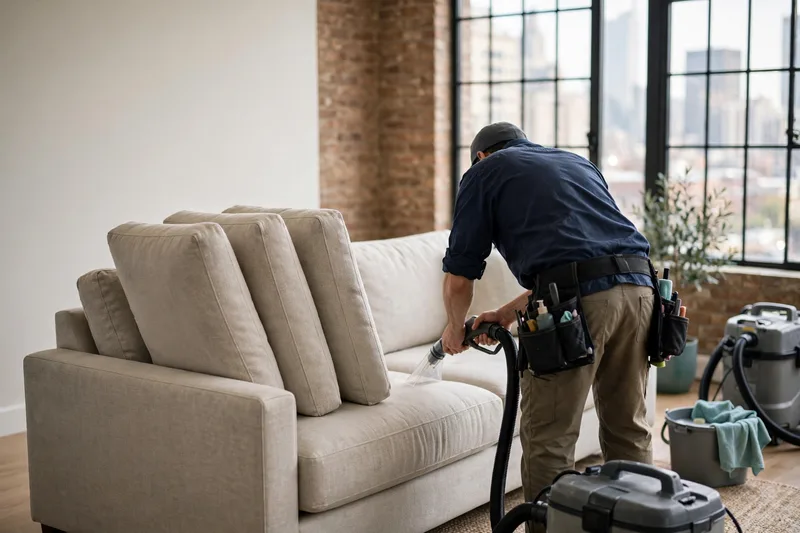
The short answer: professional upholstery cleaning means the fabric is identified and its care label code read first, a hidden spot is tested for color bleeding, the piece is vacuumed with the cushions off, stains and body-oil panels are pre-treated, and then the fabric is cleaned by the method its code allows: hot water extraction, low-moisture cleaning or solvent cleaning. Most couches and sofas dry in 2 to 6 hours with air movers running. The quote depends on the piece, the fabric and the condition, and it comes in writing before work starts. Everything below is that answer in full, section by section.

What upholstery cleaning includes
People book this service with a simple picture in mind: a machine, a couch, an hour. The real service is a sequence, and the order matters more than the machine. Here is what a complete upholstery cleaning service covers when it is done properly, and what you should expect any professional visit to include. An upholstery cleaning Chicago visit starts with the fabric code, because the tag decides what can safely touch the piece.
- Inspection and fabric identification. The fiber is identified (cotton, linen, polyester, microfiber, wool blends and velvets all behave differently) and the care label code is found, usually under a seat cushion or on the deck beneath it.
- A hidden color test. Cleaning solution is applied to an out-of-sight area and checked for color bleeding, watermarking and texture change before any visible fabric is touched. This two-minute step is what separates careful cleaners from expensive accidents.
- A real vacuum, cushions off. Seats, backs, arms, seams and the deck under the cushions are vacuumed. The grit down there is not just dirt: it is abrasive, and it saws at the fabric from underneath every time someone sits down.
- Pre-treatment. Body-oil panels on arms and headrests, food and drink marks, and pet areas each get a matched treatment with dwell time. Urine gets an enzyme treatment, because ordinary detergent does not break down urine salts.
- Cleaning by the method the code allows. Hot water extraction, low-moisture cleaning or solvent cleaning, covered in the fabric code section below.
- Rinse and extraction. The solution and the soil leave together. Residue left in the fibers is the main reason a cleaned couch looks dull again within months.
- Grooming and speed drying. The pile is brushed so it dries evenly, cushions are propped so air reaches every side, and air movers shorten the dry time to hours instead of a day.
What it does not include, said plainly: repairs, reupholstery, dye work, and guarantees about stains that turn out to be damage. A good cleaner tells you which of your marks are soil and which are damage before starting, not after. Our carpet cleaning page covers the floor side of the same room; this page is only about the furniture.
What the quote depends on
Upholstery is priced by the job because no two jobs are the same job. Three things set the scope, and any quote given without asking about them is a guess dressed as a number. That is why an upholstery cleaning service should always ask about the piece, the fabric and the condition before naming a figure.
- The piece. A dining chair, an armchair, a loveseat, a three-seat sofa and a six-piece sectional are different amounts of fabric, seams and cushion work. Sectionals are priced by their sections, not waved at as one couch.
- The fabric. A sturdy synthetic that allows hot water extraction is a straightforward clean. A natural fiber that browns if it stays wet, a fabric that bleeds color, or a solvent-only piece each demand slower methods, more testing and more care.
- The condition. Years of body oil, pet urine in the foam, heavy soil in a family room piece, or a previous cleaner's residue all add stages. A lightly used guest room chair does not.
Two smaller factors ride along: access (a sectional on a third-floor walk-up takes longer to work around than the same piece in a single-story home) and extras you choose, like treating extra cushions or a matching ottoman. What you get from us is a firm written price once the piece and fabric are known, before cleaning starts. If the price and the work do not match when we see the piece in person, we say so before a drop of solution is mixed.
Fabric codes W, S, WS and X: read the tag before anyone adds water
Nearly every piece of furniture sold in the last forty years carries a cleaning code, set by the furniture industry so owners and cleaners know what the fabric can take. It sits on the care label, usually under a seat cushion or stapled to the deck under the cushions. Four letters cover almost everything, and they decide the method before anything else is discussed. Reading the tag first is what separates an upholstery cleaning Chicago professional from a machine hired for the afternoon.
| Code | What it means | Cleaning method | Common fabrics |
|---|---|---|---|
| W | Water-based cleaning is safe | Hot water extraction or low-moisture water-based cleaning | Most polyester, nylon and microfiber family couches |
| S | Solvent cleaning only. Water can watermark, shrink or distort the fabric | Dry solvent cleaning, no water-based solutions | Some velvets, silk blends, certain natural fiber weaves |
| WS | Either water-based or solvent cleaning, used with care | Method picked after the color test, often low-moisture | Cotton and linen blends, many mid-range sofas |
| X | No liquids at all | Vacuum and brush only | Some delicate or bonded fabrics that no solution should touch |
The code is the start, not the whole story. Codes are assigned by manufacturers with a margin of caution, labels go missing on older pieces, and two fabrics with the same code can react differently to the same solution. That is why the hidden color test still happens on every piece, code or no code: the fabric in front of us outranks the label. Where there is no label at all, the fiber is identified by its weave, burn characteristics and how a test area responds, and the gentlest method that can do the job is the one used.
Why does this section sit so high on the page? Because it is the question almost nobody in Chicago answers in the open, and it is where couches get ruined. The two classic disasters are a solvent-only fabric cleaned with water, which watermarks or shrinks in one pass, and a bleeding dye cleaned without a test, which moves color from the pattern into the plain areas beside it. Both happen in the first five minutes of a careless clean, and neither can be undone. If a cleaner cannot tell you what code your couch carries, they are guessing with your furniture.

Steam or shampoo: the honest verdict by fabric
Two words cause most of the confusion in this trade. The first is steam. What almost every professional means by steam cleaning furniture is hot water extraction: a hot cleaning solution is sprayed into the fabric at controlled pressure and pulled straight back out by vacuum, taking the soil with it. Little actual steam is involved, and that is a good thing, because live steam would damage many fabrics and set many stains. The right method for an upholstery cleaning Chicago job follows the fabric, not the machine the crew happens to own.
The second is shampoo. Shampooing works a foam into the fabric with a rotary brush and lets it dry, then the dried foam and soil are vacuumed away. It can brighten a lightly soiled piece, but it has a built-in flaw: some of the shampoo stays in the fabric, and dried detergent is sticky at a microscopic level, so the piece collects fresh soil faster afterward. That is the honest answer to the common complaint that a couch looked worse a few months after it was cleaned.
- W code fabrics (most family couches): hot water extraction, because it removes the most soil and leaves the least behind.
- WS code fabrics: low-moisture extraction or careful solvent cleaning, picked after the color test. Delicate natural fibers dry too slowly for a soaking clean.
- S code fabrics: solvent cleaning only, whatever the machine in the van can do.
- X code fabrics: neither. Vacuum, brush, and honest advice about what cleaning cannot do for the piece.
People searching for steam cleaning furniture services are really asking which method will not wreck the couch. The answer is never the machine. It is the match between the fabric, its code and the method, in that order.
Couch cleaning in Chicago homes: the piece everyone actually means
Most calls that start as couch cleaning chicago searches are about one specific couch: the family couch, sat on every day, eaten on more often than anyone admits, and shared with at least one dog. That couch has a predictable pattern of wear, and cleaning it well means working the pattern, not just the surface.
The arms and the headrest darken first, because skin oil transfers there daily and oil holds soil. Working those zones on purpose, rather than passing a machine over the whole couch at one setting, is the difference a professional couch cleaning service is paid for. The seat cushions develop a gray cast in the middle where grit and fabric rub together. The front edge of the seats takes shoe scuffs and pet hair works deep into the weave. Under the cushions sits the deck, collecting crumbs, coins and grit that grind the cushion fabric from below. A proper couch clean works each of those zones on purpose: degreasing treatment on the oil panels, deep extraction on the seats, and a full vacuum of the deck before the cushions go back.
Chicago adds two local twists. Winter salt and slush track onto couch fronts and ottomans from boots resting on them, leaving white mineral marks that need the right treatment rather than more water. And the city's housing stock mixes new synthetic sectionals in high-rises with older natural-fiber pieces in greystones and bungalows, sometimes in the same living room. The code check is what keeps those two pieces from being cleaned as if they were the same couch.
Sofa cleaning service, piece by piece: what gets cleaned
A sofa cleaning service is really several different jobs sharing a name. This is the scope we work to, piece by piece, with the typical time each takes on site. Times are for cleaning only; drying runs alongside and after, and is covered in its own section below.
| Piece | What gets cleaned | Typical time |
|---|---|---|
| Armchair / recliner | Seat, back, arms, headrest and footrest fabric, cushions both sides | 30 to 45 minutes |
| Loveseat | Both seats and backs, arms, cushions both sides, deck vacuumed | 30 to 45 minutes |
| Three-seat sofa | All seats and backs, arms, headrests, cushions both sides, deck vacuumed | 45 to 60 minutes |
| Sectional | Each section cleaned as its own piece, corner included, cushions both sides | 1 to 2 hours, large sectionals longer |
| Ottoman | Top and sides; the top usually carries the heaviest soil and shoe marks | 15 to 30 minutes |
| Dining chairs | Seat pads and backs; cleaned in a batch, food spots pre-treated | About 10 minutes each in a set |
Matching pieces booked together are cleaned in one visit, and a typical living room set of a sofa, a loveseat and a chair runs about 2 to 3 hours end to end. Loose back cushions and throws in washable fabrics are pointed out honestly: some are better served by a careful home wash, and we will tell you which ones rather than charge to clean them.

How the cleaning runs, first check to final walk-through
Six stages, in the only order that protects the fabric. Skipping the first two is how couches get damaged by the people paid to clean them. A crew doing upholstery cleaning Chicago work tests the fabric code before any water touches the piece, because the wrong method can set a stain for good.
Check the fabric code and test the color
The care label under a cushion sets the method: W, S, WS or X. A hidden spot is tested for color bleeding and water marking before any cleaning solution touches the visible fabric.
Vacuum the whole piece, cushions off
Cushions come off and everything is vacuumed: seats, backs, arms, seams and the deck underneath, where grit, coins and pet hair collect and where most home vacuuming never reaches.
Pre-treat stains and body-oil panels
Arms and headrests carry body oil, cushions carry the spills. Each gets the treatment that matches it, including enzyme treatment where urine is involved, with dwell time to work.
Clean by the method the code allows
Hot water extraction for water-safe fabrics, low-moisture cleaning where drying speed or delicacy demands it, solvent cleaning for S code pieces. X code pieces are vacuumed and brushed only.
Extract and rinse so nothing stays behind
Solution and soil are pulled back out together. A rinse pass leaves the fabric close to neutral, because detergent residue left in fibers is what makes a cleaned couch dull again fast.
Groom, dry and walk it through
The pile is groomed to dry evenly, cushions are propped with air movers running, and the piece is checked with you: what came out, what faded, and what was never going to move, said plainly.
Pet odor and stains: why the smell lives in the cushion
Pet odor is the problem that defeats most casual cleaning, and the reason is anatomy. A couch cushion is fabric over foam. Urine passes through the fabric in seconds and spreads inside the foam, where it dries into salts. Those salts pull moisture from the air, which is why a cushion can smell fine on a dry day and smell again when the weather turns humid. Cleaning the fabric alone freshens the surface for about a week. Then the foam talks again. Pet smell lives deep in the cushion, and an upholstery cleaning Chicago treatment has to reach it there or the odor comes back with the next warm day.
The working treatment goes where the urine went. The cushion is treated with an enzyme product that breaks the urine salts down, given real dwell time, and then extracted deeply so the broken-down material leaves instead of drying back into the foam. Repeat accidents in the same spot need repeat passes, and we will say so up front. The honest limit, stated before we start: foam that has been soaked over and over for years can hold odor past the point cleaning can reverse, and replacing that cushion core is the true fix. We would rather tell you that on the phone than let you discover it after paying for a clean.
Everyday pet soil is the easier half of the same job: hair worked into the weave comes out with the vacuum and extraction stages, and the dander load in the fabric drops with it, which is why pet homes sit on the shorter cleaning interval in the frequency section below.
Drying: the part that decides whether it smells fresh next week
A clean couch put back together wet is a job half done. Fabric dries quickly; foam does not, and damp foam in a closed room grows a musty smell within a day. Drying is therefore part of the cleaning, not an errand left to the homeowner. Cushions are propped so air reaches both sides, air movers are aimed at the pieces, and the room is left ventilated. Drying decides whether an upholstery cleaning Chicago clean still smells fresh next week, so the visit is not finished when the machine stops.
| Method | Typical dry time | Notes |
|---|---|---|
| Hot water extraction | 2 to 6 hours with air movers | Thick cushions and deep sectionals can take up to 8 hours |
| Low-moisture cleaning | 1 to 3 hours | The choice for delicate fabrics and fast turnarounds |
| Solvent cleaning | About 1 hour | The solvent flashes off quickly; the room is ventilated as it does |
Two habits protect the result: do not sit on the piece or replace cushion covers until it is dry to the touch all the way through, and keep the air moving in the room for the first evening. In winter, Chicago heating actually helps: warm dry indoor air shortens drying. In a humid summer week, the air movers earn their place.

Do it yourself or hire it out: where home cleaning honestly ends
Home machines and home remedies have a real place in this topic, and pretending otherwise would be selling, not helping. A sturdy water-safe couch with a fresh spill is a fair home job with a small machine, if the code is checked and a hidden area is tested first. Weekly vacuuming with an upholstery tool does more for a couch's life than any single deep clean.
The limits are just as real. Home machines spray more water and extract less of it than professional equipment, so the piece stays wet longer, and slow drying is where musty smells and, on natural fibers, browning begin. The two famous home remedies carry their own risks: dish soap solutions leave residue that pulls soil back, and hydrogen peroxide can lift color out of dyed fabric, which turns a stain problem into a damage problem. Rental machines arrive with the last user's detergent still in the lines, at unknown strength.
The line we would draw for our own family: home care for spills, crumbs and maintenance; professional cleaning for the whole piece, for anything with a code other than W, for pet urine, and for any couch that matters enough that a mistake would hurt.
How often should upholstery be cleaned?
Every 12 to 18 months suits most homes. Every 6 to 12 months is the right interval where the couch is shared with pets, worked hard by small children, or sat in by someone with allergies. The reasoning is wear, not just looks: grit and body oil break fibers down quietly, and a couch cleaned on schedule lasts years longer than the same couch cleaned only when it looks dirty, because by the time soil shows on the surface it has been grinding in the weave for a long while.
Between cleans, the maintenance that actually matters is short: vacuum weekly including under the cushions, rotate cushions monthly, and blot spills at once with a clean white cloth from the edge inward. That routine, plus a professional clean on the interval above, is the whole formula. Couches in Chicago homes with forced-air heating collect one extra load worth knowing about: a winter of dry heated air and tracked-in salt dust settles into fabric steadily, which is why spring is the city's natural deep-clean season.
Leather and delicate fabrics: the honest boundary
Leather is cleaned, but it is a different job. It is never hot water extracted. The surface is cleaned gently with leather-safe products and then conditioned, because a cleaned hide that is not conditioned dries, stiffens and eventually cracks. Color wear, scratches and claw damage are repair and recoloring work in another trade, and no cleaning price should quietly pretend to include them. When you call about a leather set, tell us it is leather, and the visit is planned around the right products from the start.
At the delicate end of fabric sit silk, some velvets, antique pieces and anything coded X. These are handled with the gentlest method their code allows, or vacuumed and brushed only, and in a few cases the honest answer is that a piece has more value as it is than cleaned aggressively. A cleaner who will say that out loud is worth more than one who promises every fabric the same result.
Wet furniture after a leak or a flood: our home turf
Plenty of Chicago furniture gets wet the other way: not from a spill, but from a burst pipe, a failed supply line or a flooded room. This is where an upholstery page on a restoration site earns its place. Foam is a sponge with a long memory. A cushion left wet grows mold inside the foam within days, and by then the piece is usually lost, however good it looks from outside.
Caught in the first 24 to 48 hours, the same piece can usually be saved: cushions extracted, treated and dried with air movement, frames dried and checked, and the whole thing documented. That speed is why our water mitigation crews handle soaked furniture as part of the drying job rather than an afterthought, and why pieces with any mold growth go through the mold remediation route instead of a standard clean. The exception stands on health grounds: soft furnishings soaked in sewage water are removed, not cleaned. If the water came from a sudden, covered event, photograph the furniture before anything is moved and keep the paperwork; insurers pay for documented losses, not memories.
How to choose an upholstery cleaner in Chicago
Five questions separate the careful cleaners from the rest, and every one of them can be asked on the first call. Ask how the company handles upholstery cleaning Chicago drying and fabric codes before you book, because those two answers tell you most of what you need.
- Do you check the fabric code before cleaning? Any hesitation here ends the conversation. The code decides the method.
- Do you test for color bleeding? On a hidden area, every time, whatever the label says.
- How is the price set? By the piece, the fabric and the condition, in writing before work starts. A single flat promise for any couch, sight unseen, is a number invented to get the booking.
- What happens if a stain does not come out? The honest answer involves limits stated before the clean, not excuses after it.
- How is the furniture dried? Air movers and propped cushions, planned as part of the job, with a straight answer about when the piece can be used again.
National chains and local independents both clean couches in this city, and the name on the van matters less than the five answers above. When you compare upholstery cleaning Chicago companies, compare the method, not the slogan. The company that asks about your fabric before quoting is the one that has read a care label before.
Upholstery cleaning across Chicago
We clean couches, sofas, sectionals and chairs across the city, from high-rise condos along the lake where the sectional comes apart to fit the elevator, to greystones and two-flats with older natural-fiber pieces that need the gentle route, to bungalows where one family couch does the work of three rooms. Upholstery cleaning chicago wide means reading the label in all of those homes, because the city's furniture is as mixed as its housing: new synthetics, mid-century wool blends, leather sets and hand-me-down velvet, sometimes on the same block.





