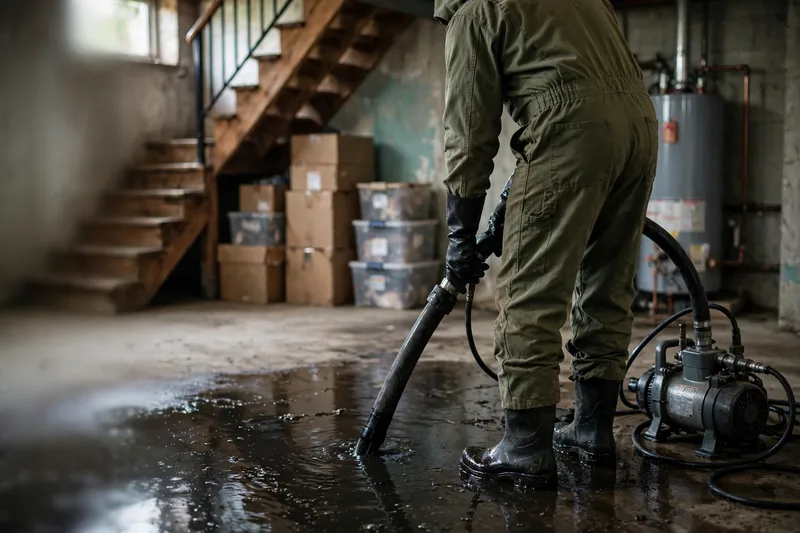
The short answer: sewage cleanup in Aurora means stopping the water at its source, extracting the contaminated water, removing every porous material the sewage soaked, washing and disinfecting every surface it touched, drying the structure to verified moisture readings, and documenting all of it, because a standard homeowners policy excludes sewer backup and only an endorsement pays. Sewage is Category 3 water, the grossly contaminated class, and it is worked as a biohazard job, not a mopping job: carpet and padding always come out, affected drywall is cut, and disinfection happens only after removal and washing, never instead of them. A sewage cleanup Aurora job is won in the first day, on source control, removal and drying. Everything below is that answer in full.

The first hour after a sewage backup: what to do while you wait
The first hour decides how much of your basement the sewage gets to keep. Work this list in order. It is the same list we work from when a sewage cleanup aurora call comes in, most of it needs no contractor at all, and every item on it exists because the opposite move is the one that fills the forums with month long smell stories.
- Stop adding water. No flushing, no laundry, no dishwasher, no showers, no running taps that drain into the system. Every gallon sent down a drain right now is a gallon looking for the lowest opening in your home, which is the floor you are trying to save.
- Keep everyone out of the water. Children and pets entirely, adults except for the steps below. Sewage is Category 3 contamination; treat the flooded area as closed, and wash anything that touched it, shoes included, before it walks through the rest of the house.
- Power off, only if you can stay dry. If the breaker panel is reachable without standing in water, turn off power to the flooded area. If reaching it means wading, leave it alone and tell us when you call. Electricity and contaminated water are the one combination on this page that cannot wait for judgement.
- Photograph everything before anything moves. The water line on the walls, the fixtures it came through, your belongings in place, the floor drain. This record is what your insurance file, and any argument about where the water came from, stands on later.
- Throw nothing away yet. Even the ruined items. Damaged property is inventory and evidence; discard happens after documentation, or after your adjuster releases it, and the salvage section below explains what will go and what will stay.
- If several fixtures are backing up together, call the city too. That pattern can mean the blockage is in the public main, not your line. The City of Aurora's Water and Sewer Maintenance line is (630) 256-3710. The responsibility section of this page explains where their pipe ends and yours begins, and why that call protects you either way.
- Open the insurance question early. Call your insurer and ask one specific question: does my policy carry a water backup endorsement. The answer decides how the claim works, and the insurance section below explains the endorsement most homeowners have never heard of.
- Then call for the assessment. Call (773) 570-9869 and describe what came up, which fixtures are involved, and whether the basement is finished. That decides what the first truck carries.
What sewage cleanup includes
Sewage cleanup services are sold in every shape in this trade, but a proper job follows a sequence, and the order is the substance: each stage exists because skipping it is how sewage jobs fail, with disinfectant sprayed over contamination that is still in the carpet pad, and a smell that returns every humid week for years. A homeowner reading a quote for sewer backup cleanup aurora work should be able to find every one of these stages in it, named, in this order. That sequence is what separates real sewage cleanup Aurora homeowners can trust from a mop-and-spray visit that leaves the contamination in place.
- Source control. The backup stopped before anything is cleaned: the blockage located, in your line or the city's main, and the water stopped at its source. Cleaning a room that is still receiving sewage is theatre.
- Extraction. The standing sewage and contaminated water pumped and extracted with professional equipment, contained as it leaves the building and disposed of as contaminated material.
- Removal of contaminated materials. Carpet, padding, affected drywall and insulation, and any porous material the sewage soaked, cut out, bagged and removed, each item documented for your insurance file first. This is the stage household cleaning cannot replace.
- Cleaning and disinfection. Every contacted surface washed, then treated with antimicrobial product at the strength and contact time the work demands. Cleaning first, disinfectant second: disinfectant laid over contamination disinfects the top of the problem.
- Structural drying. The structure dried with air movers and dehumidification to measured moisture readings, because material left damp behind the cleanup grows mold within 24 to 48 hours.
- Verification. Moisture readings confirm the structure is dry and the work is complete, and the room is walked through with you. A cleanup that ends on a smell test ends early.
- Repairs and documentation. Removed flooring, drywall and finishes replaced against the written scope, and the file handed over: photographs, readings and the disposal record.
Two of our Aurora pages stand directly behind this one. The drying half of a sewage job follows the same standard as our water damage restoration Aurora work, because wet drywall obeys the same clock whatever the water carried; and where a backup sat before we were called, the growth that follows is contained and removed the way our Aurora mold remediation page describes. The pages are one system, because in a real basement the problems arrive together.

How the work runs, first call to final walkthrough
Seven stages, in order. The two that separate restoration from expensive mopping on a sewage cleanup Aurora job are the removal of what sewage soaked, documented before it leaves, and the drying verified by readings before anything is closed up.
Call and describe the backup
What came up and where, which fixtures are involved, whether the basement is finished, and whether more than one fixture is affected. That description decides the first truck's load and whether the city's main needs checking alongside our visit.
Safety check and source control
The crew confirms the power and water state, closes off the contaminated area, and works out whether the blockage sits in your line or the city's main. Nothing is cleaned until the water has stopped coming.
Extraction of sewage and standing water
The contaminated water is pumped and extracted with professional equipment, contained as it leaves the building, because what comes out of a Category 3 room is handled as contaminated material, not mop water.
Removal of contaminated materials
Carpet, padding, affected drywall and other porous materials the sewage soaked are cut out, bagged and removed, each item documented for your insurance file before it leaves. This is the step household cleaning cannot substitute for.
Cleaning and disinfection
Every surface the sewage touched is washed, then treated with antimicrobial product at full contact time, including the floor beneath removed materials and the fixtures themselves. Cleaning first, disinfectant second, always in that order.
Structural drying and verification
The structure is dried with air movers and dehumidification to measured moisture readings, and the readings, not the calendar, say when the room is dry. Verification closes the health question the backup opened.
Repairs and the final walkthrough
Removed flooring, drywall and finishes are replaced against the written scope. The job closes with a walkthrough and your documentation file: photographs, moisture readings and the disposal record, for your insurer and your records.
Category 3: why sewage is not just dirty water
The restoration standard, ANSI/IICRC S500, sorts water damage into three categories by how contaminated the water is, and the category decides everything about how a sewage cleanup Aurora job is worked: the protective equipment, what has to be removed, and what cleaned means. Sewage sits in the highest class by definition, and understanding the three classes is understanding your cleanup bill, so here is the working knowledge in one table.
| Category | What it is | Examples | How it is handled |
|---|---|---|---|
| Category 1: clean water | Water from a sanitary source that has not picked up contamination | A burst supply pipe, a failed water heater, rain through a roof opening | Extract, dry, and most materials are saved in place if drying starts fast |
| Category 2: grey water | Water carrying chemicals or organic load that can cause discomfort or illness | Dishwasher and washing machine discharge, an overflowing toilet with urine only | Worked with protection and disinfection; porous materials judged item by item, and it degrades toward Category 3 if it sits |
| Category 3: black water | Grossly contaminated water carrying bacteria, viruses and other pathogens | Any sewage backup, toilet overflow with fecal matter, water that has passed through a sewer or drain, floodwater from outside | Biohazard discipline: protective equipment, containment, porous materials removed, antimicrobial treatment on every contacted surface, verified drying |
The category can move, and that movement is the quiet clock in every backup. Grey water left standing warms, feeds bacteria and arrives at Category 3 conditions in a day or two; even clean water that passes through a floor drain contaminated by an old backup arrives carrying the drain's history. It is why the same overflow is a small job on the morning it happens and a removal job by the weekend.
The health side, stated plainly. Sewage carries the organisms behind most stomach and intestinal illness: E. coli, Salmonella, norovirus, hepatitis A and a range of parasites among them. They survive on hard surfaces for days to weeks and inside porous materials for far longer, which is why the cleanup standard is removal and disinfection rather than fragrance and hope. Exposure is usually ordinary rather than dramatic: skin contact, contaminated shoes crossing a kitchen, a hand to the face, a child or a pet through the wrong floor.
The defence is equally ordinary: stay out of the water, keep the vulnerable members of the household out entirely, wash what touched anything, and let the contaminated area be cleaned by people equipped for it. Sewer gas deserves one honest sentence of its own: the smell most homes notice is a nuisance and an irritant at household levels, and a strong gas build up in an enclosed space is genuinely dangerous, which is why a room that smells strongly of sewer gas gets ventilated and left, not investigated with a candle or a long stay.
The aim of this section is respect for the material, not fear of your own house: handled in order, a sewage backup is a bad week, not a lasting condition.
What has to go, what can be saved
After the water is out, this is the question every homeowner asks standing in the doorway, and it deserves a table rather than a shrug. The rule underneath it is porosity: sewage disinfects on hard surfaces and hides in porous ones, so the salvage line follows the material, not the object's price or meaning. Everything on the removal side is photographed and inventoried first, because the discard list is also a contents claim.
| Item | Usual outcome | Why |
|---|---|---|
| Carpet and carpet padding | Removed and discarded, always | Porous through their full depth; contamination reaches the backing and the pad where no cleaning or disinfectant follows it |
| Drywall and insulation the water reached | Cut out above the water line and removed | Paper faced and absorbent; sewage wicks up inside the wall past the visible line, and the cavity cannot be disinfected in place |
| Upholstered furniture and mattresses soaked by sewage | Removed and discarded | Foam and stuffing hold contamination past any surface treatment; the standard treats them as unsalvageable in Category 3 |
| Clothing, bedding and washable textiles | Judged item by item | Items with light contact can be sanitised through hot specialist washing; saturated items and anything for babies are discarded |
| Hard furniture, sealed wood, metal, glass | Cleaned, disinfected and kept | Non-porous surfaces release contamination fully with washing and antimicrobial treatment |
| Tile, sealed concrete and solid flooring | Cleaned, disinfected and kept | The surface itself is sound once cleaned; grout lines and the subfloor beneath are checked before the verdict |
| Electronics and appliances the water reached | Specialist assessment, promptly | Sewage is corrosive and electrically unsafe; items assessed early sometimes survive, items left wet do not |
| Food, medicine and cosmetics in the affected area | Discarded, always | No cleaning standard makes them safe after Category 3 contact or flood exposure |
| Documents and photographs | Often partly saved | Drying, cleaning and copying rescue more than expected when they are reached before they dry together |
Two habits protect this half of your loss. Nothing leaves before it is photographed and listed, because a contents claim built from memory pays a fraction of one built from a room by room record. And the removal decisions are made against the standard, not against the mood of the worst day: the crew that offers to clean sewage out of carpet and hand it back is offering you the contamination with better presentation, and the smell that returns in July will introduce you to it again.
Two backups that are not the same job
The basement sewer backup
The classic sewage backup Aurora case arrives in storm season: the city main surcharges under a heavy rain, or the home's own line closes on roots, and the water chooses the lowest openings in the house, the floor drain, the basement shower, the downstairs toilet. Its signature is spread: several fixtures involved, water across the basement floor, and everything stored at floor level in the loss.
This is the sewage cleanup basement pattern the questions cluster around, and its working shape is the full sequence on this page: source control first (your line or the city's main decides who fixes what), extraction, removal of what the water soaked, disinfection of the whole contacted area, and drying verified before flooring returns. Finished basements carry the larger bill because they hold more porous material per square foot, which is also why they argue hardest for the backwater valve in the prevention section.
The toilet overflow
The smaller cousin is one fixture and one room: a toilet that overflows with waste, caught in minutes or found in hours. Caught fast on a hard bathroom floor, it can stay a contained job: extraction, removal of anything porous it reached, disinfection of the floor, the fixture and the wall base, and drying checked at the floor edges where water runs under trim and into the subfloor. Found late, or on carpet, it stops being small: the category is the same as the basement case, only the area is smaller, and the removal rules do not shrink with the puddle. The honest line is that area decides the size of the job and category decides its discipline, and the two are easy to confuse when the puddle looks harmless.

How long sewage cleanup takes
Three clocks again: the emergency work, measured in days; the drying, measured by moisture readings; and the rebuild, measured by what was removed. Severity, meaning how far the sewage spread and how much porous material it took, sets the total for a sewage backup cleanup aurora job more than any promise does. For most homes, sewage cleanup Aurora work runs a few days of emergency cleaning and drying before any rebuilding can even be quoted. A homeowner comparing quotes for sewage cleanup Aurora work should ask how many days of drying the quote includes, because drying by moisture readings is what stops the smell coming back.
| Severity | Typical total time | What sets it |
|---|---|---|
| Contained: one fixture, hard floors, caught fast | 1 to 3 days | Extraction and disinfection on day one, short drying, little or nothing to rebuild |
| Basement-wide: unfinished or partly finished | 3 to 7 days | Removal of soaked materials, disinfection across the floor, drying verified over 3 to 5 days |
| Finished basement: flooring, drywall and rooms involved | 1 to 3 weeks | The cleanup week, then replacement of flooring, drywall and finishes against the written scope |
| Any severity, with the sewer line itself broken | The cleanup plus the repair schedule | The line repair is the plumber's half and runs on its own clock; cleanup cannot finish ahead of a source still leaking |
The fastest lever is the same one as in water, mold and fire: how quickly the source is controlled and the removal starts. A backup assessed on day one is a scope agreed while the contamination map is still honest. The same backup assessed after a week of mopping is an argument about what the water reached, conducted over a smell that has had time to move into materials the first version of the job would have saved.
Insurance and sewage: the endorsement most homes do not know they need
Of the four Aurora services on this site, sewage is the one where the insurance answer surprises people, because it runs backwards from fire. Fire is the standard covered peril. A sewer backup, under a standard homeowners policy, is excluded: water or sewage that backs up through sewers and drains sits outside the base cover, however it entered and whatever it ruined.
The cover that does exist. It is sold as an endorsement, an add-on to the policy usually called water backup or sewer overflow coverage, bought for a modest yearly amount and paid out up to a limit you choose when you buy it. The limits are commonly sold in set amounts, typically from 5,000 up to 25,000 dollars of cover, and the endorsement often carries its own smaller deductible.
Two boundaries are worth learning before you need them: the endorsement pays for the damage the backup caused, not for repairing the sewer line itself, which is a separate kind of cover; and it does not pay for flooding from outside the home, which belongs to flood insurance, a different policy entirely.
The practical moves are unglamorous and decisive: check whether your policy carries the endorsement and at what limit, on a calm week rather than a flooded one; document the backup before anything is discarded; keep the invoices for emergency work; and if the blockage turns out to be in the city's main, get that finding in writing, because it belongs in the file whatever route the claim takes.
Why sewage claims shrink. Read across the forums and the pattern repeats: the loss was real and the record was not. Claims shrink when the contaminated materials were thrown out before they were photographed, when the backup is reported days late with the evidence cleaned away, and when the homeowner discovers the missing endorsement at the adjuster's kitchen table rather than at the agent's desk a year earlier. Everything in the first hour section of this page exists to keep your file out of that story. If an insurer mishandles a claim, the Illinois Department of Insurance is the consumer backstop, the same as in our fire guidance.
City main or your line: who is responsible in Aurora
Every backup raises the same argument at the kerb: whose pipe failed. The area's own utility answers it on the record. Fox Metro Water Reclamation District, which treats the wastewater for Aurora and its neighbours, sets the line out plainly on its basement backups guidance: residents are responsible for the maintenance and repair of their own sanitary sewer service lines, the pipe running from the home to its connection with the public main; the main itself, usually lying in the street or the parkway, belongs to the city and the district. A blockage in your line is your problem to fix. A surcharge or blockage in the public main is theirs.
That line decides the first phone call, so make it on pattern rather than on hope. Several fixtures backing up together, the floor drain rising, the problem arriving with a storm: call it in, so the main gets checked before you pay to clear a line that was never blocked. Inside Aurora's city limits, that call is the City of Aurora Water and Sewer Maintenance line, (630) 256-3710.
In unincorporated areas, Fox Metro takes the call at (630) 301-6811 in business hours and (630) 892-4378 at other times, and they will investigate the sanitary main. One fixture misbehaving alone, a single slow toilet or one gurgling sink, is almost always inside your own system, and that is a plumber's camera, not a city's crew. Either way, get the finding written down: which side of the line the blockage sat on is the fact your insurance file, and any further argument, will be built from.
One more Fox Metro fact belongs in an Aurora homeowner's notebook: the district runs the Sewer Overhead Assistance Program, SOAP, which gives financial support to homeowners making qualifying prevention retrofits, the overhead sewer and valve work the next section describes. Prevention help exists on the record; the time to ask about it is before your backup, not after.
The smell that will not leave, and the smell that arrives alone
Sewer smell is the complaint that outlives the disaster, and it comes in two kinds that need opposite responses. The first is leftover contamination: a backup was mopped and disinfected on the surface while the carpet pad, the drywall base or the material under the flooring kept what it soaked. That smell has a signature: it lives in one area, it strengthens in warm and humid weather, and it survives air fresheners because its source is a material, not the air. Its cure is not a stronger scent; it is finding the material and removing it, which is why the cleanup standard on this page is removal first.
The second kind arrives with no backup at all, and it is usually plumbing, not contamination. Every fixture in your home is sealed against sewer gas by a trap, a bend holding a plug of water, and a trap that dries out lets the gas straight through: the basement floor drain nobody pours water into, the guest bathroom used twice a year, and, the classic find, the washing machine standpipe box in an unused laundry corner.
A perished wax ring under a toilet leaks gas at floor level, and a blocked vent stack can push sewer gas out through the weakest trap in the house. The diagnosis runs in that order: refill the dry traps with a cup of water each, check the toilet's base for movement and smell at floor level, and only then suspect the vent or the line. A plumber owns most of that list.
What belongs to us is the first kind (on a sewage cleanup Aurora call, that history question is the first one we ask), and the honest test between them is history: a smell that began with a backup and never left is contamination until proven otherwise.

Stopping the next one: backwater valves, flood guards and habits
Prevention divides by cause, because the backups divide by cause. Against a blockage in your own line, the tools are a camera inspection that finds roots and failing joints years before they close the pipe, grease kept out of the kitchen drain, and wipes kept out of the toilet whatever the packet promises. Against the other failure, the city main surcharging in a storm, habits do nothing and one device does nearly everything: the backwater valve.
A backwater valve is a one way gate in your sewer line. Wastewater flows out through it freely. When the main outside surcharges and water tries to reverse toward the house, the flap floats shut and the backup stops at the valve instead of arriving through your floor drain and lowest fixtures. It is fitted by a licensed plumber, it needs an access point so the flap can be inspected and cleared, and it protects against exactly the storm season pattern behind most Aurora basement backups.
It carries one rule that owners learn the hard way and this page will state for free: while the valve is closed against a backup, your own wastewater cannot leave either. Flush, run laundry or shower during those hours and the water backs up inside your own home, self inflicted. When the storm passes and the main clears, the valve reopens on its own.
A simpler cousin exists for the single floor drain: the flood guard, a float stopper that seals one drain against rising water for very little money, worth having as a first line while the valve conversation happens. And the retrofits carry local support: Fox Metro's SOAP program, described in the responsibility section above, exists to help with qualifying work of exactly this kind. Prevention is the only stage of a sewage cleanup Aurora job that happens before the sewage, and it is the only one entirely in your hands.
Can you clean it yourself? The honest line
Some of the most watched videos in this field are do it yourself sewage cleanups, and some of the most exhausted posts are written months later by people who followed them. Both are understandable: the bill is real, the mess feels like only a mess, and a mop is already in the house. So the line deserves to be drawn with reasons rather than rules.
What a homeowner can do, and should, is everything in the first hour list: stop the water, keep the family out, photograph, ventilate, and lift small hard surface items to safety with gloves and washing after. Small spills of clean or grey water on hard floors are ordinary housework. Raw sewage is a different material.
It carries pathogens that survive for weeks in what they soak; it penetrates carpet, pad, drywall and soft furnishings past the reach of any surface cleaning; scrubbing and household vacuuming put it into the air; and the waste itself has to leave the house as contaminated material, not down the same drains that just failed. The professional half of a sewage cleanup Aurora job is not a stronger mop: it is protective equipment, extraction equipment, removal of what cannot be disinfected, antimicrobial treatment at working contact times, and drying verified by instruments.
Homeowners who stay on their side of that line do not pay for the same job twice, once in effort and once in the callback when the smell moves in for the summer.
Choosing a sewage cleanup company in Aurora: the standard
Sewage work has its own governing standard, and it is the first question worth asking any company, including us: do you work to the ANSI/IICRC S500, the standard that classes this water as Category 3 and sets how it is contained, removed and disinfected. The second question is the removal: will the porous materials the sewage soaked actually come out, carpet, pad and affected drywall, or does the quote plan to clean over them and call the smell gone. The third is the verification: how is dry and done shown, moisture readings and a walkthrough, or a sniff at the door. A sewage cleanup Aurora company that answers those three cleanly has told you most of what the sales conversation exists to hide.
Then read the behaviour, because a backup brings out the trade's worst habits at the homeowner's most disgusted moment. The red flags rhyme across the stories people tell: the quote given from the doorstep before the contamination is mapped; the offer to save the carpet; the company that cannot say where the removed material goes; the scope that is one round number covering pipe and cleanup without separating them.
Against those, the green flags are the ones this page is built on: the source controlled before the cleaning is sold, the plumber's half and the cleanup half named honestly, documentation before disposal, and drying verified by readings. The best sewage cleanup company for an Aurora home is rarely the one with the loudest emergency claim; it is the one whose method you can read before you call. Ask the three questions of us first. If our answers match this page, call. If another company's are better, call them.
What the quote depends on
No honest figure for sewage cleanup aurora work exists before someone has stood in the basement, and any company giving one from a photograph is inventing it. What can be stated exactly is what the number is built from.
- The spread. How far the sewage travelled and how many rooms and fixtures it reached: the single largest driver of the whole scope.
- Finished or unfinished. A finished basement holds carpet, drywall, insulation and furniture per square foot where an unfinished one holds a concrete floor and stored boxes.
- The removal volume. How much porous material has to come out and be disposed of as contaminated waste.
- How long it sat. An hour's backup and a weekend's backup are different jobs; time moves contamination deeper and categories upward.
- The drying load, set by the materials involved and verified by readings rather than estimated by eye.
- Which half is whose. The cleanup scope stands separately from any line repair the plumber prices; a quote that blends them cannot be read, and cannot be compared.
And the checklist worth keeping for any quote, ours included: it names the source and how it was controlled, lists the materials coming out room by room, states how disinfection and drying are verified, separates the pipe work from the cleanup, and is firm before the main work starts. A single round number with no scope is not a quote; it is an opening position.
Sewage help across Aurora
We answer calls across the whole city, from the older streets near downtown and the Fox River, where clay lines and tree roots write most of the backup stories, to the far east side subdivisions, and across the four counties Aurora touches: Kane, DuPage, Will and Kendall.
Most people find this page while searching sewage cleanup aurora with water still on the floor, or the morning after, and the ones searching emergency sewage cleanup in Aurora at two in the morning are asking the same questions faster; others land here from a sewer backup cleanup aurora search, a smell that will not leave a basement, or the discovery that their policy never covered the event at all, which are the same emergency at different hours.
A homeowner searching sewage cleanup near me in Aurora is usually asking whether the crew knows their kind of loss: the storm night surcharge in a finished basement, the root closed line in a century old street, the toilet overflow found after a weekend away. That local shape of the work is what this page was written around, and it is why sewage cleanup Aurora work is assessed standing in the basement, never priced from a photograph.
This page completes our Aurora set: the same discipline stands behind our Aurora fire damage restoration work, because a house that has met one disaster deserves one standard for all of them. Nearby communities call us too: Naperville, Batavia, Montgomery, Oswego and North Aurora are regular runs from the same number, (773) 570-9869. The full list of areas is on our service areas page.





