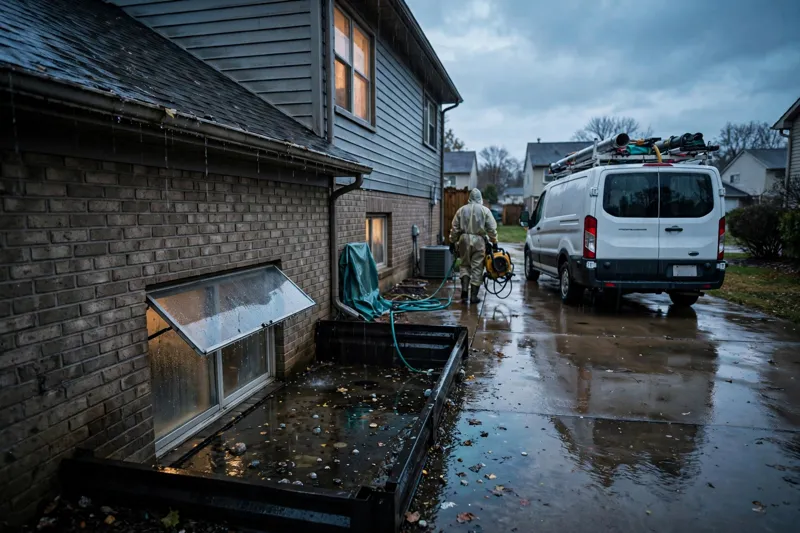
Mold Remediation Westmont IL
Mold in a Westmont basement? We answer 24/7. We find the moisture that feeds it, contain the area, remove the growth, clean what stays, and dry the space so it cannot grow back. Call now and a crew is on the way.
A homeowner who types mold remediation westmont into a search box at two in the morning wants one thing: a crew that answers. This page is written for that homeowner. It tells you what mold remediation is, what it is not, who to call first when the water came through a sewer, what the Village of Westmont can and cannot do, and what Illinois registration to ask for before any work starts.
- 24/7 emergency response, day and night
- Mold inspection, testing and containment
- Removal, cleaning and drying to moisture readings
- Written scope of work before any repair starts
Serving Westmont, Illinois, downtown Cass Avenue, Burlington Avenue, Quincy Street, Ogden Avenue, Naperville Road, 63rd Street and every block from St. Joseph Creek to the Downers Grove line.
- We answer 24/7
- Local Chicago team
- Insurance documentation help
- Straight answers, no pressure
Request mold help in Westmont
Tell us where the mold is and what it looks like. We answer 24/7.
The short answer: mold remediation in Westmont
Mold remediation is the job of finding the moisture that feeds the mold, containing the area so spores do not spread, removing the growth and the wet material it sits on, cleaning what stays, and drying the space so it cannot grow back. It is not a spray and a wipe. A spray and a wipe leaves the wet wall behind it, and the mold comes back through the paint within weeks.
A homeowner who types mold remediation westmont il into a search box is usually standing in front of a wall or a ceiling that changed colour, or smelling a musty odour that was not there last month. The first thing to know is that the mold is not the problem. The water is the problem. Mold needs moisture, and it needs it for days. Fix the moisture first, and the mold has nothing to feed on. Remediate the mold without fixing the water, and you have paid for a job that will fail.
The second thing to know is that no page can give you a price for this job. This site prints no prices, and that is a deliberate choice: the cost of a mold job depends on how far the mold spread, what material it sits on, how many rooms are wet, and whether the water source is fixed. A company that quotes a number over the phone, before it has seen the wall, is guessing. We inspect first, then give you a written scope of work with the cost in it, before any repair starts.
The third thing to know is that Illinois now has a registration for this work, and it is in force. Part 835 of the Illinois Administrative Code, the mold remediation registration rules, was adopted and took effect on September 23, 2026. All mold remediators must register with the Illinois Department of Public Health, unless they qualify for an exemption, and there is a grace period to September 30, 2027 for companies to register and obtain certification. Ask any company for its registration before the work starts. This site claims no registration itself, and it never will. The registration is something you ask for, not something a website prints about itself.
The fourth thing to know is that Westmont is a village with a dividing line running down its middle. Cass Avenue divides the village between two sanitary districts, and which district you call depends on which side of Cass Avenue your home sits on. West of Cass Avenue, the Downers Grove Sanitary District handles the main sewer. East of Cass Avenue, the Flagg Creek Water Reclamation District handles it. South of 67th Street, the DuPage County Public Works Department handles it. The Village itself does not handle sewer service issues, and the Village has no homeowner cost-share programme for mold or flood work. This page tells you exactly who to call, with the numbers, so you do not spend the first hour on hold with the wrong office.
And the last thing to know before you read on: there is no verified named mold case in Westmont anywhere, no company, no job street address and no job date together, on any platform we checked. This page invents none. What it gives you instead is what was actually verified: the Village's own pages, the sanitary districts' own pages, the DuPage County Health Department's guidance, the Illinois Department of Public Health's registration rules, one Downers Grove company's aggregate job counts for Westmont, and one Westmont basement on video from July 2014, labelled as what it is. A page that invents a case would be lying to you. This one does not.
Where Westmont is, and where it is not
Westmont is a village in DuPage County, Illinois, a southwest suburb of Chicago, about twenty miles from the Loop. It was incorporated on November 4, 1921, and it has one ZIP code, 60559, and one post office. The 2020 census counted 24,429 people in the village, on 5.03 square miles of land. It is small enough that a crew can cross it in ten minutes, and old enough that most of its houses were built in a single boom.
The village is bounded on four sides: the Village of Oak Brook to the north, the Village of Clarendon Hills to the east, the City of Darien to the south, and the Village of Downers Grove to the west. That matters for mold work, because the village you live in decides which sanitary district takes your call, and the village next door does not take it at all. A homeowner on the Downers Grove line west of Cass Avenue calls the Downers Grove Sanitary District. A homeowner on the Clarendon Hills line east of Cass Avenue calls Flagg Creek. A homeowner south of 67th Street calls DuPage County Public Works. None of them calls the Village, because the Village does not handle sewer service issues.
Cass Avenue is the spine of the village. It runs north and south through downtown, and it is the dividing line between the two sanitary districts: everything west of Cass Avenue is Downers Grove Sanitary District, and everything east of Cass Avenue is Flagg Creek Water Reclamation District. Downtown Westmont sits on Cass Avenue, between Ogden Avenue to the north and Quincy Street to the south, and the Metra BNSF Line station is there too. Village Hall is at 31 W. Quincy Street. Public Works is at 155 E. Burlington Avenue.
The GPS anchor for this page is the Cass Avenue and Burlington Avenue crossing in downtown Westmont, on the dividing line itself, which is why this page uses it. A crew that knows which side of Cass Avenue it is standing on knows which district to call.
Ogden Avenue, U.S. Route 34, runs east and west along the northern edge of downtown. Quincy Street runs east and west through downtown. Naperville Road runs diagonally through the village's west side. 63rd Street marks the southern edge, and 55th Street runs east and west through the village's middle. Four highways frame the village: I-88 to the north, I-55 to the south, I-294 to the east, and I-355 to the west. A crew coming from the north takes I-88; a crew coming from the south takes I-55.
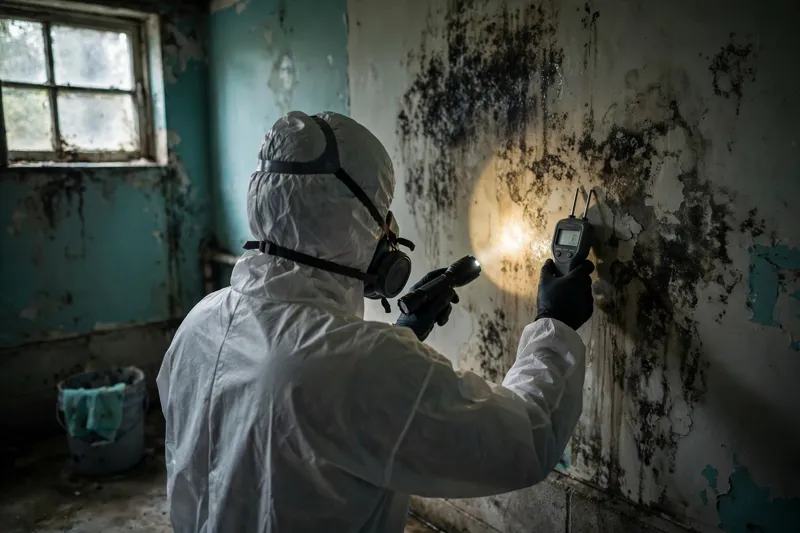
Most of Westmont's houses were built in the boom years of the 1960s and 1970s, and they are ranches and split-levels, not the brick two-flats and bungalows of Chicago. That matters for mold work in two ways. First, a ranch or a split-level has a lower level that sits partly below grade, and a lower level that got damp and was dried with household fans is the single most common mold job in this village. Second, a townhome bathroom with a slow leak behind the wall is the other common job, because one floor's supply line can wet two or three units below. A page that describes Westmont houses as historic brick two-flats is describing Chicago, not Westmont, and it has not read the village.
St. Joseph Creek runs through the village, and it is the only waterway this page names for Westmont, because it is the only one the Village's own pages name. The creek's watershed is 24 square miles, and the creek has flooded the village before, the April 2013 flood is the one the Village's own Stormwater Management page names, and the United States Geological Survey gauge on the creek recorded a peak flow of 2,290 cubic feet per second on April 18, 2013.
The 1996 peak of 1,280 cubic feet per second is the annual peak for that year, not the record, and this page does not print it as the record. Any page that lists four Westmont watersheds, or names another creek as a Westmont waterway, is printing a list it did not verify. This page names one creek, because one creek is what the Village's pages support.
Westmont is also a village where the water is managed by more offices than most homeowners expect. The Village's Public Works Department handles the streets, the storm sewers and the water mains. The sanitary districts handle the sewers. DuPage County handles the properties south of 67th Street. The Illinois Department of Public Health handles mold registration. The DuPage County Health Department handles mold guidance. The Federal Emergency Management Agency handles the floodplain rule. This page gives you each office with its number and its hours, so the first hour after you find mold is spent on the right call, not on the wrong one.
What to do in the first hour after you find mold in Westmont
Finding mold is frightening, and the first hour is the hour that decides whether the job is small or large. Seven steps, in order. They take an hour, and they save you a week. The seventh step is the one most pages leave out, and it is the one Illinois law now makes possible: ask for the registration before the work starts.
Call us first.
Call (773) 570-9869 any time, day or night. Tell us where the mold is, what it looks like, and whether there is water with it. We answer 24/7 and talk you through the first hour while a crew is on the way to your Westmont home.
Stop the water at the source.
Turn off the main water valve if the water is coming from a pipe, and turn off the water heater as well. If you cannot see the source, say so, a leak can travel ten feet or more from where it enters. Do not climb a ladder or crawl under a house to reach a valve.
Do not wipe it or run a fan on it.
A large patch of mold should not be wiped, and a fan should not run on it, because both spread spores through the house. Keep the room closed, keep children and pets out, and wear a respirator, gloves and eye protection if you must go in.
Photograph everything before you move it.
Photograph the mold and the water line before anything is moved, and keep a written list of what was wet, what you moved and what was thrown away. The insurer reads the photographs, the receipts and the drying log, and the drying log is the record that settles the claim.
Call the district if the water came through a sewer.
Call the Downers Grove Sanitary District at (630) 969-0664 if your home sits west of Cass Avenue, or the Flagg Creek Water Reclamation District at (630) 323-3299 if it sits east of Cass Avenue, or the DuPage County Public Works Department at (630) 407-6800 if it sits south of 67th Street. The district will tell you whether the blockage is in the public main or in your private service line. For storm drainage, call Village Public Works at (630) 981-6270. After hours, call the Westmont Police non-emergency line at (630) 981-6300 and press 9, and dial 9-1-1 for an emergency.
Let the drying run until the readings say dry.
Keep the air movers and dehumidifiers running, and do not close the walls until a moisture meter says they are dry. We read every wall and floor each day and write the readings into a drying log you can see. Dry is a number, not a look.
Ask for the registration before the work starts.
Ask any mold company for its Illinois Part 835 registration before the work starts, and ask whether the testing is independent of the company doing the work. Get a written scope of work with the cost in it, and do not let the walls close until the clearance check says the space is dry and the spore counts are back to normal background levels.
The step that matters most is the third one: do not wipe it, and do not run a fan on it. A large patch of mold should not be wiped, because wiping moves the spores into the air and through the house. A fan should not run on it, for the same reason. The room stays closed, the children and the pets stay out, and the person who goes in wears a respirator, gloves and eye protection.
The DuPage County Health Department's guidance says the same thing in its own words: if you can see or smell mold, you likely have a problem, and a small problem under ten square feet is one a homeowner can handle with protective equipment, but a large contamination over one hundred square feet is a job for an experienced professional contractor.
The step that saves the insurance claim is the fourth one: photograph everything before you move it. The insurer reads the photographs, the receipts and the drying log. A drying log is a written record of the moisture readings in every wall and floor, taken each day until the readings say dry. A company that dries your home without a drying log has no record that the drying happened, and the insurer has no record to read. Ask for the drying log. It is the single most useful document in a mold claim, and it costs nothing to keep.
The step that saves the most time is the fifth one: call the district before you call a plumber, if the water came up through a floor drain. A plumber can clear a private service line, but a plumber cannot clear a public main, and a plumber cannot tell you which one is blocked. The district can. West of Cass Avenue, the Downers Grove Sanitary District takes the call at (630) 969-0664, any time. East of Cass Avenue, the Flagg Creek Water Reclamation District takes it at (630) 323-3299.
South of 67th Street, the DuPage County Public Works Department takes it at (630) 407-6800. For storm drainage, the Village's Public Works Department takes it at (630) 981-6270, Monday to Friday, 7:00am to 3:30pm. After hours, the Westmont Police non-emergency line takes it at (630) 981-6300, press 9, and an emergency is 9-1-1.
Seven places mold grows in a Westmont home
Mold grows where water sat and the wall stayed wet. In Westmont, that means seven places, and they are not the seven places a Chicago page would list. The houses here are 1960s and 1970s ranches and split-levels, and the water comes from the creek, the sewers and the sump pump, not from a Chicago combined sewer, because Westmont has no combined sewers. The Village's storm sewer system is independent from the sanitary sewer system, and there are no older combined sewer sections in Westmont. Any page that says otherwise is copying a Chicago template.
1. The lower level that got damp and was dried with household fans
A ranch or a split-level has a lower level that sits partly below grade, and when the sump pump fails or the creek rises, the water comes in at the floor and wicks up the drywall. A household fan moves air across the surface, and the surface looks dry in a day. The wall behind the paint is not dry.
The drywall is wet to a height of a foot or more, the insulation behind it is wet, and the framing is wet. The mold grows behind the paint, where no one can see it, and it grows for weeks before the smell reaches the room above.
Basement mold remediation westmont jobs start with a moisture meter, not a guess. The meter reads the wall at several heights, and the reading decides how much drywall comes out. The DuPage County Health Department's guidance for flooding is specific: drywall is removed to above the high-water mark, and porous materials, ceiling tiles, sheetrock, carpeting and wood products, are discarded, not cleaned. A company that dries a lower level with household fans and calls it done has not dried it. The drying runs until the readings say dry, and the readings are written into a log you can see.
2. The attic
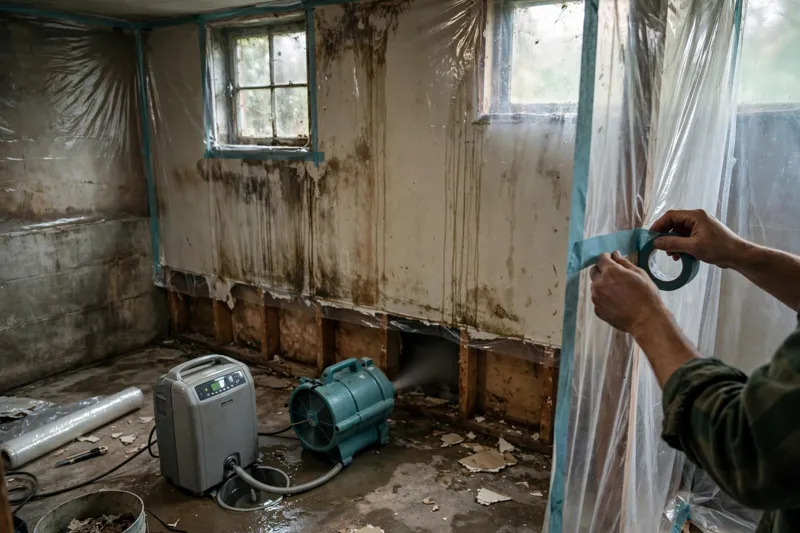
The attic is the second most common place, and it is the one homeowners find last, because no one goes into the attic. Attic mold grows where warm, moist air from the house meets a cold roof deck, and it grows on the underside of the roof sheathing and on the insulation. A bathroom fan that vents into the attic instead of outside is the usual cause, and a roof leak is the other one. The mold is often found when the roof is replaced, or when a home inspector opens the attic hatch before a sale.
Attic mold removal westmont jobs are different from basement jobs in one way: the attic is ventilated, and the mold is usually on the surface of the sheathing rather than inside a wall. That makes the removal faster, but it does not make the job smaller. The cause has to be fixed first, the fan has to be vented outside, or the roof has to be repaired, or the mold comes back through the new sheathing within a year. A company that cleans an attic without fixing the vent has sold you a cleaning, not a remediation.
3. Behind the wall of a townhome bathroom
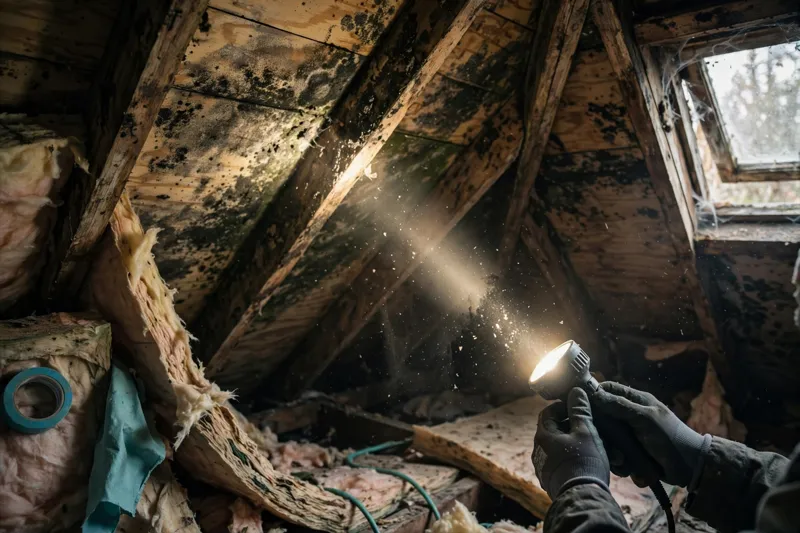
A townhome bathroom has a supply line and a drain inside a shared wall, and a slow leak behind that wall can run for months before anyone sees it. The paint bubbles, the tile grout darkens, and then the smell starts. By the time the mold is visible, it has grown through the drywall and into the framing, and it may have spread into the unit below.
A townhome job is different from a single-family job, because one floor's water heater or supply line can wet two or three units below, and the association, the management company and several owners are involved. Tell the association the day the mold appears, and keep a record of every call you make. The association owns the shared wall; you own the unit. Who pays for what depends on the declaration and the bylaws, and the answer is in the documents, not in a phone call. Read them before you sign a scope of work.
4. The black patch on the bathroom ceiling
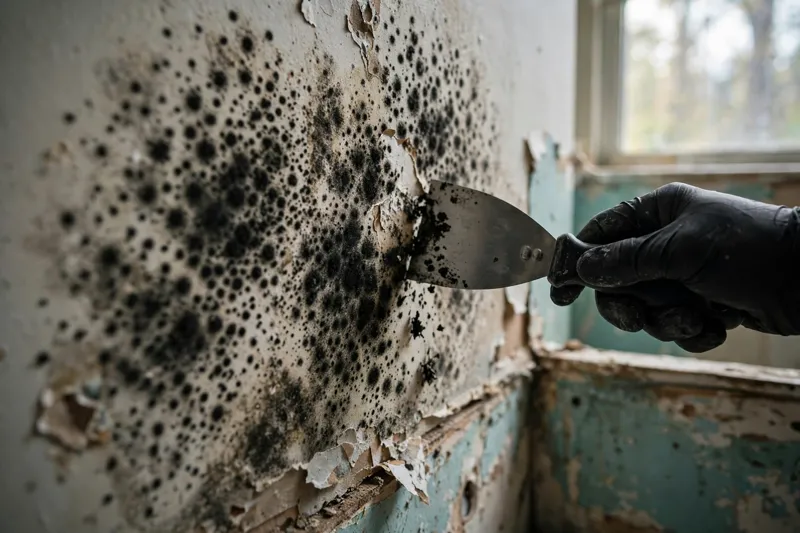
The black patch on a bathroom ceiling is the mold most homeowners see first, and it is the mold most homeowners misread. Black mold removal westmont is a search a homeowner types when the patch is black, and the search assumes the colour means something. It does not. Colour does not identify mold species, including black. The only identification is lab analysis, and no page should name a species from a colour. A black patch can be one of several species, and the species does not change the job: the moisture source is fixed, the growth is removed, the area is cleaned, and the space is dried.
What the colour does tell you is where the water is. A black patch on a bathroom ceiling usually means a leak from the floor above, or condensation from a bathroom fan that vents into the attic instead of outside. A black patch on a lower-level wall usually means water that wicked up from the floor. A black patch around a window usually means condensation from a window that leaks air. The patch is a map of the water, and the water is what gets fixed.
5. Behind the kitchen wall, under the sink and the dishwasher
The kitchen wall is the place mold grows where no one looks, because the sink cabinet hides it. A slow leak under a kitchen sink, or a dishwasher supply line that drips for months, wets the drywall behind the cabinet and the subfloor beneath it. The mold grows behind the cabinet, and it is found when the cabinet is removed for a remodel, or when the floor softens underfoot. The dishwasher is the worst of the two, because a dishwasher leak runs under the flooring and spreads across the room before it is seen.
A kitchen job is a containment job first and a removal job second. The kitchen is the room the family uses most, and the mold has to be contained before the wall comes out, or the spores spread through the whole house. The containment is plastic sheeting and negative air, a fan that pulls air into the contained area and out through a filter, so the spores do not escape into the rest of the home. A company that opens a kitchen wall without containment has spread the mold through the house, and the job has doubled.
6. The crawl space
A crawl space is a low, dark, damp space under a house, and it is the place mold grows where no one goes. A crawl space with no vapour barrier, or with a vapour barrier that has torn, lets ground moisture rise into the floor joists and the subfloor. The mold grows on the joists and on the underside of the subfloor, and it is found when the floor above softens, or when a home inspector crawls under the house before a sale. A crawl space job is a drying job first: the space has to be dried, the vapour barrier has to be repaired or replaced, and the ventilation has to be fixed, or the mold comes back.
The DuPage County Health Department's guidance applies here as it does everywhere: a small problem under ten square feet is one a homeowner can handle with protective equipment, and a large contamination over one hundred square feet is a job for an experienced professional contractor. A crawl space is almost always over one hundred square feet, and it is almost always a professional job. Do not crawl into a moldy crawl space without a respirator, gloves and eye protection.
7. After a sump pump failure or a sewer backup
The seventh place is not a room. A sump pump failure or a sewer backup puts water on the floor, and the water sits there until someone finds it. The water is often found hours later, and the mold starts within days. What is certain is that the longer the water sits, the further the mold spreads, and the larger the job becomes.
A sump pump failure has its own rules in Westmont, and they are Village rules. The Municipal Code, Section 70-22, says a sump pump discharge shall be located at least 25 feet from any Village right-of-way, and the flow caused to dissipate before reaching such right-of-way. A drain tile or sump pump job needs a waterproofing permit, and the fee is four-tenths of one percent of the cost of construction, with a minimum of one hundred dollars.
Working without a permit carries a penalty of three hundred dollars, or double the total cost of the permit, whichever is greater, plus the cost of the permit to be issued. And a permit will not be issued until the contractor or contractors are registered. Those are the Village's own words, quoted from its own pages, and they are the reason a sump pump job in Westmont starts with a permit, not with a shovel.
Mold removal is not mold remediation, and mildew is neither
Mold removal is one step inside mold remediation, and a company that sells you removal has sold you a step, not a job. Remediation is the whole process: find the moisture, contain the area, remove the growth, clean what stays, dry the space, and verify the result. Removal is the third step. A company that only wipes the surface is doing removal, not remediation, and the mold will be back through the paint within weeks, because the wet wall behind the paint is still wet.
A homeowner who types mold removal westmont il into a search box wants the same job as a homeowner who types the head phrase, and this page answers both searches the same way: the job is remediation, and removal is only the middle of it. The first question to ask any company is not what it removes, but what it does before and after the removal. Does it find the moisture source? Does it contain the area? Does it dry the space to moisture readings? Does it verify the result with a clearance check? A company that cannot answer all four is selling a wipe, not a remediation.
Mildew is surface mold, powdery, on damp surfaces, usually cleanable with soap and water. Mold that has grown into drywall, insulation or framing is a remediation job, not a cleaning job. The difference is depth: mildew sits on the surface, and mold grows into the material. A surface that can be cleaned with soap and water is a cleaning job. A wall that has to be opened to above the high-water mark is a remediation job. The DuPage County Health Department's guidance draws the same line in its own words: a small problem under ten square feet is one a homeowner can handle with protective equipment, and a large contamination over one hundred square feet is a job for an experienced professional contractor.
Colour does not identify mold species, including black. The only identification is lab analysis, and no page should name a species from a colour. A black patch on a bathroom ceiling can be one of several species, and the species does not change the job: the moisture source is fixed, the growth is removed, the area is cleaned, and the space is dried. A page that names a species from a colour is guessing, and a guess is not a diagnosis. Mold remediation westmont work is remediation, not cleaning, and the difference is the moisture source: find it, fix it, and the mold has nothing to feed on.
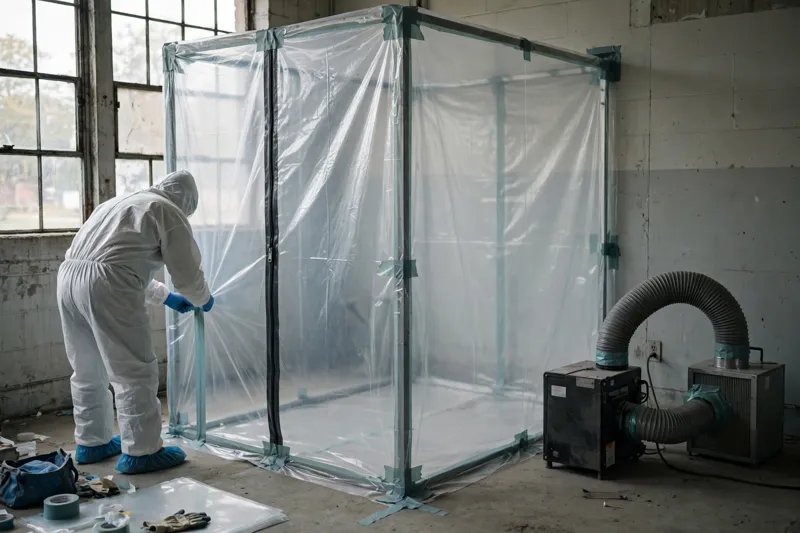
Containment is the step that separates a remediation from a wipe, and it is the step most homeowners never see. Before a wall is opened, the area is sealed with plastic sheeting, and a fan pulls air into the contained area and out through a filter, so the spores do not escape into the rest of the home. The workers inside wear respirators, gloves and eye protection. The material that comes out is bagged inside the containment, not carried through the house. A company that opens a wall without containment has spread the mold through the house, and the job has doubled. Ask any company how it contains the area, and do not accept a job that has no answer.
Mold inspection and mold testing in Westmont, two different jobs
Mold inspection and mold testing are two different jobs, and most pages confuse them. An inspection is a visual inspection with a moisture meter: a technician walks the home, finds the moisture source, measures how far the water spread, and writes a scope of work. Testing is sampling: air samples and surface samples, sent to a laboratory, which reports the spore counts and the species. An inspection tells you where the water is. Testing tells you what is in the air. You need the inspection first, and you need testing only when the inspection says you need it. Mold remediation westmont inspection comes first, and testing comes second, because an inspection tells you where the water is and testing tells you what is in the air.
A homeowner who types mold inspection westmont il into a search box wants an inspection: someone to come to the house, find the moisture, and tell them what to do. A homeowner who types mold testing westmont il wants a number: a spore count, a species, a clearance reading. The longest form of the search, mold inspection and air quality testing westmont il, is the search of a homeowner who wants both, and it is the search this page answers in full: inspection first, testing when the inspection calls for it, and clearance testing after the job, to verify the result.
The DuPage County Health Department's guidance is clear on this point, and it is the opposite of what most testing companies say: the Department does not recommend testing as a first step. If you can see or smell mold, you likely have a problem, and the problem is the moisture, not the number. Testing is useful when the mold is hidden, when the cause is unclear, or when a clearance check is needed after the job. Testing is not useful as a first step, because the first step is finding the water.
One more thing the Department's guidance tells you, and it is the reason containment matters: spore counts may be ten to one thousand times higher than background when materials are disturbed. That is why a wall is not opened without containment, and why a fan is not run on a large patch. Disturbing mold without containment puts ten to one thousand times the background spore count into the air of the house, and the house is where the family breathes.
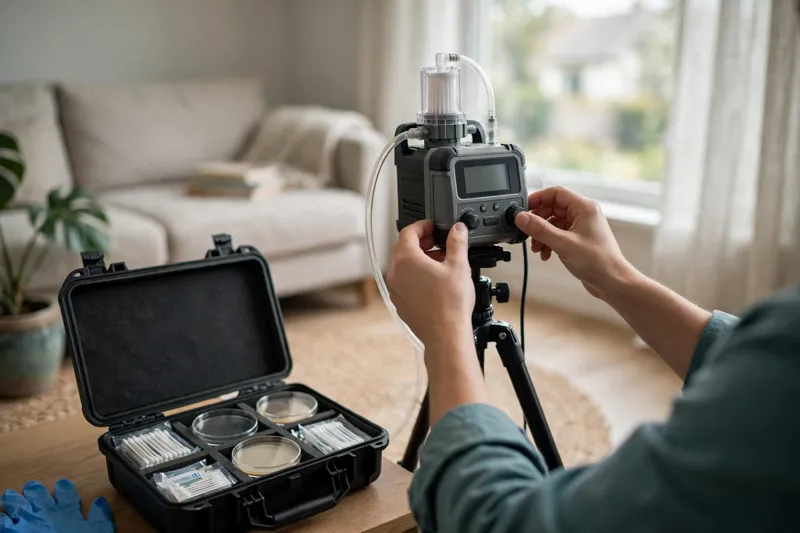
Clearance testing is the last step of a remediation, and it is the step that proves the job worked. After the growth is removed, the area is cleaned, and the space is dried to moisture readings, the air is sampled again and the spore counts are compared with the background levels outside the home. A remediated home is one where the spore counts are back to normal background levels, not a home with no spores, because spores are everywhere and no home is ever spore-free. A company that promises a spore-free home is promising something that does not exist. Ask for the clearance check, and ask for the numbers in writing.
Testing also has one rule that matters for trust: the testing should be independent of the company doing the work. A company that tests its own work has a reason to pass it, and a company that finds mold on its own test has a reason to sell the job. Ask whether the testing is independent of the company doing the work, and ask for the laboratory report, not a summary. The report is the record, and the record is what the insurer reads.
Renters, condos and townhomes: who pays for mold in Westmont
Who pays for mold in Westmont depends on what caused it and what the lease or the declaration says. The landlord usually owns the building and its pipes, so the landlord pays for the building repair. A renter pays when the renter caused the moisture, such as an overflowing tub left running, or a window left open in a storm. Read your lease and tell your landlord the day the mold appears, because the day you tell them is the day the record starts.
A condo or townhome job is different from a single-family job, because one floor's water heater or supply line can wet two or three units below, and the association, the management company and several owners are involved. The association owns the shared wall; you own the unit. Who pays for what depends on the declaration and the bylaws, and the answer is in the documents, not in a phone call. Read them before you sign a scope of work, and keep a record of every call you make to the association, the management company and the insurer.
Mold remediation westmont jobs in condos and townhomes also have one practical difference: the containment has to protect the neighbours, not just the homeowner. A shared wall means a shared air path, and a wall opened without containment puts spores into the unit next door. The containment is plastic sheeting and negative air, and the material that comes out is bagged inside the containment, not carried through the common hallway. A company that opens a shared wall without containment has made the neighbours' problem, and the association will hear about it.
Mold through the year in Westmont
Water losses in Westmont happen all year, but the pattern is seasonal, and the season tells you where to look. Spring brings the thaw and the rain together, and the sump pump runs the most. A sump pump that failed over the winter is found in the spring, when the thaw fills the pit and the pump does not start, and mold remediation westmont work in the spring is usually a winter failure found late. Summer brings fast, hard storms that surcharge the sewers, and a sewer backup in July is a summer job.
Winter brings frozen pipes and frozen discharge lines, and a burst pipe in January is a winter job. Fall brings leaves that block the gutters and the drains, and a blocked gutter in October is a fall job.
The mold follows the water by weeks, not days. A spring flood that was dried with household fans is a summer mold job. A winter burst pipe that was dried properly is not a mold job at all. The season that matters most is the season the water was not dried, and the drying is what decides whether the mold comes. Keep the gutters clear in the fall, keep the sump pump running in the spring, keep the pipes warm in the winter, and keep the discharge line clear of ice. Four habits, four seasons, and the mold has nothing to feed on.
What mold remediation costs in Westmont
This site prints no prices, and this section tells you why, and what the cost depends on, so you can judge a quote when you get one. The cost of a mold job depends on how far the mold spread, what material it sits on, how many rooms are wet, how long the water sat, and whether the water source is fixed. A small job in one room is not the same job as a basement job, and a basement job is not the same job as a whole-home job. A company that quotes a number over the phone, before it has seen the wall, is guessing, and the guess is usually low.
A homeowner who types mold remediation cost westmont into a search box wants a number, and this page will not give one, because a number on this page would be a lie.
Another engine says the most common job is about five thousand seven hundred and seventy-five dollars. The only honest answer is a written scope of work, after an inspection, with the cost in it, before any repair starts.
What the cost depends on, in order: the extent of the growth, the material it sits on, the number of rooms, the water source, and the drying. A homeowner who types how long does mold remediation take westmont into a search box wants a number of days, and the answer is the same as the cost: it depends on how far the mold spread and whether the water source is fixed. Drywall that has to come out to above the high-water mark costs more than drywall that can stay.
Insulation that has to be discarded costs more than insulation that can dry. A job that needs containment costs more than a job that does not. A job that needs clearance testing costs more than a job that does not. And a job that starts after the water source is fixed costs less than a job that has to be done twice, because the first company did not fix the water.
Mold remediation westmont jobs also carry one cost that most homeowners do not expect: the repair after the remediation. Remediation removes the growth and the wet material. It does not rebuild the wall. The wall is rebuilt after the drying is finished and the clearance check says the space is dry. The repair is a separate scope of work, with its own cost, and it starts after the remediation ends. A quote that does not separate the two is a quote that hides the second half of the job.
Does insurance cover mold in Westmont
Insurance usually covers mold when the mold came from a sudden and accidental covered event, such as a burst pipe or an appliance failure. The insurer pays for the drying and the remediation, less your deductible, and the mold portion may have its own limit. Mold from a slow leak, poor maintenance or flooding from outside is usually not covered. The cause decides the coverage, and the cause is what the adjuster reads first.
A burst pipe is the clearest case. A pipe that froze and split in a cold snap is a sudden event, and the insurer pays for the water damage the burst caused and the mold that followed it, not for the pipe itself. A pipe that leaked slowly for months may be classed as wear and tear, and the mold that grew from it may not be covered. The difference is sudden against slow, and the difference is decided by the photographs, the receipts and the drying log. Report a burst the day you find it, and photograph everything before you move it.
Mold after water damage westmont is the search a homeowner types when the basement flooded and the mold came after it, and the answer is the same: the cause decides. A basement that flooded because a storm overwhelmed the drain is usually a flood question, not a homeowners question, and a homeowners policy does not cover flooding from outside. A basement that flooded because a sump pump failed may be covered if you hold the water-backup endorsement. A window well that flooded because a storm overwhelmed the drain is usually a flood question. A window well that flooded because a sump pump failed may be covered if you hold the endorsement. Ask your insurer before the next storm, not after it.
The payment itself depends on your policy, your deductible, the cause of the mold, and the limits you bought. No page can give you a number, because no page knows your policy. The insurer pays the cost of the drying and the remediation, less your deductible, and the mold portion may carry its own limit. Keep every receipt and photograph, and keep the drying log. The drying log is the record that settles the claim, and it costs nothing to keep.
City programmes: what Westmont can pay for, and what it cannot
Westmont has no homeowner cost-share programme for mold or flood work. That is the first fact, and it is the one most pages get wrong. The Village's Public Works Programs page lists only the Tree Seedling Giveaway, Protect our Pollinators, River Sweep, Adopt-A-Planter, the Tree Planting Incentive, trees up to five hundred and ninety-nine dollars a year, trees only, Oak-toberfest and Alley Replacement. There is no rebate, no cost-share and no grant for mold or flood work on that page, and this page does not invent one.
What does exist is a District programme, not a Village programme, and it exists only east of Cass Avenue. Mold remediation westmont homeowners east of Cass Avenue should read the letter before they buy a valve, because the letter is the programme, and the programme is the letter. The Flagg Creek Water Reclamation District's programme letter, dated December 2, 2013, says the District will reimburse an owner up to four thousand dollars or fifty percent of the cost, whichever is less, of installing an approved backflow prevention device or overhead sewer.
The letter says a check valve may cost as little as one thousand to two thousand dollars. The contact is (630) 323-3299, extension 6101, and the District is at 7001 Frontage Road, Burr Ridge, Illinois 60527. The letter says nothing about whether the reimbursement is limited to a single payment, and this page does not assert it. No current-year funding confirmation was found on the District's site, so the figures are framed as the District's 2013 programme letter wording, not as a current offer.
The total programme funding limit in the District's Chapter 41 is twenty thousand dollars for the period to April 30, 2014, a total limit, not a per-homeowner cap, and it is changeable or eliminable on annual review.
West of Cass Avenue, the Downers Grove Sanitary District runs three programmes of its own: the Building Sanitary Service Repair Assistance Program, the Overhead Sewer Program and the Building Upstream Program. The Overhead Sewer Program's cap, as recorded in the Downers Grove battery, is up to three thousand dollars or fifty percent, whichever is less, for buildings connected before July 17, 1996. Those are Downers Grove Sanitary District figures, not Westmont figures, and they apply west of Cass Avenue only. The District is a separate unit of government, not part of the Village, and its office is at 2710 Curtiss Street, Downers Grove, Illinois 60515.
The Village's own money for stormwater comes from a sales tax, not from a homeowner programme. In the spring of 2015, Westmont voters approved a half-percent stormwater sales tax, collected since July 2015, which generates over one million dollars a year. The revenue is specifically targeted for stormwater and infrastructure improvements, public-system work, such as the St. Joseph Creek improvements and the storm sewer work, and it does not pay homeowners. A homeowner who asks the Village for a rebate for a backwater valve will be told the same thing this page tells you: the Village has no homeowner programme, and the only reimbursement is the District's, east of Cass Avenue, under the 2013 letter.
Illinois mold registration: what to ask for, and what not to believe
Illinois now has a registration for mold remediation, and it is in force. Part 835 of the Illinois Administrative Code, the mold remediation registration rules, was adopted and took effect on September 23, 2026. The Illinois Department of Public Health's own page says all mold remediators must register with the Department, unless they qualify for an exemption. There is a grace period to September 30, 2027: a company can continue without an active third-party certification until that date if it submits a registration form and obtains certification on or before September 30, 2027. After that, Section 835.210(d) says that on and after October 1, 2027, no individual remains in good standing or performs mold remediation without certification.
Three claims about Illinois registration are wrong, and this page names them so you do not believe them. The first is that Illinois has no licence or registration for mold work. That was true before September 23, 2026, and it is not true now. The second is that registrations are not yet enforced while the rules are pending.
The third is that Illinois has no state-specific licensing board solely for mold remediators. The registration is what exists.
Mold remediation westmont companies should be asked four things before the work starts. First, ask for its Illinois Part 835 registration. Second, ask whether the testing is independent of the company doing the work. Third, ask for a written scope of work before the work starts, with the cost in it. Fourth, ask for proof of liability insurance. This site claims no registration itself, and it never will. The registration is something you ask for, not something a website prints about itself. A company that cannot show its registration, or that tells you Illinois has no registration, is a company that has not read the Department's page.
The sump pump rule, the permit and the penalty
Westmont's sump pump rule is a Village rule, and it is written in the Municipal Code. Section 70-22 says a sump pump discharge shall be located at least 25 feet from any Village right-of-way, and the flow caused to dissipate before reaching such right-of-way. A sump pump that discharges onto the sidewalk, or into the street, or onto the neighbour's lot, is a violation. A sump pump that discharges twenty-five feet from the right-of-way, with the flow dissipating before it reaches the right-of-way, is in compliance. Measure the discharge before you call the job done.
A drain tile or sump pump job needs a waterproofing permit, and the Village's Waterproofing Permit Guide, revised March 2025, says so. The fee is four-tenths of one percent of the cost of construction, with a minimum of one hundred dollars. The remaining fees are assessed at the time of permit issuance. A permit will not be issued until the contractor or contractors are registered. That last line is the one most homeowners miss: the contractor has to be registered before the permit is issued, not after the work starts.
Working without a permit carries a penalty, and the Village's own "Work Without A Permit" page states it in full, quoting Section 18-45: the person shall be assessed a penalty of three hundred dollars, or double the total cost of the permit, whichever is greater, plus the cost of the permit to be issued. The Village adds the cost of the permit to the penalty, the penalty is not instead of the permit, it is in addition to it. A job done without a permit costs the penalty, plus double the permit cost, plus the permit cost itself. Get the permit first.
The 50 percent rule, in plain words
The only 50 percent rule that counts is a FEMA rule for homes in a floodplain. If repairs cost half or more of what the home is worth, excluding the land, the home must be brought up to current flood standards. That is the rule, and it is the only 50 percent rule this page prints. There is no informal fifty-fifty split between insurance and remediation, and no page should invent one. A page that tells you the insurer pays half and you pay half is inventing a rule that does not exist.
The rule matters for mold work in one way: a home that flooded, and whose repairs reach half the value of the home, has to be brought up to flood standards, and the mold remediation is part of those repairs. A home that flooded once, and was repaired without meeting the standards, is a home that will flood again, and the mold will come back with the water. The rule is a flood rule, not a mold rule, but the mold follows the flood, and the flood follows the rule. Mold remediation westmont jobs in a floodplain home are flood jobs first and mold jobs second, because the water is the cause and the mold is the result.
Trenchless pipe bursting is not a burst pipe
Trenchless pipe bursting replaces a broken sewer line by pulling a new pipe through the old one, with no open trench. A burst pipe is a supply pipe that split open, usually from freezing. One engine gives trenchless pipe bursting at one hundred and forty-five to two hundred and fifty dollars or more per linear foot, with a total of six thousand to twenty thousand dollars.
Another gives one hundred and fifty to two hundred and fifty dollars per foot, with a typical total of four thousand five hundred to fifteen thousand dollars. A third gives one hundred and twenty to two hundred and fifty dollars or more per foot, with six thousand to fifteen thousand dollars or more for a forty to sixty foot lateral. This site prints no prices for either job.
What matters for mold work is which pipe broke. A burst supply pipe puts clean water on the floor, and the mold that follows it is a water-damage mold job. A broken sewer line puts sewage on the floor, and the mold that follows it is a sewage mold job, with containment and a different cleaning protocol. A trenchless pipe bursting job replaces the sewer line so the sewage does not come back. A burst pipe job replaces the supply pipe so the water does not come back. The two jobs are different, the two waters are different, and the two molds are different. Tell the company which pipe broke, and the company will tell you which job it is.
St. Joseph Creek: the water behind Westmont mold
St. Joseph Creek is the water behind Westmont mold, and it is the only waterway this page names for Westmont, because it is the only one the Village's own pages name. The creek's watershed is 24 square miles, and the final watershed plan is dated February 2021. The creek flooded the village in April 2013, and the United States Geological Survey gauge on the creek, station 05540195, recorded a peak flow of 2,290 cubic feet per second on April 18, 2013, at a gage height of 12.89 feet. The 1996 peak of 1,280 cubic feet per second is the annual peak for that year, not the record, and this page does not print it as the record.
Three concern areas are partly confirmed, in different wording, in the Park District minutes of September 9, 2015: King Arthur Court, Grant and Richmond Streets, and North Warwick. Those are the streets the Village's own records name. The federal disaster declaration for the April 2013 flooding, FEMA-4116-IL, covered flooding from April 16 to May 5, 2013, across forty-six Illinois counties. The Village's own Stormwater Management page says that following the devastating flood in April of 2013, the Village created the Community Stormwater Committee to study the causes and possible solutions for flooding in Westmont. The creek is the water, the flood is the record, and the mold is the result.
Lookalikes: the other Westmonts, and the towns next door
Westmont is not the only Westmont, and the search engines know it. There is a Westmont in New Jersey, and a Westmont in California, and a Westmont in the search results for every term that does not carry the state. A homeowner who types the head phrase without the state may see a Westmont that is not this Westmont, and a page that does not carry the state in its title and its headings may rank for the wrong Westmont. This page carries the state in its title, in its headings and in its address, because the state is what separates this Westmont from the others.
The towns next door matter too, because the mold work crosses their lines. Clarendon Hills is east of Cass Avenue, and it is where the Flagg Creek district's work begins. Darien is south, and Oak Brook is north. A homeowner on the Downers Grove line calls the Downers Grove district. A homeowner on the Clarendon Hills line calls Flagg Creek. A homeowner south of 67th Street calls DuPage County Public Works. The town you live in decides the office you call, and the office you call decides how fast the water stops.
The Village, the districts and the county: who to call, with the
The Village of Westmont's own offices are the first call for storm drainage and for permits, and they are not the call for sewer service. Village Hall is at 31 W. Quincy Street, Westmont, Illinois 60559, and the number is (630) 981-6200, Monday to Friday, 8:00am to 4:00pm. Public Works is at 155 E. Burlington Avenue, Westmont, Illinois 60559, and the number is (630) 981-6270, Monday to Friday, 7:00am to 3:30pm. Public Works has six divisions, and the Underground Division handles the public storm sewers, the street drainage and the water main breaks.
The Village's Report A Concern page takes requests online, but it has no request type for a sewer backup or for flooding. After hours, the Westmont Police non-emergency line takes the call at (630) 981-6300, press 9, and an emergency is 9-1-1.
The sanitary districts are the call for sewer backups, and they are separate units of government, not part of the Village. The Downers Grove Sanitary District is at 2710 Curtiss Street, Downers Grove, Illinois 60515, and the number to report a backup is (630) 969-0664, any time. The Flagg Creek Water Reclamation District is at 7001 Frontage Road, Burr Ridge, Illinois 60527, and the number is (630) 323-3299, extension 6101 for the reimbursement programme. The DuPage County Public Works Department takes the call for properties south of 67th Street at (630) 407-6800.
The DuPage County Health Department takes mold guidance calls at (630) 682-7400. The Illinois Department of Public Health takes registration questions through its own site, dph.illinois.gov. The Village's live site is westmont.illinois.gov, the old village domain does not resolve, and this page does not print it as a working address.
Mold remediation westmont work in this village is a job that crosses five offices: the Village for the permit and the storm drain, the district for the sewer, the county for the properties south of 67th Street and for the mold guidance, the state for the registration, and the federal government for the floodplain rule. A page that gives you one office has given you one fifth of the answer. This page gives you all five, with the numbers, because the first hour after you find mold is spent on the right call.
The creek, the plans and the tax
St. Joseph Creek is the water behind Westmont mold, and the plans for it are the plans this page can verify. The final watershed plan for St. Joseph Creek is dated February 2021, and the watershed is 24 square miles. The Village's Stormwater Management page names the April 2013 flood and the Community Stormwater Committee that was created after it. The March 2018 NPDES plan, fifty-nine pages, is the only Village-linked stormwater plan that could be located, and its pages four and five contain no four-watershed division and no mention of any other creek.
The January 2011 Stormwater Master Plan could not be located anywhere, not on the Village site, not on Google, not on Bing, and not on the DuPage County Watershed Plans page. This page does not print a four-watershed list, because the plan that would support it could not be found.
The money for the public stormwater work comes from a sales tax, not from a homeowner programme. In the spring of 2015, Westmont voters approved a half-percent stormwater sales tax, collected since July 2015, which generates over one million dollars a year. The revenue is specifically targeted for stormwater and infrastructure improvements, public-system work, such as the St. Joseph Creek improvements and the storm sewer work, and it does not pay homeowners. A homeowner who asks the Village for a rebate for a backwater valve will be told the same thing this page tells you: the Village has no homeowner programme, and the only reimbursement is the District's, east of Cass Avenue, under the 2013 letter.
Mold in Westmont businesses and rental buildings
Mold in a Westmont business is a different job from mold in a Westmont home, because a business has customers, employees and a lease, and a rental building has tenants and a landlord. A restaurant with mold behind the wall is a health question, not just a building question. An office with mold in the ceiling is a question for the employees who breathe the air. A rental building with mold in three units is a question for the landlord, the tenants and the insurer, all at once.
Mold remediation westmont work in a business starts the same way it starts in a home: find the moisture, contain the area, remove the growth, clean what stays, and dry the space. The difference is the containment. A business cannot close for a week, and a rental building cannot empty for a week, so the containment has to let the business keep running while the work goes on. The contained area is sealed, the negative air runs, and the work happens inside the containment while the rest of the building stays open. A company that tells a business to close for the whole job has not planned the containment.
A rental building also has a record-keeping duty that a home does not. The landlord has to tell the tenants what was found, what was done and when the clearance check says the space is dry. The tenants have to be told the day the mold appears, and the landlord has to be told the day the mold appears. The record is the photographs, the receipts, the drying log and the clearance report, and the record is what the insurer reads and what the tenants ask for. Keep the record, and keep it in writing.
Mold by building type in Westmont
A ranch is the most common house in Westmont, and its mold job is the lower level. A ranch has one floor above grade and one floor below, and the lower level is where the water comes in. A split-level has three levels, and its mold job is the lowest level and the stairwell between the levels. A townhome has shared walls, and its mold job is the shared wall and the unit below. A condo has a shared wall and a shared floor, and its mold job is the same as a townhome's, with an association in the middle. A two-story house has a mold job in the attic as well as the lower level, because the warm air rises and the cold roof deck condenses it.
The building type decides the containment, the drying and the repair. A ranch lower level is a containment of one room, with the family living upstairs. A split-level lowest level is a containment of two rooms, with the family living on the middle level. A townhome shared wall is a containment that protects the neighbours. A condo is a containment that protects the association's common areas. A two-story attic is a containment of the attic hatch, with the family living below. The job is the same in every building, find the moisture, contain the area, remove the growth, clean what stays, dry the space, but the containment is different in every building, and the company has to plan it for the building it is standing in.
Mold remediation westmont work in a 1960s or 1970s ranch or split-level also has one more feature: the materials are old. The drywall is old, the insulation is old, and the framing is old. Old drywall that has been wet is discarded, not cleaned, and the DuPage County Health Department's guidance says so: porous materials, ceiling tiles, sheetrock, carpeting and wood products, are discarded. Old insulation that has been wet is discarded too. The repair after the remediation is a rebuild of the wall, not a patch of the paint, and the rebuild starts after the drying is finished and the clearance check says the space is dry.
Choosing a mold company in Westmont
Choose a mold company the way you choose a surgeon: by what it asks you, not by what it tells you. A good company asks where the mold is, what it looks like, whether there is water with it, and when you first saw it. A good company asks for the inspection before it quotes a price. A good company asks whether the testing is independent. A bad company quotes a price over the phone, before it has seen the wall, and a bad company tells you Illinois has no registration.
Ask four things before the work starts, and do not accept a job that has no answer. First, ask for its Illinois Part 835 registration. Second, ask whether the testing is independent of the company doing the work. Third, ask for a written scope of work before the work starts, with the cost in it. Fourth, ask for proof of liability insurance. Then ask for the drying log, and ask for the clearance check in writing. A company that can answer all six is a company that has done this job before. A company that cannot answer the first is a company that has not read the Department's page.
Mold remediation westmont companies should also be asked one more thing: how they contain the area. The containment is plastic sheeting and negative air, and the material that comes out is bagged inside the containment, not carried through the house. A company that opens a wall without containment has spread the mold through the house, and the job has doubled. Ask how it contains the area, and do not accept a job that has no answer. The containment is the step that separates a remediation from a wipe, and it is the step most homeowners never see.
The first-hour checklist for mold in Westmont
Print this section, or save it on your phone, because the first hour after you find mold is the hour that decides whether the job is small or large. Seven steps, in order, and each one takes minutes.
- Call us first, at (773) 570-9869. We answer 24/7, and we talk you through the first hour while a crew is on the way.
- Stop the water at the source, if you can do it safely. Turn off the main water valve if the water is coming from a pipe, and turn off the water heater as well.
- Do not wipe a large patch, and do not run a fan on it. Both spread spores through the house. Keep the room closed, and keep children and pets out.
- Wear a respirator, gloves and eye protection if you must go into the room. Do not go in without them.
- Photograph the mold and the water line before anything is moved, and keep a written list of what was wet, what you moved and what was thrown away.
- Call the district if the water came up through a floor drain: Downers Grove west of Cass Avenue at (630) 969-0664, Flagg Creek east of Cass Avenue at (630) 323-3299, DuPage County Public Works south of 67th Street at (630) 407-6800. For storm drainage, call Village Public Works at (630) 981-6270. After hours, call the Westmont Police non-emergency line at (630) 981-6300 and press 9, and dial 9-1-1 for an emergency.
- Ask for the registration before the work starts. Ask for the Illinois Part 835 registration, ask whether the testing is independent, ask for a written scope of work, and ask for proof of liability insurance.
Mold remediation westmont jobs that start with this checklist are jobs that end well, because the water is stopped, the mold is contained, the record is kept, and the right office is called. Jobs that start without it are jobs that double: the water keeps feeding the wall, the spores spread through the house, the insurer has no record to read, and the wrong office takes the call. Seven steps, one hour, and the job is half done before the crew arrives.
After the job: the clearance check and the repair
After the job, two things happen, in order: the clearance check, and the repair. The clearance check comes first, because the repair cannot start until the space is dry. The air is sampled, and the spore counts are compared with the background levels outside the home. A remediated home is one where the spore counts are back to normal background levels, not a home with no spores, because spores are everywhere and no home is ever spore-free. The clearance check is the proof that the job worked, and it is given to you in writing, with the numbers.
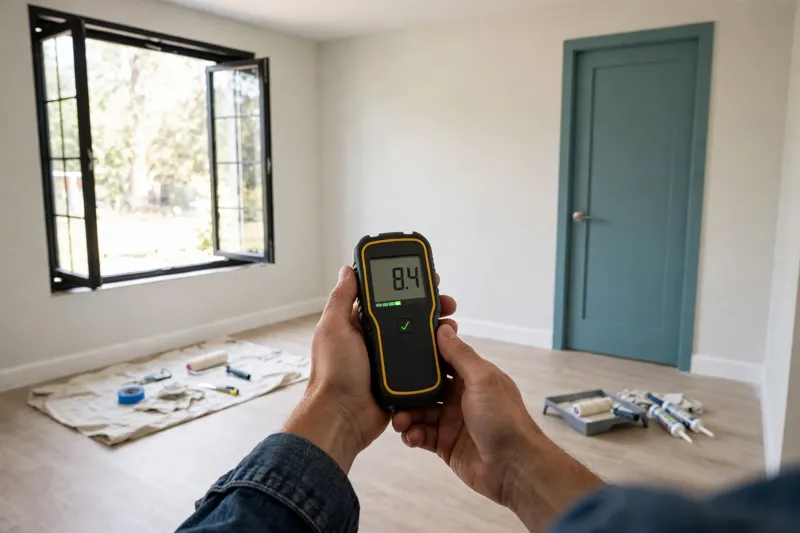
The repair comes second, because the wall cannot be rebuilt until the drying is finished. The drywall that came out to above the high-water mark is replaced. The insulation that was discarded is replaced. The framing that was cleaned is left to dry, and the moisture readings are taken each day until they say dry. The repair is a separate scope of work, with its own cost, and it starts after the remediation ends. A quote that does not separate the two is a quote that hides the second half of the job.
After the job, keep the record. The photographs, the receipts, the drying log and the clearance report are the record, and the record is what the insurer reads, what the next buyer asks for, and what the association asks for. A home with a record is a home that can be sold. A home without a record is a home that has to be explained. Keep the record, and keep it in writing.
Mold remediation westmont work is not finished when the crew leaves. It is finished when the clearance check says the space is dry, the spore counts are back to normal background levels, and the repair is done. A company that leaves without a clearance check has left the job half done. A company that leaves without a drying log has left no record that the drying happened. Ask for both, and do not let the walls close until you have them.
Winter preparation for Westmont homes
Winter is the season that makes mold, because winter is the season that bursts pipes and freezes discharge lines. Mold remediation westmont jobs in winter are usually a burst pipe or a frozen discharge line, and both are preventable. A pipe that froze and split in a cold snap puts clean water on the floor, and the mold that follows it is a water-damage mold job. A sump pump discharge line that froze puts water back into the pit, and the pit overflows, and the mold that follows it is a sump pump mold job. Both are preventable, and both are prevented the same way: keep the pipes warm, and keep the discharge line clear of ice.
Four habits, before the first freeze. First, insulate the pipes in the unheated spaces, the crawl space, the attic, the garage and the lower level. Second, keep the heat on in the whole house, even in the rooms you do not use, because a cold room is a room with a frozen pipe. Third, keep the sump pump discharge line clear of ice, and check that the discharge is at least 25 feet from any Village right-of-way, with the flow dissipating before it reaches the right-of-way, as Section 70-22 requires. Fourth, keep the gutters clear of leaves, because a blocked gutter in October is a wet wall in January.
A burst pipe in January is a sudden event, and the insurer usually pays for the water damage the burst caused and the mold that followed it, not for the pipe itself. A pipe that leaked slowly for months may be classed as wear and tear, and the mold that grew from it may not be covered. Report a burst the day you find it, and photograph everything before you move it. The difference between covered and not covered is sudden against slow, and the difference is decided by the photographs, the receipts and the drying log.
What a written scope of work must contain
A written scope of work is the document that separates a remediation from a guess, and it must contain six things. First, the moisture source, and how it was found. Second, the extent of the growth, and how far it spread, with the moisture readings that prove it. Third, the containment, the plastic sheeting and the negative air, and how the area will be sealed before the wall is opened. Fourth, the removal, what comes out, what stays, and what is discarded, with the porous materials named. Fifth, the drying, the air movers and the dehumidifiers, the readings that will be taken each day, and the number that means dry. Sixth, the verification, the clearance check, with the spore counts compared to the background levels outside the home.
A scope of work that does not contain all six is a scope of work that hides the job. A scope that does not name the moisture source is a scope that will fail, because the water will feed the wall again. A scope that does not name the containment is a scope that will spread the mold through the house. A scope that does not name the drying readings is a scope that will close the walls wet. A scope that does not name the clearance check is a scope that has no proof the job worked. Ask for the scope, read it, and do not sign a scope that is missing any of the six.
The scope of work also carries the cost, and the cost is in the scope, not on the phone. A company that quotes a number over the phone, before it has seen the wall, is guessing, and the guess is usually low. A company that inspects first, then gives you a written scope with the cost in it, is a company that has measured the job. The inspection is free of guesswork, and the scope is the record of what was measured. Keep the scope, and keep it in writing, because the scope is what the insurer reads and what the next buyer asks for.
Mold remediation street by street in Westmont
Westmont is a village of streets, and the mold work follows the streets, because the water follows the streets. Cass Avenue is the dividing line, and the district you call depends on which side of it your home sits on. Ogden Avenue is the northern edge of downtown, and Quincy Street is the east-west street through downtown, where Village Hall sits at 31 W. Quincy Street. Burlington Avenue is where Public Works sits, at 155 E. Burlington Avenue. Naperville Road runs diagonally through the west side, and 63rd Street marks the southern edge, where the DuPage County Public Works Department takes the call for properties south of 67th Street.
A homeowner who types mold remediation westmont il near cass avenue into a search box is standing on the dividing line itself, and the answer is the line: west of Cass Avenue, the Downers Grove Sanitary District takes the call at (630) 969-0664. East of Cass Avenue, the Flagg Creek Water Reclamation District takes the call at (630) 323-3299. The GPS anchor for this page is the Cass Avenue and Burlington Avenue crossing in downtown Westmont, on the dividing line itself, at 41.79585 north, 87.97533 west, which is why this page uses it.
A crew that knows which side of Cass Avenue it is standing on knows which district to call, and a crew that does not know is a crew that will spend the first hour on hold with the wrong office.
The concern streets are the streets the Village's own records name: King Arthur Court, Grant and Richmond Streets, and North Warwick. Those are the streets the Park District minutes of September 9, 2015 name, in different wording, and they are the streets this page names. The creek runs through the village, and the flood of April 2013 is the flood the Village's own page names. The water is the cause, the mold is the result, and the job is to fix the water first and remove the mold second, on every street in the village, from Cass Avenue to the Downers Grove line, from Ogden Avenue to 63rd Street, and from St. Joseph Creek to the Clarendon Hills line.
Mold remediation westmont work is the same job on every street, and it is a different job on every street, because the water is different on every street. A lower level on King Arthur Court that flooded in April 2013 is a different job from a townhome bathroom on Naperville Road with a slow leak, and a townhome bathroom with a slow leak is a different job from an attic on 63rd Street with a fan that vents into the roof. The job is the same, find the moisture, contain the area, remove the growth, clean what stays, dry the space, but the water is different, and the water is what gets fixed first.
Call now, we answer 24/7
Mold in your Westmont home? Call (773) 570-9869 now. We answer day and night, we find the moisture that feeds it, and we do not stop until the readings say dry.
Frequently asked questions about mold in Westmont
What is mold remediation in Westmont?
Mold remediation in Westmont is the job of finding the moisture that feeds the mold, containing the area so spores do not spread, removing the growth and the wet material it sits on, cleaning what stays, and drying the space so it cannot grow back. It starts with an inspection and ends with a clearance check.
What is the 50 percent rule for mold remediation in Westmont?
The only 50 percent rule that counts is a FEMA rule for homes in a floodplain. If repairs cost half or more of what the home is worth, excluding the land, the home must be brought up to flood standards. No informal fifty-fifty split between insurance and remediation exists, and no page should invent one.
How long does mold remediation take in Westmont?
A small job in one room takes one to two days of active work, and a basement or attic job takes two to five days. A whole-home job can take one to three weeks. The time depends on how much mold there is, how far it spread, what material it sits on, and whether the water source is fixed first.
What is mold remediation called?
It is called mold remediation, and removal is only one step inside it. Remediation is the whole process: find the moisture, contain the area, remove the growth, clean what stays, dry the space, and verify the result. A company that only wipes the surface is doing removal, not remediation, and the mold will be back.
Does insurance cover mold remediation in Westmont?
It usually does when the mold came from a sudden and accidental covered event, such as a burst pipe or an appliance failure. The insurer pays for the drying and the remediation, less your deductible, and the mold portion may have its own limit. Mold from a slow leak, poor maintenance or flooding from outside is usually not covered.
What is the process for mold remediation in Westmont?
The process runs in order: inspection, containment, removal, cleaning, drying and verification. We find the moisture source and measure how far the mold spread, seal the area and run negative air, remove the growth and the wet material, clean what stays, dry the space to moisture readings, and check the result before the repair starts.
Does homeowners insurance cover mold in Westmont?
It usually does when the mold came from a covered event, such as a burst pipe or a storm that damaged the roof. It does not cover mold from a slow leak, high humidity, poor ventilation or flooding from outside. Report the mold the same day you find it, and photograph everything before you move it.
What should I do when I find mold in my Westmont home?
Call us first, then stop the water at the source if you can do it safely. Do not wipe a large patch or run a fan on it, because both spread spores through the house. Wear a respirator, gloves and eye protection, keep children and pets out of the room, and photograph the mold before anything is moved.
How much does insurance pay for mold remediation in Westmont?
No page can give you a number, because the payment depends on your policy, your deductible, the cause of the mold, and the limits you bought. The insurer pays the cost of the drying and the remediation, less your deductible, and the mold portion may carry its own limit. Keep every receipt and photograph.
Are renters responsible for mold in Westmont?
It depends on what caused the mold and what the lease says. The landlord usually owns the building and its pipes, so the landlord pays for the building repair. A renter pays when the renter caused the moisture, such as an overflowing tub left running. Read your lease and tell your landlord the day the mold appears.
How much does mold testing cost in Westmont?
This site prints no prices, so no figure here can mislead you. The cost depends on how many samples are taken, whether the testing is air or surface, and whether the tester is independent of the company doing the work. We inspect first, then give you a written scope of work with the cost in it.
Does insurance cover mold caused by a burst pipe in Westmont?
It usually does when the pipe burst suddenly, such as a pipe that froze and split. The insurer pays for the water damage the burst caused and the mold that followed it, not for the pipe itself. A pipe that leaked slowly for months may be classed as wear and tear, so report a burst the day you find it.
How much does trenchless pipe bursting cost in Westmont?
Trenchless pipe bursting replaces a broken sewer line by pulling a new pipe through the old one, with no open trench. A burst pipe is a supply pipe that split open, usually from freezing. The two jobs are different, and this site prints no prices for either one.
How much does water damage restoration cost in Westmont?
This site prints no prices, so no figure here can mislead you. The cost depends on how much water there is, what kind of water it is, how many rooms got wet, and what material it soaked. We inspect first, then give you a written scope of work with the cost in it before any repair starts.
Can mold be fully remediated in Westmont?
Yes, when the water source is fixed first and the drying is finished to moisture readings. Remediation removes the mold growth and the wet material it sits on, cleans what stays, and dries the space so it cannot grow back. It cannot work if the leak keeps feeding the wall. Spores are everywhere, so no home is ever spore-free.
Who do I call first for mold after basement flooding in Westmont?
Dry the water first, remediation follows drying, not the other way round. If the water came up through a floor drain, call the sanitary district for your side of Cass Avenue before a plumber: Downers Grove west of Cass at (630) 969-0664, Flagg Creek east of Cass at (630) 323-3299. Then call us for the mold.
What should I ask a mold company in Westmont about Illinois registration?
Ask for its Illinois Part 835 registration, which has been in force since September 23, 2026, with a grace period to September 30, 2027. Ask whether the testing is independent of the company doing the work, ask for a written scope before work starts, and ask for proof of liability insurance. This site claims no registration itself.
Where does mold actually start in a Westmont home?
It starts where water sat and the wall stayed wet: a boom-era lower level that got damp and was dried with household fans, or behind the wall of a townhome bathroom with a slow leak. The April 2013 flood, the St. Joseph Creek record and the sump-pump failures on concern streets are the water behind it. Fix the moisture first.
What is the difference between mold and mildew in Westmont?
Mildew is surface mold, powdery, on damp surfaces, usually cleanable with soap and water. Mold that has grown into drywall, insulation or framing is a remediation job, not a cleaning job. Colour does not identify species, including black: lab analysis is the only identification, and no page should name a species from a colour.
What does professional mold remediation involve in Westmont homes?
It involves finding the moisture source, containing the area, removing the growth and the wet material, cleaning what stays, and drying the space to moisture readings. In Westmont we look for mold in a boom-era lower level that got damp and was dried with household fans, or behind the wall of a townhome bathroom with a slow leak.
When should Westmont homeowners schedule mold inspection and testing?
Schedule it when you see mold, smell a musty odour you cannot find, or find water damage behind a wall. Schedule it after a flood, a sewer backup or a burst pipe, even if the walls look dry. Schedule it before you buy a home with a damp basement, and after any job that opened a wall.
Who handles sewer backups in Westmont?
It depends on which side of Cass Avenue the home sits on. West of Cass, the Downers Grove Sanitary District handles the main sewer; east of Cass, the Flagg Creek Water Reclamation District handles it. South of 67th Street, the DuPage County Public Works Department handles it. The Village itself does not handle sewer service issues.
Do you work in condos and townhomes?
Yes. A condo or townhome job is different from a single-family job, because one floor's water heater or supply line can wet two or three units below, and the association, the management company and several owners are involved. Tell the association the day the mold appears, and keep a record of every call you make.
When do Westmont water losses happen?
They happen all year, but the pattern is seasonal. Spring brings the thaw and the rain together, and the sump pump runs the most. Summer brings fast, hard storms that surcharge the sewers. Winter brings frozen pipes and frozen discharge lines. Fall brings leaves that block the gutters and the drains.
Is a window well flood covered by my policy?
It depends on what caused the water and what your policy says. A window well that flooded because a storm overwhelmed the drain is usually a flood question, not a homeowners question. A window well that flooded because a sump pump failed may be covered if you hold the water-backup endorsement. Ask your insurer before the next storm.
Sources
- Village of Westmont, westmont.illinois.gov, Village Hall, 31 W. Quincy Street, (630) 981-6200; Public Works, 155 E. Burlington Avenue, (630) 981-6270; Underground Division (Cass Avenue dividing line); Stormwater Management (April 2013 flood, Community Stormwater Committee); Waterproofing Permit Guide, revised March 2025 (Section 70-22, 25 feet, fee four-tenths of one percent, minimum one hundred dollars); Work Without A Permit (Section 18-45, penalty three hundred dollars or double the permit cost, plus the permit cost); Plumbing Guide, revised March 2025 (third provider, DuPage County Public Works south of 67th Street); Public Works Programs page (no homeowner cost-share programme); Report A Concern page; Westmont Police non-emergency (630) 981-6300, press 9.
- Flagg Creek Water Reclamation District, flaggcreekwrd.org, Chapter 41 (Ordinance 870, passed August 23, 2013; total programme funding limit twenty thousand dollars to April 30, 2014); programme letter dated December 2, 2013 (reimbursement up to four thousand dollars or fifty percent, whichever is less; check valve may cost as little as one thousand to two thousand dollars; contact (630) 323-3299, extension 6101; District at 7001 Frontage Road, Burr Ridge, Illinois 60527).
- Downers Grove Sanitary District, dgsd.org, office 2710 Curtiss Street, Downers Grove, Illinois 60515; report a backup (630) 969-0664; Building Sanitary Service Repair Assistance Program, Overhead Sewer Program (up to three thousand dollars or fifty percent, whichever is less; buildings connected before July 17, 1996), Building Upstream Program; west of Cass Avenue only.
- Illinois Department of Public Health, dph.illinois.gov, Part 835 mold remediation registration, adopted and effective September 23, 2026; grace period to September 30, 2027; Section 835.210(d) cutoff October 1, 2027.
- DuPage County Health Department, dupagehealth.org, Mold guidance page and October 2008 mold fact sheet (under ten square feet homeowner with protective equipment; over one hundred square feet professional contractor; testing not recommended as a first step; spore counts ten to one thousand times background when disturbed; discard porous materials; dry two to three days; drywall removed above the high-water mark; ten percent bleach, ten minutes contact; contact (630) 682-7400).
- DuPage County Public Works Department, (630) 407-6800, for properties south of 67th Street in Westmont.
- United States Geological Survey, gauge 05540195, St. Joseph Creek at Westmont, peak flow 2,290 cubic feet per second, April 18, 2013; annual peak 1,280 cubic feet per second, July 18, 1996.
- Federal Emergency Management Agency, Disaster Declaration FEMA-4116-IL, flooding April 16 to May 5, 2013, forty-six Illinois counties.
- Dan Redden, Guardian Mold Prevent, "Can I Get Mold Regrowth After Mold Remediation? Westmont, IL", YouTube, five minutes three seconds, forty-five views, eleven years ago; Westmont basement, project finished July 2014, revisited about six to seven months later.
- WikiHow, "How to Get Rid of Mold and Mildew: Expert-Backed Tips", co-authored Mike Kapur, Certified Mold Assessor and Home Inspector, Sonic Home Inspections, and Raven Minyard, BA; last updated July 25, 2026; 1,443,212 views.
- St. Joseph Creek Watershed Plan, final, February 2021, watershed 24 square miles.
- Park District minutes, September 9, 2015, concern areas King Arthur Court, Grant and Richmond Streets, and North Warwick.
Mold remediation near Westmont
More Restoration Services Near Westmont
Every service below is one tap away. Pick the one that matches your problem.

Water Damage Restoration
Fast water extraction, structural drying, and full repair after burst pipes, leaks, and floods.
Learn more →
Water Mitigation
Emergency water removal, structural drying, and mold prevention to stop the damage fast, 24/7.
Learn more →
Mold Remediation
Safe, contained mold remediation that removes contamination and fixes the moisture source.
Learn more →
Sewage Cleanup
Safe removal and disinfection of dangerous sewage backups and black water.
Learn more →
Flood Cleanup
Water pumped out, structure dried, and debris cleared fast after storms and flooding.
Learn more →
Hardwood Floors Water Damage
Cupped, buckled or stained hardwood after a leak? How we dry it, when sanding saves it, and when the boards have to go.
Learn more →