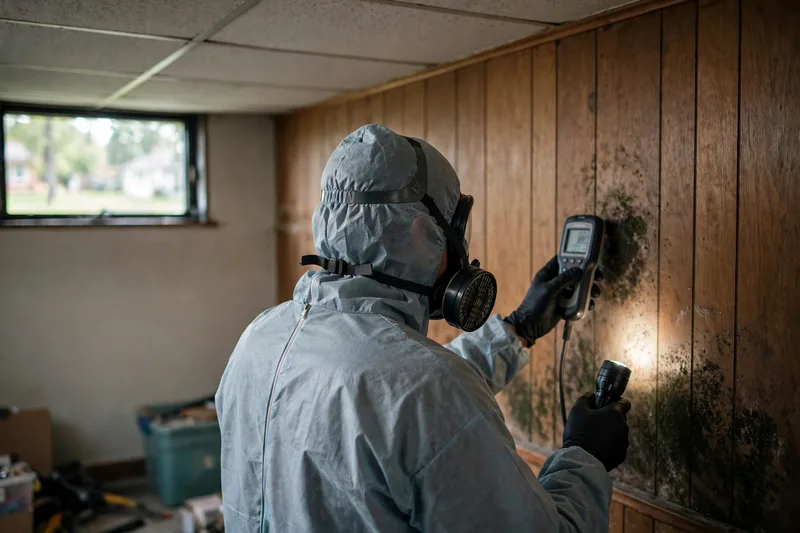
The short answer: mold remediation skokie work means finding the moisture that is feeding the growth, sealing the area under containment, removing the mold and the material it ruined, cleaning and drying the structure, and proving the result, not spraying a surface and hoping. Small patches under about 10 square feet on hard surfaces can be a careful do-it-yourself job once the water source is fixed; anything larger, inside walls or ducts, across attic decking, or fed by a sewer backup or a flooded basement is professional work. A mold remediation skokie job succeeds or fails on the moisture fix: remove the growth and leave the water, and the mold returns on schedule. Everything below is that answer in full.

Found mold in your Skokie home: the first steps
The first hour with mold is calmer than the first hour with a flood, and the mistakes are quieter too. Most of the damage done in week one is done by kindness: someone scrubs the patch with bleach, or paints it before the weekend guests arrive, or tears out a section of wall with no containment and spreads spores through the house on the dust. Work this short list instead. This is the same list we work from when a mold remediation skokie call comes in.
- Do not disturb a large area. Scraping, sanding or ripping out moldy material without containment is how a one room problem becomes a whole house problem. A small surface patch is fine to wipe; a wall section is not a cleaning project.
- Do not paint over it. Paint hides the stain and leaves the colony alive underneath, still fed by the wall's moisture. It also hides the evidence from the next person who needs to diagnose the problem, including you, and it is the one move a buyer's inspector is trained to notice.
- Find the water. Every colony has a supply line: a leak, condensation, a failed sump, a roof flashing, a bathroom fan venting where it should not, or a sewer line that sent water up through the floor drain in the last big storm. Look for the source and stop what you safely can. Until the water stops, every other step is temporary.
- Photograph before you clean. Date stamped photos of the growth, the room, and anything it has damaged. If insurance or a home sale ever touches this, and in Skokie a home sale touches it often, that record is what the conversation stands on.
- Keep vulnerable people out of the room. Until you know the size of it, children, anyone asthmatic and anyone with a weakened immune system should not be sleeping next to an active colony.
- Then get it assessed. Call (773) 570-9869 and describe where it is, how big it looks, and what water event you connect it with. That decides whether this is a cleaning weekend or a containment job, and it is the same first step behind every mold removal skokie call we take: the assessment itself costs nothing but the conversation.
Do it yourself or call a professional? The honest line
This is the question under almost every mold search, and it deserves a straighter answer than most companies give, since the straight answer sometimes sends you to a hardware store instead of to us. The US EPA's guidance draws the line by size, and every serious source in this trade works from the same bands. What the bands assume is that the water source is already fixed; no size of mold job is a do-it-yourself job while its water is still running.
| Affected area | Honest answer | Conditions that change it |
|---|---|---|
| Under 10 square feet (about a 3 by 3 foot patch) | Reasonable to clean yourself on hard surfaces: detergent and water, gloves, ventilation, dry it fully | Call instead if it is on drywall or wood that stayed wet, or anyone in the home is asthmatic or immune compromised |
| 10 to 30 square feet | Get a professional assessment before you decide; this is the band where surface cleaning most often hides a wall cavity problem | Any sign the growth is inside the wall, or a water source you cannot find, moves it to professional |
| 30 to 100 square feet | Professional work, strongly recommended: containment and air scrubbing are what keep the cleanup from spreading it | HVAC ducts involved at any size means professional, because the system distributes spores house wide |
| Over 100 square feet | Professional, no honest exception | Growth fed by sewage or flood water is professional at any size, on health grounds alone; so is mold on the old floor tile or pipe insulation of a pre 1980s Skokie home, where asbestos has to be ruled out first |
Read the table from the other direction and it also tells you when a company is overselling: a two square foot patch of mildew on bathroom tile does not need a crew in protective suits, and a company that says otherwise is telling you something about itself. A mold remediation skokie il assessment that ends with "clean it yourself, here is how" is a real outcome of calling us, and it happens.
Mold removal or mold remediation: the difference that matters
Homeowners searching mold removal skokie are usually asking for the same help as those searching remediation, but the two words promise different things, and one of the promises cannot be kept. Removal, taken literally, means a home with no mold in it. That home does not exist: mold spores are a normal part of the air in every house, and any company guaranteeing their total removal is guaranteeing the impossible.
That is worth remembering when a mold removal company advertises total elimination: the promise itself is the tell. Remediation is the discipline that actually exists. It means bringing a mold problem back to a normal condition: the moisture found and fixed, the growth and the material it ruined removed under containment, the remaining structure cleaned and dried, and the result verified. The goal is not a sterile house; it is a dry house with no active colony and no food left for the next one.
When you compare companies, ask which of the two they are selling. The ones selling remediation will show you a scope. The ones selling removal will show you a slogan. A mold remediation skokie scope that names the moisture source, the material coming out and the readings at the finish is the document that proves which of the two you are buying.
What professional mold remediation includes
Remediation services near me searches return every shape of offer in this trade, but when a job is past the do-it-yourself line, a proper one follows a sequence, and the order matters: each stage exists because skipping it is how remediation fails and mold returns. A crew doing mold remediation Skokie work contains the area first, then removes the growth, because skipping containment is how spores reach the rest of the house.
- Inspection and moisture mapping. The visible growth is the symptom; the map finds the disease. Meters trace moisture through walls, floors, ceilings and the attic, and the affected area is almost always larger than the stain that led you to it.
- A written scope. What will be contained, what material comes out and why, how cleaning and drying will run, and how the finish will be checked. Signed before demolition, it is the document your insurer or your buyer will later ask for.
- Containment and negative air. Plastic barriers, a zipper door, and a HEPA air scrubber holding the work area under negative pressure, so the spores the work raises are captured instead of toured through your home.
- Removal of what cannot be cleaned. Porous material that grew mold through, soaked insulation, ruined drywall, swollen board, is cut out and bagged inside the containment. Judgment, not enthusiasm: what can be cleaned and verified, stays.
- HEPA cleaning and treatment. Remaining surfaces are HEPA vacuumed and cleaned; structural material gets an antimicrobial treatment where it earns its place. The scrubber runs through this stage, not just the demolition.
- Drying to a standard. The structure is dried and checked against moisture readings, because a remediated room left damp is a room scheduled to regrow.
- The documentation file. Photos before, during and after, the moisture map, the readings, and the scope. For insurance claims and for home sales, this file is half the value of the job.
Mold is also where our two Skokie pages join up: most colonies here trace back to water that was never dried, or to a backup whose cleanup stopped at the visible water, which is why the drying standard on our Skokie water damage page is written the way it is. A mold remediation skokie job that ends with the sump, the leak or the venting unfixed is a job half done, and we will say so at the assessment.

How the work runs, first call to verified dry
Seven stages, in order. The two that separate remediation from enthusiastic cleaning are the containment that goes up before anything is disturbed, and the readings that prove the finish.
Call and describe the mold
Where you found it, how large the area looks, any smell, and any water event you connect it with: a basement that took sewer water, a leak, a sump failure, a home inspection finding. That description decides what the inspection carries.
Inspection and moisture mapping
The crew finds where the moisture is, not just where the growth shows. Meters and a moisture map of walls, floors, attic and cavities show the true size of the affected area, because visible mold is usually the smaller half.
Written scope before work
What will be contained, what material comes out and why, how cleaning and drying will run, and how the end will be verified. A firm written scope, signed before demolition, is your protection and ours.
Containment and negative air
The work area is sealed with plastic barriers and zipper access, and a HEPA air scrubber holds it under negative pressure. Spores raised by the work stay in the work area. This step is what separates remediation from enthusiastic cleaning.
Removal of affected material
Moldy drywall, insulation and other porous material that cannot be cleaned are cut out and bagged inside the containment. What stays is what can be cleaned and verified; what goes is what would regrow.
HEPA cleaning and treatment
Surfaces are HEPA vacuumed and cleaned, structural material is treated with an antimicrobial where it helps, and the air scrubber keeps running through the cleaning stage so what was raised is captured, not resettled.
Drying, clearance and prevention
The structure is dried to a measured standard, the area is checked against that standard, and you get the prevention handover: the source fixed, humidity targets, the village prevention options where a sewer backup started the problem, and the readings and photos file for your records, your insurer or your buyer.
Mold inspection and testing in Skokie: what helps, what is theater
Skokie is one of the few suburbs where the testing end of this trade is genuinely built out: dedicated inspection companies serve this village, test only, and do not sell cleanup. That is the healthy shape of the market, and it makes the honest version of this section easier to give, because the honest answer is: sometimes you need a test, and sometimes a test is a product being sold to you. Here is the version we give our own families.
What an inspection is. A mold inspection skokie visit that earns its name is mostly not about the mold you can see. It is a moisture investigation: meters in walls and floors, a look at the attic, the basement, the bathrooms and the usual supply lines, and a map of what is wet and why.
In this village the map has a local habit: it starts at the basement floor drain and the sump pit and works outward, because a colony fed by a sewer backup and a colony fed by a dripping sink are scoped, priced and prevented completely differently. The growth you found is the clue; the inspection's job is the cause and the true affected area. That map is what a mold remediation skokie scope should be built from, whoever writes it.
Where hidden mold lives. The colonies that surprise people are rarely on the wall they were staring at. In Skokie they hide behind the finished walls of basements that were extracted after a backup but never verified dry, inside wall cavities behind the wood paneling these homes were finished with, on the underside of attic decking above the insulation, and under flooring laid over a slab or a crawl space that wicks moisture every wet spring.
A mold testing skokie search often starts with a smell and no visible patch, and that is exactly the case where the moisture map earns its keep: the meter finds the wet cavity first, and the growth is usually keeping the same address as the water. Homeowners who meet mold for the first time during a remodel learn the same lesson from the other side: the colony was there before the wall came down, and the remodel is simply when the house showed its work.
That is the case a mold remediation skokie assessment is built for: the smell with no patch, the meter finding the wet cavity before anyone opens a wall.
When testing helps. A Skokie homeowner genuinely benefits from testing in a few clear cases: when a home purchase needs documentation, when a medical conversation needs the species identified, when a dispute, with an insurer, a landlord or a seller, needs a lab record, and after remediation, when a clearance test is how an independent check confirms the work. In those cases the sample should go to an accredited laboratory, and the person testing should have no financial interest in the remediation that follows. This village makes that easy to arrange: testing only companies are a normal call here, and using one is not an insult to whoever remediates.
When testing is theater. The Illinois Department of Public Health's own guidance is blunt: if you can see mold, you usually do not need to test to know what to do next, because every mold is handled the same way, find the water, remove the growth, dry the structure. There are no state or federal standards that declare a spore count safe or unsafe, so a report full of counts, without a moisture diagnosis, is paper.
Be equally wary of the free test offered by a company that then bids the cleanup: the test that always finds an emergency is a sales tool, not a measurement. Homeowners also meet the language of contamination levels and stages in inspection reports; it sounds more official than it is, because no state or federal scale grades a house that way. What sets a scope is the extent, measured in square feet and materials, not a stage.
Our own position is on the table: we remediate, and where a job needs independent testing, for a sale, a dispute or a clearance check, we will tell you to hire it independently rather than mark our own homework. That is the arrangement the honest end of this trade recommends, and the one we would want in our own houses.

How long mold remediation takes
Two clocks again: the remediation itself, measured in days, and the putting back, drywall, flooring, paint, measured in scheduling. The bands below follow the size of the affected area, because size, more than any product choice, is what sets the duration of a mold remediation skokie job.
| Affected area | Typical remediation time | What sets it |
|---|---|---|
| Small: under 10 sq ft | 1 to 2 days | Surface cleaning and drying; often no containment needed beyond the immediate area |
| Moderate: 10 to 100 sq ft | 3 to 7 days | Containment setup, material removal, HEPA cleaning stages and verified drying |
| Large: over 100 sq ft, whole rooms or HVAC | 1 to 3 weeks or more | Demolition scope, duct cleaning, multiple rooms in sequence, clearance checks |
| Repairs after remediation | Days to weeks beyond the above | Drywall, flooring and paint scheduling; the remediation clock ends at verified dry, the rebuild runs on its own |
The fastest lever is the same one as in water damage: how soon the problem is found and its water stopped. A colony assessed in its first month is usually a moderate job. The same colony found at a home inspection, a year into its leak or a full storm season after its backup, is how the third row of that table happens, and Skokie's basement colonies are found that way more often than any other kind, because a backup gets cleaned, the smell fades, and the wall cavity quietly keeps the secret until the next sale.
Insurance and mold: the separate limit nobody mentions
Mold has its own corner of the homeowners policy, and it surprises people at claim time because it works differently from the water that caused it. The water event and the mold are often treated as two different things by the same policy.
The mold limit. Many policies cap mold remediation at a separate, smaller amount, commonly a few thousand dollars, whatever the size of the loss. Homeowners who assumed their full policy stood behind a large mold job learn about the cap from the denial letter. Read yours now, while nothing is growing: the mold or fungi limit is usually in the endorsements, in plain figures.
Sudden versus gradual, again. Mold that follows a sudden, covered water event, a burst pipe handled promptly, has its best chance of coverage, up to that cap. Mold from a slow leak, chronic humidity, or a problem left growing is treated as maintenance and neglect, and is the standard denial. And Skokie adds the row this village's housing stock makes common: mold that follows a sewer backup lives or dies on the water backup endorsement, because without it the underlying water was never covered, and its consequences are not either.
| Situation | Usually covered? | Why |
|---|---|---|
| Mold after a burst pipe or appliance failure, reported promptly | Often yes, up to the policy's mold limit | The cause was sudden and accidental; the mold is a consequence of a covered event |
| Mold after a sewer backup through a failed lateral or floor drain | Only with the water backup endorsement, and the mold limit still applies | The underlying water needs its own endorsement before its consequences are considered; in Skokie this is the row that decides most basement claims |
| Mold after sump failure during a storm | Usually only with the water backup endorsement | Sump water is treated like other water that rises or backs up, not like a burst pipe |
| Mold from a slow leak over months | Usually no | Gradual damage is treated as maintenance, not an accident |
| Mold from chronic humidity or poor ventilation | Usually no | A housekeeping condition, not an insured event |
| Testing and remediation beyond the mold cap | The excess is the homeowner's | The cap is a hard ceiling in most policy wordings |
The working habits that protect a mold claim are the water damage ones: document before you clean, keep damaged material until it is released, and have the remediation documented with photos, a moisture map and readings. If a claim is mishandled, the Illinois Department of Insurance is the consumer backstop. And one question from the forums deserves a straight answer here: homeowners ask whether even asking their insurer about mold will count against them. A documented, promptly handled claim on a real event is what the policy is for; an undocumented problem left growing is the worst of both worlds.
Mold and your health: the calm, honest version
No section of this page matters more to get right in tone, because the internet offers homeowners two bad options: panic, or dismissal. The health agencies, the EPA, the CDC and the Illinois Department of Public Health among them, describe something more measured. For most people, mold exposure means allergy type symptoms: a stuffy nose, itchy eyes, sneezing, coughing, a sore throat, irritated skin. For people with asthma, mold can be a genuine trigger that makes the condition harder to control, and for people with weakened immune systems, certain molds can cause infections that are serious. Those are the groups who should treat any growth at home as urgent and involve their doctor early.
What the agencies do not do is hand out the certainties the internet sells. There is no established test that proves a home's spore count is making a specific person ill, and "toxic mold" as a phrase carries more marketing than medicine.
The practical guidance that follows from the evidence is boring and solid: symptoms that worsen at home and ease away from it are worth a medical conversation and a building investigation at the same time; visible growth should be dealt with on the building's schedule, quickly, without waiting for a diagnosis to justify it; and no remediation company, including this one, is qualified to tell you what is making you sick. Our job is the house. A doctor's job is you. Beware any company that offers to do both.
A mold remediation skokie assessment will tell you what is growing and what is feeding it; what it is doing to your health is a question for your doctor, and we will say so on the first call.
Attic mold: the colony Skokie's post war roofs keep quiet
If basement mold arrives with a storm, attic mold arrives with a home inspection. It is the colony Skokie homeowners most often meet as a line in a buyer's report, years after it started, in houses whose roofs have been quietly breathing wrong for a decade.
The village's housing stock shapes it: the low, wide roofs of the post war ranches and split levels spread a long, shallow attic over the whole house, full of cold corners where air moves slowly and moisture settles, and a dormer or a split level offset gives it more joints to hide in. Its causes are so consistent that an experienced inspector checks the same three things first.
A mold remediation skokie attic job starts with those same three checks, because the fan, the vents and the leak are the job, and the cleaning follows them.
- The bathroom fan that vents into the attic. The single most common cause we find. Years of shower steam pumped into a cold attic condense on the roof decking and feed a colony that grows one winter at a time. The fan was supposed to vent through the roof or a wall; in a long line of post war Skokie homes, it simply ends above the insulation.
- Blocked soffit vents. Insulation pushed over the eaves starves the attic of the airflow that dries it. The attic then holds every bit of moisture the house gives it, and the north facing decking, the coldest surface, grows first.
- Ice dams, roof leaks and winter condensation. A slow flashing leak, frost that forms on the underside of the decking in a hard freeze and melts on the first warm day, or meltwater backed up behind an ice dam at the eaves, wets the same boards month after month.
An attic mold remediation job follows the same discipline as any other colony, with the order of operations flipped in one important way: the ventilation or leak fix comes with the cleaning, not after it, because attic mold cleaned under an unvented fan is a subscription, not a solution. Wet insulation under the colony usually comes out, the decking and framing are cleaned and treated, the wood is dried and proven by readings, and the bath fan ends up ducted outside where it always belonged.
Homeowners ask whether attic mold is dangerous to the living space below; the measured answer is that its spores can travel on air currents through hatches and recessed lights, which is a reason to fix it properly, and not a reason to panic about a colony that has quietly sat above the ceiling for years.
It is also why this job turns up at sales: a buyer's inspector with a ladder and a flashlight finds in ten minutes what the house hid for a decade, and the paperwork from a proper job, scope, photos and readings, is what turns that finding from a deal problem into a footnote.

Basement mold and black mold: where Skokie colonies live
Downstairs is the other home of Skokie mold, and most basement mold removal skokie calls arrive holding hands with the water page: the backup that came up through the floor drain when a clay lateral failed or a storm overwhelmed the line, the sump failure during the same storm's outage, the seepage through a foundation wall in saturated ground.
Selling a house with mold in Skokie: disclosure, honestly
Skokie trades post war houses steadily, and mold meets the sale process here more often than it meets any emergency call. The pattern is so regular it deserves its own section: a colony lives quietly in an attic or a finished basement for years, a buyer's inspector finds it in an afternoon, and the sale suddenly turns on a question neither side planned for. What happens next depends almost entirely on whether the problem arrives with paperwork or without it. The questions homeowners around this village ask about disclosure, being sued over a sale, and proving what a seller knew are among the most repeated mold questions in the local searches; this is the building side of the answers.
The disclosure duty. Illinois law requires sellers to complete a residential disclosure report covering known material defects, and known mold, dampness and flooding history belong in that territory. In Skokie, buyers' inspectors know exactly where this housing stock hides its problems: the attic above the bathrooms and the bottom of the basement walls are the first two stops on every inspection in the village. We are a restoration crew, not lawyers, and your broker or attorney owns the legal answer for your sale.
What we can tell you is the pattern from the building side: the sales that go wrong are the concealed ones, the colony painted over the week before listing, the basement that smells of fresh paint and old water. Buyers sue over surprises. They negotiate over disclosed, documented repairs.
Credit or remediate before closing. Sellers ask whether to fix it or credit the buyer. The documented job usually serves the seller better: a credit is priced against the buyer's worst imagination, while a remediation with a written scope, photos, readings and, where it was used, an independent clearance result, closes the question at its real size. There are sales where a credit is right, a fast closing, an estate sale, a buyer who plans a renovation anyway. The honest rule is that uncertainty is what gets discounted, and either route works better once the problem has been measured rather than guessed at. A mold remediation skokie file with a written scope, photos, readings and a clearance result is what turns that measurement into a sale that closes.
| Situation | What usually happens | What decides it |
|---|---|---|
| Known mold, disclosed, remediated with documentation | The sale proceeds; the file becomes part of the transfer paperwork | Scope, photos, readings and any clearance result the buyer can read |
| Known mold, disclosed, sold as a credit | The buyer prices the fix into the offer, usually at the pessimistic end | Whether the size was measured by an assessment or guessed from a stain |
| Mold found by the buyer's inspector, undisclosed | Renegotiation, delay, or a collapsed deal | Trust: the buyer now wonders what else was not mentioned |
| Mold concealed under paint or flooring | The worst outcome of the four: post closing disputes and legal exposure | Concealment is the one pattern the disclosure law is written against |
| Buyer or seller pays for the inspection? | Whoever ordered it, unless the contract says otherwise | An independent inspection serves both sides better than a seller's or a buyer's company marking its own side's homework |
One more Skokie habit is worth copying whether you are buying or selling: in a market of post war homes with finished basements, the pre listing or pre purchase moisture check is cheap certainty. The attic above the bathrooms and the bottom of the basement walls, on the drain side, are the two places an inspector will look first, and knowing what is there before the other side's inspector does is worth more than any argument after.
The scam guard: what an honest mold quote contains
Of every question homeowners bring to this trade, the most common is not about mold at all. It is about the quote: is this number real, or am I being worked over. The suspicion is earned. Homeowners in the Chicago suburbs tell the same story in the local forums: thousands paid for remediation that a second opinion later called unnecessary, scopes that grew once the walls were open, tests that found an emergency in every room of a house with one damp corner. The difference between the honest quote and the expensive story is rarely the mold. It is what the quote is actually selling. This section is the checklist we would hand our own families.
- A real quote starts from a moisture map, not a photograph. If the number arrived before anyone put a meter in a wall, the number is a guess wearing a uniform.
- It names rooms, materials and reasons. What comes out and why, what gets cleaned and why it can stay. A scope you can read is a plan; a single round number is an opening position.
- It separates remediation from rebuilding. Drywall, flooring and paint are a second job with a second price. Bundling them into one foggy figure is where quotes quietly double.
- It states how the finish is verified. Readings against a standard, and where the stakes call for it, an independent clearance check the company does not grade itself.
- It fixes the water, or says plainly that it does not. A scope that cleans the growth and leaves the leak, the sump, the venting or the backup route untouched is a partial scope, and should be priced and judged as one.
- The red flags rhyme. A free test that finds an emergency in every room. Fogging or spraying offered as the whole fix, with no physical removal. A price that expires if you do not sign today. A tester who earns from the cleanup his test just prescribed. Any one of them is a reason to get the second quote before the first signature.
Hold us to the same list. A mold remediation companies near me search cannot tell you which company writes scopes like this; only asking can, and the companies that work this way answer these questions without being chased.
Why mold comes back, and how Skokie homes keep it out
Ask the homeowners who have remediated twice and they will teach you this section from experience: the second job was the first job plus the water fix that should have been part of it. That is the pattern behind most repeat calls we get: the growth was cleaned, the water was not fixed. Mold needs two things, food and moisture. Your house is unavoidably made of food: drywall paper, wood, dust, the paper backing on insulation, the glue under old floor tile. Moisture is the only variable you control, which is why every durable fix is a moisture fix.
- Hold indoor humidity between 30 and 50 percent. A small gauge in the basement and the bathrooms turns guessing into knowing. Dehumidify the lower level in summer; a finished basement against cool foundation walls will push past the line on its own.
- Vent bathrooms and kitchens outside. After the attic section above, this needs no arguing: a fan that ends in the attic trades a bathroom problem for a roof problem, and attic mold is usually priced by a buyer's inspector.
- Fix leaks on the day's schedule, not the season's. The slow drip under a sink is the most productive mold farm in the average home precisely because it is small enough to postpone.
- Keep the sump system honest. A failed sump is a basement flood, and a basement flood dried late is a mold job. The backup ladder on our water page, spare pump, second pump, battery backup, high water alarm, exists because of this page's problem.
- Keep the lateral honest too. Skokie's clay laterals crack and take roots with age; a line that drains slowly is a backup rehearsing. A camera look at a suspect lateral is cheaper than the second remediation.
- Dry every water event like you mean it. Anything soaked, a spill, a leak, a backup, has 24 to 48 hours before growth can start. Drying to a reading, not to a touch, is the whole game.
- Close the sewer's door. The prevention this village offers its repeat addresses: the overhead sewer conversion that takes your basement drains off the street's level entirely, with the village sharing the cost. That program gets its own section below, because for a home whose mold started at the floor drain, it is not a plumbing upgrade. It is the end of the mold pattern.
Prevention writing in this trade usually ends by selling a coating or a spray. Ours ends with a gauge, a vent, a fixed leak and a sound drain line, because that is what the evidence supports: a home kept dry does not grow mold, whatever was sprayed on it years before.
Why Skokie homes grow mold the way they do
Mold follows the water, and Skokie's water has a local shape. The village was farmland within living memory: after the war it filled in fast, block after block of ranches, raised ranches and split levels through the 1950s and 1960s, built for young families at a speed that shows in the infrastructure now.
The sewer laterals are clay, and seventy years on they crack, shift and take root intrusions; the drains inside are cast iron, narrowing with scale; the ground is wet clay that holds storm water against foundation walls; and the low ground near the North Branch gives the water table a short walk to the nearest basement.
The basements themselves complete the pattern: poured as storage, finished later as the families grew, with carpet, paneling and drywall over walls that were never meant to be living space, and sump systems added as an afterthought that now carry a heavy load every wet spring.
It is why mold searches here spike twice a year, after the biggest storm months and during home sales: the first group found a colony, the second group had one found for them. None of this makes Skokie unusual among post war suburbs; it makes the moisture habits above worth more here than in a newer place, and it is why this page treats mold as a water problem with a longer shadow, not a separate curse. That local shape is exactly what a mold remediation skokie scope has to be built around: the clay laterals, the finished basements and the shallow attics that hide the water.
When the water came up through the drain: the village's part
Some Skokie colonies trace back to water that came into the basement from the sewer side, and those carry two questions the other colonies do not: was any of it the village's side of the line, and is there help paying to stop it happening again. The first answer follows one line on the ground. The sewer lateral, the pipe running from your house to the public main, belongs to the homeowner: its cracks, its roots and its repairs are yours. The public main in the street belongs to the Village of Skokie.
If water is coming up through several drains at once, if the street is flooded, or if your neighbors have the same water at the same hour, report it to the Village of Skokie Water and Sewer Division at (847) 933-8427: that report documents the event with a date on it, which an insurance conversation will later want, and it is how the Village learns where its system struggled in that storm. And the village has answered the second question with money.
| Question | The Village's terms |
|---|---|
| How much? | The Village shares the cost 50/50, up to 7,500 dollars |
| For what work? | Converting a home to an overhead sewer. Prevention only: cleanup, remediation and restoration are never eligible |
| How many homes? | Up to 30 homes a year, first come first served; whether places remain this year is the Division's answer to give |
| Who do I ask? | Water and Sewer Division, (847) 933-8427 |
What no version of the answer includes is a village crew drying your basement: the cleanup, the drying and the remediation are yours from the first hour, whoever's side of the line failed, and the mold clock, 24 to 48 hours on wet material, runs while the cause is argued about. Report it, document it, start drying at the same time, and put the prevention question to the Division while the memory is fresh, because the homes on an aging lateral that flood once are the homes the pattern visits again.
Choosing a mold remediation company in Skokie: the new law
Illinois changed the rules of this trade recently, and the change is a gift to homeowners who know about it. The state's Mold Remediation Registration Code took effect on September 23, 2026, under the Mold Remediation Registration Act: companies that perform mold remediation must register with the Illinois Department of Public Health, unless exempt. People already working in the trade may continue without third party certification until September 30, 2027, as long as they submit a registration form; companies that only assess and test do not register as remediators.
We state this as consumer guidance, the way the state's own pages state it, and it gives you a check that did not exist before, free and quick: ask any company you are considering for its IDPH registration. A mold remediation companies near me search cannot answer that question for you. Only the company can.
Then read the behavior, because paperwork is the floor, not the ceiling. The stories homeowners tell after bad jobs rhyme: the company that found an emergency in every room and would not put the scope in writing; the quote that doubled once the walls were open; the crew that demolished without containment and left the house dusted with the problem; the remediation that finished without anyone drying or fixing the water, so the sequel arrived by spring.
Against those, the green flags are the ones this whole page is built on: a moisture map before a number, a written scope before demolition, containment you can see, readings at the finish, and straight answers about what the company is not, not a lab, not a doctor, not a guarantor of a mold free world. Franchise or local is the smaller question: the big brands bring systems and rotating crews; a local team brings its own name on the line.
Ask the questions of us first, whether you found us through mold removal skokie il or remediation. If our answers match this page, call. If another company's are better, call them, and check their registration while you are at it.
What the quote depends on
No honest figure for mold remediation skokie work exists before someone has stood in the room, and any company giving one from a photograph is inventing it. What can be stated exactly is what the number is built from.
- The size of the affected area, measured, not guessed: the timeline table above is why a 15 square foot job and a 150 square foot job live in different worlds.
- Where the growth is. A surface colony on tile and a colony through drywall into a stud cavity, or across an attic's decking under a dormer, are different scopes wearing the same stain.
- What fed it. A colony from a bathroom fan and a colony from a sewer backup are different jobs: the second carries sewage protocols from the first square foot.
- The material involved. What can be cleaned in place versus what comes out: insulation, drywall and pad are removal items; framing and hard surfaces are cleaning items. In a pre 1980s Skokie home, add whether suspect tile or pipe insulation has to be tested before it can be touched.
- The containment and air control the job needs, which follows the size and the home's layout, including whether the HVAC system is involved.
- The water fix. A scope that excludes the leak, the sump, the venting or the backup protection is a partial scope, and should be priced and judged as one.
- Testing and documentation, where a sale, a dispute or a clearance check calls for them.
And the checklist worth keeping for any quote, ours included: it names the rooms and materials, says what comes out and why, states the containment and drying method and how the finish is verified, separates remediation from rebuilding, and is firm before the main work starts. A single round number with no scope is not a quote; it is an opening position.
Mold help across Skokie
We answer calls across the whole village, from the older streets near downtown Skokie and the Skokie Swift corridor to the neighborhoods around Old Orchard and the low ground near the North Branch, and into the neighboring communities that share Skokie's housing stock and storm pattern: Evanston, Lincolnwood, Morton Grove, Niles, Glenview and Wilmette. Most mold remediation skokie searches start in the middle of a worrying week, comparing remediation services near me; others land here from a mold removal skokie search after a home inspection found the colony first.
What they are usually asking is whether the crew knows their kind of house: the post war ranch with a finished basement, the clay lateral, the shallow attic, the sump that carries a heavy load in wet clay. That local shape of the work is what this page was written around. The full list of areas is on our service areas page, and the same crew answers at (773) 570-9869.





