
Lombard, IL 60148 · DuPage County · 24/7 emergency
Mold Remediation Lombard
You found mold on the basement wall. You need mold remediation lombard crews who answer the phone, find the water that fed it, and tell you the truth about what has to come out. That is what we do.
We inspect the growth, contain the work area, remove what cannot be saved, clean what can, dry the building to meter readings, and fix the moisture that fed it. No call centre, no sales script, no price quoted before we have seen the job. One crew, one file, one number to call.
- Crews answer 24/7, nights, weekends, holidays
- Inspection, containment, safe removal and drying
- Moisture readings written into a log you can see
- Insurance file: photographs, receipts, moisture log
Serving Lombard and the villages around it, Villa Park, Addison, Glen Ellyn, Oakbrook Terrace and Downers Grove. One phone number: (773) 570-9869.
- We answer 24/7
- Local Chicago team
- Insurance documentation help
- Straight answers, no pressure
Request mold remediation help in Lombard
Tell us where the mold is and what it looks like. We answer 24/7 and call you back within the hour.
Mold remediation in Lombard, the short answer
Mold remediation lombard work means five things in order: find the mold, contain it, remove what cannot be saved, clean what can, and fix the moisture that fed it. The first four are the cleanup. The fifth is the cure. A company that removes the mold and leaves the leak has sold you half a job, and the mold comes back, in the same wall, in the same season, fed by the same water.
Three words on this page need separating, because companies use them as if they meant the same thing and they do not. Mold removal is one part of the job: taking the mold and the material it grew on out of the house. Mold remediation is the whole job: inspect, contain, remove, clean, dry, fix the moisture source and verify the space reads dry. Mold inspection is the first step: finding the growth, mapping how far it spread, and deciding whether the work is a clean or a removal. A company that sells you removal and calls it remediation has sold you the middle of the job, and the two ends, the moisture and the verification, are the parts that decide whether the mold comes back.
When you call, we ask four questions: where is the mold, what does it look like, is water still coming in, and is anyone in the house with a breathing condition. A small patch on bare concrete is one job. Black mold across a finished basement wall is another, because the wall has to come open. Mold in a heating vent is a third, because the spores travel on the air. The answer decides what gear comes off the truck.
It spreads over one to four weeks. Lombard basements run damp, which makes it faster. Dry the space within two days, and the growth has nothing to feed on. The companies disagree on the exact window, one says twenty-four hours, one says twenty-four to forty-eight, one says seventy-two hours or less, so this page prints the range and attributes each number, instead of picking one and calling it settled.
Before anything is touched, photograph the mold and the water line, and keep a written list of what was wet and what was thrown away. The insurer reads the photographs, the receipts and the moisture log. A job with no log is a job with no proof, and a claim with no proof is a slow claim. Do not dry-brush the mold, do not point a fan at it, and do not paint over it, all three spread the spores.
One thing this page will not do: it will not invent a Lombard case. The one video we found is named below, with the honest caveat that it gives no name, no address and no date. Everything else on this page is a county fact, a Village fact, a dated regional flood, or a range the sources agree on. If a mold remediation lombard page shows you a named Lombard family with a street address and a date, ask for the source, we could not find one.
If the mold is spreading now, or the water is still coming in, skip the reading. Call (773) 570-9869. We answer 24/7. The rest of this page is here for the morning after, when the water is out and the decisions start.
Where Lombard is, and why mold grows here
Lombard is a village in DuPage County, Illinois, west of Chicago. The 2020 census put its population at forty-four thousand four hundred seventy-six people. Its one ZIP code is 60148. The neighbouring ZIP 60181 belongs mostly to Villa Park, about seven in ten of its addresses sit in Villa Park and almost none in Lombard, so if a page lists 60181 as a Lombard ZIP, the page is wrong.
Lombard sits on a watershed divide. Most of the village drains to the East Branch of the DuPage River, a twenty-four-mile river with an eighty-two-square-mile watershed. Through Ginger Creek, parts of the village drain the other way, to Salt Creek. Glencrest Creek, an East Branch tributary, runs through Lombard itself. A sign at the Village municipal complex on Wilson Avenue marks the divide. Which side of the divide your house sits on decides which river your street drains to, and which river backs up when the rain is heavy.
About one third of Lombard still has combined sewers. A combined sewer carries sanitary waste and rainfall runoff in the same pipe. In a big rain the pipe fills past capacity, and the water overflows to ground level and comes back into homes through floor drains. The Village says a check valve or an overhead sewer, required in all new construction, may prevent a backup. The water and sewer fund is collected separately through a five dollar monthly capital fee paid by water customers, funding the gradual replacement of combined sewers. Replacing all of them at once would cost more than one hundred million dollars, so the work goes street by street, year by year.
The Village has spent real money on the other end of the problem. Pond modifications at Terrace View, Vista, Morris and Finley/Charles Lane gained twenty-six acre-feet of flood-water storage. Backup generators sit at all of the village's fourteen sanitary pumping stations, so the pumps keep running when the power goes out. The Crescent Avenue pump station at the East Branch, a forty-year-old station, was replaced, and its pumping rate rose from fifty to one hundred seventy cubic feet per second until the river reaches its ten-year flood stage. The Westwood Creek Channelization Project re-establishes drainage impeded by silt and sediment and reduces flooding south of North Avenue.
The villages around Lombard share the same creeks and the same weather. Ginger Creek runs through Downers Grove, Lombard, Oak Brook, Oakbrook Terrace and Westmont, and the East Branch watershed takes in Bloomingdale, Glendale Heights, Glen Ellyn, Downers Grove, Lisle, Westmont, Woodridge and Naperville. A storm that floods Lombard floods the villages on the same creek, and a crew that works the whole watershed knows the pattern.
The same firms show up on the live search for all of them, and the same Village programmes, the Residential Drainage Program, the Overhead Sewer Grant, the Clear Water Disconnect Grant, exist only in Lombard, because each village runs its own grants and its own rules. A homeowner in Villa Park, across the line in the 60181 ZIP, does not qualify for Lombard's programmes, and a homeowner in Lombard does not qualify for Villa Park's. The line matters, and the ZIP on your address decides which side of it you sit on.
Our crews work from the downtown crossing of St Charles Road and Park Avenue, in the 60148 ZIP. North Lombard runs up toward Lilacia Park and the Lilac Time festival grounds. South Lombard runs down toward Yorktown Center and Four Seasons Park. The downtown district sits between them, with the Helen Plum Library and Lombard Common water park on the crew's route. The villages around Lombard, Villa Park, Addison, Glen Ellyn, Oakbrook Terrace, Downers Grove, Westmont and Oak Brook, share the same creeks and the same weather, and we serve them too.
Three dated floods explain why Lombard homeowners know the word "basement" as a verb. In July 1996, rain fell at sixteen point nine four inches in twenty-four hours near Aurora, still the Illinois statewide record, and more than thirty-five thousand homes flooded. In September 2008, rain fell across the region for fifty-one hours, and the National Centers for Environmental Information recorded major street and parking-lot flooding around Route 53 and North Avenue in Lombard itself, with Route 53 closed south of Butterfield as the East Branch overflowed.
In April 2013, the East Branch at Bolingbrook crested at twenty-five point eight five feet, and the Village newsletter put the number of flooded Lombard basements at about three thousand. Those three floods are the reason the Village's grant programmes exist, and the reason mold follows water in this village. A basement that flooded in April 2013 and was never dried to meter readings is a basement that grew mold behind the drywall, and the mold is still there, waiting for the next wet spring. They are dated regional events, not a named household's story.
Mold in Lombard follows the same pattern as water in Lombard: it starts in the basement, because the basement is the lowest point in the house and the water finds it first. Summer humidity runs above sixty percent, and a basement that is never dehumidified stays damp all summer. Spring snowmelt and the spring thaw push groundwater against the foundation, and a sump pump that fails in the thaw lets the water in.
Winter condensation forms on cold walls and cold pipes, and the damp spot behind the furnace is the first patch of the year. The county health department names the same four drivers, dampness, high humidity, poor ventilation and temperature, and a Lombard basement in July has all four. Fix the moisture, and the mold stops. Leave the moisture, and the mold comes back after every cleaning, because the cleaning treats the symptom and the water is the cause. That is why mold remediation lombard work starts in the basement, where the water finds the house first.
How mold remediation works in a Lombard home
Emergency mold remediation lombard work follows the same seven steps every time, whatever the source of the water. The order matters: containment before removal, removal before drying, drying before repair, and the file before the claim. Skip a step and the job comes back, as a smell, as a stain, or as a patch of mold in the same wall six months later.
Call us first.
Call (773) 570-9869 any time, day or night. Tell us where the mold is, what it looks like, and whether water is still coming in. We answer 24/7 and talk you through the first hour while a crew is on the way to your Lombard home.
Make it safe and stop the moisture.
Do not dry-brush the mold, do not point a fan at it, and do not paint over it, all three spread the spores. Wear an N95 mask and gloves. Turn off the heating system if the growth is near a vent, and find the water: a leak, a seep, a failed sump pump. The mold stops growing when the water stops.
Inspect and map the growth.
We meter every wall and floor, open what reads wet, and map how far the growth spread behind the paint. Hidden growth is the rule in Lombard basements, not the exception, because the water runs inside the wall before it shows on the face. You get a written scope before any work starts.
Contain the work area.
The work area is sealed with plastic sheeting, and the air is pulled through a HEPA filter so the spores do not travel to the clean rooms. Containment is what separates remediation from a clean-up: without it, the spores spread through the house on the air, and the job creates a second job.
Remove what cannot be saved and clean what can.
Porous material that grew mold, drywall, carpeting, ceiling tiles, soaked insulation, is bagged and discarded, not cleaned. Hard surfaces are cleaned and treated, and the air is HEPA-vacuumed. Nothing that grew mold goes back into the wall, and nothing porous is washed and reused.
Dry it and verify it is dry.
Dehumidifiers and air movers run until the moisture readings say dry, and the readings go into a log you can see. Dry is a number on the meter, not a look. The walls do not close until the readings say dry, because a wall closed while it is still wet grows mold behind the paint.
Fix the source and hand over the file.
The sump pump is repaired or replaced, the foundation crack is sealed after the wall is dry, the gutters are fixed so the water runs away from the wall. When the drying is finished, you get the file: the moisture log, the photographs and the receipts, ready for the insurer.
Seven places mold hides in a Lombard home
Most Lombard mold jobs come from one of seven places. Each one has its own first move, its own risk and its own insurance answer. If you know which one you have, you know what to do in the first hour.
1. The basement
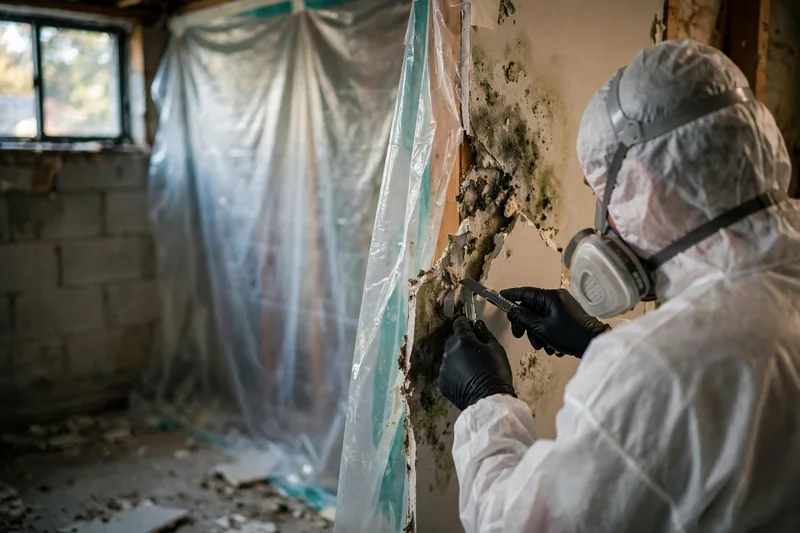
Mold in basement Lombard homes is the most common call we take, and the April 2013 flood is the reason why. Rain falls faster than the sewers can carry it away, the ground saturates, and the water finds the lowest point in the house. In a combined-sewer street it can also come up through a floor drain. The mold follows the water, and it grows behind the drywall before it shows on the face.
The first move is the same whatever the route in: find the water, stop it, and photograph the mold before anything is touched. A small patch under ten square feet on bare concrete can be cleaned by the homeowner, with an N95 mask and gloves. A larger area, finished drywall, or a musty smell with no visible patch needs a professional, because the growth is probably hidden behind the wall. Keep the humidity between thirty and fifty percent, and keep a dehumidifier running through the summer, because a Lombard basement in July runs damp without one.
Basement mold is the mold remediation lombard work that follows a basement flood: inspection, containment, removal, cleaning and drying, in that order. Flood water from outside is not covered by a standard homeowners policy, it needs flood insurance, so the file matters even more. Keep the photographs, the receipts and the moisture log, and keep the list of what was thrown away. A claim with no proof is a slow claim.
2. Behind the drywall, after water damage
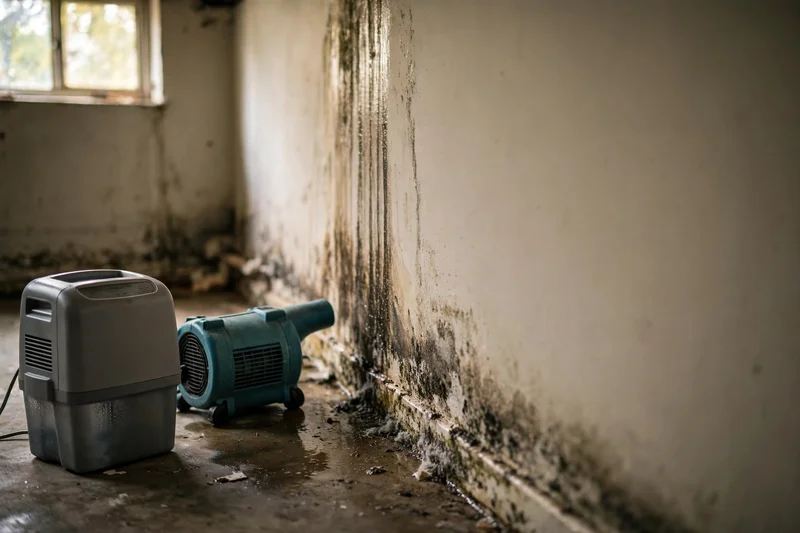
Mold after water damage Lombard homes is the job that starts a week after the flood, when the drying looked finished and the wall looked dry. Water runs down inside walls, so a wall that looks dry on the outside can be wet inside. The mold grows in the dark, behind the paint, and the first sign is a musty smell that does not leave, or paint that bubbles at the base of the wall.
We map every wall with a moisture meter, open what reads wet, and dry what stays. Dry is a number on the meter, not a look. A wall closed while it is still wet grows mold behind the paint, and the mold shows up months later, when the repair is finished and the claim is closed. Wet drywall comes out to above the high-water mark, and porous material, carpeting, ceiling tiles and soaked insulation, is discarded, not cleaned.
The drying after a burst pipe or a basement flood is a room-by-room mold remediation lombard job, and the mold check is part of it. A wall that reads wet after a week of drying needs opening, because the water is trapped behind it. The moisture log is the proof either way, and the insurer reads it.
3. Black mold
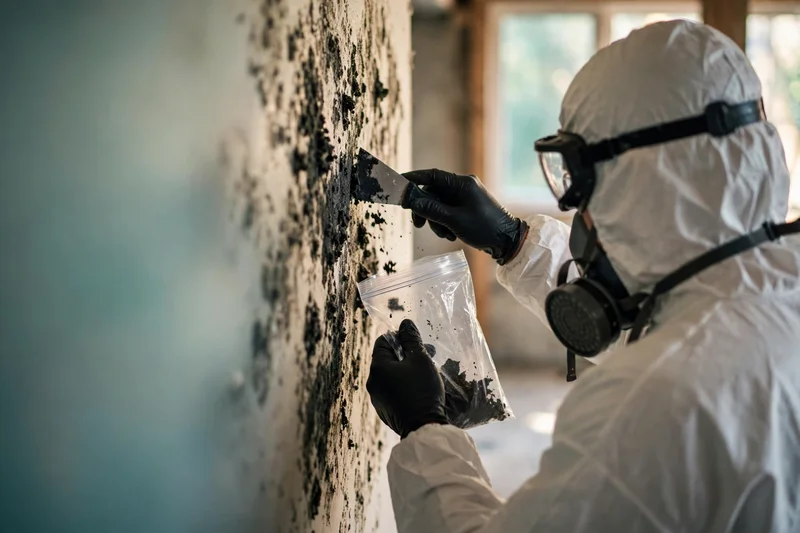
Black mold removal Lombard jobs start with a phone call that sounds worried, and the worry is understandable. Black mold is usually Stachybotrys, a mold that grows on wet cellulose, drywall, wood, paper, and it looks alarming. But the colour of a mold does not settle its species, and the species does not settle the job. A black patch and a green patch are removed the same way: containment, removal, cleaning, drying, and the moisture fixed.
What matters is where it grew, how far it spread, and whether the water is still coming in. A small black patch on a hard surface can be cleaned by the homeowner, with an N95 mask and gloves. A large patch, a patch on finished drywall, or a patch near a heating vent needs a professional, because the growth is probably wider than the patch you can see, and the spores travel on the air. Do not dry-brush it, do not point a fan at it, and do not paint over it, all three spread the spores.
Can black mold be completely removed? Yes, when the growth is removed, the moisture is fixed, and the space is dried to meter readings. No, when the water is left running, because the mold grows back on the same wall in the same season. The removal is the middle of the mold remediation lombard job. The moisture and the verification are the ends, and the ends decide whether the mold comes back.
4. The attic
Attic mold grows where warm air meets a cold roof. In a Lombard winter, warm air from the house rises into the attic, hits the cold underside of the roof deck, and condenses. The damp spot grows mold on the sheathing, and the first sign is a dark stain on the wood when someone goes up to look at the insulation. A roof leak does the same thing from the other side: water runs along the rafters and the joists before it drops, so the wet patch on the ceiling is rarely under the hole in the roof.
The first move is a look at the roof and the ventilation. A roof leak from a storm is usually a covered event. A roof that has not been maintained for years may not be. The age of the roof and the maintenance record decide it, and the adjuster will ask. Keep the receipts for the roof repair, because the repair is part of the file. Wet insulation comes out, because it loses its shape and its value, and it holds water against the framing. The framing behind it is metered, dried and treated, and the insulation goes back only when the framing reads dry.
Attic mold is a ventilation job as much as a removal job, and a mold remediation lombard crew fixes both. The attic needs air moving through it, and the bathroom fans need to vent outside, not into the attic. A fan that vents into the attic pumps warm, wet air onto the cold roof deck every morning, and the mold grows where the air lands. Fix the vent, fix the leak, dry the wood, and the mold has nothing to feed on.
5. The bathroom
Bathroom mold grows where the water is every day: around the tub, behind the tile, under the sink, and in the grout that never quite dries. A bathroom with no fan, or a fan that vents into the attic, stays damp after every shower, and the damp spot behind the tile is the first patch of the year. A small patch on a hard surface, tile, glass, porcelain, can be cleaned by the homeowner, with detergent and water, then a ten percent bleach solution with ten minutes of contact.
The patch that matters is the one behind the tile. Water gets behind the grout, soaks the backing board, and grows mold where nobody can see it. The signs are grout that crumbles, tile that feels loose, a soft spot in the wall beside the tub, and a musty smell that does not leave after cleaning. A wall that reads wet after a week of drying needs opening, because the water is trapped behind the tile.
Run the fan during every shower and for half an hour after, and keep the door open when the room is not in use. A bathroom that dries between showers does not grow mold. A bathroom that stays damp grows it in the grout first, and behind the tile second. The fan is the cheapest mold prevention in the house, and the one most often switched off. It is the simplest mold remediation lombard lesson in the house.
6. The crawl space and the heating system
Crawl space mold grows where nobody looks. A Lombard crawl space runs damp all summer, because the ground is wet and the air is still, and the mold grows on the joists and the subfloor from underneath. The first sign is a musty smell in the rooms above, or a floor that feels soft underfoot. A heating system makes it worse, because the ducts run through the damp space and carry the spores into every room in the house.
Mold in a heating vent is a third kind of job, because the spores travel on the air. Turn off the heating system if the growth is near a vent, and do not run the fan until the growth is contained. The ducts are cleaned, the filter is replaced, and the crawl space is dried before the system runs again. A system that runs while the mold is open spreads the spores through the house, and the job creates a second job.
The crawl space needs the same mold remediation lombard fix as the basement: the water stopped, the air moving, and the humidity kept between thirty and fifty percent. A vapour barrier on the ground, a sealed vent, and a dehumidifier that drains to the sump pit are the three moves that keep a crawl space dry. A crawl space that stays damp grows mold on the joists, and the joists are the floor the house stands on.
7. The kitchen and the laundry
Kitchen and laundry mold grows where the water is small and constant: a dishwasher line that drips, a washing machine hose that weeps, a refrigerator ice-maker line that leaks behind the machine. A washing machine hose fails at the fitting, and the first sign is a wet floor behind the machine. Pull the machine out twice a year and look at the hoses. If a hose is bulging, cracked or stiff, replace it before it breaks.
Turn off the water to the appliance first, then the main valve if the shut-off does not hold. Mop up what you can, and get the air moving. A small appliance leak dried within a day or two is a small job. The same leak left for a week is a subfloor job, because the water has run under the flooring and into the joists. The drying log is the proof either way, and the insurer reads it, which is why a mold remediation lombard crew keeps one.
The kitchen sink cabinet is the most common hiding place of all. A slow drip under the sink soaks the cabinet floor, and the mold grows on the wood where nobody looks until the cabinet smells. Open the cabinet once a month, run your hand along the pipes, and look at the floor of the cabinet. A dry cabinet is a clean cabinet. A damp cabinet is a mold job waiting for a season.
What the video hunt found
We searched YouTube six ways and watched the one Lombard mold video in full, with sound. It runs three minutes and twenty-two seconds, it was uploaded on 25 March 2014, and it has one hundred forty-one views. It shows a foreclosed, vacant Lombard home, contracted by a bank, with mold on a bathroom ceiling and a dark, damp basement with seepage. The presenter is Dan Redden, of Guardian Mold Prevent. The video gives no homeowner's name, no bank's name, no street address and no incident date. It is the strongest record we found, and it fails the test on all three elements. That is the whole video record for mold in Lombard: one video, one vacant house, no name, no address, no date.
The searches for a burst pipe, a sump pump failure and a sewage backup in Lombard returned no Lombard-specific result at all, which is its own finding: the town's water jobs are not on video, and the companies that work them do not film them. If a page shows you a Lombard homeowner on video with a street address and a date, ask for the link, we searched six ways and did not find one. The one company clip we found runs three minutes and twenty-two seconds and shows a vacant house.
The 2010 walk-through from the water page shows the inside of a flooded Lombard basement and gives a year and nothing else. The street-flooding video from 22 June 2020 shows water in the street, no home, no homeowner, no address. That is the whole video record, for water and for mold together: a basement with no name, a street with no home, a vacant house with no address, and an advertisement.
Insurance: what is covered
Does homeowners insurance cover mold remediation in Lombard? It covers mold remediation only when the mold follows a sudden and accidental covered event, such as a burst pipe that soaked a wall. Mold from a slow leak, poor maintenance or flooding from outside is usually excluded. Illinois has no special mold-cover law, so the policy is the whole answer. Does homeowners insurance cover mold remediation lombard jobs after a slow leak? A slow leak is maintenance, not a sudden event, and the mold it grows is excluded.
Three endorsements decide most Lombard claims. The first is sewer backup cover, which the standard policy does not carry, and about one third of Lombard still has combined sewers, so the risk is real. The second is flood insurance, which the standard policy never carries, because flooding from outside is a separate policy. The third is the mold sub-limit, which caps what the insurer pays for mold work after a covered event. Ask your agent for your number, in writing.
How much does homeowners insurance pay for water damage? No page can give you a number, because the payment depends on your policy, your deductible, the cause of the water and the limits you bought. The insurer pays the approved cost of the drying and the repair, less your deductible. The formula is the approved cost minus the deductible, and the formula is the only honest number we can print.
Does renters insurance cover water damage? It covers your belongings when the water came from a sudden and accidental internal event, such as a burst pipe or an appliance overflow, plus loss of use and liability. It does not cover the building itself, which is the landlord's policy, and it does not cover flooding, gradual damage or negligence. Tell your landlord the day the water appears, and photograph everything before you move it. A tenant who finds mold should report it to the landlord in writing, with photographs, the day it appears. The state health department does not inspect rental housing, so the tenant's route is the landlord first, then the village code enforcement office.
Does homeowners insurance cover a burst pipe? It usually does when the pipe burst suddenly, such as a pipe that froze and split in a cold snap. The insurer pays for the water damage the burst caused, not for the pipe itself. A pipe that leaked slowly for months may be classed as wear and tear. Report a burst the day you find it, and photograph the split before the plumber cuts it out. The mold that follows a burst pipe is covered the same way the water damage is, because the mold is the consequence of the covered event, but only up to the mold sub-limit, and only if the drying started in time.
Does homeowners insurance cover mold? It covers mold only when the mold follows a sudden covered event, such as a burst pipe that soaked a wall. Mold from a slow leak, poor maintenance or flooding from outside is usually excluded. Ask your agent for your number, in writing, before the rain. A slow seep through a foundation crack is not a sudden event, and a basement that has been damp for a year is not a sudden event either. The timing matters as much as the cause, and the drying log is what proves the timing.
Flood insurance is the one cover this page has to explain separately, because it is the one most Lombard homeowners think they have and do not. A standard homeowners policy never covers flooding from outside, rain that comes in through the door, a creek that overflows, a street that floods. That needs a flood insurance policy, and the flood policy is a separate policy with its own limits, its own waiting period and its own rules about what is covered in a basement. Mold remediation lombard work after a flood is the same work, inspection, containment, removal, cleaning, drying, but the payer is different, and the file matters even more, because the flood claim is judged on the photographs and the moisture log alone.
The claim file is the moisture log, the photographs and the receipts. Photograph the mold and the water line before anything is touched. Keep a written list of what was wet, what you moved and what was thrown away. Keep every receipt. The adjuster reads the file, and a file with a daily moisture log settles faster than a file without one. Call your insurer the day the water appears, not the day the drying finishes.
What drives the cost, and why this page prints no prices
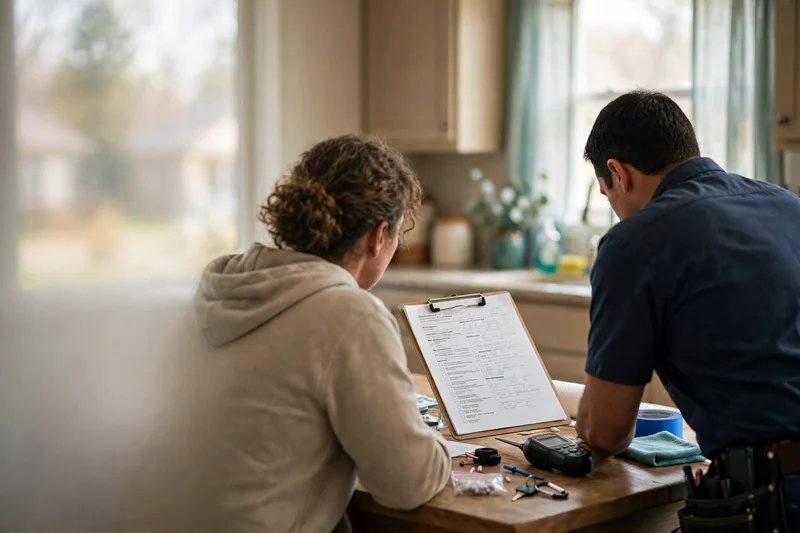
How much does mold remediation cost in Lombard? This site prints no prices, and this page is no exception. A number printed here would be a guess, and a guess that misleads a homeowner at midnight is worse than no number at all. What this page can do honestly is tell you what drives the cost, so you know what to ask when a crew gives you a written scope of work.
The cost depends on the size of the growth, where it sits, what material it grew on, how much containment the job needs, whether water is still coming in, and how much demolition, drying, disposal and repair the job takes. A small patch on bare concrete is one job. A finished basement wall with mold behind the drywall is another, because the wall has to come open and go back. Mold in a heating vent is a third, because the ducts have to be cleaned and the system has to stay off until the work is done. A whole house is a fourth, because the containment has to cover the whole house.
Time drives the cost too. Mold that is found in the first days is a removal job. Mold that has had a month to grow is a removal job plus a drying job plus a repair job, because the water has soaked into the framing and the framing has to be opened and dried from the inside. The cheapest call you can make is the early one.
We inspect first, then give you a written mold remediation lombard scope with the cost in it before any work starts. A phone quote before an inspection is a guess. Ask for the scope in writing, ask what the moisture log will show, and ask what happens if the readings say the wall is still wet on day five. The answers to those three questions tell you more about a company than any price on a website.
The scope should list the rooms, the materials that come out, the materials that stay, the equipment that runs, and the number of drying days the crew expects. It should say what the rebuild covers and what it does not, and it should say who pays if the drying runs longer than expected. A scope that lists none of that is a scope that hides the cost, and a cost that is hidden on day one is a cost that appears on day ten.
A homeowner who types mold remediation cost lombard into the search is looking for a number, and the honest answer is the list of drivers above, not a figure. This page prints none of those ranges as facts, because none of them is settled. What is settled is the list of drivers above, and the drivers are what a homeowner can check against a written scope. If a scope lists a price with no drivers behind it, the scope is a guess, and a guess is not a scope.
Village programmes that do apply
Lombard homeowners have five Village programmes that may help with water, and water is the cause of the mold behind every mold remediation lombard job. They are real, they are published by the Village, and they are worth knowing about before the rain. They are also limited, and this page prints their limits plainly.
The Residential Drainage Program is the big one. The Village Board approved it in 2023, and it takes a concierge approach: field and data assessments, technical guidance, and then a reimbursement of fifty percent, up to fifteen thousand dollars, for qualified improvements that address standing water lasting more than seventy-two hours on multiple properties. It covers two or more contiguous properties, and the eligible costs include surveying, engineering, permits and construction, including the connection to the public storm sewer. The reimbursement comes after completion, after a final inspection, and after a paid-in-full receipt. The policy dates to 20 January 2000 and was updated on 2 March 2023.
The Overhead Sewer Grant Program has assisted nearly four hundred residents, according to the Village's own FAQ. Its terms from a 2013 newsletter were seventy-five percent up to five thousand dollars, but those are 2013 terms, and this page does not print them as current. Check the current terms on the Village's Grants page before you plan around them. The Clear Water Disconnect Grant has contributed to dozens of homes removing sump pumps and downspouts from sanitary sewers.
The Backyard Drainage Grant covers flooding that remains for seventy-two hours or more and affects at least two contiguous properties. The Flood Susceptible Homes Redevelopment Program, adopted by the Board in 2022, incentivises the replacement of single-family detached homes with severe or chronic flooding, but basement flooding caused solely by a sanitary sewer backup is not eligible for it. The Rain Barrel Grant Program has put hundreds of rain barrels in residents' hands since 2009.
Now the correction that matters most. The DuPage County Cost-Share Drainage Assistance Program pays fifty percent, up to five thousand dollars per project, with a two-hundred-dollar nonrefundable application fee, and applications for the 2026-2027 season were due on 1 March 2027, with the county expecting about fifty thousand dollars a year in total. It is strictly for unincorporated DuPage County properties. Homes inside an incorporated village such as Lombard do not qualify. It is not one, and this page will not repeat the mistake. If a page tells you the county programme will pay for your Lombard drainage work, the page is wrong.
The Village's Grants page sits at villageoflombard.org/299/Grants. The Private Development Engineer in the Department of Community Development, (630) 620-5972, takes calls about flooding on private property. Village Public Works, (630) 620-5740, takes calls about flooding in a public right-of-way and about sewer backups. Village Hall sits at 255 E Wilson Avenue, Lombard, IL 60148-3926, and the main phone is (630) 620-5700.
Who to call for mold remediation in Lombard
Who to call for mold remediation lombard work depends on what is happening right now. The order is safety first, then the source, then the mold, then the claim. Get the order wrong and the job costs more.
Call 911 if there is danger, live power in the water, a gas smell, a ceiling that may fall. Call Village Public Works at (630) 620-5740 if the water came up through a floor drain, or if the street is flooding too. After four in the afternoon or at weekends, dial 911 for a blocked or flooded roadway or a water main break. Call a licensed plumber to stop an active leak. Call a twenty-four-hour remediation company for the inspection and the removal. Then call your insurer, with the photographs already taken.
For flooding on your own property, a yard that will not drain, a neighbour's water running onto your lot, the call goes to the Department of Community Development, to the Private Development Engineer, at (630) 620-5972 or. The department's main number, for building inspections, is (630) 620-5750. Village Hall sits at 255 E Wilson Avenue, Lombard, IL 60148-3926, and the main phone is (630) 620-5700. Walk-in hours are Monday to Thursday, eight thirty in the morning to four in the afternoon, and the phones are answered Monday to Friday, eight in the morning to four thirty in the afternoon.
Our number is (773) 570-9869, and we answer 24/7. Tell us where the mold is, what it looks like, and whether water is still coming in. We talk you through the first hour while a crew is on the way. No call centre, no sales script, no price quoted before we have seen the job.
Inspection and testing: what they do, and what they do not do
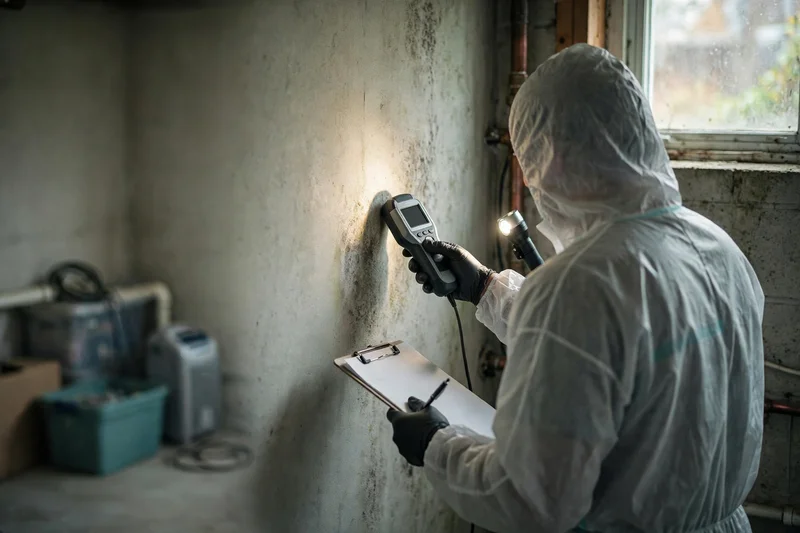
Mold inspection Lombard IL is the first step of the job, and it is the step that decides whether the work is a clean or a removal. An inspection finds the growth, maps how far it spread behind the paint, reads the moisture in every wall and floor, and finds the water that fed it. The inspector meters the walls, opens what reads wet, and writes a scope: the rooms, the materials that come out, the materials that stay, and the drying days the crew expects. A scope with no meter readings behind it is a guess, and a guess is not a scope.
Mold testing Lombard homes is a different job, and the three sources on this page disagree about it, so this page prints all three positions and picks none of them. The DuPage County Health Department says do not test first: sampling is unreliable, no standards exist for an acceptable quantity of mold, testing is expensive, and the results are hard to interpret. Three positions, three different answers, and the homeowner is the one who has to choose.
What testing does is confirm whether mold is present and how far it spread, which decides whether the work is a clean or a removal. What testing does not do is fix the moisture, and a test on a wet wall tells you the wall is wet, which you already know. The county health department's position is that testing adds little when the mold is already visible, because the visible growth is the answer.
The testing company's position is that testing tells you what species is growing and how far the spores have spread, which decides the containment. Both positions are honest, and both are printed here. The order that most crews follow is: dry first, then test if the spread is unclear, then clean or remove. Testing a wet wall tells you the wall is wet, and you already know that.

What should a homeowner ask before agreeing to testing? Ask what the test will change: if the test comes back positive, does the scope change, and if it comes back negative, does the work stop. Ask who does the testing: the company doing the removal, or an independent tester.
Ask what the test costs, in writing, before the test is taken. And ask what happens to the results: who reads them, and whether the insurer reads them too. A test that changes nothing is a test that costs money and answers nothing. A test that changes the scope is a test worth taking.
A free mold remediation lombard inspection that ends with a written scope is a real inspection. A free inspection that ends with a price and no scope is a sales call. Ask for the scope in writing, ask for the meter readings, and ask what the company does when the readings say the wall is still wet on day five. The answers to those three questions are the company. Everything else is a website.
What the county and the state say about mold
The DuPage County Health Department's mold page, last reviewed on the eighteenth of August 2023, says mold is a microscopic fungus, and that indoor growth needs dampness, high humidity, poor ventilation and temperature. The page links to a fact sheet from October 2008, eighteen years old and still the live document on the department's own site, which this page cites with its date, because a date on a source is part of the source.
The fact sheet says a homeowner can clean under ten square feet with protective gear, a respirator, gloves and eye protection, and should use an experienced professional over one hundred square feet. It says the department does not recommend testing as a first step, because sampling is unreliable and no standards exist for an acceptable quantity of mold. It says the department does not accredit, certify, recommend or endorse any contractors. It says airborne spore counts can run ten to one thousand times higher during cleanup than before it.
It says to clean with a ten percent bleach solution, with ten minutes of contact time, to discard porous materials, to remove drywall above the high-water mark, and to dry the area completely in two to three days. The department's number is (630) 682-7400.
The Illinois Department of Public Health's registration page says the Mold Remediation Registration Code took effect on the twenty-third of September 2026, that registration is due by the thirtieth of September 2027, and that from the first of October 2027 nobody performs mold remediation in Illinois without certification. The statute is the Mold Remediation Registration Act, as amended by Public Act 103-0893, effective the first of January 2025. The department runs a Registered Mold Remediator Search Tool, and it says a company cannot be listed without a certified mold remediator on staff.
Professionals who solely provide mold assessment services do not need to register, only remediation providers do. The department's contact is, and its phone is (217) 782-5830. Two pages that were live in August 2026 still say the rules are "not yet in force" or "still being finalized". Both are wrong since the twenty-third of September 2026, and neither is cited on this page.
Here is the conflict the two official sources leave open, and this page does not settle it. The county health department says a homeowner can clean under ten square feet and should use a professional over one hundred square feet. The state health department's FAQ says a homeowner can clean under ten square feet and should use a professional over ten square feet. The small number agrees. The large number does not: one hundred square feet on the county page, ten square feet on the state page.
A homeowner with fifty square feet of growth is told to clean it by one page and to hire a professional by the other. This page prints both numbers, with both sources, and tells the homeowner to ask the company for a written scope either way. A scope settles the question. A threshold does not.
What the new registration law means for a Lombard homeowner calling a mold remediation lombard company is simple: from the first of October 2027, the person doing the remediation must be certified, and the company must be registered. Before that date, a company can continue without certification if it is registered and certified by the deadline. Ask the company for its registration and its certification, in writing, before the work starts. This site claims no registration, and this page is consumer guidance, not a credential claim. The law exists so a homeowner can ask the question, and the question is worth asking.
The growth window is the second conflict, and this page prints all three numbers with their sources. Three numbers from two companies, and the companies disagree with themselves. The honest statement is the range: mold starts in one to two days on a wet surface, and the colonies follow in days to weeks. Dry the space within two days, and the growth has nothing to feed on.
The fifteen questions Lombard homeowners ask the Village
These are the fifteen questions on the Village of Lombard's own Drainage and Flooding Information page, in the Village's own words, and the answers below come from the Village's own pages. A mold remediation lombard job starts where the Village's answers stop, inside your house. The Village owns the public main and the street. You own the private service line and everything inside the walls.
"My street is flooded during a rainstorm. Why is this happening?" Because the sewers filled past capacity. About one third of Lombard still has combined sewers, which carry sanitary waste and rainfall runoff in the same pipe, and in a big rain the pipe fills and the water overflows to ground level. Call Village Public Works at (630) 620-5740 if the street is flooding, and 911 after four in the afternoon or at weekends.
"I had a sewer backup into my home. Why did this happen and what can be done about this?" The same capacity problem, inside the house. When the combined sewer fills, the water comes back through the floor drains. A check valve or an overhead sewer, required in all new construction, may prevent the next backup, and the Village's Overhead Sewer Grant has assisted nearly four hundred residents with that work.
"If my sewer backs up, who do I call?" Village Public Works at (630) 620-5740, and 911 after four in the afternoon or at weekends. Then call a remediation crew for the inspection and the removal, because the water that came back through a floor drain is sewage, and sewage needs cleaning before drying.
"Why doesn't the Village replace all of its old combined sewers?" Because replacing all of them at once would cost more than one hundred million dollars. The water and sewer fund is collected separately through a five dollar monthly capital fee paid by water customers, and the replacement goes street by street, year by year.
"I pay property taxes. Why don't you use this money to prevent flooding?" Because the Village receives less than eight cents of each property-tax dollar. The rest goes to the schools, the county, the park district and the other taxing bodies. The Village's flood work is paid for out of the water and sewer fund and the stormwater budget, not out of the property-tax dollar.
"I have standing water in my backyard. Why is it there and how can I fix this?" Standing water means the ground is saturated or the drainage is blocked, and the fix starts with the ground: gutters and downspouts that carry the water away from the foundation, and ground that slopes away from the wall. If the water stands for more than seventy-two hours, the Backyard Drainage Grant and the Residential Drainage Program may help.
"What is the Village going to do about standing water in my back yard?" The Village's Residential Drainage Program takes a concierge approach: field and data assessments, technical guidance throughout, and then a reimbursement of fifty percent, up to fifteen thousand dollars, for qualified improvements on two or more contiguous properties where the water stands for more than seventy-two hours.
"Does the Village have any programs or assistance that can help me improve my property?" Five of them: the Residential Drainage Program, the Overhead Sewer Grant, the Clear Water Disconnect Grant, the Backyard Drainage Grant and the Flood Susceptible Homes Redevelopment Program, plus the Rain Barrel Grant. They pay for prevention. The grants do not pay for the drying and the removal after a flood, that is the homeowner's job, or the insurer's.
"What types of building restrictions are in place to help protect my property?" An overhead sewer is required in all new construction, and a check valve may be required where the risk is high. The Flood Susceptible Homes Redevelopment Program, adopted in 2022, incentivises the replacement of single-family detached homes with severe or chronic flooding, and it waived Village permit fees for demolition.
"Can stormwater from my roof gutter be directed to anywhere on my property?" and "Can I block stormwater runoff coming from my neighbor's property?" The Village's full answers to both sit on its own FAQ page, because both turn on the Village's stormwater rules rather than on a remediation crew. The short version is that roof water and runoff are the owner's responsibility to keep on the owner's own property, and the Village's Private Development Engineer, (630) 620-5972, is the person to ask before you change a gutter or build a barrier.
"Why does the Village allow for new construction on properties that have held water in the past?" New construction on a property that has held water must meet the current rules, including the overhead sewer requirement. The Flood Susceptible Homes Redevelopment Program exists for the properties where the flooding is severe and chronic, and where the answer is replacement rather than repair.
"What action has the Village taken to help provide more space for stormwater?" Pond modifications at Terrace View, Vista, Morris and Finley/Charles Lane gained twenty-six acre-feet of flood-water storage, and backup generators sit at all fourteen sanitary pumping stations. The Crescent Avenue pump station at the East Branch was replaced, and its pumping rate rose from fifty to one hundred seventy cubic feet per second.
"What plans does the Village have Village planning to help with ongoing stormwater challenges?" The Westwood Creek Channelization Project re-establishes drainage impeded by silt and sediment and reduces flooding south of North Avenue. The Village's capital plan runs to 2035, and the pond work, the pump-station work and the grant programmes run inside it.
"Why does my basement flood during rainstorms?" and "Who is responsible for basement flooding?" The basement floods because the ground saturates and the sewers fill, and because about one third of the village still has combined sewers. The Village owns the public main and the street. You own the private service line and the house. Knowing which side of that line the problem sits on decides who pays for the fix, and whether the mold that follows is a Village job or a homeowner's job. It is the homeowner's job, and the mold that follows a flood is the homeowner's mold to remove.
Commercial mold in Lombard
Mold remediation lombard work is not only houses. Lombard's commercial buildings, the offices and shops along St Charles Road, the stores at Yorktown Center, the restaurants and small businesses downtown, grow mold the same way houses do, and the stakes are higher, because a closed shop loses a day's trade for every day it stays shut, and a restaurant that reopens before the cleaning is finished risks the health inspection.
A commercial job starts the same way: stop the moisture, inspect the growth, contain the work area, remove what cannot be saved, clean what can, dry it to meter readings. The difference is the scale and the paperwork. A shop with mold behind the drywall needs the wall open and the growth out before the customers come back, and the insurer needs the same file a homeowner needs, photographs, receipts and a moisture log, plus the record of the trade lost while the shop was closed. A restaurant with a sewer backup needs cleaning and sanitising before it can open, and the health department's word matters more than the moisture log.
The drying runs the same three to seven days with professional equipment, and the full job runs one to four weeks. The difference is that a commercial drying runs around the clock, with more air movers and more dehumidifiers, because a day saved is a day of trade. The moisture readings go into the same log, and the walls do not close until the readings say dry. A shop that stays closed for a week loses a week of trade, and a shop that reopens wet loses the stock, the customers and the health inspection. The moisture log is the record that proves the shop was dry when it reopened.
If your business has mold, call (773) 570-9869. We answer 24/7, and we talk you through the first hour while a crew is on the way. The first question is the same as for a house: where is the mold, what does it look like, and is water still coming in.
If your business has mold, call (773) 570-9869. We answer 24/7, and we talk you through the first hour while a crew is on the way. The first question is the same as for a house: where is the mold, what does it look like, and is water still coming in.
Choosing a mold remediation company in Lombard
Three questions tell you more about a company than any price on a website. First, what will the moisture log show, and can I see it each day. Second, what is the written scope of work, and what happens if the readings say the wall is still wet on day five. Third, who is on the crew, and are they the people who will do the removal or the people who will sell the rebuild.
A company that quotes a price before an inspection is guessing. A company that promises a drying time before it has metered the walls is guessing. A company that shows you a named Lombard case with a street address and a date should be asked for the source, because we searched every platform we could reach and found no verified named Lombard mold case. A company that shows you a case from Coral Springs, Florida, is showing you a case from Coral Springs, Florida. A company that cannot show you a moisture log is a company that does not keep one, and a company that does not keep one cannot prove the building is dry.
Ask for the moisture log in writing, ask for the scope in writing, and ask what the company does when the readings say the wall is still wet. Ask whether the crew carries moisture meters and dehumidifiers, or only wet vacuums. Ask how the company documents the job for the insurer. The answers to those questions are the company. Everything else is a website. Ask, too, whether the crew that answers the phone is the crew that does the removal, or whether the job is passed to a subcontractor after the first visit. The crew that meters the walls on day one should be the crew that reads them on day five, because the log is only as good as the hands that kept it.
Ask for the moisture log in writing, ask for the scope in writing, and ask what the company does when the readings say the wall is still wet. Ask whether the crew carries moisture meters and dehumidifiers, or only wet vacuums. Ask how the company documents the job for the insurer. The answers to those questions are the company. Everything else is a website.
We give you the moisture log each day, the scope in writing before any work starts, and the file, the moisture log, the photographs and the receipts, when the drying is finished. Call (773) 570-9869 any time, day or night.
Your first hour: what to do, in order
Mold remediation in Lombard starts with the first hour, and the first hour is the cheapest hour of the whole job. Mold that is found in the first days is a removal job. Mold that has had a month to grow is a removal job plus a drying job plus a repair job, because the water has soaked into the framing and the framing has to be opened and dried from the inside. The first hour is also the hour that decides the claim, because the photographs taken in the first hour are the evidence the adjuster reads, and the mold spreads while the photographs wait. Take the photograph now.
- Stay out of the water. Never step into water that may touch outlets, appliances or cords. Turn off the power at the breaker if you can do it safely, from dry ground. Call 911 if there is an electrical or gas hazard.
- Stop the moisture. Turn off the main water valve if the water is coming from a pipe, and turn off the water heater as well. If the water is coming up through a floor drain, call Village Public Works at (630) 620-5740.
- Do not disturb the mold. Do not dry-brush it, do not point a fan at it, and do not paint over it. Wear an N95 mask and gloves. Turn off the heating system if the growth is near a vent.
- Photograph everything. Photograph the mold and the water line before anything is moved. Keep a written list of what was wet, what you moved and what was thrown away.
- Move what can be saved. Lift furniture onto blocks, roll up rugs, and move boxes and papers to dry ground. Do not move anything heavy through standing water.
- Call a plumber, then a remediation crew, then your insurer. The plumber stops the leak. The crew inspects the growth and starts the containment. The insurer opens the claim, and the photographs and the moisture log are the file.
- Do not pump against outside water. If flood water is still outside, wait until the outside level is lower than the basement level before pumping, because pumping too fast can damage the walls.
- Do not clean sewage yourself. Porous material that touched sewage is discarded, not cleaned. Hard surfaces are cleaned and sanitised by the crew before any drying starts.
After the job: removal, the log and the rebuild
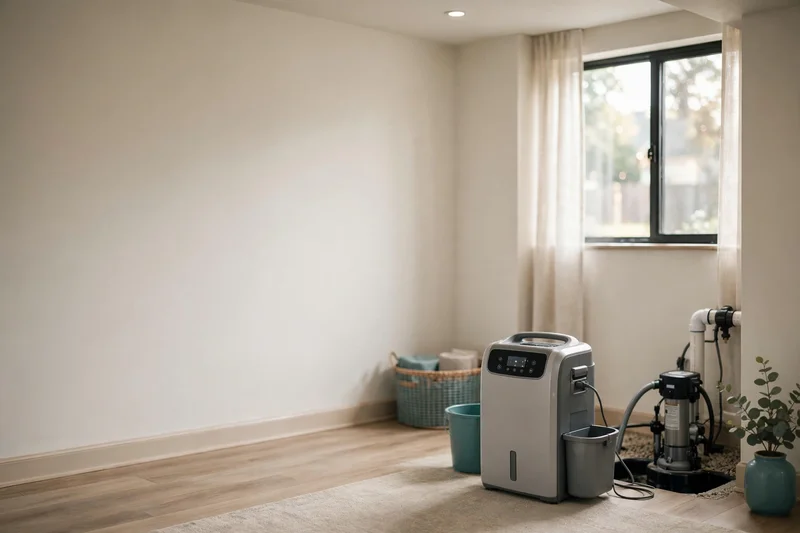
How long does it take to dry out mold damage in Lombard? About three to five days with professional equipment, for a standard Lombard basement job. A minor job can dry in a day or two, and a saturated basement with soaked framing and flooring can take seven to fourteen days or more. Carpet dries in one to three days, drywall in two to five, and hardwood, plaster and concrete in a week or more. Cooler November air slows evaporation, so a winter job dries slower than a summer one.
The drying runs on air movers and dehumidifiers, and the readings are taken every day. Each wall and floor is mapped with a moisture meter, and the readings go into a moisture log you can see. The walls do not close until the readings say dry. A wall closed while it is still wet grows mold behind the paint, and the mold shows up months later, when the repair is finished and the claim is closed.
Mold remediation Lombard IL is the rebuild that follows the removal: the drywall that came out goes back, the flooring that could not be saved is replaced, and the finishes are put back to how they were before the loss. The repair starts only after the drying is finished and the readings say dry. A rebuild over wet wood is a rebuild that rots, smells and grows mold.
The rebuild that follows the removal is a matching job. The drywall that came out goes back to the same height, the flooring that could not be saved is replaced with a match for the floor that stayed, and the baseboards, the paint and the trim are put back to how they were before the loss. A rebuild that matches is a rebuild the insurer accepts, and a rebuild that does not match is a rebuild the homeowner notices every day.
The paint goes on last, and only on a wall that reads dry, because paint on a wet wall bubbles and peels, and the peeling starts the argument about whether the drying was ever finished. The moisture log answers that argument, which is why the log is kept and handed over with the file.
When the drying is finished, you get the file: the moisture log, the photographs and the receipts, ready for the insurer. Keep the file. If the adjuster asks a question in six months, the file answers it. If the mold shows up in a year, the file proves the removal was done and the readings said dry. Check the house yourself six months after the job: smell the rooms that were wet, look at the paint at the base of the walls, and walk the floors that were cupped.
A smell that comes back, paint that bubbles, or a floor that cups again means water is still in the wall, and the wall needs opening. A dry house stays dry, and a house that stays dry is a house the moisture log can prove.
What the drying looks like, day by day
A mold remediation drying does not happen in one day, and the homeowner who knows what each day looks like worries less. The first day is the loudest and the wettest. The crew contains the work area, removes what cannot be saved, and sets the air movers and the dehumidifiers. The readings are taken and written down, and the log starts. The house is noisy, the air is damp, and the dehumidifiers run all night.
On the second and third days, the readings start to fall. The air movers are moved to the walls that read wettest, and the dehumidifiers are emptied or drained. The crew meters every wall and floor again, and the new readings go into the log next to the old ones, with the date and the time written beside each one. A wall that was wet on day one and drier on day three is a wall that is drying. A wall that reads the same on day three as it did on day one is a wall with water trapped behind it, and the crew opens it.
On the fourth and fifth days, most of the drying is done. The carpet is dry, the drywall is dry, and the framing is nearly dry. The hardwood is still cupped, and the concrete is still giving back water. The crew keeps the equipment running, because stopping early is the mistake that costs the most. A floor sanded before it is dry cups again, and a wall closed before it is dry grows mold behind the paint.
On the sixth and seventh days, the readings reach the dry standard for each material, and the equipment comes out. The crew walks the house with you, meter in hand, and shows you the readings on every wall and every floor. The file is handed over: the moisture log, the photographs and the receipts. The rebuild starts after that, and only after that. A drying that runs long is not a drying that failed. It is a drying that found hidden water, and hidden water is the water that would have come back as mold in six months.
What delays a drying? Cold air, because cold air holds less moisture and the dehumidifiers work slower. Concrete, because it drinks the water deep and gives it back slowly. Hidden water, because a wall that looks dry on the outside can be wet inside, and the crew has to open it to dry it. And a second leak, because a drying that starts before the source is fixed is a drying that never finishes. The source is fixed first, always.
Before you call: the five things to have ready
You do not need to have anything ready to call us, we answer 24/7 and talk you through the first hour. But five things make the call faster, and the job faster after it. The first is your address, with the ZIP, so the crew knows which side of the divide your street sits on. The second is where the mold is, and how big the patch is. The third is what kind of water fed it, clean, dirty or sewage, because the answer decides what gear comes off the truck.
The fourth is whether the water is still coming in, and whether you have turned the main valve off. The fifth is whether you have called the Village, because a sewer backup is a Village call first and a crew call second.
Photograph the mold before anything is touched, and keep the photographs on your phone, not only in your head. Keep a written list of what was wet, what you moved and what was thrown away. Keep the policy number for your homeowners insurance, and the name of your agent. The crew will ask for none of this on the first call, but the insurer will ask for all of it, and the file you build in the first hour is the file the claim is judged on. Write the list on paper if the phone is wet, and photograph the paper too, because a list written in the first hour is a list the adjuster trusts, and a list written a week later is a list the adjuster questions.
A mold call at midnight is a call from a homeowner standing in a damp basement. We know that, and the first thing we do is talk you through the first hour: stay out of the water, turn off the power if you can do it safely, turn off the main valve, photograph the mold, and call the Village if the water came up through a floor drain. The crew is on the way while you do it.
Getting ready for a Lombard winter
A Lombard winter is a burst pipe season, and the preparation is cheap. Insulate the pipes in unheated spaces, the garage, the crawl space, the wall cavity over the garage. Let the taps drip on the coldest nights, and keep the heat on in every room, even the ones you do not use. A pipe in a cold room is a pipe waiting to split, and a split pipe is a mold job in the spring.
Test the sump pump before the spring thaw, and keep the discharge line clear of ice in winter. A discharge line that freezes backs the water up into the pit, and the pit overflows onto the floor. Clear the gutters and the downspouts in the autumn, and make sure the downspouts carry the water away from the foundation. A downspout that drops the water at the wall is a foundation leak waiting to happen. A mold call in February is usually a frozen discharge line or a frozen pipe, and both are cheaper to prevent in October than to repair in February.
Know where the main valve is before the water comes in, and show everyone in the house where it is. A valve nobody can find is a valve that does not exist. Keep the number for Village Public Works, (630) 620-5740, on the fridge, next to the number for the plumber and the number for us: (773) 570-9869. Tape the list to the inside of the basement door, where you will see it when the water is already on the floor.
Street by street: where Lombard floods, and what we see there
Mold remediation in Lombard is a street-by-street job, because the village is a watershed divide and the water behaves differently on each side of it. The East Branch side drains one way, the Salt Creek side drains the other, and the combined-sewer streets back up when the separate-sewer streets stay dry.
St Charles Road runs east to west through downtown Lombard, past the crossing with Park Avenue at the centre of the village. Park Avenue runs north to south at about the same longitude, and the two roads meet in the 60148 ZIP. North Lombard runs up from St Charles Road toward Lilacia Park and the Lilac Time festival grounds, and the homes there sit on the higher ground. South Lombard runs down toward Yorktown Center and Four Seasons Park, and the homes there sit closer to the creeks.
Route 53 and North Avenue is the corner the National Centers for Environmental Information named in the September 2008 flood, when major street and parking-lot flooding closed Route 53 south of Butterfield as the East Branch overflowed. Butterfield Road runs along the river's edge, and the East Branch at Bolingbrook, downstream of Lombard, crested at twenty-five point eight five feet in April 2013, the highest on record. When the river crests, the streets beside it flood first.
Wilson Avenue carries Village Hall at 255 E Wilson Avenue, and the sign at the Village municipal complex on Wilson Avenue marks the watershed divide itself. Main Street, for the record, does not meet St Charles Road, it sits in north Lombard, far from the downtown crossing, and any page that puts the two together is wrong.
Glencrest Creek runs through Lombard itself, as an East Branch tributary, and Ginger Creek carries the Salt Creek side of the village through Downers Grove, Oak Brook, Oakbrook Terrace and Westmont. The Westwood Creek Channelization Project re-establishes drainage impeded by silt and sediment and reduces flooding south of North Avenue, and the Terrace View Pond gained thirteen acre-feet of flood-water storage in the pond programme. A mold job on the East Branch side of the divide is a river job. A job on the Salt Creek side is a creek job. The water behaves differently on each side, and the crew that knows which side your street sits on knows what the water will do next.
Wherever your street sits, the first hour is the same: stay out of the water, stop the source, photograph the mold, and call. The number is (773) 570-9869, and we answer 24/7.
Call now, we answer 24/7
Mold does not wait for office hours, and neither do we. Call (773) 570-9869 now, a real person answers, talks you through the first hour, and sends a crew to your Lombard home. Inspection, containment, safe removal and drying, with a moisture log you can see and a file your insurer can read.
Frequently asked questions
The last six are the questions Lombard homeowners ask most on the live search.
What is mold remediation in Lombard?
Mold remediation in Lombard is the job of finding the mold, containing it, removing what cannot be saved, cleaning what can, and fixing the moisture that fed it. It starts with an inspection and a moisture reading, then containment, removal, cleaning and drying. The work is not finished until the source is fixed and the space reads dry.
Does homeowners insurance cover water damage restoration
It covers only part of it, and the part depends on the cause. A sudden and accidental event, such as a burst pipe, is usually covered, less your deductible. The repair of the pipe itself, a slow leak, flooding from outside and a sewer backup are usually not covered unless your policy carries the endorsement that covers them.
How long does water damage restoration take?
Drying takes three to seven days with professional equipment, and the full job takes one to four weeks. A minor job in one room can dry in a day or two, and a severe job with soaked framing and flooring can take weeks to months.
What is water damage restoration called?
It is called water damage restoration, and mitigation is only the first half of it. Mitigation is the emergency work: stop the source, extract the water and dry the building. Restoration is the whole job: mitigation first, then the repair that puts the home back to how it was. Drying alone is mitigation, not restoration.
Does insurance cover water damage restoration?
It usually does when the water came from a sudden and accidental covered event, such as a burst pipe or an appliance failure. The insurer pays for the drying and the repair, less your deductible. It does not cover flooding from outside, a slow leak or a sewer backup unless you hold the endorsement that covers them.
What is the water damage restoration process?
The process runs in order: stop the source, extract the standing water, document everything, remove what cannot be saved, set the drying and monitor the moisture readings each day. The drying runs until the readings say dry, and the repair starts only after that. The file you hand the insurer is the drying log, the photographs and the receipts.
Does homeowners insurance cover mold?
It covers mold only when the mold follows a sudden covered event, such as a burst pipe that soaked a wall. Mold from a slow leak, poor maintenance or flooding from outside is usually excluded.
What should I do when I find mold?
Fix the moisture source first, because mold without water stops growing. Wear an N95 mask and gloves, and dry the area within twenty-four to forty-eight hours. A small patch under ten square feet on a hard surface can be cleaned by the homeowner. A larger area, sewage, a heating system or a rental needs a professional.
How much does homeowners insurance pay for water damage?
No page can give you a number, because the payment depends on your policy, your deductible, the cause of the water and the limits you bought. The insurer pays the approved cost of the drying and the repair, less your deductible. Keep every receipt and photograph, and keep the drying log, because the log settles the claim.
Does renters insurance cover water damage?
It covers your belongings when the water came from a sudden and accidental internal event, such as a burst pipe or an appliance overflow, plus loss of use and liability. It does not cover the building itself, which is the landlord's policy, and it does not cover flooding, gradual damage or negligence. Tell your landlord the day the water appears.
How much does mold testing cost?
This site prints no prices, so no figure here can mislead you. Testing confirms whether mold is present and how far it spread, which decides whether the work is a clean or a removal. The county health department does not recommend testing first.
Does homeowners insurance cover a burst pipe?
It usually does when the pipe burst suddenly, such as a pipe that froze and split in a cold snap. The insurer pays for the water damage the burst caused, not for the pipe itself. A pipe that leaked slowly for months may be classed as wear and tear, so report a burst the day you find it.
How much does trenchless sewer repair cost?
Trenchless sewer repair replaces a broken sewer line by pulling a new pipe through the old one, with no open trench across the yard. A burst pipe is a different job: a supply pipe that split open, usually from freezing.
How much does water damage restoration cost?
This site prints no prices, so no figure here can mislead you. The cost depends on how much water there is, what kind of water it is, how many rooms got wet and what material it soaked. We inspect first, then give you a written scope of work with the cost in it before any repair starts.
What does it mean for water damage to be fully remediated?
It means the source is stopped, all the moisture is removed and meter-verified dry, contaminated materials are cleaned or removed, mold is addressed, and the structure is repaired to how it was before the loss. The home is safe to occupy, and the work is documented. Fully remediated means the readings say dry and the file proves it.
How much does mold remediation cost in Lombard?
This site prints no prices, so no figure here can mislead you. What drives the cost is the size of the growth, where it sits, what material it grew on, how much containment the job needs, whether water is coming in, and how much demolition and drying it takes. We inspect and give you a scope before any work starts.
How fast does mold grow after water damage in Lombard?
It spreads over one to four weeks. Lombard basements run damp, which makes it faster. Dry the space within two days, and the growth has nothing to feed on.
What should I do if I find mold in my Lombard basement?
Fix the moisture source first: check the sump pump and its battery, the foundation, the window wells and the storm-sewer backup. A small patch under ten square feet on bare concrete can be cleaned by the homeowner. A larger area, finished drywall, hidden growth or sewage needs a professional. Keep the humidity between thirty and fifty percent.
Does homeowners insurance cover mold remediation in Lombard?
It covers mold remediation only when the mold follows a sudden and accidental covered event, such as a burst pipe. Illinois has no special mold-cover law. Slow seepage, humidity, foundation water, flooding and sewer backup are usually excluded unless endorsed.
Who should I call for mold remediation in Lombard?
Call 911 if there is danger, such as live power in the water. Call a licensed plumber to stop an active leak, then a remediation company for the inspection and the removal. If the water came up through a floor drain, call Village Public Works at (630) 620-5740 first. Then call your insurer, with the photographs already taken.
What's the difference between mold removal and mold remediation?
Removal is one part of the job: taking the mold and the material it grew on out of the house. Remediation is the job: inspect, contain, remove, clean, dry, fix the moisture source and verify the space reads dry. A company that removes the mold and leaves the leak has sold you half a job, and the mold comes back.
What is the most effective mold and mildew remover?
For a small patch on a hard surface, detergent and water, then a ten percent bleach solution with ten minutes of contact, which is the county health department's guidance. No product fixes a wet wall, and no spray replaces drying. Porous material that grew mold is discarded, not cleaned, and the moisture source must be fixed first.
What is considered Stage 4 mold contamination?
There is no single official standard called Stage 4, so the phrase means whatever the company using it says it means. Some companies use it for widespread growth across several rooms or inside structural materials. Ask any company that quotes a stage to define it in writing, with the rooms and materials listed, before you agree to anything.
Does water damage always mean mold?
No. Mold needs moisture and time, and water that is dried within twenty-four to forty-eight hours gives it neither. Water that sits for days on drywall, wood or carpet is a different story: the mold starts in one to two days and the colonies follow. The drying log is what proves the water did not sit long enough to grow.
Is mold in a basement bad?
Any mold growth indoors is a problem, and a basement is where Lombard mold starts most often, because basements run damp and the water finds them first. A small patch on bare concrete can be cleaned by the homeowner. A larger area, finished drywall or a musty smell with no visible patch needs a professional, because the growth is hidden.
What are the tenant rights in Illinois regarding mold?
A landlord must keep a home habitable, and a tenant who finds mold should report it to the landlord in writing, with photographs, the day it appears. The state health department does not inspect rental housing, so the tenant's route is the landlord first, then village code enforcement. Keep every letter and reply, because the paper trail settles the dispute.
Sources
Every fact on this page comes from one of the sources below. If a fact has no source here, it is not on this page.
- Village of Lombard, Stormwater and Flooding FAQs, villageoflombard.org/454/Storm-Flooding-FAQs, the fifteen questions on the Village's own page, verbatim: "My street is flooded during a rainstorm. Why is this happening?", "I had a sewer backup into my home. Why did this happen and what can be done about this?", "If my sewer backs up, who do I call?", "Why doesn't the Village replace all of its old combined sewers?", "I pay property taxes. Why don't you use this money to prevent flooding?", "I have standing water in my backyard. Why is it there and how can I fix this?", "What is the Village going to do about standing water in my back yard?", "Does the Village have any programs or assistance that can help me improve my property?", "What types of building restrictions are in place to help protect my property?", "Can stormwater from my roof gutter be directed to anywhere on my property?", "Why does the Village allow for new construction on properties that have held water in the past?", "Can I block stormwater runoff coming from my neighbor's property?", "What action has the Village taken to help provide more space for stormwater?", "What plans does the Village have Village planning to help with ongoing stormwater challenges?" [sic, as published], and on the landing page: "Why does my basement flood during rainstorms?" and "Who is responsible for basement flooding?"
- Village of Lombard, Grants page, villageoflombard.org/299/Grants, Residential Drainage Program, Overhead Sewer Grant, Clear Water Disconnect Grant, Backyard Drainage Grant, Rain Barrel Grant.
- DuPage County Health Department, mold guidance, dupagehealth.org/294/Mold (last reviewed 8/18/2023) and the October 2008 mold fact sheet (DocumentCenter/View/1022/Mold-Fact-Sheet), under ten square feet a homeowner can clean with protective gear; over one hundred square feet use an experienced professional; the department does not recommend testing first and does not accredit, certify or recommend contractors; (630) 682-7400.
- Illinois Department of Public Health, Mold Remediation Registration, dph.illinois.gov, Mold Remediation Registration Code (77 Ill. Adm. Code 835) effective September 23, 2026; registration deadline September 30, 2027; certification requirement from October 1, 2027; / (217) 782-5830.
- Village of Lombard, June/July 2013 newsletter, about three thousand Lombard basements flooded in April 2013; emergency declared at 4:58 a.m. on April 18, 2013.
- U.S. Census Bureau, QuickFacts, Village of Lombard, population 44,476 at the 2020 census.
- National Weather Service and U.S. Geological Survey, July 1996 flood, 16.94 inches in 24 hours near Aurora, Illinois statewide record, still standing as of 2022; more than 35,000 homes flooded.
- U.S. Geological Survey and National Centers for Environmental Information, September 2008 flood, 2.39-10.51 inches over 51 hours, Sept 12-14, 2008; major street and parking-lot flooding around Route 53 and North Avenue in Lombard; Route 53 closed south of Butterfield.
- National Weather Service, April 2013 flood, East Branch DuPage River at Bolingbrook crested 25.85 feet on April 18, 2013 (previous record 24.04 on September 14, 2008).
- YouTube, November 19, 2026, "Basement Mold Removal Lombard, IL" (Guardian Mold Prevent, Dan Redden, uploaded 25 March 2014, 141 views, watched in full with sound), foreclosed vacant Lombard home, bank-contracted, bathroom-ceiling mold and a dark damp basement with seepage; no name, no address, no incident date.
More Restoration Services Near Lombard
Every service below is one tap away. Pick the one that matches your problem.

Water Damage Restoration
Fast water extraction, structural drying, and full repair after burst pipes, leaks, and floods.
Learn more →
Water Mitigation
Emergency water removal, structural drying, and mold prevention to stop the damage fast, 24/7.
Learn more →
Mold Remediation
Safe, contained mold remediation that removes contamination and fixes the moisture source.
Learn more →
Sewage Cleanup
Safe removal and disinfection of dangerous sewage backups and black water.
Learn more →
Flood Cleanup
Water pumped out, structure dried, and debris cleared fast after storms and flooding.
Learn more →
Hardwood Floors Water Damage
Cupped, buckled or stained hardwood after a leak? How we dry it, when sanding saves it, and when the boards have to go.
Learn more →