The short answer: fire damage restoration in Aurora means securing the house the same day with board-up and tarping, documenting everything for the insurance claim, extracting the firefighting water and drying the structure, removing soot and smoke with dry methods before wet ones, cleaning or packing out the contents, and only then rebuilding, against a written, itemised scope. The flames are rarely the whole loss: smoke and soot travel through the whole home, and the water that saved the house starts its own damage clock within 24 to 48 hours. A fire damage restoration Aurora job is won or lost in the first 48 hours, on security, documentation and drying, long before the rebuild begins. Everything below is that answer in full.

The first 24 hours after a house fire in Aurora
The night of a fire runs on other people's authority: the fire department decides when the building is safe, the investigators decide when it is released, and after that the decisions come back to you faster than anyone is ready for. Work this list in order. It is the same list we work from when a fire damage restoration aurora call comes in, and most of it needs no contractor at all.
- Stay out until the fire department clears the building. Structure weakened by heat, gas left on, and smouldering material are all real after the trucks leave. Their clearance, not the quiet, is the signal.
- Call your insurer and open the claim on day one. Illinois insurers must acknowledge a claim within 15 days, and the clock, the record and your living expense coverage all start with that call. Ask specifically what emergency work they authorize immediately.
- Photograph everything before anything moves. Every room, including the ones that look untouched, your belongings in place, the openings the fire made. Date stamped and thorough: this record is what the settlement stands on.
- Throw nothing away. Not the ruined sofa, not the food, not the melted appliance. Damaged items are evidence and inventory; discard only when your adjuster releases them or a genuine safety hazard forces it, and photograph those first.
- Get the openings secured. Windows out, doors damaged, a roof line opened by the fire: every one admits the next loss, rain, animals and people. Board-up is the same day item; the section below is devoted to it.
- Do not clean soot, and do not run the furnace or AC. Wet wiping smears soot into surfaces it would otherwise lift from, and the duct system distributes soot to every room it serves each time it cycles. Both mistakes are made by helpful people in the first evening.
- While you wait for help: gather the documents that tend to burn or scatter, identification, insurance papers, medications, and start the list of what was in each room while memory is fresh. If the home is uninhabitable, ask your adjuster about additional living expense coverage before you pay for the hotel yourself.
- Then call for the assessment. Call (773) 570-9869 and describe what burned, which rooms are involved, and what the fire department has said. That decides what the first truck carries.
Emergency board-up and roof tarping: the same day job
Of everything on this page, board-up is the least glamorous and the least postponable. A burned house is an open house: open to the rain that turns a fire loss into a fire and water loss, open to the animals and the simply curious, and open in the one way that matters to your insurer, unsecured. Policies expect the owner to protect the property from further damage after a loss, and the board-up invoice, small against everything that follows, is the receipt that you did.
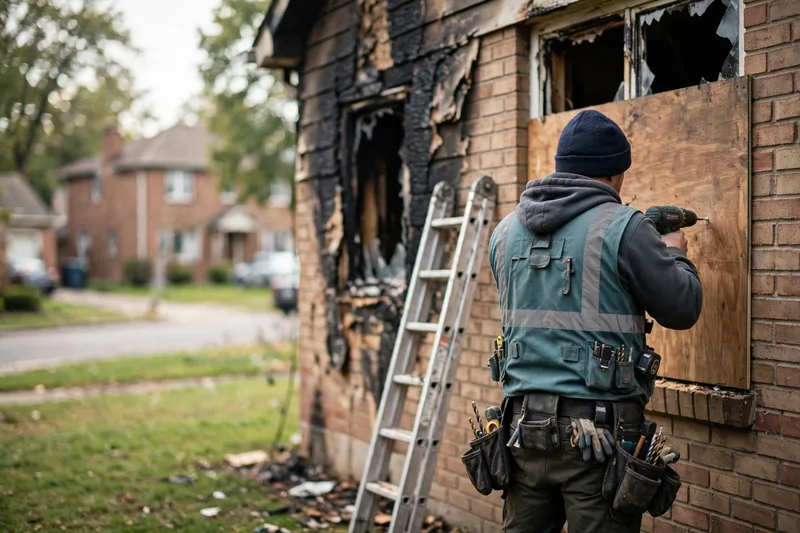
Every fire damage restoration Aurora job opens with this step, whether the call comes at noon or at three in the morning. A house fire cleanup aurora crew treats securing the building as its own trade step, done properly: plywood fitted and screwed to framing, not leaned; roof tarping weighted and sealed against the wind that comes off the Fox River valley; doors that no longer latch replaced by secured panels; and the utilities left in the state the fire department and the utility companies direct. It is also the moment the home becomes safe to leave, which for most families is the real deliverable of the worst day: the house is closed, the claim is open, and sleep is possible.
Homeowners sometimes ask whether they can board up themselves. On a small, ground level opening, with the structure cleared and sound, a careful homeowner can; on a roof line, a second storey, or anywhere near fire weakened structure, it is a professional job on safety grounds alone. The order matters more than the performer: it happens today, not after the weekend, because the weather does not consult the restoration schedule.
What fire damage restoration includes
Fire damage restoration services are sold in every shape in this trade, but a proper job follows a sequence, and the order is the substance: each stage exists because skipping or rushing it is how fire jobs fail, with soot sealed under paint, mold growing behind rebuilt walls, and claims argued from memory instead of record. A fire damage restoration Aurora homeowner reading a quote should be able to find every one of these stages in it, named, in this order.
- Emergency securing. Board-up and roof tarping, described above, closing the building the same day.
- Inspection and documentation. The damage map in full: what burned, where soot travelled, where firefighting water went, what the contents suffered. Photographs and readings that become the claim record and the written scope.
- Water extraction and structural drying. The water that saved the house, removed and dried to measured readings before it starts mold and corrosion of its own.
- Demolition and debris removal. Charred and unsalvageable material out, down to structure that can be cleaned and verified sound, with everything removed documented for the claim.
- Soot and smoke cleaning. Dry removal first, then wet cleaning where surfaces allow, including the HVAC system and ducts that spread the smoke. The section after the steps is devoted to this, because it is where most of the home is won or lost.
- Contents pack-out and cleaning. Your belongings inventoried, packed out where needed, and cleaned through the systems that fit each material, or documented and released for disposal where cleaning cannot honestly save them.
- Odor removal and sealing. On clean surfaces only: fogging or hydroxyl treatment, and sealants where soot penetrated porous material. Source removal first, always.
- Repairs and reconstruction. Framing, drywall, finishes and paint, rebuilt against the written scope and its permits, closing with the walkthrough and your documentation file.
Two of our Aurora pages stand directly behind this one. The drying half of a fire job follows the same standard as our water damage restoration Aurora work, because the water obeys the same rules whatever delivered it; and where firefighting water was left standing before we were called, the sequel is handled with the same containment discipline as our mold remediation in Aurora. The three pages are one system, because in a real house the three problems arrive together.

How the work runs, first call to final walkthrough
Seven stages, in order. The two that separate restoration from expensive cleaning are the documentation built before anything is disturbed, and the drying measured before anything is closed up.
Call and describe the fire
What burned, which rooms are involved, whether the fire department has cleared the building, and whether the roof or windows are open to the weather. That description decides what the first truck carries.
Safety check and emergency board-up
The crew confirms the structure is safe to work in, utilities are in the state they should be, and every opening the fire made is boarded or tarped the same day: the building secured against weather, animals and entry before anything else proceeds.
Inspection and documentation
The full damage map: burned structure, soot travel through the home, water from firefighting, and contents. Photographs and readings build the record your insurance claim and the written scope both stand on.
Water extraction and structural drying
Firefighting water is extracted and the structure is dried to measured readings, because soot and standing water together corrode and stain, and wet material grows mold within 24 to 48 hours.
Demolition and debris removal
Charred and unsalvageable material comes out, bagged and removed, down to the structure that can be cleaned and kept. What stays is what can be verified clean and sound; what goes is documented for the claim.
Soot, smoke and odor work, and contents
Dry soot removal, wet cleaning where surfaces allow, HVAC and duct cleaning, then sealing and deodorizing on clean surfaces. Contents are inventoried, packed out where needed, and cleaned through the systems that fit each material.
Repairs, reconstruction and the final walkthrough
Framing, drywall, finishes and paint, rebuilt against the written scope and the permits the work requires. The job closes with a walkthrough and your documentation file: photos, readings, scope and paperwork for your insurer and your records.
Smoke, soot and odor: the damage that travels
Ask homeowners a month after a contained kitchen fire what the job turned out to be, and few say the kitchen. The fire burned one room; the smoke visited all of them. Smoke rises, spreads along ceilings, presses into wall cavities and duct runs, and deposits soot on every surface it touches, including rooms whose doors were closed and rooms on other floors. Understanding soot is understanding most of your restoration bill, so here is the working knowledge, including the part the search engines argue about: not all soot is the same soot.
| Soot type | Comes from | How it behaves | How it is removed |
|---|---|---|---|
| Dry soot | Fast burning, high heat fires in wood and paper | A fine, dry powder that sits on surfaces; the most forgiving kind if it is lifted before it is wetted | Dry chemical sponge and HEPA vacuuming, always first; wet cleaning only after the dry pass |
| Wet soot | Slow, smouldering, low heat fires in plastics and synthetics | Sticky, smeary and pungent; smears badly under pressure and stains porous surfaces | Dry lift what will lift, then specialist wet cleaning with degreasing agents; patience over pressure |
| Protein soot | Kitchen fires, food and oils burning | Nearly invisible as a film, with the strongest odor of the four; yellows paint and varnish over time | Degreasing clean of every affected surface; odor treatment is the main event, since the film itself hides |
| Fuel oil soot | Furnace and boiler malfunctions, the puffback | A fine grey black film blown through the duct system to every register in the house | Surface cleaning throughout plus full duct and HVAC cleaning, or it redistributes with every heating cycle |
The table explains the two rules repeated across this page. Dry methods come first because water turns three of the four kinds into stains. And the HVAC system is part of the cleaning, not an extra: soot in the ducts is soot scheduled to return to the walls, which is why a smoke damage cleanup aurora scope that never mentions the ductwork is missing the distribution system of the whole problem.
Odor, honestly. Smoke odor lives in sources: the soot film itself, charred material, and odor compounds absorbed into porous surfaces, wall cavities, insulation and fabrics. It is removed in the order those sources are removed: cleaning first, then deodorizing methods on the clean surfaces, thermal fogging that follows the path the smoke took, or hydroxyl treatment that can run in an occupied space, with ozone used only in empty buildings under controls because it is hard on lungs and materials alike.
Where soot penetrated a porous surface past cleaning, a fire rated sealant locks the residue down before paint. What never works is what arrives in a spray bottle: scent layered over a source is a postponement that warm weather collects on. A home that still smells at the first heat wave was fragranced, not restored, and the difference between those two outcomes is set in this stage of the work. It is also where a fire damage restoration Aurora scope earns or loses its money, because this stage is the one cheap quotes quietly shrink.
The paint question, answered plainly. Painting over smoke damage without the cleaning and sealing order is the most common expensive mistake in this trade, and the most searched question in the cluster for a reason: it looks like a shortcut. Soot bleeds through ordinary paint, the odor reactivates in summer, and the failed coat then has to be cleaned through. Clean, dry, seal with a stain blocking fire rated primer, then paint: in that order a soot damaged wall becomes a normal wall, and in any other order it becomes a story told at the next sale.

Your belongings: pack-out, cleaning and the salvage line
Structure gets the attention; contents get the grief. The furniture, clothing, photographs and ordinary objects of a house carry most of its meaning and, after a fire, most of its uncertainty: what can be saved is the question underneath half the searches in this cluster. The professional answer is a system, not a shrug: everything is inventoried in place, photographed, and sorted into what cleans on site, what packs out to specialist cleaning, and what cannot honestly be saved, with that third list agreed and documented rather than decided by a crew with a skip.
| Category | Usual outcome | Why |
|---|---|---|
| Hard furniture, metal, glass, sealed surfaces | Cleaned and kept | Non-porous surfaces release soot fully with dry then wet cleaning |
| Clothing, bedding, soft furnishings | Professionally cleaned, most pieces | Specialist wash systems are built to remove soot and odor from textiles; direct heat damage is the exception |
| Upholstered furniture | Judgment call, piece by piece | Light soot cleans; heavy saturation into foam often does not release its odor |
| Electronics and appliances | Specialist clean and test, promptly | Soot is corrosive; electronics cleaned early often survive, electronics left sitting often do not |
| Documents, photographs, books | Often partly saved | Drying, cleaning and copying rescue more than expected; charred edges are trimmed, contents survive |
| Food, medicine, cosmetics exposed to heat or smoke | Discarded, always | Heat and smoke compromise sealed goods too; no cleaning standard makes them safe |
| Charred, melted or structurally weakened items | Discarded, documented first | The material itself is gone; the photograph and the inventory line are what the claim pays on |
Two habits protect this half of your loss. The inventory is taken before things move, because a contents claim built from memory in month three pays a fraction of one built from a room by room record in week one. And nothing on the discard side leaves without documentation or your adjuster's release: the most expensive sentence in fire claims is some version of we threw it all out the first weekend. Fire and smoke damage restoration in Aurora homes is half building work; this table is the other half, and it deserves the same discipline.
The water left behind: the second job inside the first
Nobody pictures a flood at a fire scene, but a working house fire is put out with water, in volume: into walls, ceilings, floors and everything the flames never reached. That water obeys the same rules as any other water in a house. Extraction and structural drying belong inside the first two days, because wet drywall and insulation grow mold within 24 to 48 hours, and soot mixed with water becomes a corrosive slurry that stains surfaces dry soot would have lifted from. A fire damage restoration Aurora scope that stops at the burned rooms and schedules the drying for later has quietly booked a second damage, and it is the most common way a fire job becomes a fire and mold job.
This is also why the Aurora pages are built as one system. The drying half of the work here is held to the standard set out on our Aurora water damage page, readings, equipment and verification alike; and if the water was already standing for days before the call, the growth that follows is contained and removed the way our Aurora mold page describes. When you compare fire damage restoration services, ask how the drying is handled and who verifies it: the companies that treat it as a stage of the fire job give a different answer from the ones that treat it as your next phone call.

How long fire damage restoration takes
Two clocks again: mitigation, measured in days, and the rebuild, measured in permits and scheduling as much as in work. The bands below follow the severity of the fire, because severity, more than any product or promise, sets the duration of a fire damage cleanup aurora job.
| Severity | Typical total time | What sets it |
|---|---|---|
| Minor: one room, smoke spread | 1 to 2 weeks | Soot and odor work across the home, contents cleaning, first repairs; no structural involvement |
| Moderate: kitchen or room lost, smoke throughout | 1 to 2 months | Mitigation in the first 1 to 2 weeks, then demolition, rebuild of the affected rooms and finishes |
| Major: structural fire, roof or framing involved | 4 to 12 months or more | Engineering, permits and inspections, full reconstruction; the city's schedule counts alongside the crew's |
| The first 48 hours, every severity | Days 1 to 2 | Board-up, documentation, extraction and drying: the stages no later effort can substitute for |
The fastest lever is the same one as in water and mold: how quickly the loss is documented and the mitigation started. A fire assessed on day one is a scope agreed while the evidence is fresh. The same fire assessed in week three is an argument about what the house looked like before the well meaning cleanup, and rebuilds delayed by permits are at least predictable; rebuilds delayed by undocumented scopes are not.
Insurance and fire: the covered peril, and its fine print
Fire is the peril the homeowners policy was invented around, which makes its claims the most straightforward in this trade and still full of surprises for the unprepared. The structure, your contents, and your additional living expenses while the home is uninhabitable are the three heads of a normal fire claim, each with its own mechanics.
How the money actually moves. Emergency work is authorized and paid first, because stopping the loss serves everyone. The structure settlement is then built on an agreed scope of work, line by line, in the estimating format insurers use, and where your policy pays replacement cost value, part of the settlement is held back as depreciation and released when the work is complete and documented. Contents settle against your inventory. Homeowners expecting one cheque learn this staging from letters; it is better learned here: the documentation file, photos, inventory, readings and scope, is not paperwork around the claim. It is the claim.
The clauses that decide arguments. Ordinance or law coverage pays, commonly up to a percentage of the dwelling cover, for the code upgrades a rebuild must satisfy in a house built to an older code, which in Aurora's older stock is a real line, not a footnote. A home left vacant for an extended stretch can fall outside the policy's terms entirely, which matters for houses already empty when they burn. And the everyday reduction is not a denial at all: it is a scope difference between your restorer's line items and the adjuster's, settled by evidence. Illinois gives you two fixed points in the process: your insurer must acknowledge the claim within 15 days, and the Illinois Department of Insurance stands behind the process if a claim is mishandled.
Why fire claims get denied or cut. The denial grounds are narrow and serious: a cause investigation finding the fire deliberate, or a material misstatement in the application. The reductions are mundane: late reporting with the evidence cleaned away, undocumented contents, vacancy problems, and scopes argued from memory. Read across the forums and the same story repeats in a hundred kitchens: the loss was real, the record was not. Everything in the first 24 hours section exists to keep your file out of that story.
Choosing a fire damage restoration company in Aurora: certification
Fire and smoke work has its own credential, and it is the first question worth asking any company, including us: are your technicians certified in fire and smoke restoration. The IICRC's FSRT, Fire and Smoke Restoration Technician, is the certification that names this exact discipline, soot behaviour, cleaning chemistry, odor control and contents handling, and a company doing this work weekly should be able to answer without pausing. The second question is the scope: will the rebuild be priced in an itemised written scope you can read before you sign it.
The third is the documentation: do you receive the photo record, the moisture readings and the claim paperwork at the end. A fire damage restoration company that answers those three cleanly has told you most of what the sales conversation exists to hide.
Then read the behaviour, because fire brings out the trade's worst sales habits at the homeowner's worst moment. The red flags rhyme across the stories people tell: the contract for the entire rebuild pressed on you the first night, before any scope exists; the demand for a large payment before work begins; the company that cannot explain what happens to your belongings; the scope that is one round number. Judge any fire damage restoration Aurora company by whether its behaviour matches its paperwork.
Against those, the green flags are the ones this page is built on: the house secured before anything is sold, emergency stabilization separated from the rebuild decision so you can make the second one in daylight, drying verified by readings, and straight answers about what restoration cannot do. The best fire damage restoration company for an Aurora home is rarely the first at the curb; it is the one whose scope you can read and whose documentation you keep.
Franchise or local is the smaller question: systems and rotating crews on one side, a name on the line in a four county city on the other. Ask the three questions of us first. If our answers match this page, call. If another company's are better, call them.
What the quote depends on
No honest figure for fire damage restoration aurora il work exists before someone has stood in the house, and any company giving one from a photograph is inventing it. What can be stated exactly is what the number is built from.
- The split between burned and smoked. The area the flames touched against the far larger area the soot reached: that ratio shapes the whole scope.
- Structural involvement. Finishes only, or framing, roof and systems: the line between a repair and a reconstruction.
- The soot types present, because protein soot from a kitchen and dry soot from a fast burn clean at different speeds and by different methods.
- The water load. How much firefighting water the structure holds, and how much drying and demolition it drives.
- The contents position. What cleans in place, what packs out, and what is documented and replaced: often the largest variable in the claim.
- The rebuild specification, including the code upgrades the ordinance or law cover exists for in older Aurora homes.
And the checklist worth keeping for any quote, ours included: it separates emergency stabilization from the rebuild, names the rooms and the soot and water work in each, states how drying is verified, lists the contents handling, and is firm before the main work starts. A single round number with no scope is not a quote; it is an opening position.
Why Aurora burns the way it does
The causes of house fires are national; their local weighting is Aurora's. Cooking is the leading cause of home fires in the United States, and an Aurora kitchen is no exception. Behind it come the local emphases: heating equipment worked hard through long Kane County winters, space heaters in the older homes near downtown and along the Fox River whose systems were built for another century, candles and smoking materials, and electrical faults in housing stock that ranges from brand new subdivisions on the far east side to homes wired before the war. The U.S.
Fire Administration's prevention guidance reduces to habits sized for that list: a working smoke alarm on every level and in every bedroom, tested monthly; a kitchen rule that nothing cooking is left alone; three feet of clear space around anything that heats; and a plan for getting out that the whole household has walked, because the restoration questions on this page are the ones nobody asks when the prevention questions were answered.
None of that is said to lecture a city we work in. It is said because the pattern shows in the work: the Aurora fire calls that end as one room and smoke are the ones where an alarm bought the minutes that mattered, and the ones that end as a rebuild are the ones where nobody knew until the fire had the house. Prevention is the only stage of fire damage restoration that happens before the fire, and it is the only one entirely in the homeowner's hands.
Fire help across Aurora and North Aurora
We answer calls across the whole city, from the older streets near downtown and the Fox River to the far east side subdivisions, and across the four counties Aurora touches: Kane, DuPage, Will and Kendall. Most people find this page while searching fire damage restoration aurora on the worst night of their year, or the morning after; others land here from a fire damage cleanup aurora search, a board up question, or a smoke smell that will not leave a house the fire barely touched, which are the same emergency at different hours.
A homeowner searching fire damage restoration near me in Aurora is usually asking whether the crew knows their kind of loss: the kitchen fire in a newer development, the furnace puffback in a century old basement, the roof opened in a storm season rebuild. That local shape of the work is what this page was written around. Others compare fire damage restoration services across the Fox Valley before they call; securing, cleanup, contents and the full rebuild all start at the same place either way: the inspection and the record it builds.
Nearby communities call us too: Naperville, Batavia, Montgomery, Oswego and North Aurora are regular runs from the same number, (773) 570-9869. The full list of areas is on our service areas page.





