The short answer: commercial water damage restoration Chicago is the work that returns a damaged business property to operating condition: emergency mitigation to stop the loss, verified structural drying, cleaning and remediation, then repairs and reconstruction, sequenced in phases so the building keeps functioning around the work. In Chicago it serves offices, retail stores, warehouses and restaurants, and it succeeds or fails on three things a home job never faces: how much of the operation stays open, how well the loss is documented for the insurer, and how honestly the landlord and tenant questions are handled from day one.

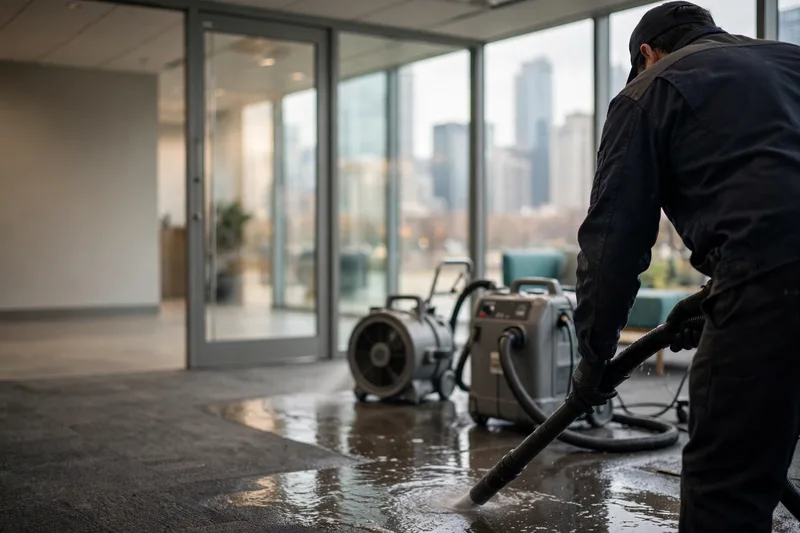
Illustration: a technician extracts standing water from a flooded office lobby in Chicago.
What commercial water damage restoration actually covers
Three words get confused on every commercial loss: mitigation, restoration and reconstruction. They are three jobs, and ordering them wrong is how buildings get rebuilt over wet walls.
| Stage | What it means | When it runs |
|---|---|---|
| Mitigation | Stop the loss: source controlled, water extracted, structure dried and verified, damage prevented from spreading | Immediately, around the clock |
| Restoration | Return the space to working order: cleaning, disinfection, mold remediation, contents and systems recovered | As soon as areas verify dry |
| Reconstruction | Rebuild what the loss destroyed: drywall, ceilings, flooring, finishes, tenant improvements | After remediation, phased by area |
The order is not paperwork. Finishes installed over a structure that never verified dry trap moisture where mold finds it, and the repair bill arrives twice.
Offices: water hides, and the work runs around people
An office loss is rarely dramatic at first glance. A riser leaks inside a wall on the tenth floor, a supply line lets go above a ceiling grid over the weekend, a rooftop unit drains the wrong way into a corridor. By Monday the carpet smells, the drywall base is soft, and the server room is the room everybody is worried about.
Raised floors and ceiling voids hide water for days, which is why the first job is mapping, not mopping: moisture readings across the affected floors, the path of the water traced through chases and corridors, and the rooms nobody has opened yet checked before they are written off as dry. Server rooms and electrical closets get priority, because an hour of water near live equipment is a different kind of loss from an hour of water on carpet tile.
The work itself runs around people who still have jobs to do. Off hours stages and quiet drying plans matter more here than raw speed: containment turns one floor into two, a work zone and an operating office, and the noisy stages move to nights and weekends. Staff keep working in the clean half while the wet half dries, and the daily readings are logged so the building manager can watch the numbers fall instead of taking our word for it.

Illustration: a technician checks moisture readings on an office wall during commercial drying in Chicago.
Retail stores and restaurants: the health rules decide reopening
A shop or a dining room has one clock the other property types do not: the inspector. A sales floor can dry and still stay shut if it smells of a loss, and a kitchen that took water answers to health rules before it answers to the contractor. That is the whole job in retail and food service: the cleaning and the paperwork have to arrive together, or the doors stay closed.
In a retail store the first triage is the stock. Shelving near the floor, cardboard packaging, fabric goods and anything that wicked water up from the base are logged item by item before they are moved, because the claim pays for what the photos prove. Dry goods are lifted to higher shelving, wet goods are separated, and the sales floor is dried in zones so part of the store can trade while the wet zone is worked.
In a restaurant the kitchen is the critical room. Water under equipment, in wall bases and under tile does not dry on its own, and food prep areas need documented disinfection before service resumes. Tables and chairs move out, the floor is extracted and cleaned, and the dining room is returned in sections so the business can seat guests again while the back of house finishes. The one thing nobody should do is reopen on a promise: clearance is documented, and the inspector sees the file.

Illustration: a crew cleans up water damage in a Chicago restaurant dining area.
Warehouses: scale is the problem, and the dock keeps moving
A warehouse loss is measured in square feet and pallet positions, not rooms. Tall ceilings, vast concrete floors, racked inventory and dock schedules that cannot wait: the plan has to keep freight moving while the wet zones dry, or the water loss becomes a logistics loss on top of it.
The first triage is the inventory. Stock on lower rack levels and pallets sitting on the floor is logged and lifted before it wicks water up from the base. Desiccant drying handles the volume a row of small machines cannot, and aisles are dried in phases so forklifts keep running in the clean lanes while the wet lanes are worked. Dock doors stay usable, because a warehouse that cannot receive or ship is a warehouse losing money twice.
Concrete looks dry long before it is dry. Moisture readings on the slab decide when racking goes back and when pallets return to the floor, not the colour of the surface. That is the reading that protects the next shipment: stock set down on a slab that never verified dry picks up moisture from below, and the damage shows up weeks later in someone else's warehouse.

Illustration: a crew extracts standing water from a flooded warehouse floor in Chicago.
The first hour decides the size of the claim
The first day decides the size of the whole claim. In order:
- Protect people first. Keep staff and tenants out of standing water near electrical systems. Nobody wades in for a photograph.
- Stop the source if your team safely can. Close the riser, the unit shutoff or the sprinkler zone, and note the exact time. The mitigation crew handles the rest of the system.
- Shut utilities where it is safe to reach them. Power to affected areas, gas only on instruction from the utility or fire department.
- Document before anything moves. Video the source, the path and every affected room, then photographs of contents where they sit. This footage is claim evidence; once cleanup starts it can never be recreated.
- Notify in parallel. Owner, tenants, insurer, and your restoration vendor. Late notice helps nobody and slow notice can complicate coverage.
- Start mitigation the same day. Extraction and drying placed inside 24 hours are the difference between a water claim and a water plus mold claim a week later.
- Restrict and sign the area. Closed means closed: tape, signage and a note to tenants beats a rumour in the corridor.
What not to do after commercial water damage
Most of the expensive mistakes on a commercial loss are made in the first hours, by good people moving fast. Five of them come up again and again:
- Do not switch on wet equipment. Electronics powered up while wet fail in ways that cannot be repaired. Power down, leave it off, and let the crew test it.
- Do not clean up the evidence. Mopping the scene before the photographs are taken deletes the proof your claim runs on.
- Do not wait for the lease argument. Mitigation is a shared duty from hour one, whoever pays in the end. Damage allowed to grow unmitigated is the one outcome every policy argues against.
- Do not dry by eye. A wall that looks dry can still read wet on a meter, and finishes installed over it trap the moisture where mold finds it.
- Do not reopen a food space on a promise. Kitchens and prep areas reopen on documented clearance, not on a verbal assurance.
How a commercial job runs, call to handback
Seven stages, in order, with the building's operation planned around each one.
Call and dispatch
One call reaches the emergency line day or night. You describe the loss, the building and the access; the right sized crew and equipment leave for the address, and you get a named contact for the whole job.
Make it safe
On arrival the crew makes the scene safe: the source is stopped where possible, electrical hazards are isolated, access is restricted, and the path of the water is traced to its source and its furthest reach.
Extract the water
Standing water is pulled out, wet materials that cannot dry are opened or removed, and the inventory and contents at risk are logged before they are moved.
Dry to verified readings
Commercial drying equipment is placed and moisture readings are taken daily and logged until the structure verifies dry on meters, not on opinion.
Document for the claim
From the first hour the job builds the file an adjuster needs: photographs, a moisture map, daily readings, equipment and labour logs, and a line item estimate in the format insurers use.
Clean and repair
With the structure dry, cleaning, disinfection and any mold remediation run under containment where needed, followed by the repairs that return surfaces, systems and finishes to working order.
Hand back in phases
Areas return as they finish and verify, not in one distant unveiling: the clean half reopens while the wet half completes, and the final walkthrough signs off readings, repairs and paperwork together.
Documentation your insurer will ask for
Ask adjusters what separates a smooth commercial settlement from a fight and they describe paperwork, not pumps. A professional commercial file contains the items below, built from the first visit.
| Document | Why the adjuster wants it |
|---|---|
| Photos and video before cleanup | Proof of the loss as it was: the source, the path and the contents where they sat |
| Moisture map with daily readings | Proof the structure dried to verified numbers, not to somebody's opinion |
| Equipment and labour logs | Proof of what ran, where, and for how long |
| Contents inventory | Item by item record of what was saved, dried or written off |
| Line item estimate | Estimate written in the format insurers use, so approval runs on evidence |
That file does three jobs at once. It gets the claim approved on evidence instead of argument. It protects the landlord tenant split, because the cause and the timeline are recorded while they are facts rather than positions. And it protects the reopening, because inspectors accept documented clearance far faster than verbal assurance. That is the file a commercial water damage restoration chicago job is really judged by: not the pumps on day one, but the paper that gets the claim paid and the doors reopened.
Commercial flood cleanup: burst mains, storms and sprinkler discharge
Commercial flood cleanup differs from a house job in one way that matters: the building keeps running. Tenants, stock and staff are still inside while water moves through ceilings, risers and stairwells, so the first call is about isolating the wet zone.
A burst main, a sprinkler discharge or storm water through a loading dock each leave a different water category and a different drying plan. We confirm the source, protect the dry areas, extract, and then dry to written readings so the handback date is based on measurements, not hope.
How long drying takes
Ranges below are planning spans for typical losses. Your building's size, materials and access move them; the readings, not the calendar, declare each phase done.
| Phase | Typical span | What decides it |
|---|---|---|
| Assessment and extraction | 1 to 3 days | Water volume, access, how many tenancies the path crosses |
| Structural drying | 3 to 7 days for most losses | Materials involved and whether readings fall daily; large or multi floor events run longer |
| Cleaning and remediation | Days, overlapping drying where safe | Water category, contamination, inspection requirements |
| Reconstruction | The variable tail: small losses whole again inside two weeks; severe losses run for weeks | Scope of demolition, permits, materials, phased handback plan |
Where we work in Chicago
We answer commercial calls across the city, from Loop towers and River North offices to warehouse corridors along the expressways and the retail strips of the neighbourhoods. One dispatch number, and crews that arrive knowing the building type in front of them, whether that is a ground floor shop in a brick two flat or a distribution floor out by Midway. The work is the same discipline in every one of those buildings; what changes is the access, the hours and the paperwork, and a commercial water damage restoration chicago crew plans all three before the first meter comes out.
How to choose a commercial water damage company
Five checks separate a commercial operator from a residential crew with a bigger van.
- Ask who leads the job. A named project lead with a phone that gets answered beats a call queue on any loss bigger than a room.
- Ask to see the documentation habit. Sample moisture logs, photo reports and estimate formats, shown before you need them, tell you what your claim file will look like.
- Ask about off hours and phasing. How they would keep your clean areas operating is the commercial question; listen for dock, elevator and tenant communication in the answer.
- Ask for insurance in writing. Carried insurance and safety documentation are ordinary requests in commercial work. A straight company hands them over without a pause.
- Ask for the emergency plan conversation. A vendor willing to walk your building before any loss, and map it, is telling you how the 2 AM call will go.
And keep perspective on the relationship: the right vendor for a building is a standing one. The cheapest first response that leaves a thin file and a wet wall is the most expensive outcome in this trade, whichever page of the ledger it lands on.





