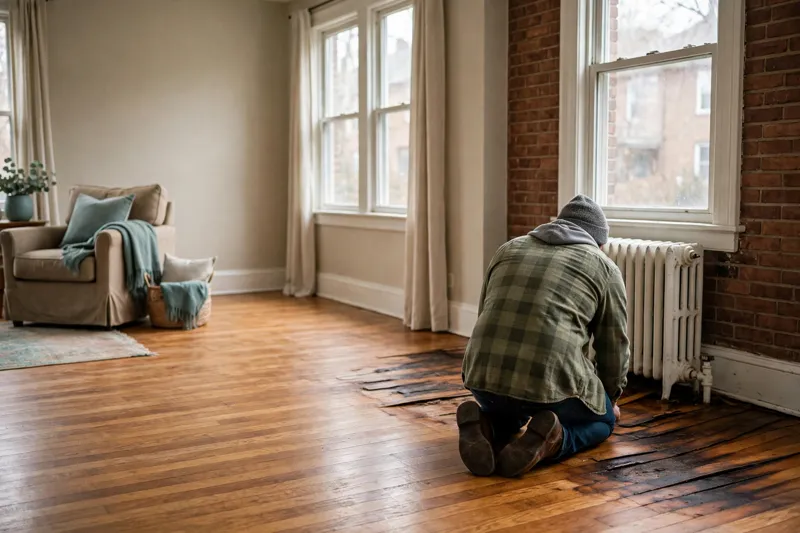
Chicago, IL · A save-or-replace guide
Water Damaged Hardwood Floors: Can They Be Saved?
A wet hardwood floor is not one problem. It is a question with three answers: save it, sand it, or pull it out, and the wrong answer costs the whole room. This guide is the decision framework the Chicago field does not have: how to read the damage, how to dry the floor and the subfloor under it, how much sanding the floor has left, and when the insurance adjuster pays for the whole room instead of a few boards.
- Cupping, crowning and buckling, what each pattern means, and which one can be saved
- The 48-hour steady-reading rule, and why the dry standard is a range, not one number
- The sanding check: how many refinishes a decades-old floor has left
- The two-professional handoff, and the matching dispute with the adjuster
Written for Chicago homeowners, the bungalows, the greystones, and the two-flats.
- We answer 24/7
- Local Chicago team
- Insurance documentation help
- Straight answers, no pressure
Have a question? Call us any time
Send the form and we will call you back. Fast response, no obligation.
The short answer: often, if you catch it early and dry it right
Water damaged hardwood floors in Chicago can often be saved, if the water was clean, you caught it fast, and the boards are only cupped. A floor that cupped a little and dried within a day or two usually flattens on its own, and a light sanding finishes the job. A floor that buckled, rotted, or sat in sewage does not come back, and neither does a floor whose subfloor stayed wet. The meter decides which one you have.
None of the fourteen answers named our site. This page is roughly twice the longest, and it is the first Chicago version written as a decision framework instead of a sales pitch.
The most repeated question in those searches was whether a wet hardwood floor can recover, seven times across the fourteen searches, and the next two were how long the drying takes and whether insurance covers it, seven times each. The only Chicago-specific question in the whole set was where to get a hardwood floor refinished in Chicago. The questions section below answers all of them, in the homeowners' own words where the forums gave them.
| What you see | What it means | Save or replace |
|---|---|---|
| Edges raised, centres low, cupping | The bottom of the board took more water than the top | Often saved, dry it, wait, then sand |
| Boards lifting off the subfloor, buckling | The wood swelled past what the fasteners can hold | Usually replaced, the boards come out |
| Centres higher than edges, crowning | A cupped floor that was sanded while still wet | Hard to fix, the crown was sanded into the floor |
| Dark or black stain, grey at the seams | Water reached the wood itself, often with iron from nails | Stain may stay, sanding may not lift it |
| Soft or spongy underfoot | The subfloor is wet, not just the floor | Floor comes out, dry the subfloor first |
| Musty smell, damp in the room | Water is still working through the house | Stop and call, the source is still open |
The table is the whole page in one place. The sections that follow explain each row: how to read the damage, how to dry the floor and the subfloor, how much sanding the floor has left, and what the adjuster pays for. The question behind the table is the one homeowners type first, can the floor be saved, and the answer is a reading, not a feeling.
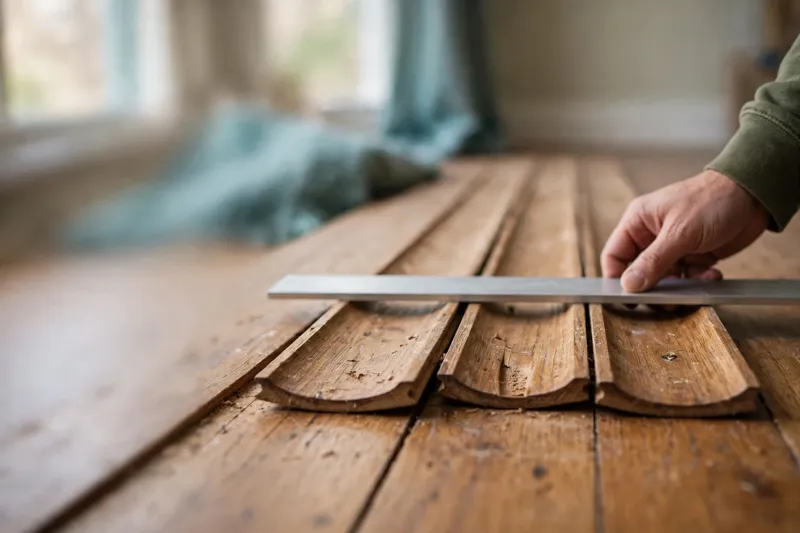
Reading the damage: cupping, crowning, buckling and black stains
Cupping is the edges of the boards rising above the centres, a shallow U shape, the boards still attached to the subfloor, the bottom of the board took more water than the top, and the pattern often flattens as the floor dries.
Buckling is the boards lifting, tenting and pulling away from the subfloor, sometimes by an inch or more, the wood swelled past what the fasteners can hold, and the pattern rarely flattens on its own. Crowning is the third pattern, and it is the one the homeowner causes: a cupped floor sanded while it is still wet flattens at the edges, and when the boards dry they rise in the middle. Buckling hardwood floors water damage is the search that decides the replacement call, and the guides agree on that too.
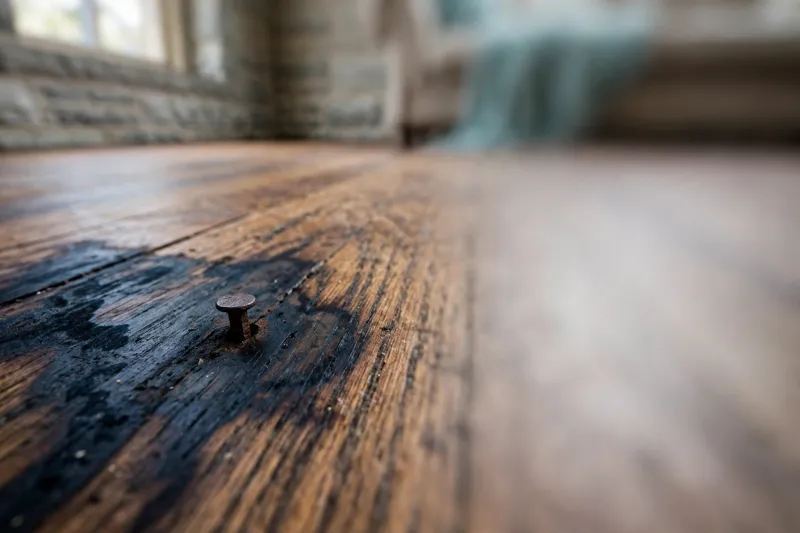
The stains tell you how far the water got. A dark or black stain means the water reached the wood itself, and in oak the iron from nails and other steel reacts with the tannin in the wood to form a blue-black or grey stain, the United States Forest Products Laboratory explains the reaction, and the fix is a treatment for the stain, not a coat of finish over it. A white haze or clouding sits in the finish, not in the wood, and it can often be lifted without touching the boards. Dark seams, gaps that opened, and boards that split are the marks of a floor that dried unevenly, and they are the marks that say the drying was never controlled.
Hardwood floor water damage signs include the ones you cannot see, and they matter more than the ones you can. A floor that feels soft or spongy underfoot has a wet subfloor, and a floor that smells musty has water still working through the house, the guides agree that a musty smell means the source is still open, and the drying has not started.
A flood and a leak are two different jobs
The video watched in full for this page draws the line the guides draw too: a flood is standing water over most or all of the floor, usually from a big pipe break, and a leak is isolated, sometimes hidden, sometimes running for weeks behind a wall. After a flood the floor will probably need replacing, some flooded floors can be dried and repaired, but only a flooring professional with moisture readings should judge, because the water sits under the floor and damages the subfloor, and it can grow mold where no one can see it. After a leak the floor can often be saved, if the leak is found, the source is shut off, and the drying starts within a day.
The subfloor is the job, not the floor. Wood subfloors, plywood, oriented strand board, engineered panels, boards, warp when they get wet, and concrete is less affected, which is why the same leak means a different job in a house with a wood subfloor and a house with a slab. Often the floor must come out to dry underneath, because the water that ran under the boards stays there long after the top looks dry. A floor that was pulled up and dried from below is a floor that was dried; a floor that was dried from above is a floor that was guessed.
Check below the floor before you decide anything. The ceiling in the room below, the baseboards, the toe kicks under the cabinets, and the wall cavities behind the baseboards are the places the water goes first, and they are the places the guides mention in passing and never own as a section. A baseboard that reads wet means the wall is wet, and a wall that reads wet means the drying has not started. The check takes ten minutes with a pin meter, and it is the check that separates a floor job from a house job.
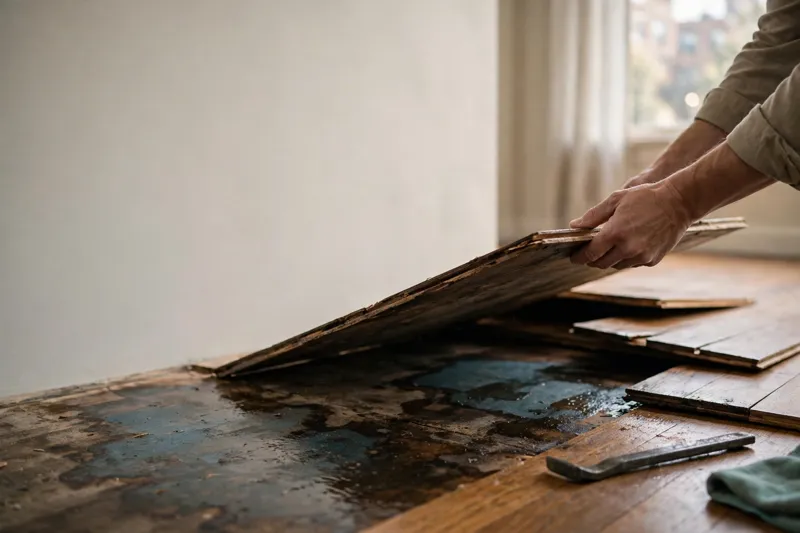
How the drying actually works, and the reading that decides it
The drying rule for water damaged hardwood floors is a reading, not a calendar. The floor is dry when the wet boards read the same as the dry boards in a room that never got wet, and when the readings stay steady for forty-eight hours, the standard the National Wood Flooring Association sets as within two points of the in-use moisture content, steady for forty-eight hours. A floor that was dried for a week and still reads wet is not dry. A floor that was dried for three days and reads the same as the dry room is dry. The calendar never decides, and the touch never decides, the meter decides.
The National Wood Flooring Association target is six to nine percent, and the Chicago restoration guide gives the same six to nine percent for Chicagoland. A Chicago emergency-drying company gives eight to ten percent as the equilibrium moisture content for Chicago. A flooring guide from Elk Grove Village gives six to twelve percent as normal.
The other engines give no number at all: within two to four percent of the dry boards, or stabilized at normal moisture, or close to the normal equilibrium range for the home and the local climate.
How the floor was installed decides how it dries. A nail-down floor over a wood subfloor can be dried from below, through the basement ceiling, and the mats can pull the water out through the boards. A glue-down floor over a slab needs drilled injection ports and negative-pressure mats, and it takes longer, because the slab holds the water and there is no way in from below. A floating floor lifts board by board, and the boards that come up can be dried and put back if they never warped.
The Chicago stock maps to all three: nail-down over a wood subfloor in the bungalows and the two-flats, glue-down over a slab in the finished basements, floating in the newer remodels, and the drying that works on one fails on the others.
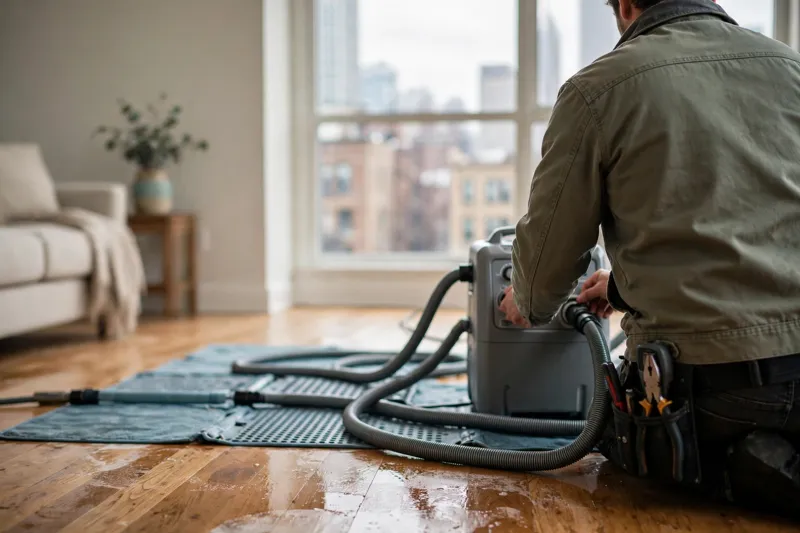
Drying hardwood floors after water damage runs on the same equipment in every guide: extraction first, then air movers and a dehumidifier, then drying mats on the floor itself, the Dri-Eaz Rescue Mat and the Injectidry HP60 are the two systems the Chicago guide names, with mats that pull the water out through the boards. The drying times disagree, and the guides give the range: two to four days with mat systems on a light loss, five to seven days on a severe one, one to three weeks for standing water, three to six weeks for a deep soak. The floor that was dried with mats and read steady for forty-eight hours is the floor that was dried; the floor that was dried with a box fan and guessed is the floor that crowns.
Before you decide: how much sanding does the floor have left
A floor that has been sanded before has less wood left to sand, and a floor that has been sanded several times may have none left at all, and that fact decides the save-or-replace call before the water does. A solid wood floor can usually be sanded and refinished several times, and a floor with a thick wear layer can take a repair sanding without showing it.
An engineered floor carries a wear layer of about one sixteenth to three sixteenths of an inch, which often allows only one light sanding, if any, and the video watched in full for this page puts the line at three millimetres: a wear layer of three millimetres or more can be sanded, and a wear layer under three millimetres cannot be sanded at all.
Water damaged engineered hardwood floors are the hardest case of all: the wear layer is thin, the boards delaminate, and the floor that was built to resist water still fails when the water sits. A floor already at the limit of its sandings before the water arrived is a floor that gets replaced, whatever the water did.
The trap is sanding too soon. A cupped floor sanded while it is still wet flattens at the edges, and when the boards dry they rise in the middle, the crown was sanded into the floor, and the floor that was flat for a week is crowned for good. The rule is the same as the drying rule: the affected boards read the same as the unaffected boards, and stay steady. A floor sanded wet is a floor sanded twice, once wrong, and once to fix the first sanding.
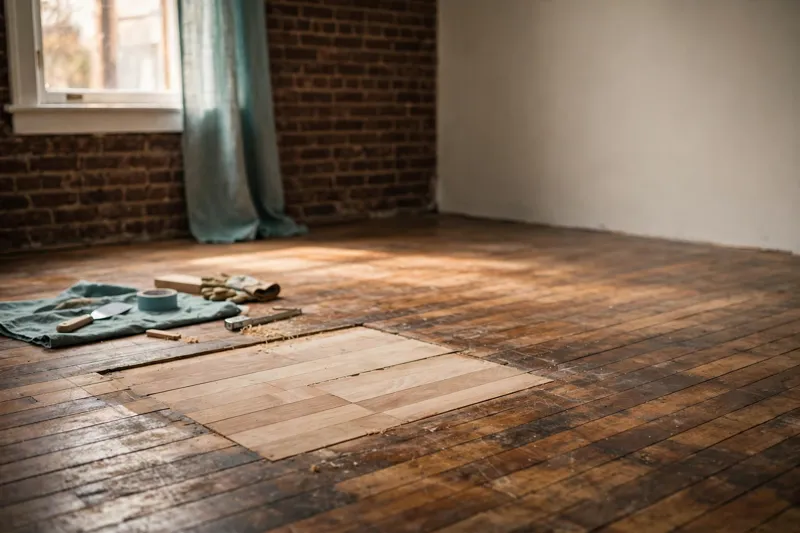
The second trap is the match. A floor that is fifty or eighty years old has a finish that no new board matches, and a repair that sands one section leaves a patch that shows for years, the whole floor usually has to be sanded to match, not just the stained section, and the boards that are woven in have to be the same species, the same grade, and the same dimensions. Photograph the species and the finish before anything is pulled, because the photograph is what the replacement is matched against.
Water damaged hardwood floors in Chicago's old houses: what the
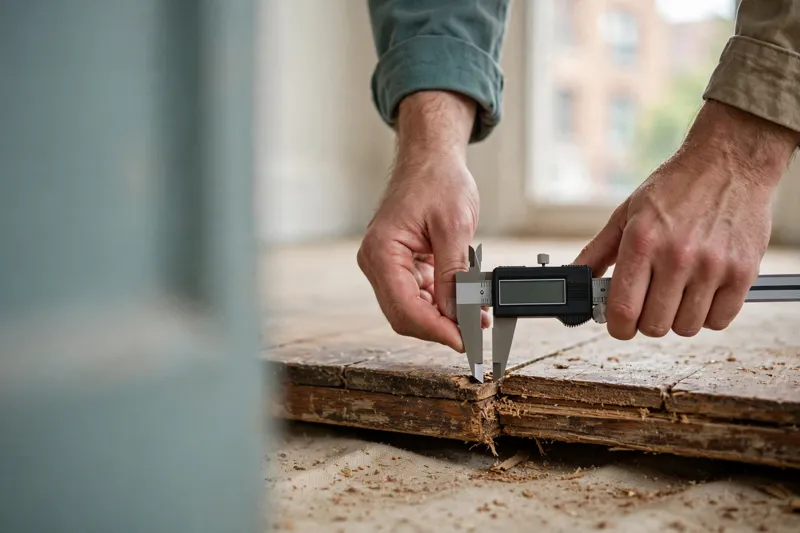
Chicago's old houses decide the answer before the water does. The brick bungalows of Portage Park and Jefferson Park, the two-flats of Logan Square and Avondale, and the older apartment buildings of Rogers Park and Edgewater carry original hardwood floors, solid oak, decades old, finished and refinished over generations, with plaster walls and wood trim that need extra care after a leak. The greystones carry the same floors under the same old finish. A floor that old has been sanded before, and the question is how many times, and the answer is measured with a caliper, not guessed from the age of the house.
The water comes from the same places in all of them. Radiator lines that leak at the valve, ice-maker lines behind the fridge, dishwasher hoses under the sink, washing-machine hoses in the basement laundry, the slow lines, not the dramatic ones, and the slow ones run for weeks before anyone sees the floor cup. A radiator leak in a Chicago condo is the case the city press carries: the building owns the radiator, the building replaces it, and the floor repair falls to the owner, and the owner who finds the leak late owns the mold that follows. The source is the first thing to find, and the floor is the second.
The finished basement is the hardest case in the city. A basement that flooded after a storm is a professional job, and the first call is to 311 to report it, not to a rental shop. The bungalow belt floods from the same storms, and the same rule holds: below grade, hardwood is the floor that loses.
The prevention is the same in every house, and it is cheaper than the repair: braided hoses replaced before they fail, a leak detector under the fridge and the dishwasher, a sump pump that is tested before the spring thaw, gutters that drain away from the house, and a dehumidifier that keeps the humidity between thirty and fifty percent through the summer. The city swings seasons, and the floor swings with them, a house that holds its humidity steady is a house whose floors stay flat.
Two jobs, two professionals, and where one ends and the other starts
A wet hardwood floor is two jobs, and they belong to two different professionals. The restoration company does the first job: extraction, structural drying, and the moisture readings that prove the house is dry. The flooring specialist does the second job: water damaged wood floor repair, sanding, board replacement, refinishing, and the match against the old wood. The two jobs run on the same day, and the handoff between them is the reading, the restoration company hands over a floor that reads dry and steady, and the flooring specialist starts from there.
The handoff is where jobs go wrong. A flooring specialist who starts sanding before the readings are steady sands a wet floor, and the floor crowns. A restoration company that dries the floor and leaves without telling the homeowner what the subfloor reads leaves a floor that looks dry and is not. The coordination is the work: the restoration company calls the flooring specialist the day the readings go steady, and the flooring specialist checks the readings again before the sander comes out of the van. A job with two professionals and one handoff is a job that finishes; a job with two professionals and no handoff is a job that gets done twice.
The drying clock runs in days, and the repair clock runs in weeks, and the repair that starts before the drying finishes is the repair that gets redone. The homeowner's job is not to do either one; it is to make the call early, and to keep the readings.
Insurance and the matching dispute: what the adjuster authorizes
A burst pipe, an overflowing appliance, a failed water heater, those are the covered cases, and the policy pays for the drying and the repair under the dwelling coverage, less the deductible and up to the limits.
A slow leak that ran for months, a sewer backup without its own endorsement, and rising floodwater are not covered, however sudden they felt when they were found. Searches for hardwood floor water damage insurance chicago return a Chicago emergency-drying company and neighbourhood service pages, not a guide, and this section is the guide those searches do not have.
The dispute is not whether the claim pays, it is what the claim pays for. The adjuster authorizes the damaged boards only, and the flooring specialist needs the whole room refinished so the repair matches, and the gap between the two is the matching dispute. The policy may carry a matching provision, and the provision is the thing to ask about before the work starts, not after it. Photograph the species and the finish before anything is pulled, because the photograph is what the replacement is matched against, and a floor with no photograph is a floor the adjuster values as the cheapest board in the store.
File the claim within a day, and file it with the file you built in the first hour: the photographs, the moisture readings with the dates, and the list of what was damaged. The Chicago restoration guide warns that a lack of mitigation can be read as neglect, and the adjuster can deny the claim on it, the drying that starts late is the drying that costs the claim as well as the floor.
It is the same answer this page gives to water damaged hardwood floors when the damage is big enough to claim: hand it over early.
Renters have a different split, and it belongs in this section because the wet-floor question comes up most in rentals. Renters are liable only for damage they caused or failed to report, negligence, misuse, or a leak they never told the landlord about. The building itself, the walls, floors, and pipes, is the landlord's, and so is the plumbing that serves the unit. Renters insurance covers the renter's belongings when the cause was sudden and accidental, and a renter who dries a landlord's floor without telling the landlord is a renter who owns the mold that follows.
How to fix water damaged hardwood floors in your Chicago home
Seven steps, in order. The first one that proves a leak decides the job, and the readings you take in the first hour decide the claim.
Make it safe first
Shut off the power to any room with standing water, from a dry location, never walk through water to reach the panel. If the water may be sewage, or if there is a gas smell, leave the house and call for help. Keep people and pets away from a sagging ceiling, and do not poke it to see what comes out. A safe house with a paper trail is a different home from a wet house with no record, and safety comes before the buckets.
Stop the water at the source
Find the source and stop it: the main valve for a supply line, the shutoff for an appliance, the water heater valve for a heater leak. A job you cannot stop at the source is not a do-it-yourself job, because the water keeps coming while you dry. Note the time you stopped it, and photograph the valve and the leak before anything moves.
Photograph and measure before anything moves
Photograph the water, the stains, the walls, the flooring, and the source, and write down when it started. Take pin-meter readings in the wet area and in a dry room that never got wet, and keep both sets of numbers with the dates. The claim runs on the file you build in the first hour, and a house with readings is a different home from one with paint over a wet wall.
Get the standing water out
Remove the standing water with a wet vacuum or a pump, and mop up what is left. Clear out the damaged items and the wet drywall, so the floor can be reached. Find the leak and shut it off before the drying starts, because a floor that keeps getting wet cannot be dried. The extraction is the fastest part of the job, and it is also the part where stopping too soon is easiest.
Lift boards so the floor and the subfloor can dry
Remove a few boards every five to ten feet, so the boards that are left have room to expand and the subfloor below them can dry. The water that ran under the boards stays there long after the top looks dry, and a floor that was never opened is a floor that was never dried. Keep the boards you lift, in order, so they can go back in the same places.
Dry with mats, air movers and a dehumidifier
Set the drying mats on the floor, run the air movers, and run the dehumidifier with the windows shut and the heating and cooling system off. Check the pin-meter readings every day, in the same spots, against the dry room. The floor is dry when the wet boards read the same as the dry boards and the readings stay steady for forty-eight hours, not when the surface feels dry, and not when the calendar says a week has passed.
Sand, replace or refinish, the whole room, not one board
Sand only when the floor is dry and steady, and sand the whole room, not just the stained section, so the finish matches. Replace the boards that cannot be sanded, a wear layer under three millimetres cannot take a sanding, with boards of the same species, grade and dimensions, woven in, not patched square. A new coat of finish can even out new wood against old, but it fixes no structural problem, no loose board, and no deep stain.
The save-or-replace checklist
- Read the pattern first, cupping, crowning, buckling, or black stain, and know which one can be saved
- Flood or leak, a flood is standing water over most of the floor, a leak is isolated and sometimes hidden
- Power off from a dry location, never walk through standing water to reach the panel
- Source stopped and the time noted, before any drying starts
- Photographs and moisture readings taken before anything moves, with the dates
- Boards lifted every five to ten feet, so the subfloor can dry
- Mats, air movers and a dehumidifier running together, windows shut, heating and cooling system off
- Readings checked every day against a dry room, drying stops when the numbers match and stay steady for forty-eight hours
- Sanding check run before the decision, a wear layer under three millimetres cannot be sanded
- Species and finish photographed before anything is pulled, for the matching dispute
- Insurer called the same day, claim number written down, receipts kept
- Two professionals called the same day, the restoration company for the drying, the flooring specialist for the repair
Run through the whole list before you start, and run it again when the readings go steady, most wet-floor jobs fail on the second run, when the subfloor reads wet.
Call now, we answer 24/7
If you are still asking whether the floor can be saved after running the checks, call (773) 570-9869. We will ask what you saw, tell you what to check tonight, and send a crew with a meter when the job needs one.
Frequently asked questions
Can water damaged hardwood floors be saved?
Yes, often, when the water was clean, you caught it fast, and the boards are only cupped, not buckled or rotted. Mild cupping can flatten as the floor dries, and a light sanding can finish the job. Buckling, rot, a soaked subfloor, or sewage means the boards come out. The meter readings decide, not the look of the surface.
Does homeowners insurance cover water damage restoration, or only part of it?
It covers only part of it. The policy pays for the drying and the repair when the cause was sudden and accidental, up to your limits, minus your deductible. It does not pay for the pipe or the appliance that failed, or for flooding from outside. A sewer backup needs its own endorsement.
How long does water damage restoration take?
Drying takes three to five days on most losses, and the job with repairs usually takes one to three weeks. The reading, not the calendar, decides when the drying is done.
What is water damage restoration called?
The full job, stopping the water, drying the structure, cleaning, and rebuilding, is called water damage restoration. The emergency half, stopping the water and drying, is also called mitigation. Removing mold growth is a separate job, called remediation, and it follows the drying, never the other way around.
Does insurance cover water damage restoration?
Yes, when the damage was sudden and accidental, a burst pipe, a failed water heater, an appliance hose that gave way. The claim runs in order: call the insurer, photograph everything, start the drying, and keep the receipts. The adjuster works from the readings and the photos, so the file you build in the first day decides the claim.
What is the water damage restoration process?
The process runs in order: inspection first, to find the source and how far the water spread; then extraction, with pumps and vacuums; then drying, with air movers and dehumidifiers; then cleaning and sanitising; then the repairs. Dry the floors, walls and framing fast to stop mold, and document everything.
Does homeowners insurance cover water damage?
It covers water damage when the cause was sudden and accidental, a burst pipe, a failed appliance, a supply line that gave way. It does not cover a slow leak that ran for months, groundwater seepage, flooding from outside, or wear and tear. Read the declarations page before the storm, not after it.
What should I do when my house floods?
Stop the water and make it safe first. Shut off the main valve, cut the power to any room with standing water, and do not walk through water that may be sewage. Call 311 to report a flooded basement, photograph everything before anything moves, and start the drying within the first day.
How much does homeowners insurance pay for water damage?
No page can give you a number, because the payment depends on your policy, your deductible, the cause, and the limits you bought. The insurer pays the drying and the repair, less your deductible, and it does not pay for the pipe that failed.
Are renters responsible for water damage?
Renters are liable only for damage they caused or failed to report, negligence, misuse, or a leak they never told the landlord about. The building itself, the walls, floors, and pipes, is the landlord's, and so is the plumbing that serves the unit. Renters insurance covers the renter's belongings when the cause was sudden and accidental.
How much does a plumber charge for a burst pipe?
This site prints no prices, so no figure here can mislead you. The charge depends on where the pipe sits, how hard it is to reach, whether the wall or the floor must come out, and whether the call is an emergency at night. The water damage the burst caused is usually the bigger part of the bill.
Does insurance cover burst pipes?
Yes, when the pipe burst suddenly, a freeze split, a joint that failed without warning, a line that gave way all at once. The insurer pays for the water damage the burst caused, not for the pipe itself. A slow leak that ran for months may be classed as wear and tear, and the claim may fail.
How much does it cost to fix a burst pipe?
This site prints no prices, so no figure here can mislead you. The cost depends on the pipe's location, the access, the material, and the water damage the burst caused, the drying and the rebuild are usually the bigger part. A camera or a moisture reading comes first, then a written scope.
How much does mold remediation cost?
This site prints no prices, so no figure here can mislead you. The cost depends on how much mold there is, where it sits, whether the wall must come out, and whether the moisture source is fixed first. Illinois now registers mold remediation work, with a grace period for existing workers, this site gives consumer guidance only.
Can mold be fully remediated?
Mold can be remediated to safe, normal levels, but no job removes every spore, spores are everywhere, indoors and out. Fully remediated means the moisture source is fixed, the growth is removed, the area is cleaned and dried to the readings, and the humidity stays in the normal range. A job that skips the source is not finished.
How do you dry water damaged hardwood floors?
Stop the source, then get the water out with a wet vacuum or a pump. Lift a few boards every five to ten feet so the subfloor can dry, then run drying mats, air movers and a dehumidifier. The floor is dry when the wet boards read the same as the dry boards and stay steady for forty-eight hours.
What is the difference between cupping and buckling?
Cupping is the edges of the boards rising above the centres, a U shape, with the boards attached, the bottom took more water than the top, and the pattern flattens as the floor dries. Buckling is the boards lifting and pulling away from the subfloor, swelled past what the fasteners can hold, and rarely flattens on its own.
When should water damaged hardwood floors be replaced?
Replace the floor when the boards buckled and pulled away from the subfloor, when the wood rotted or the subfloor stayed wet, when sewage touched it, or when the wear layer is too thin to sand. A flooded floor will probably need replacing, and only a flooring professional with moisture readings should judge it.
Can you sand water damaged hardwood floors?
Yes, when the floor is solid wood, or engineered with a wear layer of three millimetres or more, and only after the floor is dry and steady. Cupping can be sanded flat, as can peeling or cloudy finish, but the whole floor has to be sanded to match. A wear layer under three millimetres cannot be sanded at all.
Does homeowners insurance cover water damaged hardwood floors?
It covers them when the damage was sudden and accidental, a burst pipe, an appliance, a water heater, under the dwelling coverage, less your deductible. It does not cover a slow leak, flooding from outside, or a sewer backup without its endorsement. Slow mitigation can be read as neglect.
Can hardwood floors recover from water damage?
Yes, when the water was clean, you caught it fast, and the boards only cupped. Mild cupping flattens as the floor dries, and a sanding finishes the job. A floor that buckled, rotted, or sat in sewage does not recover, and neither does a floor whose subfloor stayed wet. The meter readings decide, not the look of the surface.
How long does it take hardwood floors to dry out after water damage?
With mat systems, two to four days on a light loss and five to seven days on a severe one. Standing water takes one to three weeks, and a deep soak three to six. The floor is dry when the wet boards read the same as the dry boards and stay steady for forty-eight hours.
What should I do if my wooden floor is water damaged?
Stop the water first, then get the water out with a wet vacuum or a pump. Photograph everything and take pin-meter readings before anything moves. Lift a few boards every five to ten feet so the subfloor can dry, then run drying mats, air movers and a dehumidifier. Call a professional if the boards buckled or the water was sewage.
What pulls moisture out of wood floors?
Drying mats pull the water out through the boards, and a dehumidifier pulls the moisture out of the air. Fans alone do not pull moisture out, they move air, and the moisture stays in the room. The combination does the work: mats on the floor, air movers across it, and a dehumidifier that drains itself while you sleep.
Will cupped floors go back to normal?
Often, yes, when the cupping is mild, the water was clean, and the drying starts within a day or two. Cupped floors flatten on their own once the moisture source is controlled, and a sanding finishes the job. A floor that was sanded while still wet will crown, and a floor that stayed wet for weeks may never flatten.
Will buckled hardwood floors go back to normal?
Almost never. Buckling means the boards lifted and pulled away from the subfloor, and the wood swelled past what the fasteners can hold. A buckled floor that is dried may settle a little, but the boards rarely lie flat again, and the fasteners have failed. The answer is replacement of the buckled boards, woven in, and a sanding to match.
Where can I get my hardwood floor refinished in Chicago?
A flooring specialist refinishes hardwood floors, not a restoration company, the restoration company dries the floor, and the flooring specialist sands and refinishes it. Look for a company that works with old oak and blends stain, because a new board in a decades-old floor shows unless the match is done by hand. Get the readings steady first, then call.
Is it cheaper to sand floors or replace them?
Sanding is cheaper than replacing, when the floor can be sanded, a solid floor, or an engineered floor with a wear layer of three millimetres or more. A floor that cannot be sanded, or a floor that buckled, costs more to replace than to sand. This site prints no prices, so ask a flooring specialist for a written scope.
Sources
- The Kansas City flooring guide framed as repair or replace (updated August 2026), three visible questions, and the sandable-thickness factor this page builds on.
- The Chicago wood-floor drying guide (22 September 2025), the Dri-Eaz Rescue Mat and Injectidry HP60 systems, the six-to-nine-percent Chicagoland dry standard, and ten inline questions.
- The Chicago flooring guide (updated about three months ago), the moisture-testing checklist, and the point that older flooring changes colour, so an exact board match is not always possible.
- The thin Chicago guide on whether a wet floor can be saved (last crawled about ten months ago), four save factors, and the engineered delamination signs.
- The minor-damage repair-or-replace guide (updated about ten days ago), white haze against dark stain, the Class 4 drying note, and the oak iron-tannin stain chemistry from the United States Forest Products Laboratory.
- The five-factor repair-or-replace table from a Pacific Northwest restoration company, water type, exposure, cupping severity, subfloor readings, and solid against engineered.
- The five-step drying order from a Texas restoration company, stop the water, dry slowly, meter-check, assess after drying, then repair, sand, or refinish.
- The buckling-specific guide from a Maryland flooring company, moisture thresholds, expansion gaps, and the national standards behind them.
- Home RenoVision DIY, “Floor Water Damage Repair | Repair or Replace?” (YouTube, 13:53, eight hundred seventy-two thousand views), the video watched in full for this page, with the tub leak, the rotted subfloor, the claw strength test, and the plywood laminated to one and a quarter inches for tile.
- RW Supply and Design, “Can You Save Water Damaged Wood Flooring?” (YouTube, 14:20, fifty-two thousand views), the video watched in full for this page, with the flood-against-leak line, the three-millimetre sanding rule, and the on-site example of a warped floor with a thin wear layer.
- WikiHow, “How to Dry Water Under Wood Floor: 13 Steps” (updated 18 February 2026, one hundred eighty thousand views), seven drying steps and six humidity steps, including removing a few boards every five to ten feet.
- City of Chicago, CHI311, the 311 line, twenty-four hours a day, seven days a week, three hundred and sixty-five days a year.
- People Also Ask questions quoted in this page, with the search record given in the text.
More Restoration Services in Chicago
Every service below is one tap away. Pick the one that matches your problem.

Water Damage Restoration
Fast water extraction, structural drying, and full repair after burst pipes, leaks, and floods.
Learn more →
Water Mitigation
Emergency water removal, structural drying, and mold prevention to stop the damage fast, 24/7.
Learn more →
Mold Remediation
Safe, contained mold remediation that removes contamination and fixes the moisture source.
Learn more →
Sewage Cleanup
Safe removal and disinfection of dangerous sewage backups and black water.
Learn more →
Flood Cleanup
Water pumped out, structure dried, and debris cleared fast after storms and flooding.
Learn more →
Hardwood Floors Water Damage
Cupped, buckled or stained hardwood after a leak? How we dry it, when sanding saves it, and when the boards have to go.
Learn more →