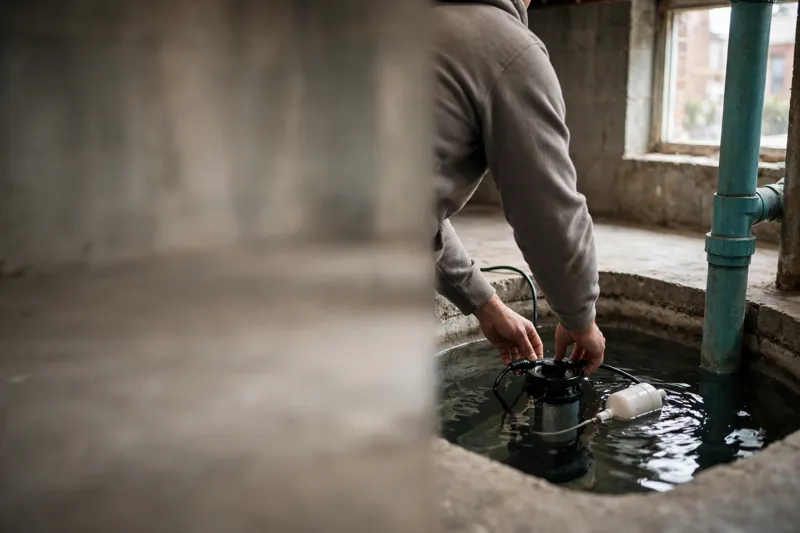
Sump Pump Failure Signs in Chicago
Sump pump failure signs are the pump's way of telling you it is about to quit, a new noise, a pit that stays full, a pump that runs and runs or will not run at all. Most Chicago basements have a pump, and most pumps fail in a storm, when you need them most. This guide reads the signs one at a time, then shows you the ten-minute test that tells you whether the pump works.
- Six signs, each one plain enough to spot from the top of the stairs
- The seven causes, with the power cut first
- The ten-minute bucket test, step by step
- What to do in the first hour after it fails
Written for Chicago homeowners, the combined sewer, the hard freezes, and the storms that cut the power.
- We answer 24/7
- Local Chicago team
- Insurance documentation help
- Straight answers, no pressure
Have a question? Call us any time
Tell us what your pump is doing and we will call you back. We answer 24/7.
The short answer: test it before you trust it
A sump pump fails quietly, and then it fails all at once. The pit fills a little higher each storm, the pump works a little harder, and one night it does not start. Homeowners search sump pump failure signs chicago after the first wet basement, and the answer is the same every time: the pump was giving signs for months, and nobody was watching.
The test takes ten minutes and a bucket of water. Pour five gallons into the pit and watch: the float should lift, the pump should start, and the water should drop fast. If the pump does not start, or it starts and the water stays put, the pump has already failed, the basement just has not flooded yet. The seven steps at the bottom walk through the whole test, including the battery backup.
| Sign | What it usually means | What to do first |
|---|---|---|
| Strange noises | Jammed impeller, worn bearings, loose part | Listen, then run the bucket test |
| Runs constantly or short-cycles | Stuck float switch or undersized pump | Lift the float by hand |
| Will not turn on | No power, stuck float, failed motor | Check the power and the breaker |
| Shaking or vibration | Damaged impeller, pump walking | Look at the pit, then test it |
| Rust and corrosion | Clogged intake or discharge, leaks | Clean the pit, check the line |
| Age | Worn motor and switch, past its range | Test it, then plan the replacement |
Read the signs in order: the noises first, because they are the easiest to hear; the running second, because it is the easiest to see; the age last, because it is the one homeowners forget, a pump does not come with a date stamped on the wall.
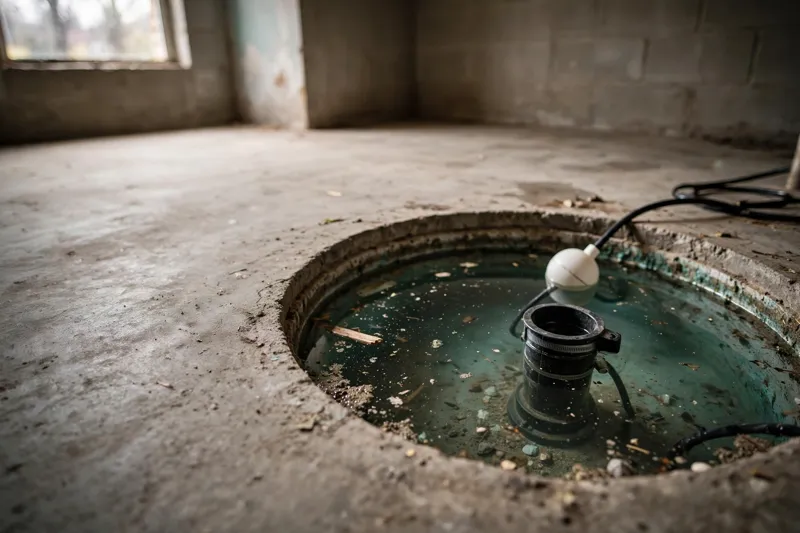
The six sump pump failure signs
If you are wondering about the signs your sump pump is failing, start with the pit and work outward. The sump pump failure warning signs below are the ones the search results repeat on every page that ranks. Each one has a plain cause behind it, and the test is the same bucket of water every time.
1. Strange noises
A pump that has run quietly for years and suddenly grinds, rattles, gurgles or bangs is telling you something has changed inside it. Grinding usually means a jammed impeller or worn bearings. Rattling usually means a loose part or debris in the pit. Gurgling usually means air in the discharge line or a check valve that is not closing. Loud banging usually means water hammer or a loose discharge pipe. Humming, with the pump not running, usually means a stuck float switch or a failed motor.
2. It runs constantly, or it cycles on and off
A pump that runs without stopping is working against something, a float switch stuck on, a blocked discharge line, a high water table, or a pump too small for the water coming in. A pump that starts and stops every few seconds is short-cycling, usually the same stuck float switch, or a check valve that lets the water run back into the pit. Either way the motor never rests, and a motor that never rests burns out.
3. It will not turn on
The sump pump not working signs are the bluntest of the lot: the water rises, the float lifts, and nothing happens. Check the power first, the plug, the breaker, the outlet, because a pump with no power is not a broken pump. Then lift the float by hand: if the pump starts, the switch is the problem. If it does not start at all, the motor has failed, and the pump needs replacing.
4. Shaking and vibration
A pump that shakes when it runs has a damaged or bent impeller, and the shaking gets worse every week it is left. One guide calls it the pump "walking", the whole unit shifts in the pit as it runs, wearing the discharge pipe and the float switch with it. Vibration on its own is not an emergency, but the failure it leads to is a motor that seizes in a storm.
5. Rust and corrosion
Rust on the pump housing or the discharge pipe is more than ugly: the metal is thinning, and thin metal clogs and leaks. Iron bacteria, the orange slime that grows in some Chicago pits, does the same job faster, coating the intake and clogging the line until the motor runs dry. A rusted pump that still runs is a pump to plan around, not a pump to trust.
6. Age
Age is the quietest sign on this page, and the one homeowners argue about most. The sources disagree on the number, the lifespan section below gives the full range, but they agree on the shape of it: a pump past its range fails more often, fails harder, and fails in storms. A pump you have already repaired once has told you its age. Test it twice as often, and plan the replacement before the next wet season.
What the noises mean
Of all the sump pump failure signs, a new noise is the one homeowners notice first, because a pump is supposed to be boring. It should hum quietly for a few seconds, move the water, and stop. Anything else is a sound with a cause behind it. Searches for sump pump making noise signs of failure all ask the same question: is this noise normal, or is the pump about to quit?
Grinding means a jammed impeller or worn bearings. Rattling means a loose part or debris in the pit. Gurgling means air in the line or a check valve that is not closing, so the pump pushes the same water twice. Loud banging or thumping means water hammer or a loose pipe. Humming, loud, with the pump not running, means a stuck float or a failed motor.
Is it okay for a sump pump to be loud? A pump makes some noise when it runs, that is normal, and a new pump is often louder than the old one for the first week. A new noise, or a noise that gets louder week by week, is not normal. Run the bucket test; if the noise is still there, call a professional or replace the pump.
Why pumps fail: the seven causes
Most sump pump failure signs point back to one of seven causes, and the first one is not a part of the pump at all.
A power outage. The guide that ranks first for this topic calls it the top cause, and the search results agree. The battery backup section below is the fix.
2. A stuck float switch. The float is a plastic ball on an arm, or a cylinder that slides up a rod, and it turns the pump on when the water lifts it. Debris, mud, a wire or the pit wall can jam it in either position. Stuck down, the pump never starts. Stuck up, the pump never stops. Lift it by hand, if it moves freely and the pump answers, the switch was the problem.
3. A clogged or frozen discharge line. The line that carries the water out can clog with sediment, ice or debris, and in Chicago it can freeze solid in January. A pump pushing against a blocked line runs hot, runs loud, and burns out. The winter section below covers the freeze in full.
4. An undersized or overwhelmed pump. A pump too small for the water coming in runs constantly and never catches up, and so does a pump that is the right size for a normal storm and the wrong size for a hard one. A 2003 home with two pumps and a battery backup still flooded in heavy rain, one homeowner reported, because the water came in faster than both pumps could move it, and mud had clogged the pit as well.
5. Lack of maintenance. A pit that is never cleaned fills with sediment and debris, and the sediment fouls the float switch and the intake. The ranking guide's routine is a bucket test every three months, a pit cleaning once a year, a check of the discharge line, and a check valve that actually closes. All of it is easy to skip, and a skipped test is how a small fault becomes a flood.
6. Age and wear. Motors wear out, bearings wear out, and switches wear out. A pump that has run for a decade has run through hundreds of storms, and each one takes a little off the motor. The lifespan section below gives the range the sources disagree on, but older pumps fail more often, and they fail in storms.
7. Improper installation. A pump set too high starts late and stops early. A pump set too low cycles every few minutes. A discharge line with no check valve lets the water run straight back into the pit. A pump with no alarm tells you nothing until the water is on the floor. If both pumps in a six-to-seven-year-old system failed together, one homeowner asked whether the system was installed wrong, the right question, because two pumps failing together usually means the installation.
What happens when the pump fails
Homeowners ask what happens when sump pump fails, and the short answer is that the pit fills, the water finds the lowest opening, and the basement floods, usually in the middle of a storm, at night. Ignore sump pump failure signs and the pit overflows into the room. Searches for sump pump failure basement flooding spike after every heavy rain in Chicago, and the pattern is always the same: the pump stopped, the water kept coming, and nobody knew until the floor was wet.
The water rises through the floor and the wall cracks, and it damages flooring, drywall, furniture and anything stored low. A finished basement, drywall, insulation, flooring, soaks up the water and hides it, and costs far more to put back than a bare concrete floor. The search results say mold can start within twenty-four to forty-eight hours after water sits, a claim, not a measured fact, and the drying has to start inside that window either way.
The kind of water matters as much as the amount: groundwater seeping through the floor, water rising from a failed pump, sewer water up through a floor drain, the dirtiest kind, a burst pipe or a failed water heater, and surface water through a window well or under a door. Each one needs a different first step.
| Where the water comes from | What kind it is | First step |
|---|---|---|
| Groundwater seeping through the floor | Groundwater | Pump it out, then dry it |
| A failed pump or a power cut | Groundwater, rising from the pit | Restore the pump or bring a portable one |
| A floor drain | Sewer water, treat it as sewage | Stay out of it, call for help |
| A burst pipe or a water heater | Clean water from inside the house | Shut off the main valve |
| A window well or a door | Surface water from outside | Stop the inflow, then pump it out |
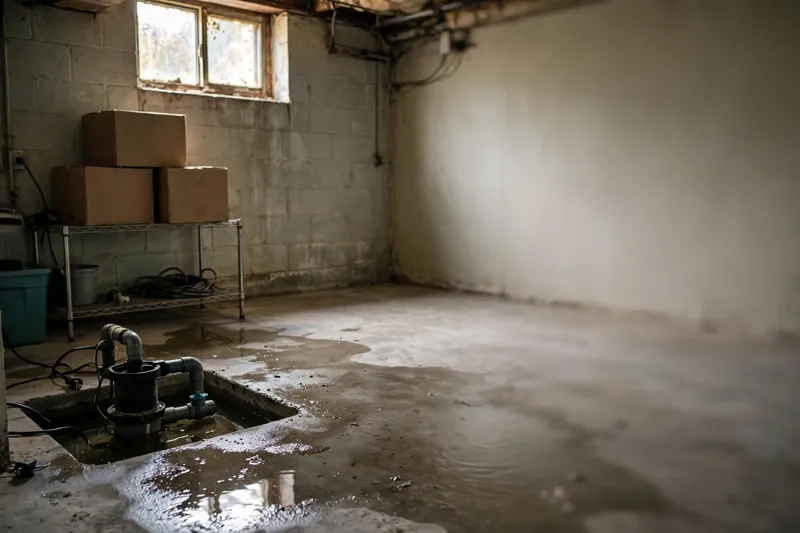
The first hour after it fails
What should you do if your sump pump floods your basement? Five steps, in order, from the guide that maps them out. Stay out of standing water if the electrics are under it, and call the utility if the power is out at the panel. Stop the source or restore power to the pump if it is safe, a tripped breaker is a thirty-second fix. Move your belongings up and photograph everything first. Treat water from a floor drain as sewage, not as rain. And get the extraction and drying started the same day.
Stay safe first. Water near power is the one danger that comes before the damage. If the water is rising and you cannot see the floor, leave the house and call from outside. Do not wade in to save a box, and do not reach for a plug with wet hands.
Then document. Photograph the water line on the walls, the pit, the pump, and every damaged item, before you move anything, the insurer needs the photos, and they need to exist before the cleanup starts. Write down the time the water was found, what the pump was doing, and whether the power was on.
Who are the best places to get a sump pump installed in Chicago? This post recommends no company. Ask for a licensed plumber or sewer contractor, ask how the discharge line will run and where it will end, and get the scope in writing before the work starts.
How to test your pump
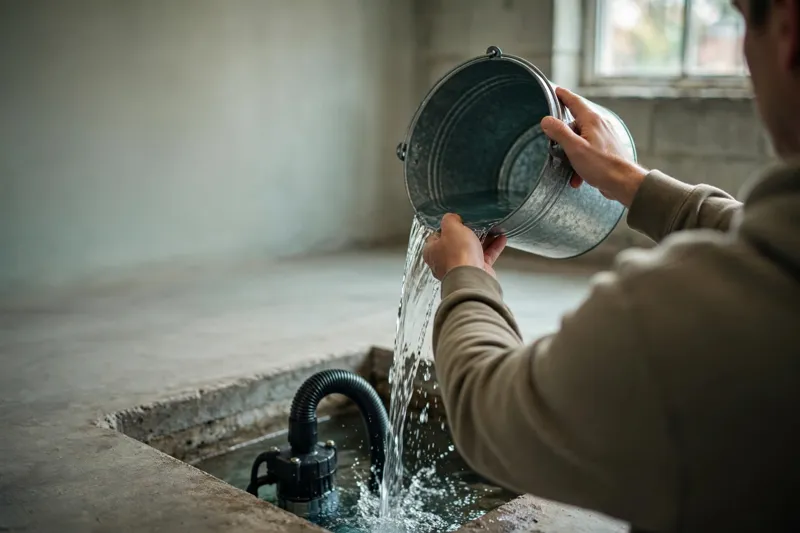
Homeowners ask how to tell if sump pump is failing without taking the pump apart, and the answer is the bucket test. It is the test every guide on this page recommends, and the one the search results repeat more than any other: pour five gallons of water into the pit, slowly, and watch the pump start, move the water out, and shut off when the pit is empty. The pit should empty fast. If the water stays put, the pump is not doing its job.
Test it every three months, and monthly through the wet season, every three months as a minimum, at least twice a year. The ranking guide says quarterly; the search results say monthly. Either way, the test that matters is the one you actually run, and the pump that has never been tested is the pump that fails in the storm.
Test the backup the same way, on the same day. Cut the power to the pump and run the bucket test again, the battery backup should start the pump and keep it running until the pit is empty. A backup that has never been tested is a hope, not a backup. The seven steps at the bottom of this page walk through the whole test.
Winter in Chicago: the frozen discharge line
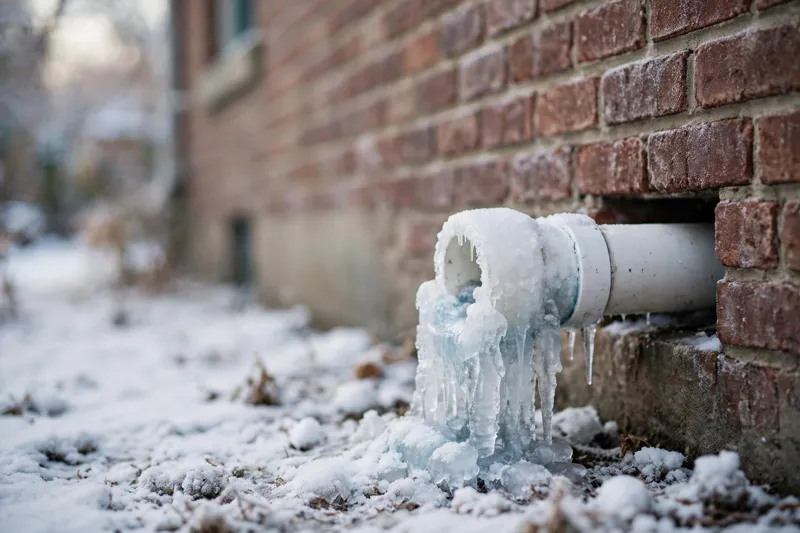
Winter adds its own sump pump failure signs, and the first is the one Chicago homeowners forget: the discharge line freezes. Searches for sump pump failure in winter chicago spike in January, and the search results name the frozen discharge line as the most common winter cause, the water in the pipe outside turns to ice, the pump keeps running against a blocked line, and the pit fills until the basement floods in the middle of winter.
The other winter causes follow from the same cold. Winter storms cut the power. Melting snow and ice send a high volume of water into the pit all at once, and a pump that copes in summer can be overwhelmed by the melt. And a pump that has not been maintained through the year is more likely to fail in the cold.
Is it normal for a sump pump to run in the winter? Yes, in Chicago, the melt keeps the water table high, and the pump should cycle through the winter. What is not normal is a pump that runs without stopping, or a pump that runs and the pit stays full. That is a frozen line, a stuck float, or a pump that has given up, and the check is the same in January as in July: look at the discharge line first, then the power, then the float.
Before the first hard freeze, insulate the discharge line or fit a freeze-resistant one, make sure it slopes away and ends where the water can run off, and test the pump and the battery backup. If the pump fails in winter, check the discharge line for ice first, then the power and the float, and if it is not working, call a professional plumber right away, because a basement that floods in January does not dry in January.
Why the pump runs constantly
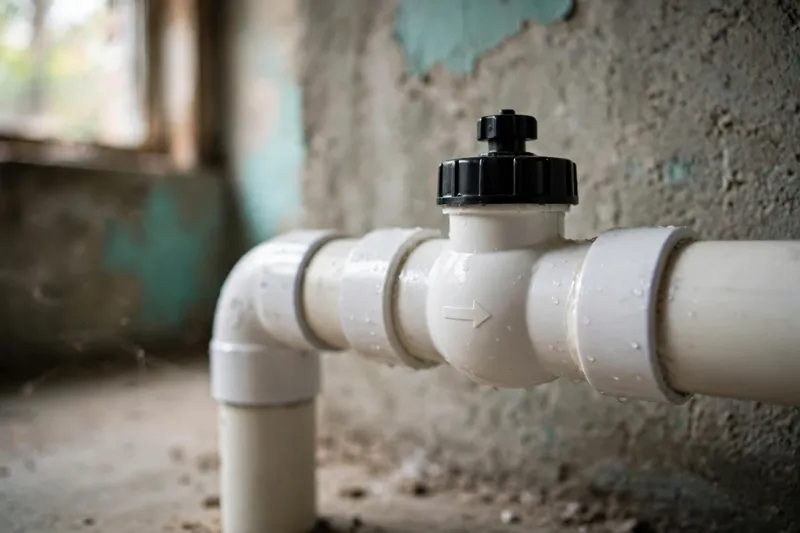
The search term sump pump runs constantly sign of failure is a question with a yes behind it: a pump that never stops is a pump heading for failure. The causes are five, all checkable from the top of the stairs: a float switch stuck on, a check valve that has failed, a discharge line blocked or frozen, a pump too small for the water coming in, or a water table that is simply high.
Continuous running overheats the motor, and an overheated motor burns out. One search answer says a pump running nonstop can seize up within days if it is not fixed, a claim from the search results, not a measured fact, but the direction is not in dispute: a pump that never rests is a pump wearing itself out. Check the float switch first, then the discharge line, then the check valve. If the pump still runs without stopping, call a professional before the motor gives up, a motor that burns out in a storm is a basement that floods in a storm.
The battery backup: the second pump
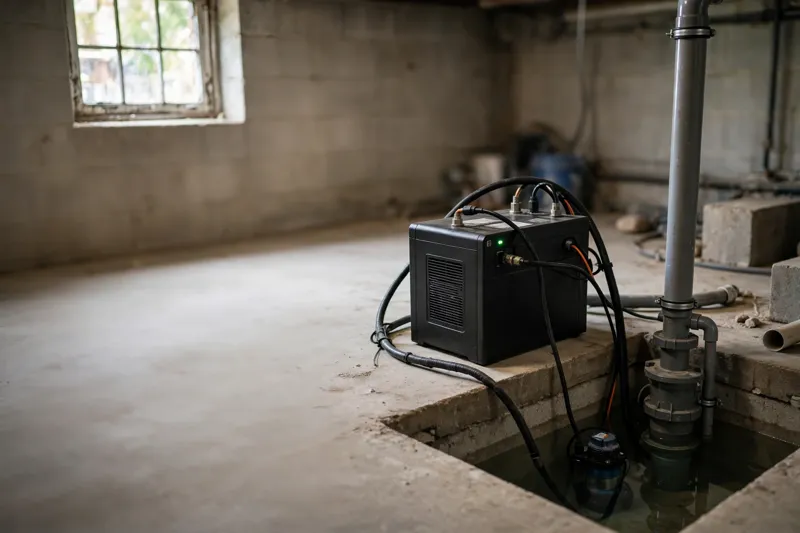
A battery backup is not an accessory in a Chicago basement. It is the second pump. The storms that flood basements are the same storms that cut the power, and a pump without power is a hole in the floor. A backup keeps the pump running through the outage, and an alarm tells you when the battery is low or the pump has failed, because a backup that fails silently is no backup at all.
A bigger battery runs longer, and a pump that cycles every few minutes drains it faster than one that runs once an hour. Test it the same way you test the pump: cut the power, run the bucket test, and see whether the backup starts the pump.
Some homeowners fit a water-powered backup as well, or a dual-pump system, or a generator. Any of them beats a single pump with no backup. What matters is the test: a backup that has never been tested is a hope, and a hope does not move water. Test the pump and the backup together, every three months.
How long a pump lasts, and when to replace it
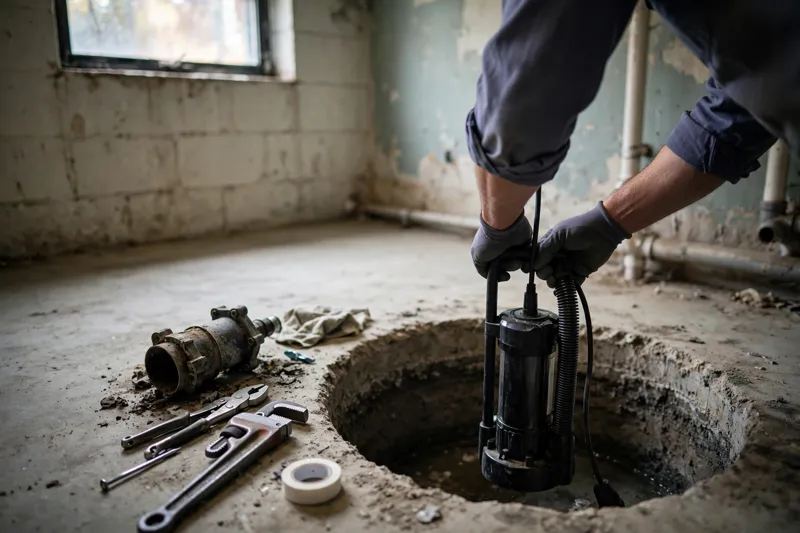
Homeowners ask how often should a sump pump be replaced chicago, and the honest answer is that the sources disagree, so this page gives the range, not a single number. Age is the quietest of the sump pump failure signs, and the disagreement is the point: most sources put the range at five to ten years, with seven to ten the most common figure. One search answer says five to seven years, with a maximum of about ten. One plumber's page says up to fifteen years, another says about five to seven.
The four AI engines that answered the twenty questions on this page agreed on seven to ten years, but the Google search answers conflicted, so the page still presents the range. Pedestal pumps last longer, ten to fifteen years and more, and the battery lasts three to five years.
Can a pump last twenty years? Yes, some do, with regular testing, a clean pit and a clear discharge line. But a pump that old has run through hundreds of storms, and the question is whether you want to find out in the middle of one. The search results give a rule of thumb: once a pump reaches seven years old, watch it closely, and do not wait for a complete failure, because waiting usually ends with a flooded basement.
Replace it when the signs stack up: the pump is past the age range the sources give, it has been repaired before, the housing is rusted through, the water in the pit does not drop when it runs, or a new grinding noise follows a repair. When in doubt, replace it before the next storm, a pump replaced in dry weather is a job; a pump replaced in a flood is an emergency. What a replacement costs depends on the pump type, the pit and discharge line, whether a battery backup or alarm is added, and whether it is planned work or an emergency callout, a planned replacement in dry weather is the cheaper job, every time.
Chicago: three things that make it worse
Chicago makes a failed sump pump worse in three ways. First, the combined sewer: the city runs one pipe for sewage and stormwater, and in a hard storm the pipe fills and the water has nowhere to go, so a failed pump here floods faster than in a city with separate sewers, because the street system is already full when the pump stops.
Second, the freeze. The discharge line runs outside, and a Chicago January can freeze it solid. That is why the winter section above comes before the battery section: the frozen line is the failure the rest of the country does not have to think about, and the fix is a Chicago fix.
Third, the power. The storms that flood basements cut the power, and the power cut turns a working pump into a hole in the floor. Call 311 when the street water is involved, the line is staffed twenty-four hours a day, seven days a week, and the number in the site footer is (312) 744-5000, but 311 is the call for street water, not for the pump itself. The pump is the homeowner's equipment, and so is the fix.
The Private Drain Program is the City's programme for a broken sewer drain tile under the public way: the owner first hires a licensed sewer contractor to rod and video-inspect it, and if the break is in the public way the City repairs it at no cost. A failed sump pump is a different thing entirely, the homeowner's own pump, inside the homeowner's own basement, and the programme does not cover it.
One Chicago name belongs on this page as a fact, not a recommendation: U.S. Waterproofing's Chicago seasonal sump guide is the most visible Chicago page on the first page of the winter and replacement searches. None is recommended here, they are named because they rank, and a homeowner who searches these terms will meet them first.
What Chicago homeowners are actually asking
No verified named Chicago sump pump failure case exists anywhere in this sweep, no company, no street address, no date, with a live source behind it. What exists instead is what homeowners are asking.
A homeowner in May 2026 found the pump filling up but not turning on, tried the breaker and the float switch, and carried the water out in buckets, hoping it would last until tomorrow. A homeowner in August 2026 asked whether to fix, renovate or sell after a basement flooded in a storm: the power went out, the primary pump failed, and the battery backup went out too. A homeowner in March 2022 found the pump making weird noises for two days in a new home, the check valve had failed stuck closed.
A homeowner in May 2016 warned that pumps fail when you need them most. A homeowner in May 2026 got a water alarm at one in the morning and found the basement completely flooded. A homeowner in August 2025 asked whether both pumps failing in a six-to-seven-year-old system meant the installation was wrong.
The replacement questions are just as plain. One homeowner was quoted eighteen hundred dollars to replace a pump and asked whether to do it himself. Another asked how to tell, before it fails, when a pump needs replacing, the old one dated from 2017. A third asked about a pump installed in 2009. A fourth weighed two quotes over three thousand dollars against doing the job herself. And a Chicago homeowner in May 2020 asked whether a flood control system was necessary at all, quoted ten thousand dollars for drain tile and five thousand for the rebuild. The answer is the same as this page: test the pump, read the signs, and replace it before the storm.
Insurance: the endorsement question
A standard homeowners policy generally does not cover a sump pump that failed on its own. The failure is wear and tear or a maintenance problem, not a sudden accident. Cover for a failed pump usually needs a water backup or sump overflow endorsement, and the time to ask about it is before the storm, not after the basement floods.
The same rule answers the wider questions. A burst pipe is usually covered, because the burst was sudden, but the insurer pays for the water damage, not for the pipe itself. A sewer backup is usually covered only with the endorsement. Water from outside is flooding, and it needs the separate flood policy. Mold is covered only when it follows a sudden, accidental loss the policy already covers, and mold cover has its own sub-limit.
What the insurer pays is the drying and the repair, less your deductible, up to the limits you bought. No page can give you a number, because the payment depends on your policy, your deductible, the cause of the loss and the limits. Ask your insurer what your policy actually covers, the endorsement, the sub-limit, and the deductible, before the next storm. Our does homeowners insurance cover water damage post covers the rule in full.
Test your pump in seven steps
Seven steps, in order, from the pit to the discharge line and the battery backup. Do them once, then run them again every three months, and monthly through the wet season.
Find the pump and look at the pit.
Lift the cover off the pit and look at the water level. Check for debris, mud or silt in the pit, and make sure the float switch can move freely. A float tangled in a wire or jammed against the pit wall cannot do its job.
Check the power first.
Make sure the pump is plugged in, the breaker has not tripped, and the outlet works. A pump with no power is not a broken pump, and the fix costs nothing.
Lift the float by hand.
Lift the float switch slowly and listen. The pump should start as the float rises and stop as it falls. A float that sticks halfway, or a switch that clicks and nothing happens, is the most common fault on this page.
Pour five gallons of water into the pit.
This is the bucket test, and it is the test that matters. Pour the water in slowly and watch the pump start, move the water out, and shut off when the pit is empty. If the water stays put, the pump is not doing its job.
Listen for the noises.
Grinding, rattling, gurgling, banging and humming each point at a different fault. A new noise after years of quiet running is a warning, not background sound.
Check the discharge line outside.
Follow the pipe out of the house and look at the whole run. It should be clear, sloped away from the walls, and ending well away from the foundation. In winter, check it for ice first.
Test the backup the same way.
Cut the power to the pump and run the bucket test again. The battery backup should start the pump and keep it running until the pit is empty. If it does not, find out now, not in the middle of a storm.
Your checklist, before the next storm
Write the sump pump failure signs down and keep the list by the stairs: the noises, the running, the vibration, the rust, the age. Before the next storm, test the pump and the battery, check the discharge line, clear the pit, and keep our number, (773) 570-9869, on the fridge. For the system around the pump, grading, gutters, a backwater valve, see our prevention guide: searches for sump pump failure prevention chicago belong there. During the storm, watch the pit and the floor drain.
After the storm, check the basement before the water has time to sit, and call the same day if it is wet. The sump pump failure signs in this guide are the same six every Chicago guide lists, and the five-minute test is what turns the list into a warning.
Call now, a pump that quits in a storm
If your pump is making a new noise, running without stopping, or not running at all, the answer is a test today, not a flood tomorrow. The call to make is (773) 570-9869. We answer 24/7 and talk you through the bucket test while a crew is on the way.
Sump pump acting up in Chicago?
We answer 24/7. Call now and a crew is on the way.
Call (773) 570-9869Frequently asked questions
What are the signs of sump pump failure?
The six signs are strange noises, a pump that runs constantly or cycles on and off in seconds, a pump that will not start, shaking or vibration, rust and corrosion on the pump or the discharge pipe, and age. A pump that shows any one of them needs a test the same day, not after the next storm.
Does homeowners insurance cover water damage restoration, or only part of it?
It covers only part of it. The policy pays for the drying and the repair when the cause was sudden and accidental, up to the limits you bought, minus your deductible. It does not pay for the pipe or appliance that failed, and it does not pay for flooding from outside. A sewer backup needs the endorsement.
How long does water damage restoration take?
Drying takes three to five days on a small, contained clean-water loss in one room, and the full job, drying plus repairs, usually takes one to four weeks. The time depends on how much water there is, what kind of water it is, what got wet, and whether the insurer has approved the work.
What is water damage restoration called?
The full job, stopping the water, drying the structure, cleaning, and rebuilding, is called water damage restoration. The emergency half, stopping the water and drying, is also called mitigation. Removing mold growth is a separate job, called remediation, and it follows the drying, never the other way around.
Does insurance cover water damage restoration?
It usually does when the damage was sudden and accidental, such as a burst pipe or an appliance failure. It does not cover flooding from outside, which needs separate flood insurance. A sewer backup is usually covered only if you hold the endorsement for it, so ask your insurer before the next storm.
What is the water damage restoration process?
The process runs in order: inspection first, to find the source and measure how far the water spread; then extraction, with pumps and vacuums; then drying, with air movers and dehumidifiers; then cleaning and sanitizing; then the repairs that put the room back. Act fast, the search results say mold can start within a day or two.
Does homeowners insurance cover mold?
It covers mold only when the mold follows a sudden, accidental loss the policy already covers, such as a burst pipe. Mold from a slow leak, from flooding outside, or from a damp basement the owner never fixed is usually not covered. Mold cover also has its own sub-limit, so read the policy before you need it.
What should I do when I find mold?
Fix the moisture source first, or the mold comes back. Wear a respirator rated N95, gloves and goggles, and clean only a small patch yourself, the guidance the search engines cite is ten square feet or less. Anything bigger, or mold that keeps coming back, needs a professional crew with the right equipment.
How much does homeowners insurance pay for water damage?
No page can give you a number, because the payment depends on your policy, your deductible, the cause of the loss, and the limits you bought. The insurer pays the drying and the repair, less your deductible, and it does not pay for the pipe that failed. Ask your insurer what your limits are before the next storm.
Are renters responsible for mold damage?
It depends on what caused the mold. The landlord owns the building and its pipes, so the landlord pays when a leak, a failed pump or a building defect caused it. A renter pays when the renter caused the damp, an overflowing tub left running, or a leak never reported. Renters insurance covers the renter's belongings, not the building.
How much does mold testing cost?
This site prints no prices, so no figure here can mislead you. The cost depends on how many samples are taken, whether the testing is air or surface, whether a lab is involved, and how big the affected area is. We inspect first, then give you a written scope before any work starts.
Does homeowners insurance cover burst pipes?
Yes, when the pipe burst suddenly, a freeze split, a joint that failed without warning, a line that gave way all at once. The insurer pays for the water damage the burst caused, not for the pipe itself. A slow leak that ran for months is a different story, and it may be classed as wear and tear.
How much does trenchless pipe bursting cost?
This site prints no prices for either job, because pipe bursting means two different things. Trenchless pipe bursting replaces a broken sewer line by pulling a new pipe through the old one. A burst pipe is a supply pipe that split open, usually from freezing, and the fix is a repair, not a replacement.
How much does water damage restoration cost?
This site prints no prices, so no figure here can mislead you. The cost depends on how much water there was, how far it spread, what kind of water it was, and what it touched. A bare concrete floor dries fast. A finished basement with drywall, insulation and flooring costs far more to put back.
Can mold be fully remediated?
Yes, when the water source is fixed first and the drying is finished to moisture readings. Remediation means removing the mold growth, cleaning what stays, and drying the space so it cannot grow back. No home is ever one hundred percent free of mold spores.
How do I test my sump pump?
Pour five gallons of water into the pit and watch what happens. The float should lift, the pump should start, and the water should drop fast. Test it every three months, and monthly through the wet season. If the pump does not start, or it starts and the water stays put, it needs a repair or a replacement.
How long does a sump pump last?
The sources disagree, so there is no single number. Most put the range at five to ten years, with seven to ten the most common figure; one search answer says five to seven years with a maximum of about ten, and one plumber's page says up to fifteen. Pedestal pumps last longer, and the battery lasts three to five years.
What happens if my sump pump fails during a storm?
The pit fills and the basement can flood within minutes, one search answer says often within fifteen minutes. The water rises through the floor and the wall cracks, and it damages flooring, drywall, furniture and anything stored low. Turn off the power to the basement, get the water out, and call for help the same day.
Do I need a battery backup for my sump pump?
Yes, in a Chicago basement. The storms that flood basements are the same storms that cut the power, and a pump without power is a hole in the floor. A battery backup keeps the pump running through the outage, and an alarm tells you when the battery is low or the pump has failed.
Why is my sump pump running constantly?
The usual causes are a float switch stuck in the on position, a check valve that has failed, a discharge line that is blocked or frozen, or a pump that is too small for the water coming in. A pump that never stops overheats and burns out, so check the float and the discharge line now, before the next storm.
How to tell if a sump pump needs replacing?
Replace it when the signs stack up: the pump is past the age range the sources give, it has been repaired before, the housing is rusted through, or the water in the pit does not drop when it runs. A grinding noise after a repair is another sign. When in doubt, replace it before the next storm, not during it.
What is the most common reason for sump pump failure?
A power outage. The guide that ranks first for this topic calls it the top cause, and the search results agree: the storms that flood basements are the same storms that cut the power. After that come a stuck float switch, a clogged or frozen discharge line, and a pump that is too small for the water coming in.
Will homeowners insurance cover a failed sump pump?
Usually not. A standard policy does not cover a sump pump that failed on its own, because the failure is wear and tear or a maintenance problem, not a sudden accident. Cover usually needs a water backup or sump overflow endorsement added to the policy, so ask your insurer what your policy actually covers.
Is it a red flag if a house has a sump pump?
No, in Chicago it is the opposite. Most basements here sit below the water table in wet weather, and a pump is standard equipment, not a warning sign. What matters is the pump's condition: test it, check the discharge line, and ask when it was last replaced.
What does a faulty sump pump sound like?
Grinding means a jammed impeller or worn bearings. Rattling means a loose part or debris in the pit. Gurgling means air in the discharge line or a check valve problem. Loud banging means water hammer or a loose discharge pipe. Humming with no pump running means a stuck float switch or a failed motor.
How long can a sump pump run before it burns out?
There is no fixed number of hours, because it depends on the pump, the water and the heat. A pump that runs nonstop overheats, and one search answer says it can seize up within days if it is not fixed. Treat constant running as an emergency: check the float switch and the discharge line the same day.
Will a sump pump freeze in winter?
The pump itself rarely freezes, because it sits in water below the frost line. The discharge line freezes, that is the winter failure. Water in the pipe outside turns to ice, the pump keeps running against a blocked line, and the pit fills. Insulate the line or fit a freeze-resistant one before the first hard freeze.
What is a better alternative to a sump pump?
There is no single replacement, because a pump and its alternatives fix different water. Gravity drainage works where the site slopes away from the house. Interior drain tile still needs a pump. An overhead sewer and a backwater valve stop sewer water, not groundwater. Most Chicago basements need the pump plus one of the others, not one instead of it.
Sources
- Water Damage Cleanup Now, "Sump Pump Failure: Flooded Basement Guide", 7 warning signs, 6 causes, power outage the top cause; quarterly bucket test, annual pit cleaning, check valve, pit water alarm; standard policies generally do not cover sump failure, endorsement needed. https://waterdamagecleanupnow.com/blog/sump-pump-failure-basement-flood/
- WaterDamageXpert, "Basement Flooding & Sump Pump Failure: What to Do", updated November 14, 2026, water-source table, five immediate steps; insurance distinctions (burst pipe typically covered; water backup and sump overflow usually need an endorsement; flooding needs flood insurance). Its images are AI-generated illustrations; it is a free referral service, not a restoration company. https://waterdamagexpert.com/guides/basement-flooding-sump-pumps/
- The Plumbing Authority, Knoxville, "Sump Pump Knoxville TN | Sump Pump Installation & Repair", 8 repair signs, 8-step test; most pumps last seven to ten years; test at least twice a year; offices at 1209 Buchanan Ave, Knoxville, TN 37917 and 136 S Illinois Ave, Oak Ridge, TN 37830. https://www.theplumbingauthority.com/plumbing-services/sump-pumps/
- wikiHow, "How to Install a Sump Pump: 13 Steps (with Pictures)" (David Balkan, Professional Plumber, CEO of Balkan Sewer and Water Main Service, last updated October 3, 2026), 717,941 views. No wikiHow article titled "How to Test a Sump Pump" exists. https://www.wikihow.com/Install-a-Sump-Pump
- Suburban Plumbing, "Sump Pump Replacement in Chicago | Fast, Reliable Service", January 17, 2025, watched in full, company + town only, not a verified case. https://www.youtube.com/watch?v=YIr8X8pL0Hg
- City of Chicago, Department of Water Management home, What We Do, Our Structure and Leadership pages, chicago.gov, November 17, 2026.
- City of Chicago, 311 Call Center Operations page, chicago.gov, staffing twenty-four hours a day, seven days a week.
- CHI 311, "Private drains program overview", December 12, 2018, 311.chicago.gov. https://311.chicago.gov/s/article/Private-drains-program-overview
More on water damage in Chicago
The service pages and guides behind this diagnostic post, the work itself, after the water gets in.
More Restoration Services in Chicago
Every service below is one tap away. Pick the one that matches your problem.

Water Damage Restoration
Fast water extraction, structural drying, and full repair after burst pipes, leaks, and floods.
Learn more →
Water Mitigation
Emergency water removal, structural drying, and mold prevention to stop the damage fast, 24/7.
Learn more →
Mold Remediation
Safe, contained mold remediation that removes contamination and fixes the moisture source.
Learn more →
Sewage Cleanup
Safe removal and disinfection of dangerous sewage backups and black water.
Learn more →
Flood Cleanup
Water pumped out, structure dried, and debris cleared fast after storms and flooding.
Learn more →
Hardwood Floors Water Damage
Cupped, buckled or stained hardwood after a leak? How we dry it, when sanding saves it, and when the boards have to go.
Learn more →