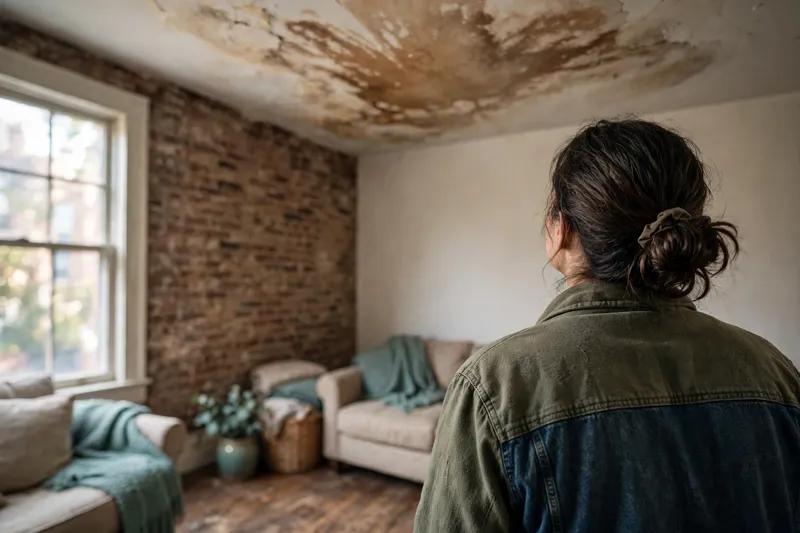
Chicago, IL · A detection guide
Signs of Water Damage in Chicago
Water rarely announces itself. It stains a ceiling, bubbles a wall, warps a floor, or leaves a smell in the basement, and by the time you see it, it has been there for weeks. This guide is about spotting it early: the ten marks to look for, the tests that prove a leak before you call anyone, and what to do in the first hour after you find one.
- The ten marks, by surface, walls, ceilings, floors, and basements
- Five at-home tests that prove a leak, with no tools beyond a meter and a pencil
- The Chicago version, plaster walls, flat roofs, garden-unit basements, and combined sewers
- What real Chicago homeowners actually asked, and what no verified case could prove
Written for Chicago homeowners, the bungalows, the two-flats, and the brick homes.
- We answer 24/7
- Local Chicago team
- Insurance documentation help
- Straight answers, no pressure
Have a question? Call us any time
Send the form and we will call you back. Fast response, no obligation.
The short answer: water leaves marks before it leaves damage
The signs of water damage are the house telling you something is wrong before the damage is visible. A stain, a smell, a warped board, a bill that jumps, each one is a mark, and the marks are worth more than the damage, because the marks come first. Find the mark, prove the leak, and the drying starts days earlier than it would have.
The question behind this page is how to tell if you have water damage, and the answer is simpler than most homeowners expect: look at the surfaces, smell the air, listen when the taps are off, and check the bill. None of the fourteen answers named our site, and none of them was written for a Chicago house. This page is the Chicago version.
One question came up more than any other in those searches: “Will water damage go away on its own?” It appeared six times across the fourteen searches, and the answer is no. Water does not dry itself out of a wall, and the stain that fades on the surface is still wet behind it. The rest of this page is what to look for, how to prove it, and what to do next.
| What you notice | What it usually means | How urgent |
|---|---|---|
| A stain on the ceiling or wall | Water travelling behind the surface | Check within days |
| Paint bubbling or peeling | Water pushing the finish off the wall | Check within days |
| A floor that warps or feels spongy | Water under the boards, in the subfloor | Check today |
| A musty smell that stays | Mold growing somewhere out of sight | Find the source this week |
| A water bill that jumps | A hidden leak running somewhere | Run the meter test today |
| Running water with the taps off | A leak behind a wall or under a floor | Check today |
| A ceiling that sags or bows | Waterlogged structure above you | Leave the room, call now |
The table is the whole page in one place. The sections that follow explain each row: what the mark means, where to check it in a Chicago house, and how fast to act.
The 10 signs of water damage, by surface
Ten marks, organised by where you find them. Each one says what it means, where to check it, and how fast to act. The marks are the same in every house, but where they hide depends on the house, and a Chicago house hides them in plaster, in flat roofs, and in basements, not in stucco and slab.
The national guides put the same ten marks in a different order, and the longest of them, a Florida-framed guide with ten marks by surface, runs about three and a half thousand words. This page carries twenty-eight questions and seven steps, and it is the first one written for a Chicago house.
On the walls
The signs of water damage in walls usually show as stains first, and as damage second. A yellow, brown, or rust-coloured ring on a wall means water has travelled behind the surface, and the ring marks where it stopped, not where it started. Check under windows, around pipes, and at the joint where the wall meets the ceiling. The stain that grows is an active leak; the stain that stays the same size may be old, and the pencil test in the next section tells the two apart.
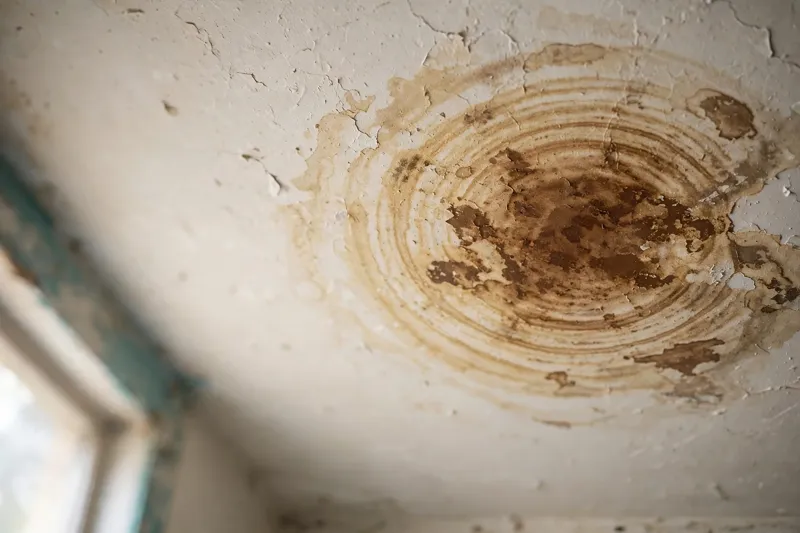
Sign 1, Stains and discoloration rings. A stain is the most common mark, and the easiest to misread. A yellow ring is usually a supply-line leak or a roof leak finding its way down. A brown ring is usually older water, or water that has picked up rust on the way. A ring that reappears after you paint over it is not a stain problem, it is a leak problem, and the paint is only hiding it. Check it within days, and outline it with a pencil so you can tell whether it is growing.
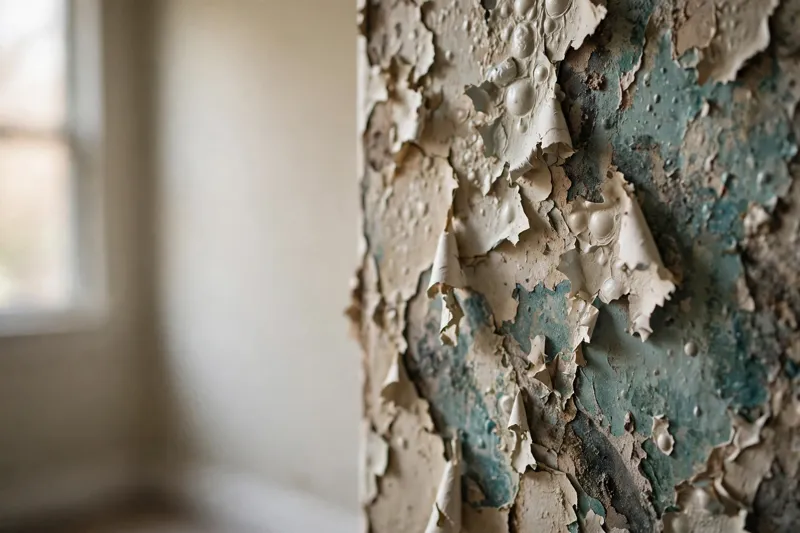
Sign 2, Bubbling, peeling, or blistering paint and wallpaper. When water gets behind a finish, it pushes the finish off the wall. Paint bubbles, wallpaper unsticks, and plaster blisters. In a Chicago house with plaster-and-lath walls, the blister can be small and hard, the plaster holds its shape while the water sits behind it, so press the spot gently: if it gives, the wall is wet inside. Check it within days, because a finish coming off the wall means the water is still there.
Sign 3, Soft, swollen, or crumbling drywall and plaster, and new cracks. Drywall swells and goes soft when it soaks, and plaster crumbles at the edges when the lath behind it stays wet. New cracks in plaster are a mark too, a Chicago restoration video watched for this page lists them alongside peeling paint and dark stains as the marks that matter. Press the wall with your palm: a wall that gives under your hand is wet through, and a wall that crumbles is a wall that has been wet for a while. Check it today.
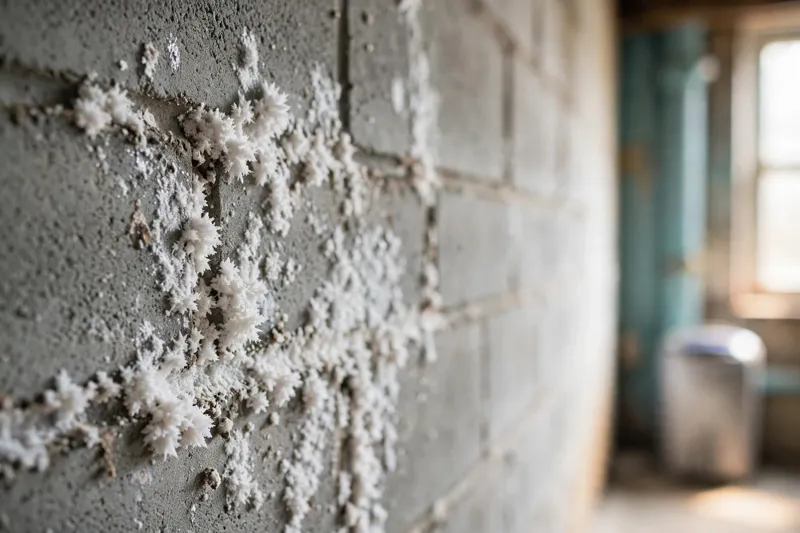
Sign 4, Efflorescence on block walls. A white, chalky crust on a basement or foundation wall is salt left behind when water moves through the masonry and dries on the surface. It is not mold, and it is not a stain, it is proof that water is moving through the wall, and it shows on block walls in garden-unit basements more than anywhere else in a Chicago house. Brush it off and watch it: if it comes back, the water is still moving, and the source is on the other side of the wall.
The bathroom is where the wall marks hide best. The signs of water damage in bathroom walls sit behind the tub, under the sink, and around the toilet base, where a slow leak can run for months behind tile. Check the wall behind the toilet with the back of your hand, look for a soft spot in the floor by the tub, and lift the edge of the vinyl if it is curling. A bathroom leak that shows on the ceiling below started in the bathroom above, and the ceiling stain is the second mark, not the first.
On the ceilings
The signs of water damage in ceiling surfaces are the ones homeowners notice first, because a ceiling stain sits at eye level every time you walk into the room. A ceiling stain is also the mark most likely to be misread, because the water that made it usually came from somewhere else, a bathroom above, a flat roof above that, or a pipe running through the ceiling cavity.
Sign 5, Brown stain rings on the ceiling. A brown ring on a ceiling is water that found its way down and stopped. In a top-floor flat under a flat roof, the ring sits near the outside wall, where meltwater backs up under the roofing. In a lower floor, the ring sits under a bathroom, a kitchen, or a radiator line. Outline it with a pencil and check it after the next rain: if it grows, the leak is active, and the ceiling is the second mark, not the first.
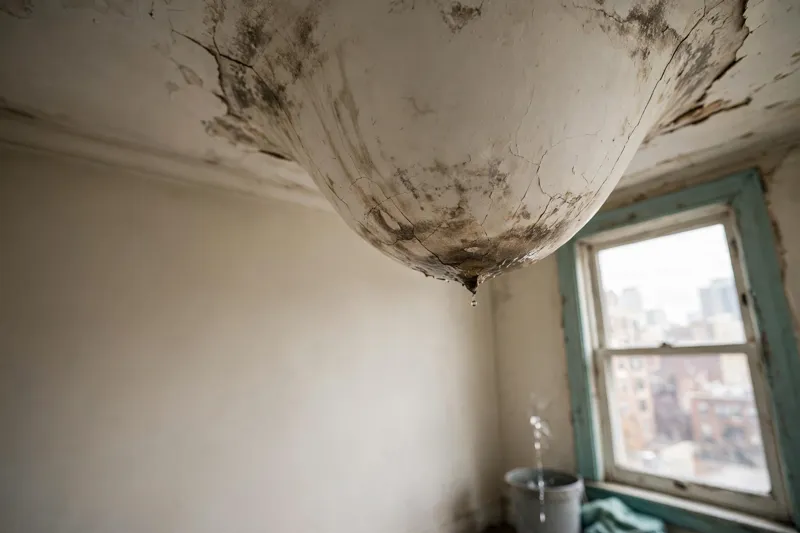
Sign 6, A sagging, bowing, or soft ceiling. A ceiling that dips in the middle, bows down, or feels soft to the touch is holding water, and it is the one mark on this page that means leave the room. Do not stand under it, and do not poke it to see what comes out, a ceiling full of water can come down in one piece. Call now, and keep everyone out of the room until a crew has looked at it. This is the only sign on this page that is a leave signal on its own.
On the floors
Floor marks show late, because water has to get through the surface before the floor shows it. By the time a floor warps, the subfloor is usually wet too, and the drying is a longer job than the floor alone suggests.
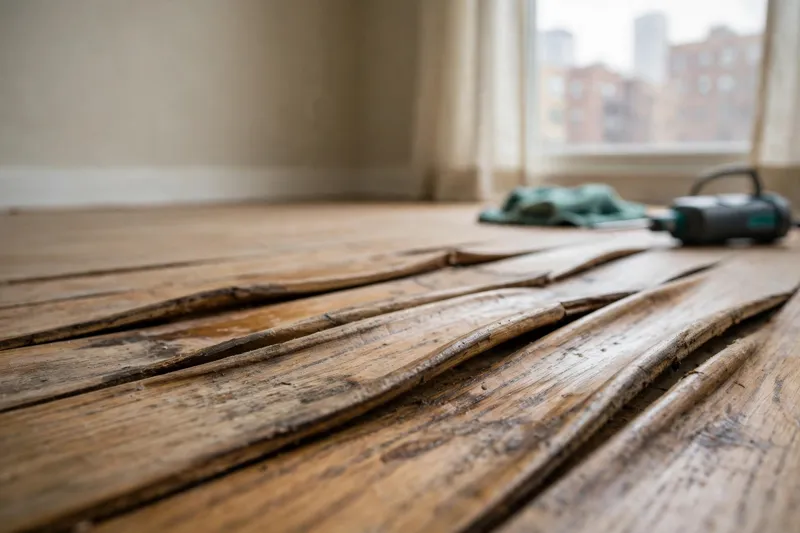
Sign 7, Warped, cupped, or buckled wood floors. Cupping, the edges of the boards rising higher than the middle, is the classic mark of water under a wood floor. Buckling, where the boards lift off the subfloor, is worse, and it means the water has been there a while. Check near appliances, under windows, and around radiator lines, and check the subfloor too: a floor that feels dry on top can be wet underneath. Dry it fast, mold can start within one to two days, and do not sand a cupped floor until the readings are steady, or the boards will crown.
Sign 8, A spongy, soft, or lifting floor, and carpet that stays damp. A floor that gives under your foot, a tile that lifts, or a carpet that stays damp days after a spill is water in the subfloor. Press the floor, lift the edge of the carpet, and check the subfloor with a meter.
In the basement
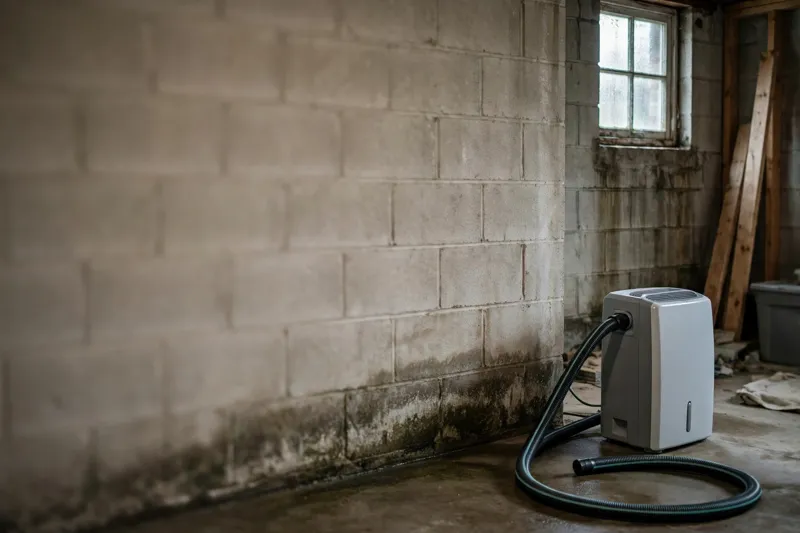
The signs of water damage in basement rooms are the ones that hide longest, because nobody looks at a basement wall every day. The basement is also where a Chicago house shows its age: block walls, floor drains, and a sewer line that runs to a combined system under the street.
Sign 9, A musty smell that stays. A musty smell after water damage is the mark homeowners notice before they see anything, and the smell is the water talking.
That is the pattern: a smell that stays means the water is still there, behind the wall or under the floor, and the source has not been found yet. Another homeowner, 27 July 2024, wrote the same story from a basement: a washing machine hose came off the sink, the floor was mopped and fanned for days, and the musty smell improved but never went away. Check the smell first, then find the source, the smell is the map.
Sign 10, The sound of running water when the taps are off, and a bill that jumps. A faint sound of running water when every tap is off is a leak behind a wall or under a floor, and a water bill that jumps with no change in use is the same leak in numbers. The two together are the strongest proof of a hidden leak in this guide, and the water-meter test in the next section confirms it in one to two hours. Check it today, because a leak you can hear is a leak that has been running for a while.
How to check for water damage: five tests that prove a leak
Finding a mark is half the job. The other half is proving the leak, because a stain can be old, a smell can be a damp basement, and a warped board can be a bad install. The five tests below prove it, and they need no tools beyond a meter, a bottle of food colouring, a hygrometer, and a pencil.
The water-meter test
Turn off every tap, every appliance, and every toilet, then read the water meter and write the number down. Wait one to two hours without using any water, then read it again. If the number moved, water is going somewhere in the house, and the leak is real even though you cannot see it. The test is the one every national guide gives first, and it is the one that settles the argument with a landlord, an insurer, or yourself.
Food colouring in the toilet tank
Put a few drops of food colouring in the toilet tank and wait twenty minutes without flushing. If colour shows in the bowl, the flapper is leaking and the tank has been refilling itself for weeks. It is the quietest leak in a house, and the cheapest one to prove, and it explains a water bill that jumps for no reason.
The pin moisture meter
A pin meter reads what your hand cannot: push the pins into the wall or the floor at the stain and at a dry spot nearby, and compare the two readings. A high reading at the stain and a low one nearby means the water is in the wall. Drying stops when the readings say so, not when the surface feels dry, and a wall that feels dry on the surface can still be wet inside, which is why most do-it-yourself dry-outs fail weeks later.
The hygrometer and the bill
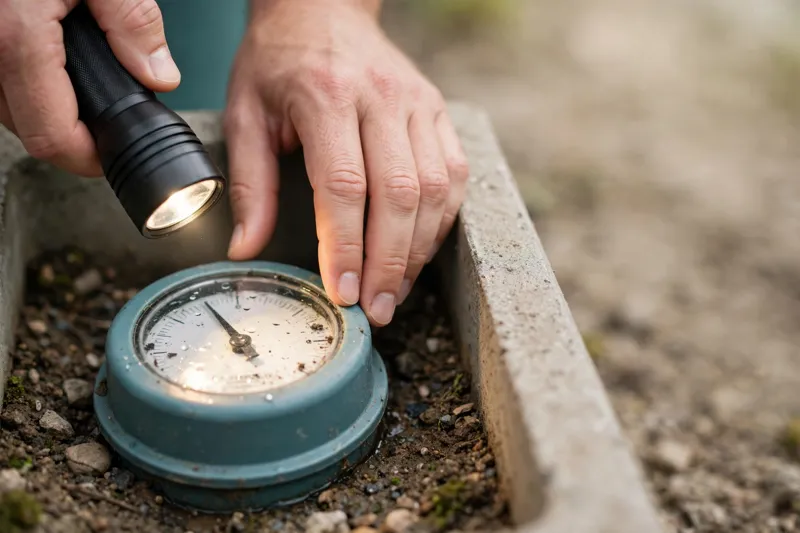
A hygrometer tells you whether the air itself is wet, and a water bill that jumps with no change in use tells you water is going somewhere. Health guidance puts the normal indoor humidity range at thirty to fifty percent, and a reading that stays above it means the house is wet somewhere. Put the two together: high humidity plus a high bill is a hidden leak until proven otherwise.
The pencil-outline stain test
Draw a pencil line around the outside edge of the stain and write the date beside it. Check it again after a few days, or after the next big rain. If the stain has grown past the line, the leak is active. If it has not, the leak may be old, but keep watching it, because a stain that grows once can grow again. The test comes from a restoration specialist who answers questions on a how-to site read end to end for this page, and it is the simplest test in this guide: a pencil, a date, and a second look.
Hidden water damage signs are the ones these tests exist for. Another homeowner, 26 May 2022, asked “I’m paranoid about water damage. Am I overreacting?”, pipes knocking inside the walls, a window with interior trim obviously rotted and repainted, and the answer is the tests above: run them, and the paranoia turns into a reading.
The Chicago version: plaster
The early signs of water damage in a Chicago house are the quiet ones: a stain that was not there last month, a smell in the basement, a bill that jumped, a floor that feels different underfoot. The house tells you early, if you know where to look, and where to look depends on how the house was built.
Plaster-and-lath walls
Most Chicago houses built before the nineteen-sixties have plaster over wood lath, and plaster hides water better than drywall does. A plaster wall can hold its shape while the lath behind it soaks, so the blister stays small and hard, and the first mark is often a hairline crack, not a stain. Press the wall gently with your palm: if it gives, the wall is wet inside, and if it crumbles at the edges, it has been wet for a while. Drywall swells and goes soft fast; plaster waits, and then it fails all at once.
Flat-roof top floors
A top-floor flat under a flat roof gets its ceiling stains near the outside wall, where meltwater backs up under the roofing and finds its way inside. The stain sits at the wall-ceiling joint, and it grows after a thaw, not after a rainstorm, which is why a ceiling stain in February points at the roof, and a ceiling stain in July points at a pipe. Check the roof side too: a parapet that ponds water, a drain that clogs with leaves, and a flashing that lifted in the wind are the three roof marks that show up inside as a ceiling stain.
Garden-unit basements
A garden-unit basement sits half below grade, and its walls are block, not poured concrete. Water moves through block, and the marks it leaves are efflorescence, the white chalky salt on the wall, and a damp line that rises after a storm. Check the floor drain after a heavy rain, and check the wall behind anything stored against it: boxes hide the damp line, and the damp line is the mark. A basement that smells musty after every storm has a water path, not a ventilation problem.
The combined sewer, and the storm that fills it
Chicago runs a combined sewer system: rain and sewage travel in the same pipes. In a heavy storm the pipes fill, and the mixture can push back up through a basement floor drain. That is why a Chicago basement flood is often a sewage question as well as a water question, and why the first step after a storm flood is to name the water before you decide anything else. When the basement floods, call 311, the line runs twenty-four hours a day, seven days a week, three hundred and sixty-five days a year, and report it. The city’s own number for the service is (312) 744-5000, printed in the CHI311 site footer.
Old pipes and old hoses
The other Chicago source is age. Supply hoses older than five years are a failure risk, and the houses with the oldest pipes are the ones with the most hidden leaks, a line that drips behind a wall for a season before the stain shows. Check the hoses under every sink and behind every toilet, and check the date on the water heater: a heater that has been in the house for a decade is a leak waiting for a weekend.
Searches for water damage warning signs chicago return the same Chicago pages again and again, the Chicago restoration guide, the Chicago Water and Fire wall-leak guide, and a lookalike domain that is not our site, and every one of them starts with the same advice: look at the pipes before you look at the walls.
Moisture mapping: what a pro does after you spot a mark
The signs of hidden water damage are the ones a moisture map finds. After you spot a mark, a crew maps the wet area with a pin meter and a thermal camera: a grid of readings across the wall and the floor, marked on a sketch of the room, so the wet area has edges and the dry area has proof. The map decides what comes out and what stays, and it goes into the claim file with the photographs.
A Chicago restoration company recently published a moisture-mapping guide for the city, and this section is the homeowner version of the same work: the map is not a gadget, it is a record. A pin meter gives a number, a thermal camera shows a cold patch where the water sits, and the two together say how far the water went, behind the drywall, under the floor, into the framing. A reading in the safe range means the room recovered; a wet reading after days of drying means the water is still working through the house.
Ask for the readings, and keep them. The claim runs on the file you build in the first day, and a house with a dry basement and a paper trail is a different home from a house with paint over a wet wall. A crew that will not show you the readings is a crew that is guessing, and the map is what turns the guess into a number.
What happens if you ignore water damage
It gets worse, and it gets more expensive. Mold can start within one to two days on a wet surface, drywall softens and floors buckle within days, and wood rots over weeks. The structure weakens, electrical hazards appear, and the insurer may refuse a claim when the damage was left to spread. A leak that was small on Monday is a job by Friday, and a job by Friday is a rebuild by the end of the month.
Searches for musty smell water damage come from homeowners who dried the surface and kept the smell, a cabinet dried for days, two coats of paint, a fan running, and the smell still there when they came home. The smell stayed because the water stayed, behind the wall or under the floor, and the source had not been found. Drying the surface is not drying the house, and the smell is the proof.
This site prints no prices, so no figure here can mislead you.
Two official programs are often confused with each other, and neither of them pays for the drying. The Flood Assistance Repair Program helps owner-occupants of single-family or two-unit homes on the West Side only, for basement damage from the 2023 or 2024 floods, with an income limit, and registration runs from the end of November to the middle of December 2026 through the Westside Health Authority. North Side areas are not eligible.
The Disaster Relief Assistance Program is different: it pays rent, mortgage, or utilities, not repairs, for households affected between January 2025 and January 2027, under three federal disaster declarations, with priority for five ZIP codes on the West and Northwest Sides. The two programs are not the same money, and a homeowner who applies for one expecting the other will wait for the wrong help.
One program that does not exist is the one homeowners keep asking about: the city’s own site carries no fifty-percent basement flooding subsidy, and twenty consecutive checks of the city’s pages found no such program. Do not plan a stay-or-leave decision, or a repair, around money that is not there.
How to check for water damage in your Chicago home
Seven checks, in order. The first one that proves a leak decides the job, and the file you build in the first day decides the claim.
Look first, then touch
Walk the house slowly, eyes first: ceilings for stains, walls for bubbling paint, floors for warping, and the basement for a musty smell. Touch the suspect spots with the back of your hand, a cold, damp patch on a warm day is water, not weather. Write down every spot before you touch anything else.
Run the water-meter test
Turn off every tap, every appliance, and every toilet, then read the water meter and write the number down. Wait one to two hours without using any water, then read it again. If the number moved, water is going somewhere in the house, and the leak is real even though you cannot see it.
Check the toilet tank with food colouring
Put a few drops of food colouring in the toilet tank and wait twenty minutes without flushing. If colour shows in the bowl, the flapper is leaking and the tank has been refilling itself for weeks. It is the quietest leak in a house, and the cheapest one to prove.
Press a pin moisture meter into the suspect wall
A pin meter reads what your hand cannot: push the pins into the wall or the floor at the stain and at a dry spot nearby, and compare the two readings. A high reading at the stain and a low one nearby means the water is in the wall. Drying stops when the readings say so, not when the surface feels dry.
Read the hygrometer and the water bill
A hygrometer tells you whether the air itself is wet, and a water bill that jumps with no change in use tells you water is going somewhere. Put the two together: high humidity plus a high bill is a hidden leak until proven otherwise. The bill is often the first witness, and the hygrometer is the second.
Outline the stain with a pencil
Draw a pencil line around the outside edge of the stain and write the date beside it. Check it again after a few days, or after the next big rain. If the stain has grown past the line, the leak is active. If it has not, the leak may be old, but keep watching it, because a stain that grows once can grow again.
Photograph it and call it in
Photograph every mark before anything moves, keep the meter readings and the dates with the photos, and call the insurer the same day. If the basement flooded, call 311 to report it. The claim runs on the file you build in the first day, and a house with a paper trail is a different home from one with paint over a wet wall.
The detection checklist
- Ceilings checked for stains and sagging, a sagging ceiling means leave the room
- Walls checked for stains, bubbling paint, soft spots, and efflorescence
- Floors checked for warping, cupping, sponginess, and carpet that stays damp
- Basement checked for a musty smell, a damp line, and water at the floor drain
- Water-meter test run, everything off, one to two hours, read it again
- Toilet tanks checked with food colouring, colour in the bowl means a leak
- Pin meter readings taken at the stain and at a dry spot nearby
- Hygrometer read, and the water bill compared with last month
- Stains outlined with a pencil and dated, then checked again after the next rain
- Photographs taken before anything moves, readings and dates kept with them
- 311 called for a flooded basement, insurer called the same day
- First hour handed off to the who-to-call guide, the timeline guide, and the mold guide
Run through the whole list twice a year, and run it again after any big storm, most signs of water damage show up first as a small change, and the checklist is what turns a small change into a caught leak.
Call now, we answer 24/7
If you found a mark and you are not sure what it means, call (773) 570-9869. We will ask what you saw, tell you what to check tonight, and send a crew with a meter when the mark needs one.
Frequently asked questions
What are the signs of water damage?
Stains on ceilings and walls, paint that bubbles or peels, floors that warp or feel spongy, a musty smell that stays, a water bill that jumps, and the sound of running water when the taps are off. Any one of them means water is getting in somewhere, and the tests in this guide confirm it first.
Does homeowners insurance cover water damage restoration, or only part of it?
It covers only part of it. The policy pays for the drying and the repair when the cause was sudden and accidental, up to your limits, minus your deductible. It does not pay for the pipe or the appliance that failed, or for flooding from outside. A sewer backup needs its own endorsement.
How long does water damage restoration take?
Drying takes three to five days on most losses, and the job with repairs usually takes one to three weeks. The reading, not the calendar, decides when the drying is done.
What is water damage restoration called?
The full job, stopping the water, drying the structure, cleaning, and rebuilding, is called water damage restoration. The emergency half, stopping the water and drying, is also called mitigation. Removing mold growth is a separate job, called remediation, and it follows the drying, never the other way around.
Does insurance cover water damage restoration?
Yes, when the damage was sudden and accidental, a burst pipe, a failed water heater, an appliance hose that gave way. The claim runs in order: call the insurer, photograph everything, start the drying, and keep the receipts. The adjuster works from the readings and the photos, so the file you build in the first day decides the claim.
What is the water damage restoration process?
The process runs in order: inspection first, to find the source and how far the water spread; then extraction, with pumps and vacuums; then drying, with air movers and dehumidifiers; then cleaning and sanitising; then the repairs. Dry the floors, walls and framing fast to stop mold, and document everything.
Does homeowners insurance cover water damage?
It covers water damage when the cause was sudden and accidental, a burst pipe, a failed appliance, a supply line that gave way. It does not cover a slow leak that ran for months, groundwater seepage, flooding from outside, or wear and tear. Read the declarations page before the storm, not after it.
What should I do when my house floods?
Stop the water and make it safe first. Shut off the main valve, cut the power to any room with standing water, and do not walk through water that may be sewage. Call 311 to report a flooded basement, photograph everything before anything moves, and start the drying within the first day.
How much does homeowners insurance pay for water damage?
No page can give you a number, because the payment depends on your policy, your deductible, the cause, and the limits you bought. The insurer pays the drying and the repair, less your deductible, and it does not pay for the pipe that failed.
Are renters responsible for water damage?
Renters are liable only for damage they caused or failed to report, negligence, misuse, or a leak they never told the landlord about. The building itself, the walls, floors, and pipes, is the landlord's, and so is the plumbing that serves the unit. Renters insurance covers the renter's belongings when the cause was sudden and accidental.
How much does a plumber charge for a burst pipe?
This site prints no prices, so no figure here can mislead you. The charge depends on where the pipe sits, how hard it is to reach, whether the wall or the floor must come out, and whether the call is an emergency at night. The water damage the burst caused is usually the bigger part of the bill.
Does insurance cover burst pipes?
Yes, when the pipe burst suddenly, a freeze split, a joint that failed without warning, a line that gave way all at once. The insurer pays for the water damage the burst caused, not for the pipe itself. A slow leak that ran for months may be classed as wear and tear, and the claim may fail.
How much does it cost to fix a burst pipe?
This site prints no prices, so no figure here can mislead you. The cost depends on the pipe's location, the access, the material, and the water damage the burst caused, the drying and the rebuild are usually the bigger part. A camera or a moisture reading comes first, then a written scope.
How much does mold remediation cost?
This site prints no prices, so no figure here can mislead you. The cost depends on how much mold there is, where it sits, whether the wall must come out, and whether the moisture source is fixed first. Illinois now registers mold remediation work, with a grace period for existing workers, this site gives consumer guidance only.
Can mold be fully remediated?
Mold can be remediated to safe, normal levels, but no job removes every spore, spores are everywhere, indoors and out. Fully remediated means the moisture source is fixed, the growth is removed, the area is cleaned and dried to the readings, and the humidity stays in the normal range. A job that skips the source is not finished.
How do I know if I have hidden water damage?
Look for the clues: a musty smell that stays, paint that bubbles, a floor that feels soft, a water bill that jumps, and the sound of running water when the taps are off. Confirm it with the water-meter test, a pin meter, or a pencil outline around the stain. Hidden water leaves marks when the leak stays out of sight.
What does water damage smell like?
Most often it smells musty and earthy, like wet cardboard or an old basement. A wet-dog or sour-laundry smell points to damp carpet or drywall, and a rotten-egg or sewage smell means contaminated water and needs urgent action. The smell alone does not prove mold, but mold can start within one to two days of the water arriving.
How can I check for water damage behind a wall?
Start without cutting anything: look for stains and soft spots, smell for mustiness, listen for running water, and press a pinless moisture meter against the wall. Then run the water-meter test and, if the readings stay high, a thermal camera or a small inspection hole with the power off. Stop and call a professional near wiring or a bulging wall.
Is a small water stain on the ceiling serious?
Treat it as serious until you prove otherwise. A small stain can be old, or the first mark of an active leak above the ceiling. Outline it with a pencil and check it after the next rain: if it grows, the leak is active. Mold can start within one to two days, so do not paint over it yet.
What happens if you ignore water damage?
It gets worse, and it gets more expensive. Mold can start within one to two days, drywall softens and floors buckle within days, and wood rots over weeks. The structure weakens, electrical hazards appear, and the insurer may refuse a claim when the damage was left to spread. A leak that was small on Monday is a job by Friday.
Will water damage go away on its own?
No. Water does not dry itself out of a wall, a floor, or a basement, it soaks deeper, and mold starts within one to two days. The stain may fade as the surface dries, but the water behind it keeps working. It only gets worse.
Can I fix water damage myself?
A small clean-water spill on a hard floor, caught fast and dried the same day, is a job most homeowners can handle. Anything bigger, water in the walls, under the floor, in the ceiling, or from a sewer, needs drying equipment and moisture readings, not a household fan. The test is the water, not your confidence.
Can you live in a house with water damage?
Only when the damage is small, clean-water, contained, and structurally and electrically safe. Sewage, a sagging ceiling, a dead furnace, or mold through the air means leave. The stay-or-leave test in the habitability guide linked at the end of this page runs through the five hazards that decide it, room by room.
How do you know if water damage is serious?
It is serious when the water is still coming in, when the ceiling sags or the floor gives, when the power is wet, when the water smells of sewage, or when mold is growing through the air. A stain that stays the same size after the drying, with dry readings behind it, is the one that is not serious.
What is the first thing to do if you have water damage?
Stop the water, then make it safe. Shut off the main valve, cut the power to any room with standing water, and do not walk through water that may be sewage. Then photograph everything before anything moves, call the insurer the same day, and start the drying within the first day.
How long can a water leak go unnoticed?
Months, sometimes years. A slow leak behind a wall or under a floor can run for a season before the stain shows, and a slab or a ceiling leak can hide longer still. The bill is often the first witness: a jump with no change in use means water is going somewhere. Check the meter, then check the walls.
Do realtors have to disclose water damage?
In Illinois, a seller must disclose known material defects, and past water damage is one of the things a buyer asks about. The answer depends on what the seller knew and what the form asks, so read the form and the repair records together. A paper trail makes a different buy.
How long does it take for mold to appear after water damage?
That is the clock this whole guide runs on. Dry the floors, walls and framing within the first day, keep the humidity in the normal range, and check the readings, the job is not the stain, it is the water behind it.
Sources
- Fox Business Markets, hidden water damage guide, the water-meter test and the room-by-room tracing.
- Mr. Handyman, early water-damage guide (Wichita and Oklahoma City), discoloration rings, bubbling paint, cupping floors, and supply hoses over five years old.
- WikiHow, “How to Clean Up Water Damage: Proper Restoration Procedures”, co-author Ryan Owsiany, updated 2 May 2025, the restoration procedure read end to end for this page, and the pencil-outline stain test.
- Water Wipeout Wizards, “Water Damage Restoration Chicago: Chicago’s Hidden Water Damage Problem Exposed!” (YouTube, 4:05), the video watched in full for this page.
- City of Chicago, CHI311, the 311 line, twenty-four hours a day, seven days a week, three hundred and sixty-five days a year, and the (312) 744-5000 number in the site footer.
- DuPage County Health Department, mold guidance, the under-ten-square-feet homeowner guidance and the over-one-hundred-square-feet professional line.
- Illinois Department of Public Health, mold questions and answers, the professional line above ten square feet, and the Part 835 registration with its grace period to the end of September 2027.
- City of Chicago, Flood Assistance Repair Program, the West Side only program for basement damage from the 2023 or 2024 floods, with registration from the end of November to the middle of December 2026.
- City of Chicago, Disaster Relief Assistance Program, the rent, mortgage, and utilities program for households affected between January 2025 and January 2027, under three federal disaster declarations.
More Restoration Services in Chicago
Every service below is one tap away. Pick the one that matches your problem.

Water Damage Restoration
Fast water extraction, structural drying, and full repair after burst pipes, leaks, and floods.
Learn more →
Water Mitigation
Emergency water removal, structural drying, and mold prevention to stop the damage fast, 24/7.
Learn more →
Mold Remediation
Safe, contained mold remediation that removes contamination and fixes the moisture source.
Learn more →
Sewage Cleanup
Safe removal and disinfection of dangerous sewage backups and black water.
Learn more →
Flood Cleanup
Water pumped out, structure dried, and debris cleared fast after storms and flooding.
Learn more →
Hardwood Floors Water Damage
Cupped, buckled or stained hardwood after a leak? How we dry it, when sanding saves it, and when the boards have to go.
Learn more →