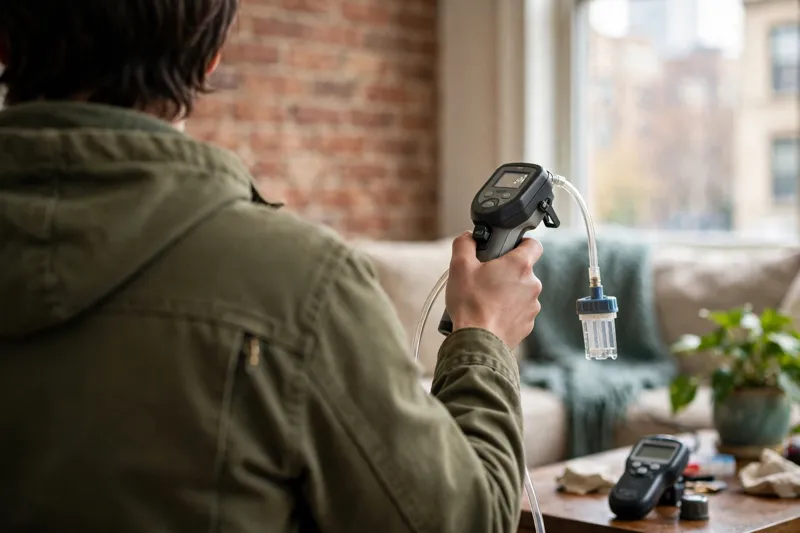
Chicago, IL · A plain-words guide for homeowners, buyers and renters
Mold Testing Chicago vs Inspection: Which Do You Need
You smell something musty in the basement, or you can see the growth on the bathroom wall, or the home inspector found a wet spot behind the drywall, and the first question is not how to kill it. The first question is whether you need a test at all, or whether an inspection answers it for less. This guide answers it the honest way: inspection first, testing only when it changes the decision.
- The inspection-first rule, and the three cases where testing earns its place
- Air samples, surface samples and bulk samples, what each one proves
- How to read a lab report against the outdoor control
- Clearance testing, and the Chicago school case that shows why it matters
Written for Chicago homeowners, the two-flats, the bungalows, the greystones, and the high-rises.
- We answer 24/7
- Local Chicago team
- Insurance documentation help
- Straight answers, no pressure
Have a question? Call us any time
Mold testing in your Chicago home, and a result you do not know how to read: send the form and we will call you back. Fast response, no obligation.
The short answer: inspection first
In most cases you do not need mold testing. You need an inspection first, and the test only when it changes the decision, when the mold is hidden and you need proof it is there, when a buyer or a seller needs evidence, when a landlord and a tenant disagree, or after remediation, when clearance testing proves the job worked.
Searches for mold testing chicago return Mold Inspection and Testing Chicago and Mold Pro Chicago at the top of the local results, with the national guides below them, and none of the fourteen answers in the set named our site. This page carries twenty-eight questions and seven steps, and it is the first Chicago version written from the testing side: what the inspector does, what the lab measures, and what the report means.
The table below is the whole page in one place, and every row of it answers a search for mold testing chicago. The sections that follow explain each row: the difference between the inspection and the test, the sampling types, the lab report, the timing after water damage, the kits, the cost drivers, and the clearance test that lets the walls close.
| Question | Inspection answers it | Testing answers it |
|---|---|---|
| Where is the mold? | Yes, the walk-through and the moisture survey | No, the lab never names the room |
| Why did it grow? | Yes, the moisture source | No |
| What species is it? | No | Yes, the lab report |
| Is one room worse than the air outside? | No | Yes, indoor vs outdoor control |
| Did the remediation work? | Partly, dry and no visible mold | Yes, clearance testing |
Mold testing Chicago vs inspection: the difference in plain words
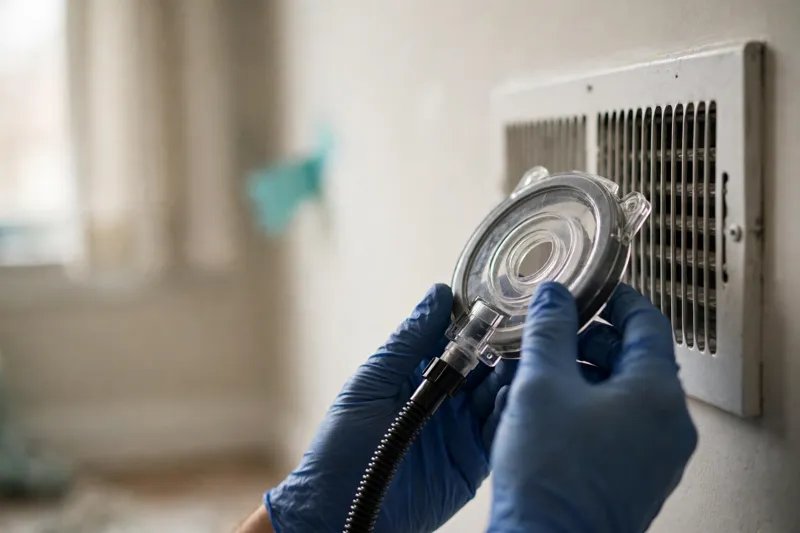
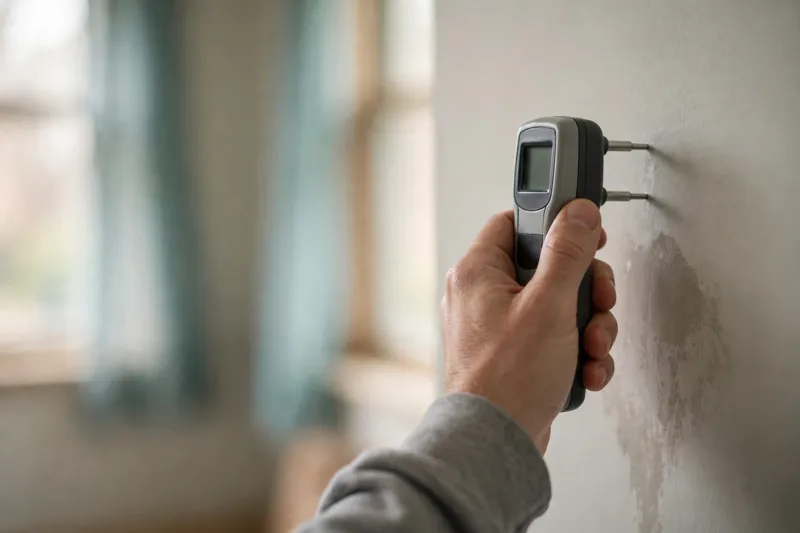
An inspection is a visual and moisture survey. The inspector walks every room, looks in the places mold hides, behind drywall, under sinks, in the attic and the crawl space, and maps the wet areas with pin and pinless meters. The inspection answers three questions: where is the mold, why did it grow, and what has to change so it does not come back. It does not put numbers on the air, and it does not name the species. It finds the problem, and it names the moisture source that caused it.
Testing is sampling. Air samples, surface samples or bulk samples go to a laboratory, which reports the species and the spore counts. Testing answers three different questions: what species is growing, how many spores the air carries, and whether one room is worse than the air outside. It does not find the leak, and it does not tell you what to fix. The lab report is a measurement, not a diagnosis, and it is only as good as the inspection that chose the samples.
When a Chicago homeowner searches for mold testing chicago, the first results are companies that sell the test before the inspection, and that order is backwards. The inspection chooses the sample: without it, the tester does not know where to sample, how many samples to take, or what question the sample is meant to answer. A test taken before the inspection is a number without a question, and the homeowner pays for the number.
The confusion is the business model: mold testing chicago listings promise an answer in a lab report, but the lab report never names the leak. The inspector who also sells the remediation has a second reason to test first, the test justifies the job. The inspector who does not sell remediation has no such reason, and that independence is the first thing to look for when you hire one. The page on who does the testing, near the end, gives the full vetting list.
The four-step order below is the whole page in one line: visual inspection, moisture mapping, sampling, lab result, and then clearance testing after any remediation. The sections that follow take each step in turn, and the seven-step guide at the end of the page turns them into a checklist you can hand to the inspector.
| Inspection | Testing | |
|---|---|---|
| What it is | Visual and moisture survey | Air, surface or bulk samples to a lab |
| What it finds | The mold, the moisture source, the extent | The species and the spore counts |
| What it cannot do | Name the species or count the spores | Find the leak or name the fix |
| When you need it | Always, first | Hidden mold, disputes, clearance |
| Who should do it | An independent inspector | An accredited laboratory, via the inspector |
Do I need mold testing or mold inspection?
The question do i need mold testing or inspection is the fourteenth term in the cluster, and it is the question this page exists to answer. The answer is the inspection first, and the test only when it changes the decision. The inspection finds the moisture, maps the wet areas, and tells you whether sampling would answer a question the inspection cannot. When the mold is visible, the inspection is usually the whole job, fix the moisture, remove the growth, dry the area to the readings, and the mold does not come back.
Homeowners who search mold testing chicago usually want one of three things: proof the mold is there, proof it is not, or proof the remediation worked. The first two are inspection questions, and the test answers them only when the mold is hidden, behind a wall, under a floor, inside a duct, where the eye cannot reach and the meter reads wet. The third is a testing question, and it has its own name: clearance testing, after the remediation is finished and the area is dry.
When the mold is visible, booking mold testing chicago firms for an air sample adds a lab fee to a job that starts with a moisture meter. The EPA and the CDC say the same thing in their guidance: sampling is usually unnecessary when mold is visible, because the mold is there and the job is to remove it and fix the moisture. The money is better spent on the inspection, the repair, and the drying, and on the clearance test after the work, which is the test that proves the job worked.
There are four cases where testing earns its place, and the page gives each one its own section. The mold is hidden and the inspector needs proof it is there. A buyer or a seller needs evidence before closing. A landlord and a tenant disagree about the cause, and the dispute needs a lab report. And after remediation, when clearance testing proves the job worked and lets the walls close. Every other case is an inspection case, and a company that sells the test first is selling the wrong step.
How professionals test for mold
The professional mold testing chicago service worth hiring follows the same order every time: inspection, moisture mapping, sampling, lab. The inspector walks the home first, maps the wet areas with the meters, and chooses the samples from what the inspection found. A company that starts with the cassette has skipped the step that decides where the cassette goes, and the numbers it returns will not tell you what you need to know.
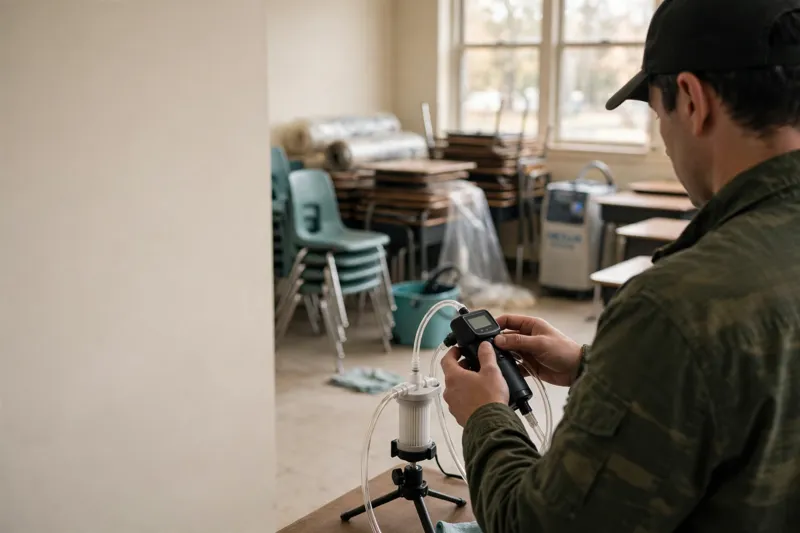
Air sampling is the most common form of mold testing chicago inspectors offer, and the cassette is its workhorse. A pump pulls room air through a spore trap cassette for a set time, and the cassette traps the spores on a slide for the lab. The inspector takes an outdoor sample the same day, upwind of the building and away from the exhaust vents, because the outdoor air is the control: without it, the indoor numbers have nothing to compare against, and the lab report is a list of numbers with no meaning.
Surface sampling is the tool for growth you can see. A tape lift presses clear tape to the growth and lifts it onto a slide; a swab wipes the growth into a tube. The lab identifies the species from the sample, and the result tells you what is growing on that surface, not what the air in the room carries, and not whether the room is worse than the air outside. Surface sampling answers the identification question, and only that question.
Bulk sampling cuts a piece of the material itself, drywall, wood, insulation, carpet, when the question is what is growing inside it. The lab cultures the sample and names the species, and the result tells you whether the material itself is colonized or only its surface is. Bulk sampling is the most destructive of the three, and it is used when the inspector needs to know whether the wall comes out or stays.
Moisture mapping runs through all of it, and it is the step the homeowner never sees on the invoice. The inspector takes pin-meter readings in the wet areas and in a dry room that never got wet, and the dry room is the control for the moisture, the way the outdoor air is the control for the spores. The readings decide when the drying is done, and they decide whether the wall comes out. A test without a moisture map is a lab report about a leak nobody found.
One more method deserves a straight answer, because Chicago home buyers ask about it by name: the ERMI test, which reads mold DNA from a dust sample and returns an index number. The national guides treat it as a screening tool, not a diagnosis, and the Chicago inspector pages address it directly, the index does not tell you where the mold is, what caused it, or whether the home is safe. This page does not recommend it as a first test, and no inspector on this page's vetting list leads with it.
How to read a mold lab report
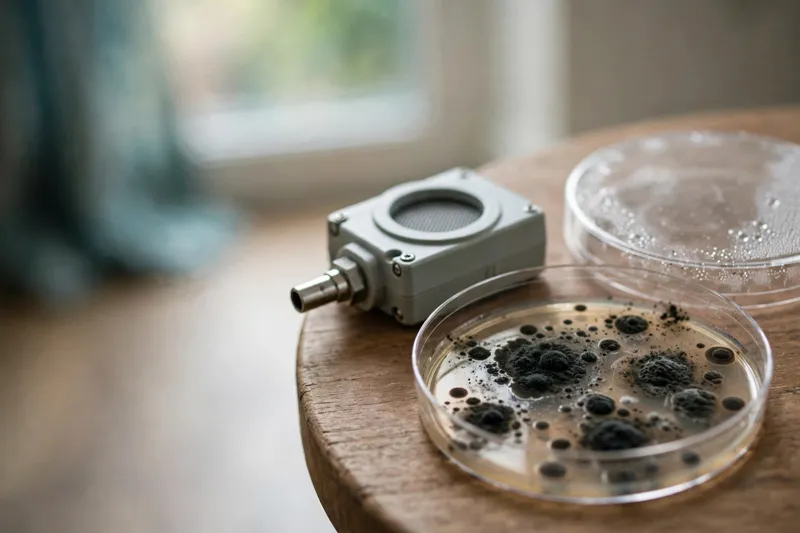
The report arrives a few days after the visit, and it looks more technical than it is. It lists the species the lab found, the spore counts for each one, and the samples they came from, the rooms indoors, and the outdoor control. The report does not say whether the home is safe, and it does not say whether the mold made anyone sick. It says what grew, where, and how much, and the inspector's job is to turn those three facts into a decision.
A mold testing chicago lab report lists the species found indoors and outdoors, with the spore counts for each, and the first thing to read is the outdoor column. The outdoor air is the baseline: it shows what the air outside carries on that day, in that weather, and the indoor numbers mean nothing without it. A report with no outdoor control is a list of numbers with no comparison, and the inspector who took the samples without one has wasted the lab fee.
The species names on the report are mostly familiar ones. Aspergillus and Penicillium appear in almost every indoor sample, because they grow on damp drywall, wood and dust in any home, their presence alone proves very little, and their counts matter more than their names. Stachybotrys, the species homeowners worry about most, grows only on material that has stayed very wet for a long time, and its presence points to a long-running leak. Chaetomium grows on wet drywall and paper, and its presence points the same way. The species tells you the history of the water, and the counts tell you the scale of the growth.
The first page of mold testing chicago results will tell you the species, but only the outdoor control tells you whether the numbers matter. Indoor counts at or below the outdoor counts are normal, the home breathes the same air the street does. Indoor counts far above the outdoor counts point to growth inside, and species that appear indoors and are absent outdoors are the signature of a source inside the home. The comparison is the reading, and the inspector's written report should state it in plain words, not leave the homeowner to compare two columns alone.
What the report cannot do is as important as what it can. No lab report carries a pass or fail line. The report cannot tell you whether the mold made anyone sick, because a spore count is not a medical test. And the report cannot tell you what to fix: the moisture source is the inspector's finding, not the lab's. A report that ends with the numbers, and no reading of them, is an unfinished job.

Mold testing Chicago after water damage: the 24-48 hour rule
Mold can start growing within one to two days of water damage, when the material stays wet, and that window is the whole timing of this page. The first day is for stopping the water and getting the drying started. The second day is for the moisture mapping that shows how far the water spread, and for the readings that will be checked every day after. A home that is dry within the window usually has no mold problem at all; a home that stays wet past it usually does.
The homeowners who search mold testing chicago after a flood want the test today, and the honest answer is that today is the wrong day for air sampling. The air in a home that has just flooded is full of dust from the cleanup, and a sample taken today measures the cleanup, not the room. Air sampling should wait five to seven days after the drying, when the dust has settled and the sample reflects the home as it will be lived in. The inspection and the moisture mapping happen now; the air sample happens later.
Searches for mold testing after water damage spike in the days after a storm, and the answer is the same in every case: inspect first, sample later. The inspector maps the wet areas in the first one to two days, the drying runs with the readings checked daily against a dry room, and the air sample waits until the drying is done and the dust has settled. A test taken on the first day tells you the room is wet, which the meter already told you, and it costs the same as a test taken on the right day, which tells you something new.
The waiting period is also the period when the mold becomes visible, and visible mold changes the decision. If the growth appears on the wall in the first week, the inspection is the whole job: fix the moisture, remove the growth, dry the area to the readings. If nothing appears and the smell will not go away, the air sample on day five to seven is the test that finds what the eye cannot. Either way, the clock that matters is the drying clock, not the testing clock, and the reading that ends the job is the moisture reading, not the lab report.
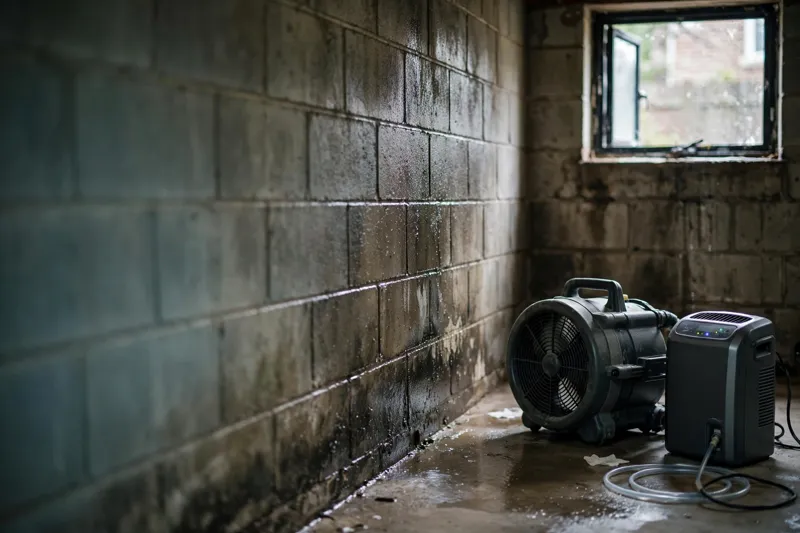
Can I test for mold myself with a kit?
Yes, you can buy a kit, and it will usually find mold, which is the problem. A petri dish left open in a room grows whatever spores are already in the air, and spores are everywhere, so a positive dish proves very little. The dish cannot tell you the source, the extent, or whether one room is worse than the air outside. It cannot tell you the species with any confidence, and it cannot tell you whether the home is safe. The kit is accurate at one thing, growing mold from the air, and that is the one thing you did not need to know.
Homeowners who search mold testing chicago and buy a kit first usually learn the same lesson: the dish grows mold, and the question stays unanswered. The online forums are full of the same story, told the same way, a homeowner who bought a kit, got a positive result, and is now more worried than before, with no idea what the result means. The most-liked post on the topic is a renter who swears by a twenty-seven-dollar kit, and the comments under it say the same thing the inspectors say: the kit tells you mold exists, and mold exists everywhere.
The kit has one honest use, and it is worth naming. A renter who cannot hire a professional, or a homeowner who needs a first signal before spending on an inspection, can use a kit as a screening step, a reason to look harder, not a result to act on. A positive dish means the room deserves an inspection. A negative dish means nothing at all, because the dish only grows what lands on it, and the mold behind the wall never lands on it. The kit is a reason to call the inspector, never a substitute for one.
The kit companies know it, which is why mold testing chicago kit listings promise certainty the dish cannot deliver. The listings promise to identify the mold, to tell you whether it is dangerous, and to guide the cleanup, and the dish does none of those things. The honest version of the kit is a petri dish, a set of instructions, and a warning that the result is a screening signal. The dishonest version is a lab report with a species name and a verdict, sold to a homeowner who does not know the difference.
What to do instead depends on what you can spend. The best next step is an inspection, with a moisture survey and a written report. The next best is a laboratory sample with an outdoor control, taken by an inspector who knows where to sample. The worst next step is a second kit, or a kit with a lab fee attached, the laboratory version of the dish has the same problem as the dish, and the five-hundred-fifty-dollar inspection quote one homeowner reported is the price of the step that actually answers the question.
Black mold testing: what the color does and does not mean
Black mold is not a species, it is a color, and several species grow black. The species homeowners worry about most is Stachybotrys, which grows on material that has stayed very wet for a long time: soaked drywall, wet wood, paper-faced insulation that never dried. The color on the wall tells you nothing about the species, and the species is the only thing that matters, which is why the test that matters is the lab report, not the color.
Black mold testing chicago searches usually mean one species, Stachybotrys, and the lab report is the only way to know whether it is the one growing. The report names the species from an air sample or a surface sample, and the name is the answer: Stachybotrys points to a long-running leak and a material that stayed wet for weeks, while Aspergillus and Penicillium point to dampness that is newer or lighter. The color never distinguishes them, and no photo of a black patch can.
Stachybotrys needs very wet material, and that is the diagnostic clue. It grows where the water ran for a long time, a slow leak behind a wall, a roof leak that soaked the insulation for a season, a basement wall that stayed wet through the winter. Finding it means the moisture source has been running for weeks, and the fix starts with the source, not the scrub brush. A wall that grows Stachybotrys has been wet far longer than the homeowner thinks, and the inspection should trace the water back to the season it started.
What to do when the lab names Stachybotrys is the same as what to do for any mold, with one difference: the remediation is more careful, not more frightening. The moisture source is fixed first, the wet material comes out, the area is cleaned and dried to the readings, and clearance testing proves the job worked. The species name changes the scope, not the order, and the clearance test at the end is the step that lets the walls close, whatever species the lab named.
What mold testing costs in Chicago: the drivers, not the numbers
The cost of mold testing chicago jobs is never one number, and this site prints no prices, the honest version of the cost question is the list of drivers, because the drivers are what make two quotes different. The size of the home decides how many rooms the inspector walks and how many samples the job needs. The sample count decides the lab fees, because every cassette and every swab is a separate laboratory charge. The rush decides the queue: a result needed in a day costs more time in the queue than it saves, and a result that can wait a few days costs less.
Searches for mold inspection cost and mold testing cost return the same lesson in different words: the inspection costs less than the testing, because it is a visual and moisture survey, not a laboratory job, and the testing costs more than the inspection, because every sample is a lab charge. The clearance test after remediation is a separate line on the quote, and it should be: the clearance tester is independent of the remediation company, and the independence is part of what you pay for. A quote that bundles the clearance test with the remediation is a quote that sells the company its own verdict.
Homeowners who search mold testing chicago for a price first usually get a range, and the range is honest: the job depends on the sample count, the home, and the lab. The way to compare two quotes is the written scope, how many samples, which type, which laboratory, and whether the clearance test is included. A quote with no sample count is a quote with no scope, and a quote with no scope cannot be compared with anything. Ask for the scope in writing before you ask for the price.
Three add-ons change the price more than anything else, and all three are worth asking about before you book. The first is the rush: results in a day cost more than results in a few days, and the rush rarely changes the decision. The second is the clearance test, which is a separate visit by a separate tester. The third is the scope itself: a home with three wet rooms needs more samples than a home with one, and a home with a hidden leak needs more inspection time than a home with visible growth. The inspector who explains the drivers before the quote is the inspector worth hiring.
How much does mold remediation cost in Illinois?
Remediation is a different job from testing, and its price is driven by the size of the job, not by the test. The drivers are the ones this page already lists for testing, applied to the removal work: how many rooms are affected, how much wet material has to come out, how long the drying runs, and whether the work needs containment to keep spores out of the clean rooms. The clearance test after the work is a separate line, done by an independent tester, and it belongs on the quote as its own item, a quote that bundles it with the remediation sells the company its own verdict.
The way to read any remediation quote is the written scope: which rooms, how much material comes out, how the drying is measured, and whether the clearance test is included. This site prints no prices, and the honest version of the cost question is the list of drivers, the full drivers breakdown, under the same no-price rule, is on our Mold Remediation Cost in Chicago page.
Clearance testing: the test that lets the walls close
Clearance testing is the test that proves the remediation worked, and it is the only test on this page that decides whether a job is finished. An independent tester, not the company that did the remediation, checks that the area is dry, that no visible mold remains, and that the indoor spore counts are at or below the outdoor control. The test happens after the work is finished and the area is clean, and it is the step that lets the walls close. A job that closes the walls without a clearance test is a job that hides its own result.
Clearance testing is where mold testing chicago earns its keep: the test proves the remediation worked, and the walls close on evidence, not on a promise. The pass is four conditions, and all four must hold: no visible mold, the area dry to the readings, no odour, and indoor spore counts at or below the outdoor control. The tester writes the result down, and the report is the document the homeowner keeps, the proof that the job worked, the paper the next buyer asks for, and the answer to the question the remediation company cannot answer about its own work.
The one verified named Chicago case on this page is a clearance-testing story, and it is the reason the test matters. In August 2026, John H. Kinzie Elementary School, a Chicago Public Schools building on the Southwest Side, closed after suspected mold was found. Tests were completed at the school in the 5600 block of South Mobile Avenue, in Garfield Ridge, and for 600 students the school year started with outside classes held inside the adjacent Kennedy High School. The school would reopen, CBS Chicago reported, when independent mold-clearance testing confirmed that established clearance criteria were met, and a follow-up item reported the reopening after that testing. The school did not reopen on a promise, or on a visual check. It reopened on an independent test.
The Kinzie case is a school, not a home, and the scale is different, but the rule is the same, and it is the rule this page is built on. The clearance test is independent, it is done after the work, and it is the gate the walls close behind. A homeowner who skips it saves one visit and loses the only proof the job worked. A homeowner who demands it gets a report that outlives the remediation company, the listing, and the argument with the next buyer. The limits of the case are worth stating plainly: the street number in some online summaries differs from the 5600 block the CBS report verified, and this page uses the 5600 block as the live report printed it.
Mold testing Chicago when buying a home
Home-buying is the main trigger for mold testing in Chicago, and the cost is the main anxiety. The story repeats in the forums: a first-home buyer gets the inspection back on a 1940s house, the basement tests positive for Stachybotrys, the reading is not very high, and the lab still flags it as a severe issue, and the buyer has to decide whether to keep going. The seller agrees to fix the leaking pipe, and the buyer has to decide what proof to demand before closing.
A positive result before closing is the moment mold testing chicago stops being a search term and becomes a negotiation: the seller fixes the leak, or the buyer walks. The negotiation runs on the file, the inspection report, the lab report, the moisture readings, and the scope of the fix. The buyer should demand three things before closing: the moisture source fixed, the growth removed and the area dried to the readings, and a clearance test by an independent tester after the work. A seller who offers a credit instead of a fix is offering the buyer the job, and the job is bigger than the credit looks.
The re-test is the step buyers forget, and it is the step that matters most. A fix without a clearance test is a promise, and a promise is not evidence, the clearance test after the work is the proof the fix worked, and the walls should not close until it passes. The buyer who closes without it owns the mold, the moisture, and the argument with the next buyer. The buyer who demands it owns a report that outlives the sale.
Disclosure runs the other way, and the seller should know it before listing. Illinois sellers must disclose known material defects on the disclosure form, and mold from a leak is a material defect. A buyer who finds mold after closing can claim the seller hid it, and the claim runs on what the seller knew and when. Test before you list, disclose what the test found, and fix what the test proves, the seller who tests first controls the negotiation, and the seller who hides it loses it.
Home testing and medical testing are two different questions
Home testing and medical testing answer different questions, and mold testing chicago results never answer the medical one. A home test measures the spores in the air and the species growing on the wall. A medical test measures what is in the body. The two numbers never meet, and no home test can tell you whether mold made you sick, that is a doctor's question, and the doctor's answer needs a medical history, an examination, and tests the home inspector cannot order.
The forums are full of the confusion, and it is worth answering plainly. Homeowners ask which test is best for mold inside the body, whether antibody tests are accurate while on treatment, and whether five positive mycotoxin results mean the house must be condemned. The honest answer is that the home test and the body test are separate jobs for separate professionals: the inspector tests the home, the doctor tests the person, and neither result substitutes for the other. A homeowner who has been sick for years and tested positive for mycotoxins needs a doctor first, and an inspector second, in that order.
The symptoms track the damp rooms, and that pattern is the useful signal. A cough that clears when you leave the house, eyes that itch at home and stop elsewhere, skin irritation that appears in the damp rooms, the pattern points to the home, and the home test tells you what is growing in it. But the pattern is not a diagnosis, and the spore count is not a medical result. The page that promises a home test will tell you whether you are sick is selling a diagnosis it cannot give, and the homeowner who believes it delays the doctor who can.
What the home test can do for a sick homeowner is narrow and real: it can tell you whether one room carries more spores than the air outside, what species is growing, and whether the remediation worked. Those three facts decide the fix, and the fix is what stops the exposure. The medical question, what the exposure did to you, and what treatment you need, belongs to the doctor, and the home test has no answer to it. Keep the two questions separate, and both get answered properly.
Tenants, landlords and mold in Chicago
Tenants who search mold testing chicago usually have a landlord problem, not a lab problem, and the Chicago ordinance answers the landlord half of it. The Residential Landlord and Tenant Ordinance, chapter 5-12 of the Municipal Code, requires the landlord to maintain the plumbing, the piping, the fixtures and the appliances in good operating condition, to prevent the accumulation of stagnant water, and to keep the floors, the interior walls and the ceilings in sound condition and good repair, and the foundation and the exterior substantially watertight. A leak from building plumbing is a failure of that duty, not an accident of the weather.
The tenant's remedies run on written notice, and the clock runs from the notice, not from the first leak. Under section 5-12-110(a), the tenant delivers written notice naming the failure, and the lease ends on a date not less than fourteen days after the landlord receives it, unless the failure is fixed in that time. Under section 5-12-110(c), where the reasonable cost of the repair does not exceed the greater of five hundred dollars or one-half of one month's rent, the tenant may have the work done at the landlord's expense, provided the cost does not exceed one month's rent, and the tenant may not repair a common element in a condo building except as the declaration allows.
Under section 5-12-110(d), the tenant may withhold from the monthly rent an amount that reflects the reduced value of the unit, after written notice, while the failure continues. The withholding is the reduced value, not the cost of the repair, the two remedies are different, and one Chicago page conflates them. The day-fifteen figure comes from the City's RLTO Summary, the summary the City requires attached to every lease, which says withholding begins from the fifteenth day. The ordinance text itself states no start day.
Section 5-12-110(e) gives the tenant damages and an injunction, a court order forcing the repair, and money for the loss. Section 5-12-110(f) covers the failure to provide essential services and a failure that is an immediate danger to health or safety: after written notice the tenant may buy a reasonable substitute service and deduct the cost, recover damages, move to substitute housing and stop paying rent for the period, withhold rent if the landlord fails to correct the failure within twenty-four hours, or end the lease if the failure persists for more than seventy-two hours. Section 5-12-110(g) covers fire or casualty damage. None of these remedies apply when the tenant caused the condition.
The label to watch for is the wrong one. Three Chicago pages call the governing law the Illinois Residential Landlord and Tenant Act, the RLTA. There is no single Illinois statute by that name. Outside Chicago and Cook County, the governing framework is the implied warranty of habitability, built from case law, not a single statute. Chicago units are governed by the RLTO, chapter 5-12 of the Municipal Code. The Cook County ordinance is a separate ordinance for the county outside the city, and its text was not verified for this page, a Chicago unit is an RLTO unit, not a county one.
The tenant's first step is the same in every case: tell the landlord in writing the same day, with photos and the time the water started. The test comes later, if it comes at all, and when it comes, it is the clearance test after the repair, or the lab report that proves the leak the landlord ignored. The file the tenant builds in the first day, the notice, the photos, the readings, the receipts, is the file the ordinance remedies run on, and a tenant who only complains has a story, not a file.
Who does mold testing in Chicago, and how to hire one
Searches for mold testing near me return the same mix in every city: independent inspectors, remediation companies that also test, and referral middlemen who sell the lead. The first cut is the simplest, hire an inspector who does not also sell remediation. The company that tests should not be the company that profits from the result, because the test justifies the job, and the job pays the tester. An inspector who sells both is not necessarily dishonest, but the homeowner cannot tell the difference, and the clearance test after the work is the only check on it.
The inspector you hire should sample with an outdoor control, use an accredited laboratory, and write a report that names the moisture source, and mold testing chicago firms that do both testing and remediation should show you the wall between the two jobs. Ask who does the lab work before you book, and ask for the lab report itself, not a summary of it. Ask whether the clearance test after remediation is done by the same company or by an independent tester, and walk away from the company that tests its own work.
Illinois does not separately license mold inspectors the way Texas and Florida do, and that fact shapes the vetting. There is no state licence to check, so the homeowner checks the next best things: the laboratory's accreditation, the inspector's training and experience, and the report itself. The state does register mold remediation work, the Illinois Department of Public Health (IDPH) registration under Part 835 is operational from 23 September 2026, with a grace period to 30 September 2027, and this site gives consumer guidance only. The registration covers remediation work, and it does not make an inspector licensed.
Seven questions before you hire, and the answers that should worry you. Who does the laboratory work, and is the laboratory accredited? Do you also sell remediation, and if so, who does the clearance test? How many samples will you take, and of which type? Will you take an outdoor control on the same day? Will the report name the moisture source, or only the species? Will you map the moisture with meters, or only look? And will you put the scope in writing before the quote? The inspector who answers all seven in plain words is the inspector worth hiring, and the search term mold inspection chicago il returns the same local results as the head term, with the same vetting applying to every name on it.
The three sample types, in depth
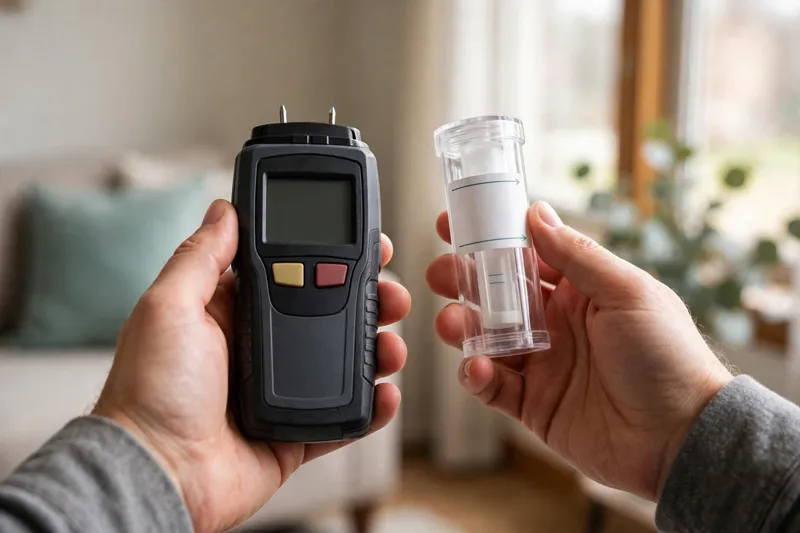
The inspector has three ways to take a sample, and each one answers a different question. Air sampling measures what is floating in the room. Surface sampling measures what is growing on the wall. Dust sampling measures what has settled over months. A good inspection uses the type that matches the question, and a bad one uses the type that is easiest to sell, so it is worth knowing what each one does before the inspector opens the case.
Air sampling is the most common form of testing, and the spore trap cassette is its workhorse. A pump pulls room air through the cassette for a few minutes, and the trap catches the spores on a sticky slide. The laboratory counts the spores under a microscope and names the species, and the report lists the counts for each room next to the outdoor control. The cassette answers one question well: what is in the air right now, in this room, compared with the air outside. It answers it badly when the room has just been cleaned, when the windows are open, or when the dust from the cleanup is still in the air, which is why the sample waits five to seven days after the drying.
The second air method is the culture plate, and it is slower and more specific. The plate grows the mold from the air sample over days, and the laboratory identifies the living species that grew. The plate tells you which species are alive and able to grow, where the spore trap tells you which species are present, alive or dead. The plate costs more time than the trap, and it is the method the inspector reaches for when the species matters more than the count, a home purchase where the lab name decides the negotiation, or a clearance test where the living growth matters more than the dead spores.
Surface sampling is the method for visible growth, and it comes in three forms. The tape lift presses clear tape against the growth and lifts a sample of it for the laboratory, and it is the quickest way to name the species on a wall. The swab wipes a small area with a sterile swab, and it is the method for a surface too rough for tape, or a growth too thin to lift.
The bulk sample is a piece of the material itself, a square of drywall, a strip of insulation, cut out and sent to the laboratory, and it is the method that shows how deep the growth goes into the material. The surface sample names the species on the wall, and it is the sample that decides the remediation: the species tells you how long the material has been wet, and the depth tells you how much of it comes out.
Dust sampling is the third type, and it is the one homeowners misunderstand most. The inspector collects settled dust from the home and the laboratory measures the mold DNA in it, producing a score that compares the home with a database of other homes. The score is a screening tool, not a diagnosis: it says the home's dust carries more or less mold DNA than the database average, and it says nothing about whether the mold made anyone sick, or whether the home is safe. There is no regulatory number for the score, and no agency sets a pass line for it, the score is a comparison, and the inspector who sells it as a verdict is selling a number the laboratory never claimed.
The sample type decides the lab fee, and the fee decides the quote, which is why the written scope matters more than the price. A quote that lists the sample types, the sample count, and the laboratory is a quote you can compare. A quote that says only "mold testing" is a quote with no scope, and the inspector who will not write the scope down is the inspector to walk away from. Ask which type, how many, and which laboratory, before you ask what it costs.
What are the different types of mold inspections?
An inspection is not one fixed job, it is a scope, and the scope is what you are buying. A visual-only inspection is the walk-through with moisture meters and no sampling: the inspector looks, measures the wet areas, and writes down the moisture source. A limited inspection covers one room or one suspected area, usually the room with the smell or the stain, and it suits a homeowner who already knows where the problem is. A full-home inspection walks every room, maps the moisture across the whole home, and takes samples only where the question needs one, the hidden growth, the dispute, or the clearance check after remediation.
The fourth type is the pre-purchase inspection, and it is the one Chicago buyers ask about most. The buyer books it before closing, the inspector reports in writing, and the report becomes part of the negotiation: the seller fixes the leak, or the buyer walks. The sample types in the section above are the tools the inspector uses inside any of these four scopes, the scope decides which rooms get walked, and the question decides whether a sample gets taken at all.
What kills mold, and what only hides it
The question behind the testing is the cleaning, and the cleaning has a rule the testing cannot change: the moisture source is fixed first, and the mold comes second. A wall that is cleaned while the leak still runs will grow mold again, and the second growth will be worse than the first, because the material is wetter and the spores are already there. The fix is always the same order, stop the water, dry the material to the readings, remove what cannot be cleaned, and clean what can, and the test at the end proves the order worked.
Hard surfaces can be cleaned, and porous materials usually cannot. Tile, glass, metal and sealed concrete can be scrubbed clean, because the mold grows on the surface and the surface can be washed. Drywall, insulation, carpet and unfinished wood cannot be cleaned the same way, because the mold grows through the material, and the surface cleaning leaves the growth inside. The rule the inspectors use is simple: if the mold has grown through it, the material comes out. A wall that is scrubbed and painted over is a wall that hides its mold, and the smell that comes back in the summer is the growth inside the wall, still wet, still growing.
Bleach is the product homeowners reach for first, and it is the product that disappoints most. On a hard surface it kills the mold it touches, and the surface looks clean, but on drywall it kills only the surface growth and leaves the growth inside the material, and the water in the bleach wets the drywall further. The surface looks clean for a week, and the smell returns. The product is not the problem: the problem is the material, and no cleaner fixes a material that has grown mold through it. The answer for drywall is removal, not a stronger cleaner.
What kills mold on a hard surface is a cleaner, a scrub brush, and a dry room, and what kills it in a home is the dry room, not the cleaner. The cleaner removes the growth; the drying removes the condition that let it grow. A home that is dried to the readings and kept dry does not grow mold again, whatever cleaner was used. A home that is cleaned and left wet grows mold again, whatever cleaner was used. The clearance test at the end measures the drying, not the cleaning, and the reading that ends the job is the moisture reading, not the lab report.
Removal beats remediation when the material is cheap and the growth is deep, and remediation beats removal when the material is structural and the growth is shallow. A square of drywall comes out in minutes and costs little to replace; a floor joist does not come out at all, and it is cleaned, dried and sealed. The inspector's report should say which is which, room by room, and the homeowner who reads it knows what to fix first. The test never decides the cleaning, the moisture decides it, and the test proves it worked.
Where mold hides in a Chicago home
Mold grows where the water sits, and in a Chicago home the water sits in five places more than anywhere else. The basement, the bathroom, the attic, the kitchen and the crawlspace account for almost every mold call in the city, and each one hides the growth in a different way. The inspector who knows the Chicago housing stock knows where to look first, and the homeowner who knows the five places knows what to check before the inspector arrives.
The basement is the first place, and in a Chicago bungalow it is the most common mold room in the city. The bungalows were built in the nineteen-tens through the nineteen-forties, brick, with a full basement under a single story, and a century of freeze and thaw has opened the foundation joints. Water comes in where the wall meets the floor, through the window wells, and around the sump pit, and it sits in the carpet and the drywall at the base of the wall.
The growth hides behind the finished wall, under the carpet, and inside the insulation, and the smell in July is the first sign, months after the water came in during the spring thaw. The moisture meter finds it in minutes: the readings at the base of the wall tell the story the eye cannot see.
The bathroom is the second place, and in a two-flat it is the room that fails most quietly. The tub surround leaks behind the tile, the grout cracks and lets water into the wall, and the exhaust fan vents into the attic instead of outside, so the steam from every shower rises into the roof space and condenses on the cold wood.
The growth hides behind the tile, inside the wall cavity, and on the attic side of the ceiling, and the first sign is the paint peeling above the shower, or the soft spot in the drywall beside the tub. A bathroom that smells musty after the shower is a bathroom with water inside the wall, and the meter on the wall beside the tub will say how far it has spread.
The attic is the third place, and it is the one homeowners check last. The roof leak that soaks the insulation for a season grows mold on the underside of the roof deck, and the bathroom fan that vents into the attic feeds it every day. The ice dam in winter backs water under the shingles and into the eaves, and the melt in spring carries it down the wall.
The growth hides on the north side of the roof deck, where the sun never reaches, and on the insulation that never dries, and the first sign is the dark stain on the ceiling below, or the frost on the nails in January. The attic is the room the inspector checks with a flashlight and a meter, and the homeowner who never goes up there is the homeowner who finds the growth last.
The kitchen is the fourth place, and it fails in small leaks that run for months. The sink cabinet leaks at the trap, the dishwasher leaks at the supply line, and the ice-maker line leaks behind the refrigerator, each one a slow drip onto the floor and into the wall, each one hidden behind a cabinet door that nobody opens.
The growth hides under the sink, behind the dishwasher, and in the subfloor under the refrigerator, and the first sign is the soft spot in the floor in front of the sink, or the smell when the cabinet door opens. A kitchen that smells musty when the cabinet opens is a kitchen with a leak inside the wall, and the meter under the sink will say how long it has been running.
The crawlspace is the fifth place, and it is the one with the least light and the most moisture. The dirt floor gives off moisture all year, the vapor barrier, where one exists, is torn or missing, and the vents that were meant to dry the space let in the humid summer air instead. The growth hides on the floor joists, on the subfloor above, and on the insulation that hangs in wet strips, and the first sign is the smell in the rooms above, or the floor that feels cold and damp in the summer. The crawlspace is the room the inspector checks last and the homeowner checks never, and the growth there is the growth that has been running longest.
The Chicago stock shapes all five. The bungalows carry the basement problem, the two-flats carry the bathroom and the flat-roof problem, the courtyard buildings carry the shared-wall problem, and the greystones carry the parapet-wall problem, the flat roof and the parapet that let water sit and seep. The new construction carries a different problem: the tight envelope that keeps the heat in also keeps the moisture in, and the bathroom fan that vents into the attic instead of outside. The inspector who knows the building type knows where the water sits, and the homeowner who knows the building type knows what to ask for first.
The testing calendar: when to test, and when not to
Mold does not grow on a schedule, but the water that feeds it does, and the Chicago year has four seasons of water, each with its own mold. Spring brings the thaw and the seepage, summer brings the humidity and the basement smell, fall brings the rain and the leaves in the gutters, and winter brings the ice dam and the frozen pipe. The test that matters is the test taken at the right time, and the right time depends on the season, the storm, and the sale.
Spring is the season of the seepage. The snow melts, the ground thaws, and the water that sat frozen all winter runs against the foundation and through the joints. The basement that was dry in January smells in April, and the growth that started in the thaw shows by May. The test in spring is the inspection first, the moisture mapping that shows where the water came in, and the air sample later, five to seven days after the drying, when the dust has settled. A test taken in the week of the thaw measures the thaw, not the home.
Summer is the season of the humidity. The basement that smells in July is the basement whose humidity never fell below the level mold needs, and the growth that started in June is visible by August. The test in summer is the air sample with the outdoor control, taken on a day when the windows are closed and the air conditioning is running, the sample that compares the indoor air with the outdoor air on the same day, in the same weather. A test taken with the windows open measures the street, not the room.
Fall is the season of the rain and the leaves. The gutters fill, the downspouts clog, and the water that should run away from the foundation runs against it instead. The growth that starts in October shows by December, behind the wall where the water ran. The test in fall is the inspection after the first heavy rain, the moisture survey that finds the wet wall before the growth shows, and the air sample after the drying, when the wall is dry and the dust has settled.
Winter is the season of the ice dam and the frozen pipe. The ice backs water under the shingles and into the eaves, the pipe freezes and bursts, and the water runs down the wall and into the insulation. The growth that starts in January shows in March, when the thaw comes and the wall stays wet. The test in winter is the moisture reading first, the map of the wet rooms, and the air sample in the spring, when the drying is done and the dust has settled. A test taken in the week of the burst measures the burst, not the home.
Three moments outside the seasons decide the test. After a storm, the inspection happens in the first one to two days and the air sample waits five to seven days after the drying. Before a listing, the seller tests first and discloses what the test found, the seller who tests first controls the negotiation. After remediation, the clearance test happens before the walls close, by an independent tester, and it is the test that lets the job end. And the moments not to test are as clear as the moments to test: visible mold means inspection first, the middle of the cleanup means dust in the air, and the middle of the drying means wet readings that say nothing new.
The disclosure form and the buying negotiation
Illinois sellers must disclose known material defects on the disclosure form, and mold from a leak is a material defect. The form is the Residential Real Property Disclosure Report, and it asks the seller to state what is known about the home, the water, the leaks, the mold, the repairs, before the buyer signs. A seller who knows about the leak and says nothing on the form has hidden a defect, and a buyer who finds the mold after closing can claim the seller hid it. The claim runs on what the seller knew and when, and the test the seller took, or did not take, is the evidence.
The seller who tests before listing controls the negotiation. The test finds the mold, the inspection finds the leak, the repair fixes both, and the clearance test proves the fix worked, and the file the seller hands the buyer is the file that ends the argument before it starts. A buyer who receives the lab report, the moisture readings, the repair invoice and the clearance report has no reason to renegotiate, and no reason to walk. A seller who lists without testing hands the buyer the test, and the buyer's test always costs the seller more than the seller's test would have.
The buyer who finds mold after closing has three questions, and the answers decide the claim. Did the seller know? The test the seller took, the repair the seller made, and the leak the seller lived with are the evidence of knowledge. Did the seller disclose? The form the seller signed is the evidence of disclosure, and a blank answer on the water question is an answer the buyer can read. And did the buyer test before closing?
The inspection the buyer ordered, and the test the buyer skipped, are the evidence of diligence, and the buyer who skipped the test owns part of the loss. The claim is rarely clean, and it is never cheap, which is why the test before closing is worth more than the claim after it.
The agent's role is the part buyers forget. The listing agent who knows about the leak and says nothing is the agent who shares the problem, and the buyer's agent who does not order the test is the agent who missed the job. A buyer should ask the agent for the disclosure form before the offer, for the inspection report before the contingency expires, and for the clearance report before the closing, and the agent who cannot produce them is the agent who has not done the job. The file is the negotiation, and the negotiation is won before the offer is signed.
The tenant's worked example: repair-and-deduct in numbers
The ordinance numbers are easier to read in a worked example, so here is one. A tenant pays a rent of one thousand eight hundred dollars a month, and the bathroom pipe leaks for a month. The tenant gives written notice, the landlord does nothing for fourteen days, and the tenant calls a plumber. The plumber's repair costs seven hundred fifty dollars.
The repair-and-deduct cap is the greater of five hundred dollars or one-half of one month's rent, one-half of one thousand eight hundred dollars is nine hundred dollars, so the cap is nine hundred dollars. The repair costs seven hundred fifty dollars, which is under the cap, and under one month's rent, so the tenant may have the work done at the landlord's expense and deduct the cost from the rent.
Change one number and the answer changes. If the same repair costs one thousand two hundred dollars, it exceeds the cap of nine hundred dollars, and the tenant may not use repair-and-deduct for it. The tenant's remedies are the other ones: withhold the reduced value of the unit, seek damages and an injunction, or end the lease. The cap is the gate, and the gate is the greater of five hundred dollars or one-half of one month's rent, a tenant who does not do the arithmetic before calling the plumber is a tenant who pays for a repair the ordinance would not have covered.
Withholding is the reduced value, not the cost of the repair, and the two numbers are different. The bathroom that cannot be used reduces the value of the unit by the value of the bathroom, not by the cost of the plumber. The tenant who withholds the plumber's bill instead of the reduced value has withheld the wrong number, and the landlord who sues for the rent will say so. The withholding begins from the fifteenth day, on the City's summary, and it continues while the failure continues, and the tenant who withholds without written notice has withheld without the protection the ordinance gives.
The essential-services clock is the shortest one in the ordinance, and it is the one tenants should know by heart. A failure to provide an essential service, or a failure that is an immediate danger to health or safety, lets the tenant withhold rent if the landlord fails to correct it within twenty-four hours, and end the lease if the failure persists for more than seventy-two hours. A burst pipe that floods the unit is the classic case: the tenant gives written notice, waits twenty-four hours, and if the water is still running, the tenant may withhold, and after seventy-two hours, the tenant may end the lease. The clock runs from the written notice, not from the first leak, and the tenant who only complains has never started it.
The five mistakes homeowners make with mold testing
They are the mistakes this page is written to prevent, and they are all cheaper to avoid than to fix.
The first mistake is testing before inspecting. The lab report names the species, not the leak, and a homeowner who tests first gets a species name and no moisture source, and the remediation company gets a blank cheque. The inspector who walks the home first finds the leak, maps the moisture, and chooses the samples, and the test that follows answers a question the inspection framed. A homeowner who tests first has paid for a number and still does not know what to fix.
The second mistake is sampling during the cleanup. The air in a home that has just flooded is full of dust from the cleanup, and a sample taken today measures the cleanup, not the room. The lab report comes back high, the homeowner panics, and the remediation company sells a bigger job, and the second sample, taken five to seven days after the drying, tells a different story. The wait is not a delay: it is the difference between a sample that measures the home and a sample that measures the mess.
The third mistake is skipping the outdoor control. A report with no outdoor column is a list of numbers with no comparison, and the inspector who takes no outdoor sample has wasted the lab fee. The outdoor air is the baseline, and the indoor numbers mean nothing without it, a count that looks high against zero looks normal against the street. The homeowner who accepts a report with no outdoor control has accepted a verdict with no evidence, and the inspector who offers one has sold a test that cannot be read.
The fourth mistake is hiring the remediator to test. The company that tests should not be the company that profits from the result, because the test justifies the job and the job pays the tester. A homeowner who hires one company for both has hired a judge who profits from the verdict, and the clearance test after the work is the only check on it, and only if the clearance tester is independent. The wall between the testing and the remediation is the homeowner's protection, and the company that will not show it is the company to walk away from.
The fifth mistake is closing the walls before clearance. The walls close, the growth hides, and the smell returns in the summer, and the homeowner who closed them owns the second remediation, the second test, and the second argument with the next buyer. The clearance test is the gate the walls close behind, and it is the cheapest test on this page: one visit, one report, and the proof the job worked. A homeowner who skips it saves one visit and loses the only proof the job worked, and the walls that closed without it are the walls that will open again.
Do air purifiers help with mold?
They help with the air, not with the mold. A purifier with a HEPA filter traps airborne spores while it runs, so the air in the room carries fewer of them. The growth on the wall stays, the moisture that feeds it stays, and the smell stays until the source is fixed. A purifier is a filter, not a fix, and a home that still smells musty with a purifier running is a home that still has wet material somewhere.
In a room that is already dry and cleaned, a HEPA unit can lower the spore count in the air. It works best in one closed room, with a unit sized for the room and a filter changed on schedule. It does nothing for the growth inside drywall or under the floor, because it catches the spores already in the air, not the colony that keeps making them.
Skip the machines that make ozone. Some purifiers sell ozone as the cleaning agent, and ozone irritates the lungs, the U.S. Environmental Protection Agency warns against ozone generators in rooms people live in. The purifier worth buying is the plain one: a HEPA filter, a fan, and a filter you change on schedule. Buy it after the drying, not before the leak is fixed.
What naturally kills mold spores?
The short answer is that no household remedy kills mold spores through a home. Vinegar, hydrogen peroxide, baking soda and tea tree oil are the names that come up in every search, and on a hard surface they can clean a small patch, the same way detergent and water can. What none of them can do is reach the growth inside drywall, insulation or wood, or prove the spores are gone. A cleaner works on the surface it touches. The growth that matters lives where no cleaner touches.
The word natural does not make a remedy stronger. A spray that smells natural and a spray that smells chemical both fail the same way: they clean the surface and leave the wet material behind, and the mold grows back from inside the wall. The only thing that ends mold in a home is the order this page repeats, stop the water, dry the material to the readings, remove what cannot be cleaned, and clean what can. A small patch on tile or glass, with dry material behind it, comes off with detergent and water and a scrub brush. Anything inside drywall or under flooring needs the material out, and the test at the end is the clearance test, not a smell test.
Are mold remediation companies legitimate?
Yes, legitimate mold remediation companies exist, and so do bad ones. A legitimate company inspects before it quotes, puts the scope in writing, names the moisture source it will fix, and hands the clearance test to an independent tester. A company that will not do those four things is selling a job, not a fix.
Illinois gives the homeowner one check to make. The Illinois Department of Public Health registration for mold remediation work is operational from 23 September 2026, with a grace period to 30 September 2027, and this site gives consumer guidance only and claims no registration itself. Ask the company whether its remediation work is registered. The registration covers remediation work, not inspection, and it does not make an inspector licensed, so it is one check among several, not the whole vetting.
The other checks are the ones this page already lists: the lab is accredited, the tester and the remediator are not the same company, the clearance test is independent, and the scope is written down before the work starts. Walk away from the company that tests its own work, promises a home with no mold at all, or pressures you to sign the same day. No honest company promises a mold-free home, the honest promise is a dry home and a clearance report that proves it.
A musty smell for years, and a baby on the way
A smell that has lasted two or three years points to water that has been getting in for years, and growth settled in behind a wall or under a floor. The smell is the clue, not the proof: only an inspection can say where the water is and how far the growth has spread.
With a baby on the way, the case for an inspection gets stronger, not because a test can promise a safe home for a baby, because no test can, but because the fix takes weeks and is far easier before the baby arrives. The inspection maps the moisture, finds the hidden growth, and names the rooms to fix first, do it now, while the nursery is still an empty room.
What the inspection looks for: moisture readings at the base of the walls, the wall behind the bath, the attic and the basement, and the ventilation in the rooms the baby will sleep in. What it cannot prove: that the house is safe, that the smell is harmless, or that a test result explains a symptom. A home test measures spores in the air; it cannot diagnose illness, and it cannot promise a baby's health, anyone in the household with breathing trouble should talk to a doctor, not to a lab report.
What to do in the first forty-eight hours
Seven steps, in order. The first three protect the home, the next two decide whether a test is needed at all, and the last two prove the job worked. Every step is one a homeowner can do tonight, with no tool but a phone camera and a moisture meter.
Start with an inspection, not a test
Walk every room with the inspector, and let the moisture meters do the talking before anyone opens a cassette. The inspector maps the wet areas, finds the source of the water, and tells you whether sampling would answer a question the inspection cannot. When mold is visible, the inspection is usually enough, the job is to fix the moisture and remove the growth, and a lab report adds nothing to that decision. Testing earns its place only when the mold is hidden, when a dispute needs evidence, or after remediation.
Find and fix the moisture source before any sampling
No sample is valid while the leak still runs, because the numbers will keep changing as the water keeps coming. The inspector traces the water to its source, a supply line, a drain, a roof leak, a failed seal, and the repair comes before the cassette, not after it. A test taken while the wall is still wet tells you the room is wet, which the meter already told you. Fix the source, dry the area, and then sample, so the result reflects the home and not the leak.
Choose the sampling type for the question
Air sampling is the tool for hidden mold and for whole-room questions: a cassette pulls room air through it and traps the spores for the lab. Surface sampling is the tool for growth you can see: a tape lift or a swab lifts the growth from the wall for identification. Bulk sampling cuts a piece of the material itself, drywall, wood, insulation, when the question is what is growing inside it. One sample type cannot answer another type's question, so the inspector picks the sample after the inspection, never before it.
Take indoor samples with an outdoor control
Take indoor samples with an outdoor control, on the same day and in the same conditions. The outdoor sample is the baseline: it shows what the air outside carries, so the lab can tell whether the indoor air carries more. Take it upwind of the building, away from the exhaust vents, and take the indoor samples with the windows shut and the heating or cooling running as usual. A sample without an outdoor control is a number without a comparison, and a number without a comparison proves nothing.
Send the samples to an accredited lab
Send the samples to an accredited laboratory, with a chain of custody. The cassettes and the swabs travel sealed and labelled, and the lab logs them in, grows the cultures where the method needs them, and counts the spores under a microscope. The lab names the species and reports the counts; it does not tell you whether the home is safe, because no number means safe. Ask the inspector which laboratory does the work before you book, and ask for the lab report itself, not a summary of it.
Read the report against the outdoor control
Read the report against the outdoor control, not against zero. The report lists the species found indoors and outdoors, with the spore counts for each, and the comparison is the reading: indoor counts at or below the outdoor counts are normal, and indoor counts far above them point to growth inside. Look for species that appear indoors and are absent outdoors, that is the signature of a source inside the home. There is no single number that means safe, and no report that says the home is clean; the report says what grew, where, and how much.
Clearance-test after remediation
Clearance-test after remediation, with an independent tester. The clearance test happens after the work is finished, the area is clean, and the moisture readings are steady, not before. The tester checks that the area is dry, that no visible mold remains, and that the indoor spore counts are at or below the outdoor control. The company that did the remediation does not do its own clearance test: the tester must be independent, or the result is the company's word for its own work. Only when the clearance test passes do the walls close.
The homeowner's checklist
The question this page answers in one page: inspection first, testing only when it changes the decision, and a clearance test after the work. Run the list in order, and keep the readings.
- Make it safe first, power off from a dry location, never walk through standing water
- Stop the water, then start the drying, the leak decides the mold, not the test
- Moisture readings in the first one to two days, and a written map of the wet rooms
- Visible mold means inspection, not testing, fix the moisture, remove the growth, dry to the readings
- No visible mold and a smell that will not go away means air sampling, five to seven days after the drying
- Every sample paired with an outdoor control, taken the same day
- Lab report read against the outdoor control, not against zero
- Clearance testing by an independent tester after the remediation, before the walls close
- Every reading, receipt, lab report and estimate kept in one folder
- Tenant: written notice to the landlord the same day, with photos and the time the water started
Call now, we answer 24/7
If you are still asking whether you need testing or inspection after running the checks, call (773) 570-9869. We will ask what you saw, tell you what to check tonight, and send a crew with a meter when the job needs one.
Frequently asked questions
Do I need mold testing or mold inspection in Chicago?
In most cases you need the inspection first, and the test only when it changes the decision. An inspector looks for the moisture source, maps the wet areas, and tells you whether sampling would answer a question the inspection cannot. When mold is visible, sampling is usually unnecessary, the job is to fix the moisture and remove the growth.
How much does mold testing cost in Chicago?
This site prints no prices, so no figure here can mislead you. The cost depends on the size of the home, how many samples the inspector takes, the lab fees, whether the results are rushed, and whether clearance testing is added after remediation. A written scope that lists the sample count is the only honest way to compare two quotes.
How much does a mold inspection cost in Chicago?
This site prints no prices, so no figure here can mislead you. An inspection costs less than testing because it is a visual and moisture survey, not a laboratory job. The price depends on the size of the home, how many rooms are checked, whether thermal imaging is used, and whether the inspector also writes a remediation scope.
What is the difference between mold testing and mold inspection?
An inspection is a visual and moisture survey: the inspector walks the home, finds the wet areas, and tells you where the mold is and why it grew. Testing is sampling: air or surface samples go to a laboratory, which reports the species and the spore counts. The inspection finds the problem; the test puts numbers on it.
How do professionals test for mold?
They start with the inspection, then choose the sample for the question. Air sampling pulls room air through a cassette that traps spores, with an outdoor control taken the same day. Surface sampling lifts growth with tape or a swab. Bulk sampling cuts a piece of the material itself. The laboratory reads the samples, and the inspector reads the laboratory.
How long does mold testing take?
The visit itself usually takes one to three hours, depending on the size of the home and how many samples are taken. The laboratory then needs a few days to grow and count the samples. The written report, with the lab results and the inspector's reading of them, follows the lab.
Can I test for mold myself with a kit?
Yes, you can buy a kit, and it will usually find mold, which is the problem. A petri dish left open grows whatever spores are already in the air, and spores are everywhere, so a positive dish proves very little. A kit cannot tell you the source, the extent, or whether one room is worse than the air outside.
What are the first signs of mold sickness?
People report a stuffy nose, a cough that will not clear, itchy eyes, a sore throat, and skin irritation that appears at home and fades elsewhere. People with asthma or allergies feel it first, and symptoms track the damp rooms. This page cannot diagnose you, a doctor can, and a home test cannot tell you what made you sick.
How quickly does mold grow after water damage?
Mold can start growing within one to two days of water damage, when the material stays wet. The first day is for stopping the water and getting the drying started; the second day is for the moisture mapping that shows how far the water spread. After a week of wet walls, the growth is visible, and the job is bigger.
Is mold testing worth it?
It is worth it when the result changes what you do next. Testing pays when the mold is hidden and you need proof it is there, when a buyer or seller needs proof, when a landlord and tenant disagree, and after remediation, to prove the job worked. When the mold is visible, spend the money on inspection and the fix.
Does homeowners insurance cover mold testing?
Sometimes, and only when the testing follows a covered loss. A burst pipe that soaked a wall can make the testing part of the claim, because the insurer needs to know the extent of the damage. Testing for a slow leak or for peace of mind is usually the homeowner's cost. Read the policy before the test, not after it.
What does a mold inspection include?
A full inspection starts with a walk-through of every room, a moisture survey with pin and pinless meters, and a look at the places mold hides, behind drywall, under sinks, in the attic and the crawl space. The inspector notes the moisture source and the visible growth, then writes a report with the findings and the next steps.
How accurate are mold testing kits?
A kit is accurate at one thing: growing mold from the air. A petri dish left open will grow colonies in almost any home, because spores are always in the air. That makes it a poor test for whether one room is worse than the air outside. For that question you need a laboratory sample with an outdoor control.
When should I get mold testing after water damage?
Start with the inspection and the moisture mapping in the first one to two days, while the water is being found. Air sampling should wait five to seven days after the drying, when the dust has settled and the sample reflects the room, not the cleanup. Clearance testing comes last, after the remediation is finished and the area is dry.
Is mold considered uninhabitable in Illinois?
Serious mold can make a Chicago rental uninhabitable when the landlord knew about the leak and failed to fix it. The tenant's remedies run on written notice: the lease can end, the repair can be deducted, or the rent can be withheld. A few spots on a bathroom ceiling do not make a home uninhabitable, the extent decides it.
What is clearance testing after mold remediation?
Clearance testing proves the remediation worked. A tester who is independent of the company that did the remediation checks that the area is dry, that no visible mold remains, and that indoor spore counts are at or below the outdoor control. It happens after the work is finished, and it is the step that lets the walls close.
Do I need mold testing if I can see mold?
Usually not. When mold is visible, the environmental agencies say sampling is usually unnecessary, the mold is there, and the job is to find the moisture that feeds it and remove the growth. Testing earns its place when the mold is hidden, when a dispute needs evidence, or after remediation, when clearance testing proves the job worked.
How do I read a mold lab report?
Read it against the outdoor control, not against zero. The report lists the species found indoors and outdoors, with the spore counts for each. Indoor counts at or below the outdoor counts are normal; indoor counts far above them, or species absent outdoors, point to growth inside. There is no number that means safe, the comparison is the reading.
Who does mold testing in Chicago?
Independent mold inspectors do the testing, and the best ones do not sell remediation, the company that tests should not be the company that profits from the result. Look for an inspector who samples with an outdoor control, uses an accredited laboratory, and writes a report that names the moisture source. Ask who does the lab work before booking.
Do I have to disclose mold in Illinois?
Yes, when you know about it. Illinois sellers must disclose known material defects on the disclosure form, and mold from a leak is a material defect. A buyer who finds mold after closing can claim the seller hid it, and the claim runs on what the seller knew and when. Test before you list, and disclose what the test found.
Is it worth getting tested for mold exposure?
A home test cannot tell you whether mold made you sick, that is a doctor's question, not a laboratory's. What a home test can tell you is whether the air in one room carries more spores than the air outside, and what species is growing. If your symptoms track the damp rooms, test the home and see a doctor.
What are the health risks of mold exposure?
Mold exposure irritates the nose, the eyes, the throat and the lungs, and it hits people with asthma or allergies hardest. Long exposure in a damp home can worsen asthma and keep a cough going. The risk depends on the person, the species, and how long the exposure lasted, a home test measures the spores, not your risk.
How do you test mold spores in your home?
An inspector takes air samples with a spore trap cassette, pulling room air through it, and takes an outdoor sample the same day as the control. The laboratory counts the spores and lists the species. A tape lift or a swab tests the growth you can see. The outdoor control is what makes the indoor numbers mean anything.
Can a house full of mold be saved?
Usually, yes, if the moisture source is fixed first. The house is saved the way a room is saved: stop the water, remove the growth and the wet material, dry the structure to the readings, and test to prove it worked. The houses that cannot be saved are the ones where water ran for years and the framing rotted.
Are mold inspections worth it?
Yes, when you need to know where the moisture is and why the mold grew. An inspection is worth it before buying a home, after a leak, when the smell lingers, and when a landlord and a tenant disagree about the cause. It never substitutes for fixing the leak, the repair ends the problem the inspection finds.
How can you test a house for black mold?
The same way you test for any mold: air samples with an outdoor control, surface samples from the growth, and a laboratory that names the species. Black mold is not a species, it is a color, and several species grow black. The test that matters is the species name on the lab report, not the color on the wall.
What kills black mold on walls?
Cleaning kills growth you can see, but it does not kill the cause. A wall that stays wet will grow mold again, no matter what you scrub it with. The fix runs in order: stop the water, remove the wet material, dry the wall to the readings, and clean what is left. The moisture is the problem, not the color.
What is the difference between mold removal and mold remediation?
Removal is taking the growth away. Remediation is the job: finding the moisture source, fixing it, removing the growth and the wet material, cleaning the area, drying it to the readings, and testing again to prove it worked. A job that removes the mold and leaves the leak is removal, not remediation, and the mold comes back.
Sources
- CBS Chicago, Chris Tye, “Suspected mold keeps John H. Kinzie Elementary students out of school as new year begins” (cbsnews.com/chicago/news/john-h-kinzie-elementary-school-suspected-mold, updated 25 August 2026), the tests completed at the school in the 5600 block of South Mobile Avenue, the 600 students holding outside classes inside adjacent Kennedy High School, and the reopening gated on independent mold-clearance testing.
- Municipal Code of Chicago, chapter 5-12, section 5-12-110, Tenant remedies, and section 5-12-070, Landlord to maintain premises, the City's published code, codelibrary.amlegal.com, the ordinance text this page follows, with the day-fifteen figure attributed to the City's RLTO Summary.
- Illinois Department of Public Health, mold registration, operational from 23 September 2026, with a grace period to 30 September 2027, consumer guidance only.
- U.S. Environmental Protection Agency, mold guidance, sampling is usually unnecessary when mold is visible, and visible mold should be cleaned rather than tested first.
- Mold Registry, “Mold Inspection & Testing Chicago”, about one thousand two hundred and fifty words, with no questions at all.
- Green Planet Restoration, the Chicago testing guide, six visible questions.
- InspectAndTest, “Mold Inspection vs. Testing: Which One Do You Need?”, twelve visible questions, and the seven questions before you hire.
- Chicago Home Inspector, “Mold Inspection and Testing in Chicago Homes”, six visible questions and three visible steps.
- Mold Inspection & Testing Chicago (moldinspectiontesting.com) and Mold Pro Chicago (moldprochicago.com), the two Chicago specialists at the top of the local results.
- WikiHow, “How to Test for Mold”, three hundred and twenty-eight thousand two hundred and sixty-eight views, the wikiHow article on home testing.
- Mr Mold Inspector, clearance-testing Short (youtube.com/shorts/6XA8avOgRgo), no transcript panel on Shorts.
- People Also Ask questions quoted in this page, with the search record given in the text.
More Restoration Services in Chicago
Every service below is one tap away. Pick the one that matches your problem.

Water Damage Restoration
Fast water extraction, structural drying, and full repair after burst pipes, leaks, and floods.
Learn more →
Water Mitigation
Emergency water removal, structural drying, and mold prevention to stop the damage fast, 24/7.
Learn more →
Mold Remediation
Safe, contained mold remediation that removes contamination and fixes the moisture source.
Learn more →
Sewage Cleanup
Safe removal and disinfection of dangerous sewage backups and black water.
Learn more →
Flood Cleanup
Water pumped out, structure dried, and debris cleared fast after storms and flooding.
Learn more →
Hardwood Floors Water Damage
Cupped, buckled or stained hardwood after a leak? How we dry it, when sanding saves it, and when the boards have to go.
Learn more →