
Chicago, IL · A cost guide for Chicago homeowners
Mold Remediation Cost Chicago: What Drives the Price
You found mold, you got three quotes, and the three totals do not look like the same job. This guide explains what drives the cost, the size, the severity, the location, the containment, and the moisture source, so you can read a quote line by line and see whether the scope is complete before you sign it.
- The eight cost drivers, in order, and why the visible patch understates the job
- Cost by room: attic, basement, bathroom, crawl space, HVAC and whole house
- How to read a quote: the nine-line checklist every honest estimate carries
- A real Chicago court case, printed with its limits, and what it does not prove
Written for Chicago homeowners, the bungalows, the two-flats, and the finished basements.
- We answer 24/7
- Local Chicago team
- Insurance documentation help
- Straight answers, no pressure
Have a question? Call us any time
Mold in your Chicago home, and a quote you cannot judge: send the form and we will call you back. Fast response, no obligation.
The short answer: no number, but a clear set of drivers
The honest answer is that no page can give you a number: the cost follows the size, the severity, the location, and whether the moisture source is fixed first. This page gives you the drivers, the rooms, the quote, and the insurance rules for mold remediation cost chicago, what you need to judge a quote.
This page carries twenty-eight questions and seven steps, and it is the first Chicago version written from the cost side: the drivers, the rooms, the quote, and the case.
Anyone searching mold remediation cost chicago wants one number, and no honest page can give it. The quote that excludes the rebuild or the moisture repair is not actually low. Read the scope, compare the line items, and the numbers start to make sense.
The table below is the whole page in one place: the drivers, the rooms, and the quote, everything that decides mold remediation cost chicago.
| Driver | What it means | What pushes it up |
|---|---|---|
| Size of the affected area | The area that must be opened, removed and dried, larger than the stain you can see | Growth inside walls, behind drywall, under flooring |
| Severity and spread | Surface growth versus growth through the structure | Porous materials that must come out; structural damage |
| Location | Attic, basement, bathroom, crawl space, HVAC, whole house | Poor access, finished space, shared ductwork |
| Containment and air filtration | Sealing the work area and running negative air | Full containment, many days, whole-floor work |
| Moisture-source repair | Fixing the water that fed the mold | Plumbing, roof, grading, or a sewer backup |
| Testing and clearance | Independent inspection before, independent clearance after | Hidden growth, repeat testing after a failed clearance |
| Rebuild | Drywall, flooring, framing and paint after the remediation | Finished rooms, matching old materials |
| Chicago multipliers | Combined sewers, finished basements, older brick stock | Category 3 water, balloon-frame cavities, flat roofs |
The sections that follow explain each row: the drivers, the rooms, the quote, the insurance rules, and the Chicago case that shows what a real remediation payment looks like in court.
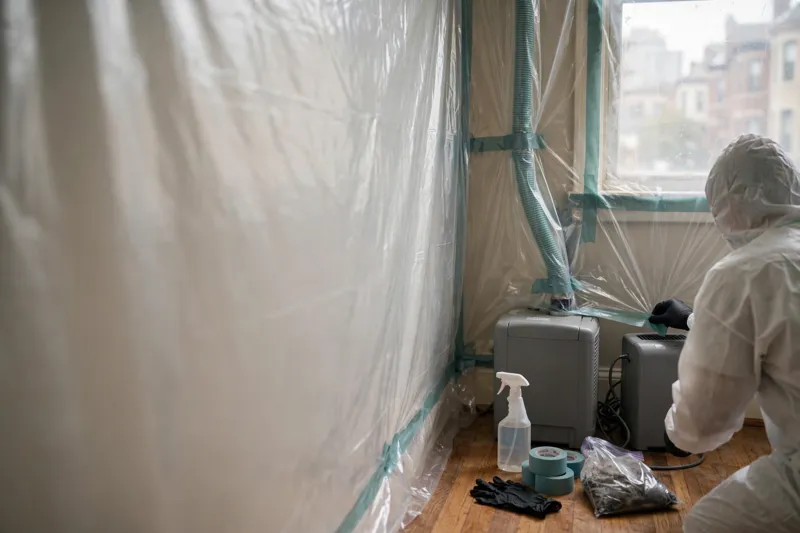
What drives mold remediation cost chicago
Eight drivers decide the cost, and they decide it in the same order on every job. Size first, because the affected area sets the scope. Severity second, because growth through the structure costs more than growth on a surface. Location third, because an attic and a finished basement are different jobs. Then containment, the moisture-source repair, testing, and the rebuild. The Chicago multipliers sit on top of all seven, because the city's sewers and its housing stock change the job before the crew arrives.
Size of the affected area
Size is the single biggest driver, and it is the one homeowners misjudge most. The visible patch is the end of the growth, not the start: mold spreads through a wall cavity far faster than the stain on the surface suggests, and the colony behind the drywall is usually larger than the patch in front of it. The affected area is the area that must be opened, removed, cleaned and dried, and it is larger than the stain you can see, because the growth follows the moisture, and the moisture follows the framing, the wiring chases, and the insulation. A contractor who prices the stain is pricing the wrong job; a contractor who prices the affected area is pricing the job you actually need.
The scope follows the readings, not the stain. The inspector maps the moisture with a pin meter, opens the wall where the readings say the growth is, and writes the scope by room and material. That scope is the document every bidder bids against, and it is the reason three quotes for the same house can look so different: one bidder priced the stain, one priced the affected area, and one priced the affected area plus the rebuild. The first quote is not low, it is incomplete.
Severity and spread
Severity is what the growth did to the materials, and it splits the job in two. Surface growth on tile, metal, or glass can be cleaned. Growth through porous materials cannot: drywall, insulation, carpet and carpet pad, and ceiling tiles that grew mold come out, because scrubbing them spreads the spores and leaves the growth inside the material. The more porous material the job removes, the larger the job, and the more the rebuild costs afterward, because every sheet of drywall that comes out must go back in.
Spread is the second half of severity. A patch that stayed in one room is one job; a patch that travelled through a wall cavity, a ceiling, or the ductwork is several jobs joined together. The ductwork is the expensive one: mold in the HVAC means the system must be cleaned, the ducts addressed, and the air tested, and the crew must keep the spores out of the rest of the house while they work. Severity is also time: a leak that ran for years grows a larger colony than a leak found in a week, and the colony that grew for years is the one that reaches the framing.
Black mold deserves a paragraph of its own, because the color frightens homeowners more than the colony warrants. Black mold jobs run higher than ordinary mold jobs, because the same drivers apply with stricter containment, more protective equipment, and more careful disposal, but the color of the mold does not set the price. The size, the location, and the moisture source do. A small black patch on a bathroom tile is a small job, and a large pale patch through a basement wall is a large one. The testing question is the same for both: the inspector identifies the growth, the scope is written by room and material, and the clearance test proves the work. A contractor who prices by color is pricing the fear, not the job.
The severity question also decides the category of the water, and the category decides the protocol. Clean water from a supply line is the lowest category, and the crew dries what it touched. Grey water from an appliance is the middle category, and the crew cleans what it touched. Sewage water is the highest category, and the crew treats everything it touched as contaminated, removes the porous materials, and cleans the rest under containment. The category is the inspector's call, made from the source and the readings, and the quote should name it, a quote that does not name the category has not decided the protocol.
Location
Location decides the access, and access decides the labor. An attic job depends on the roof deck, the ventilation, and whether the insulation must come out, and a flat roof that ponds water pushes the job up, because the roof is the moisture source and the roof must be fixed first. A basement job depends on whether the water came from a sewer backup, a foundation crack, or groundwater, and whether the basement is finished. A bathroom job is small in area but tight in access, with fixtures and tile in the way. A crawl space job is the hardest access of all: low, dark, and wet, with the crew working on their backs.
The whole-house job is the largest of all, and it is the one that follows a leak nobody found. A burst pipe in a wall cavity, a roof leak that ran for a season, a sewer backup that filled a basement and wicked up the framing, each one turns a room job into a house job. The location table in the next section breaks each room down: what the job involves, what pushes it up, and what is included and what is excluded.
Containment and air filtration
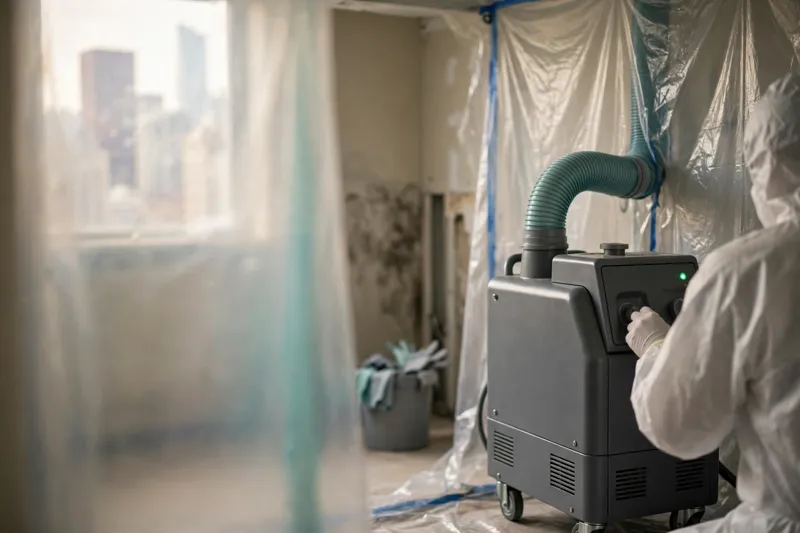
Containment is the plastic sheeting, the taped seams, and the negative air that keep the spores inside the work area while the crew opens the walls. Limited containment suits a small patch in one room; full containment suits a whole room, a whole floor, or a job that opens the ductwork. The air scrubber runs a HEPA filter and pulls the air inside the containment to negative pressure, so spores flow inward, not out into the rest of the house, and the containment stays up until the clearance test passes.
Containment is a fixed cost, and that is why small jobs carry a high effective rate: the sheeting, the taping, and the air scrubber cost the same on a small job as on a large one, and the days of containment are days the crew is on site. A quote that shows no containment at all is a quote to distrust, a crew that opens a moldy wall without sealing the room is spreading the problem, not solving it.
The containment question also decides who stays in the house, and the answer depends on the size of the job. A small patch in one room, sealed and under negative air, lets the household stay, the rest of the house is clear, and the crew works behind the plastic. A whole-floor job, a job that covers the HVAC, or a job that follows a sewer backup is a job to leave the house for, and the quote should say so. The contractor who tells you to stay through a whole-house job is a contractor who has not thought about the air you are breathing.
Moisture-source repair
The moisture source is the fix that stops the recurrence, and it is the line homeowners most often find missing from a quote. A burst pipe is repaired, a roof leak is sealed, a grading problem is re-sloped, a ventilation failure is corrected, and a sewer backup gets a backwater valve, not another coat of paint. The source repair is often a separate trade and a separate line in the quote, and it is often the most expensive line, because the plumber or the roofer is a different crew with a different bill.
A quote that excludes the source repair is not a finished job. Remediation removes the growth, but the water that fed it decides whether it returns, and a finished job fixes the source, dries the structure to the readings, and passes a clearance test. Check the source repair in the quote before you sign, and ask who performs it and whether it is included or excluded. The cheapest quote in the set is usually the one that left the source repair out.
Testing and clearance
Testing is two jobs, and both must be independent. The inspection before the work defines the scope that every bidder bids against, and the clearance test after the work proves the job is done. Both must be performed by a different company from the one that remediates, an inspector who also remediates has a reason to find a large job, and a remediator who tests his own work has a reason to pass it. The clearance tester should be named in the quote, by name, with what happens on a failed test written down.
Testing adds a line to the quote, and a failed clearance adds another: the containment stays up, the crew goes back in, and the test is run again. That is the cost of honesty, and it is worth paying, the clearance report is the document you keep with the sale file, the insurance file, and the disclosure, and it is the proof the job is done. A quote with no testing line is a quote with no proof.
Rebuild
The rebuild is the drywall, the flooring, the framing, and the paint that go back in after the remediation, and it is usually a separate bill. Remediation removes; rebuilding restores. A finished basement that loses its drywall and its flooring needs both replaced, and matching old materials costs more than installing new ones. A bathroom that loses its tile needs a tile setter, not a remediation crew.
Ask whether the rebuild is included or excluded, and get the answer in writing. A quote that includes the rebuild looks higher than a quote that excludes it, and the two are not comparable, the lower total is the one that leaves the room unfinished. The rebuild is also the line that grows: once the wall is open, the crew finds the rot, the old wiring, or the framing that must be replaced, and the scope changes. A written scope with a change-order rule is the protection.
Chicago multipliers
Chicago adds three multipliers that the national guides never mention. The first is the combined sewer: one pipe carries the sewage and the storm water together, and an intense storm pushes sewage back through the floor drains. A finished basement after a sewer backup is the most expensive common job in the city, because the finishes come out and the Category 3 protocol applies, sewage water is the highest category, and the crew treats everything it touched as contaminated.
The second is the housing stock: bungalows and two-flats with balloon-frame cavities, where one leak travels the full height of the wall; flat roofs that pond water instead of shedding it; and older brick stock where the mortar and the flashing fail together. The third is the finished basement itself: Chicago basements are living space, not storage, and a finished basement that floods loses its drywall, its flooring, and its furniture in one event. The Chicago section later in this page takes each multiplier in turn.
Why three quotes for the same house look different
Three quotes for the same house look different because they are three different scopes, not three prices for the same job. One bidder priced the stain, one priced the affected area, and one priced the affected area plus the rebuild, and the three totals cannot be compared until the scopes are compared. The first quote is not low; it is incomplete. The second is the honest one only if its nine lines match the inspector's scope. The third is the expensive one only if it includes work the house does not need, and the way to tell is the scope, not the total.
The way to make the three quotes comparable is the inspection. Get the inspection first, in writing, from a company that will not do the remediation, and give the same scope to all three bidders. The bidders then price the same document, and the totals become comparable, and the differences that remain are the differences that matter: the containment type, the days, the moisture-source repair, and the clearance tester. A bidder who will not price the inspector's scope is a bidder who wants to price his own, smaller scope, and the smaller scope is the one that grows.
Payment terms are the last line to read, and the one homeowners skip. Never pay the full job upfront: the honest structure is a deposit to start, a milestone payment when the containment is up and the removal is done, and the final payment after the clearance test passes. Hold the final payment until the clearance report is in your hand, because the clearance report is the only protection you have after the crew leaves. A contractor who demands full payment before the work starts is a contractor who does not want to be judged by the clearance test.
That is the full list of drivers behind mold remediation cost chicago: size, severity, location, containment, moisture repair, testing and rebuild.
The per-square-foot method, and why it misleads
The per-square-foot method shapes every quote for mold remediation cost chicago, so it is worth understanding before you read one. Contractors price by the affected area, not by the floor plan of the house and not by the stain you can see. The affected area is the area that must be opened, removed, cleaned and dried, and it is larger than the visible patch, because the growth follows the moisture, and the moisture follows the framing, the wiring chases, and the insulation. A one thousand square foot house is not a one thousand square foot job; the job is the affected area, and the affected area is what the inspector maps.
The shorthand misleads in three ways. First, it hides the fixed costs: containment, mobilization, air filtration, and testing cost the same on a small job as on a large one, so a small job carries a high effective rate and a large job carries a low one. A homeowner who compares two quotes by their per-foot rate is comparing the wrong number, the totals and the scopes are the numbers that matter.
Second, it hides the severity: a square foot of surface growth on tile and a square foot of growth through drywall and insulation are different jobs with different scopes, and the same rate cannot describe both. Third, it hides the location: a square foot in an attic, a square foot in a crawl space, and a square foot in a finished basement are three different jobs, with three different access stories.
The warning the cost guides give is worth repeating in full, because it is the clearest statement of the method's limit: a twelve hundred square foot crawl space with eighty square feet of growth is an eighty square foot job, not a twelve hundred square foot job. The house is not the job. The room is not the job. The affected area is the job, and the affected area is what the inspector writes in the scope, by room and by material, before any bidder prices it.
Read a quote the way the method demands. Find the affected area in the scope, and check that it matches the inspector's report. Find the containment type and the days, and check that they match the size of the job. Find the moisture-source repair, and check whether it is included or excluded. Find the clearance test, and check who performs it. A quote that shows none of those lines is not a quote, it is a total, and a total without a scope is the quote that grows.
The per-foot shorthand also misleads in the other direction: it makes a large job look cheap. A whole-house job priced by the foot looks like a bargain next to a small job priced the same way, because the fixed costs spread across more area, but the whole-house job carries the rebuild, the moisture-source repair, and the clearance testing that the small job does not. The rate is not the cost. The scope is the cost, and the scope is the document to read.
The estimate and the final bill are two different documents, and the gap between them is the change order. Once the wall is open, the crew finds the rot, the old wiring, or the framing that must be replaced, and the scope changes, and a written scope with a change-order rule is the protection. The rule should say, in writing, that no extra work starts without the homeowner's approval, and that every change is priced before it is done, not after. A quote with no change-order rule is a quote that grows without asking, and the growth is the part the homeowner discovers at the end.
The final bill should match the scope, line by line, with the changes listed separately and priced separately. Read the final bill against the inspector's scope the same way you read the quote against it: the rooms, the materials, the containment, the drying days, the source repair, and the clearance test. A final bill that cannot be matched to the scope is a bill to question, and the question to ask is which line changed and why. The clearance report is the last document in the set, and the final payment should wait for it.
The quote that hides the scope is the one to fear most, and it hides it in three ways. The first is the single total: one number, no lines, no rooms, no materials, a total that cannot be compared with anything, because there is nothing to compare it against. The second is the vague scope: mold remediation written once, with no room named, no material named, and no containment named. The third is the verbal promise: the contractor who tells you the rebuild is included, the source repair is included, and the clearance test is included, and puts none of it in writing. The written scope is the protection against all three, and the homeowner who insists on it before signing is the homeowner who holds the job.
Cost by room: what each job involves
The room tables below break mold remediation cost chicago into the jobs Chicago homes actually need. Each room has its own access story, its own materials, and its own moisture source, and the room is the unit the quote is written in. The table mirrors the location tables on the national guides and on Angi Chicago, in structure, with Chicago content: the basement after a sewer backup, the attic under a flat roof, the bathroom behind the tile, the wall cavity behind the drywall.
| Room | What the job involves | What pushes it up | Included vs excluded |
|---|---|---|---|
| Attic | Roof deck, ventilation, insulation removal | Flat roof ponding, years of slow leakage | Insulation out; roof repair usually separate |
| Basement | Finished walls and flooring out, Category 3 protocol | Sewer backup, finished space, groundwater | Finishes out; rebuild separate; backwater valve separate |
| Bathroom | Tile and drywall out, fixtures in the way | Hidden leak behind the tub, tight access | Tile out; fixtures reset by a plumber |
| Kitchen | Under-sink and behind-appliance growth | Slow appliance leak, shared wall with a bathroom | Cabinets out; appliance repair separate |
| Crawl space | Low, dark, wet work on the crew's backs | Standing water, poor ventilation, ductwork | Vapor barrier separate; encapsulation separate |
| HVAC | Duct cleaning, system cleaning, air testing | Growth through the ducts, whole-house spread | Ducts cleaned; unit replacement separate |
| Interior walls | Wall cavities opened, framing dried | Balloon-frame travel, full-height growth | Drywall out; framing stays when the readings allow |
| Whole house | Multiple rooms, multiple sources, full containment | Undiscovered leak, sewer backup, roof failure | Everything above, sequenced room by room |
Attic
Attic jobs depend on the roof deck, the ventilation, and whether the insulation must come out. A flat roof that ponds water pushes the job up, and a leak that ran for years costs more than a fresh one, because the decking itself may be rotted and the growth has had years to travel. The moisture source, usually the roof or the vents, must be fixed first, and the roof repair is usually a separate trade with a separate bill. The insulation is the hidden cost: wet insulation cannot be dried and reused, and it comes out by the bag, through the attic hatch, in the dark.
The attic job also decides the ventilation question, and the ventilation question decides whether the mold returns. An attic that cannot breathe grows mold again, because the warm air from the house meets the cold roof deck and condenses, and the condensation feeds the growth through the winter. The fix is ventilation and insulation together: the vents that let the attic breathe, and the insulation that keeps the warm air out of the roof deck. A remediation crew that cleans the attic and leaves the ventilation as it was has done half the job, and the mold will be back within the season. Ask whether the ventilation is in the scope, and get the answer in writing.
Basement
Basement jobs depend on whether the water came from a sewer backup, a foundation crack, or groundwater, and whether the basement is finished. A finished basement after a sewer backup is the most expensive common job in Chicago, because the finishes come out and the Category 3 protocol applies: sewage water is the highest category, and everything it touched is treated as contaminated. The rebuild is separate, the backwater valve is separate, and the clearance test is the document that proves the job. An unfinished basement with a foundation crack is a smaller job, the crack is sealed, the wall is dried, and the finishes were never there to lose.
The basement job also decides the rebuild question, and the rebuild is the line that grows. A finished basement that loses its drywall and its flooring needs both replaced, and matching old materials costs more than installing new ones, the carpet, the trim, and the paint are all lines in the rebuild, and the rebuild is usually a separate bill. An unfinished basement is a smaller rebuild: the wall is dried, the crack is sealed, and the finishes were never there to lose. Ask whether the rebuild is included or excluded, and get the answer in writing, because the quote that excludes the rebuild is the quote that leaves the room unfinished.
Bathroom and kitchen
Bathroom jobs are small in area but tight in access: the tile, the tub, and the fixtures are in the way, and the leak is usually hidden behind the tub or under the floor. A slow leak behind a toilet can run for months before anyone sees it, and by the time the stain appears on the ceiling below, the growth has travelled through the subfloor. Kitchen jobs follow the same pattern: an under-sink leak, a dishwasher line, or a refrigerator line that dripped for a season, with the cabinets hiding the growth until the smell gives it away. Both rooms need a plumber as well as a remediation crew, and the plumber's bill is a separate line.
Crawl space and HVAC
Crawl space jobs are the hardest access of all: low, dark, and wet, with the crew working on their backs and the ducts running through the space. Standing water, poor ventilation, and ductwork in the same space make the crawl space the room where a small growth becomes a large job. HVAC jobs are the most expensive per square foot of affected area, because the growth is in the air system itself: the ducts must be cleaned, the unit addressed, and the air tested, and the crew must keep the spores out of the rest of the house while they work. A job that covers the HVAC is a job to leave the house for, and the quote should say so.
Interior walls and whole house
Interior wall jobs are the ones that surprise homeowners most, because the visible patch is the smallest part of the job. A leak in a balloon-frame cavity travels the full height of the wall, from the basement to the attic, and the crew opens the wall in sections until the readings say the growth is done. The framing stays when the readings allow, and the drywall goes back in after the clearance test.
The whole-house job is the largest of all: multiple rooms, multiple sources, full containment, sequenced room by room, with the rebuild following the remediation. It is the job that follows a leak nobody found, a burst pipe in a wall cavity, a roof leak that ran for a season, a sewer backup that filled a basement and wicked up the framing.
The rooms the quote forgets are the closets, the laundry rooms, and the utility rooms, the small, damp, unventilated spaces where mold grows first and is found last. A closet on an exterior brick wall grows mold every winter, because the wall is cold, the closet is closed, and the air never moves. A laundry room grows mold behind the washer, where the supply hoses drip for a season. A utility room grows mold around the water heater and the floor drain, where the water sits and nobody looks. The inspector's moisture map should include these rooms, and the scope should name them, because a job that leaves the closet out is a job that leaves the mold in.
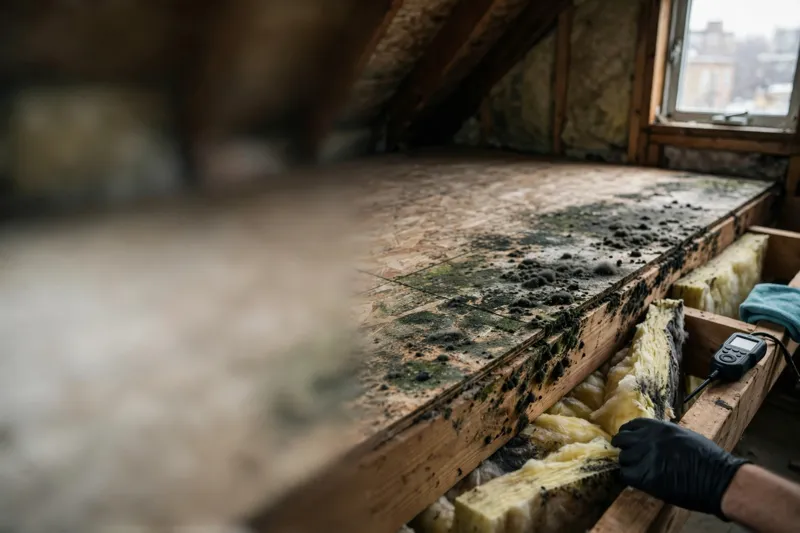
How to read a quote: the nine-line checklist
A quote that answers mold remediation cost chicago honestly is an itemized scope, not a single total. A quote that carries all nine is a quote you can compare; a quote that carries three is a quote that will grow.
A mold remediation cost estimate is only as good as its line items. Get an independent inspection first, in writing, from a company that will not do the remediation, the inspector defines the scope that every bidder bids against, and without it the bidders are pricing three different jobs. Then collect three itemized quotes and compare the line items, not the totals. A low total that excludes the rebuild or the moisture repair is not actually low; it is the quote that leaves the room unfinished and the water still coming in.
| Line | What it must show | What to watch for |
|---|---|---|
| 1. Scope by room and material | Every room, every material, removed or cleaned | A single line that says only mold remediation |
| 2. Containment type and days | Limited or full, and how many days | No containment line at all |
| 3. Removal and disposal by material | Drywall, insulation, carpet, tiles, out, bagged, sealed | Disposal left vague or unpriced |
| 4. Cleaning method | HEPA vacuum, scrubbing, what is cleaned and what is not | Fogging or ozone offered as the whole job |
| 5. Drying equipment and days | Air movers, dehumidifiers, and the days they run | No drying line, the job ends when the walls look dry |
| 6. Moisture-source repair | The repair, or its explicit exclusion in writing | Excluded silently, or not mentioned at all |
| 7. Rebuild included or excluded | Drywall, flooring, framing, paint, in or out | Excluded, with no rebuild price anywhere |
| 8. Clearance testing | Who performs it, what happens on failure | The remediator testing his own work |
| 9. Warranty terms | What is covered, for how long, in writing | A verbal promise with nothing on paper |
The ninth line deserves a note of its own. A warranty that covers the work but not the moisture source is a warranty that pays for the same job twice: the mold returns, the crew returns, and the second visit is a new bill. The warranty worth having covers the remediation and the source repair together, in writing, with the clearance test as the proof. Ask for it before you sign, not after the mold comes back.
Skip the miracle products. Fogging, ozone, and spray-and-leave treatments are offered as cheap alternatives to removal, and they are not remediation: they do not remove the growth, they do not fix the moisture source, and they do not dry the structure. Bleach is not the routine answer either, it does not kill mold inside porous materials, and it leaves the growth where it was. The job is containment, removal, cleaning, drying, and the source repair, in that order, and any quote that skips a step is not a quote.
The fogging question deserves a direct answer, because it is the question homeowners ask most. Fogging spreads a mist through the room and claims to kill the mold where it sits, and it does not remove the growth, it does not fix the moisture source, and it does not dry the structure. The mist reaches the surface and stops, while the growth inside the wall and behind the drywall stays where it was. Ozone is the same story with a different chemical: it treats the air, not the material, and it leaves the colony intact. The job is containment, removal, cleaning, drying, and the source repair, in that order, and any product that promises to skip a step is a product that skips the job.
The quote-shock that homeowners post about on the forums has the same shape every time: three quotes, all in the same general ballpark, for the same scope, containment in a bathroom and a bedroom closet, drywall out, a section of bathroom floor out, and air scrubbing, and the homeowner cannot tell which one is honest. The answer is the checklist above: the honest quote is the one whose nine lines match the inspector's scope, line by line. The other two are the ones that left a line out.
The change-order rule belongs in the quote as a tenth line, even though the checklist has nine. Once the wall is open, the crew finds the rot, the old wiring, or the framing that must be replaced, and the scope changes, and the rule should say, in writing, that no extra work starts without the homeowner's approval, and that every change is priced before it is done, not after. A quote with no change-order rule is a quote that grows without asking, and the growth is the part the homeowner discovers at the end, after the money is paid.
The warranty deserves a second look, because the warranty that covers the work but not the moisture source is a warranty that pays for the same job twice. Ask what the warranty covers, for how long, and what voids it, and get the answers in writing, with the clearance test as the proof. A warranty that requires the homeowner to maintain the humidity in the normal range is a fair warranty; a warranty that excludes the source repair is not a warranty at all. The contractor who will not put the warranty in writing is the contractor who does not intend to honor it.

Insurance: when it pays, and when it does not
Insurance changes mold remediation cost chicago only when the cause was sudden and accidental. The question does insurance cover mold remediation cost has a short answer: only when the mold followed a sudden, accidental, covered event, a burst pipe, an appliance leak, a water heater that gave way. The policy pays for the water damage and the mold that followed it, up to your limits, minus your deductible. Mold from a slow leak, from neglect, or from flooding outside is not covered, and the mold sublimits are small even when the mold is covered.
The sudden-and-accidental rule is the whole of it. A pipe that burst in a freeze is sudden; a pipe that dripped for a season is not. An appliance hose that gave way all at once is sudden; a dishwasher line that seeped for months is not. The adjuster asks when the water started, and the answer decides the claim, which is why the photographs and the readings from the first day matter more than the quote. Document everything before the demolition, report fast, and get the quote itemized so the adjuster can separate the covered water damage from the mold cleanup.
The sewer backup is the gap that catches Chicago homeowners most. A sewer backup needs its own endorsement, and that endorsement is the one most Chicago basements are missing. The standard homeowners policy excludes it, and the flood policy excludes it too, unless the flood caused the backup, and the most common Chicago basement cause, a storm overwhelming the combined sewer, is the one the standard policy leaves out. Illinois insurers have had to disclose backup coverage since the first of January 2025, under Public Act 103-0858, so the disclosure is in your policy documents, but the disclosure is not the coverage, and the endorsement must be bought before the storm, not after it.
The flood exclusion is absolute in the standard policy: flooding from outside, rising water, surface water, a river that left its banks, is not covered at all, and the mold that follows a flood is not covered either. The flood policy is a separate policy, and it covers the building and the contents under its own rules, with its own waiting period and its own limits. A homeowner who discovers the flood exclusion after the basement floods has discovered it too late, and the remediation bill is the homeowner's.
The mold sublimits are the line homeowners discover too late, and they deserve a paragraph of their own. Even when the mold is covered, because it followed a sudden, accidental, covered event, the policy caps the mold cleanup far below the main limits, and the cap is the number that decides how much of the job the insurer pays. The drying and the repair of the water damage are covered under the main limits, and the mold cleanup is covered under the sublimit, and the adjuster separates the two on the itemized quote.
Read the sublimits before the storm, not after the basement floods, and ask your agent what the number is and whether it can be raised. A homeowner who knows the sublimit before the loss is a homeowner who can plan for the gap.
The claim runs in order, and the order is the protection. Call the insurer the same day, photograph everything before anything moves, start the drying within the first day, and keep every receipt. Get the inspection in writing before the demolition, because the demolition destroys the evidence the adjuster needs. Get the quote itemized, so the adjuster can see the covered water damage and the mold cleanup as separate lines. And do not close the walls until the readings are steady, a wall closed over wet framing is a wall that grows mold again, and the second claim is harder than the first.
The adjuster's visit is the part homeowners fear most, and it is the part the file decides. The adjuster photographs the damage, reads the moisture report, and separates the covered water damage from the mold cleanup, and the separation matters, because the mold sublimits are small even when the mold is covered, and the water damage is covered under the main limits. The itemized quote is the document that makes the separation possible: the drying, the removal, the cleaning, and the rebuild, each on its own line, with the moisture-source repair named. A quote that shows one total gives the adjuster nothing to separate, and the claim is paid on the adjuster's reading, not yours.
Shopping for the endorsement is the work to do before the storm, not after it. The sewer backup endorsement is the one most Chicago basements are missing, and it must be bought before the storm, not after the basement floods, no insurer sells cover for a loss that already happened. Ask your agent whether the endorsement is on the policy, what it covers, and what its limit is, and ask the same question about the mold sublimits. The disclosure Illinois requires since the first of January 2025 tells you the endorsement exists; it does not buy it for you. The homeowner who asks before the storm is the homeowner whose basement is covered when the storm comes.
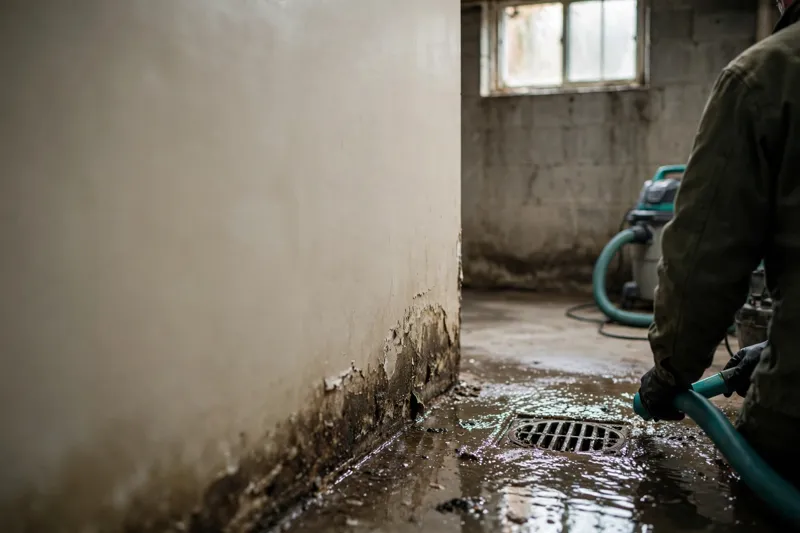
Can you do it yourself? The ten-square-foot line
The do-it-yourself line for mold remediation cost chicago starts at ten square feet. Under about ten square feet on a hard, non-porous surface, a homeowner can usually handle it: an N95 mask, gloves, goggles, a scrub brush, and a bucket, and the moisture source fixed first, or the mold returns. The surface must be hard and non-porous, tile, metal, glass, sealed concrete, and the growth must be on the surface, not inside the wall.
Removal and remediation are different jobs, and mold removal cost is only one line inside a remediation quote. Removal is taking the mold out; remediation is the full job, finding and fixing the moisture source, containing the area, removing what cannot be cleaned, cleaning and drying what stays, and proving the work with a clearance test. A homeowner who scrubs a patch and never fixes the leak has done removal, not remediation, and the patch will be back within the season.
Always call a professional when the mold is in the HVAC, when sewage or flood water was involved, when the mold is hidden inside a wall, or when anyone in the home has asthma or allergies. The HVAC spreads spores through the whole house, and a homeowner who opens a duct without containment spreads the problem to every room. Sewage water is the highest category, and a homeowner should never handle it without protective equipment and a plan. Hidden mold is the same story: the visible patch is the end of the growth, not the start, and the colony behind the drywall is larger than the patch in front of it.
The hidden-mold paragraph deserves a second look, because hidden mold is the job that grows. The visible patch is the end of the growth, not the start, and the colony behind the drywall is larger than the patch in front of it, and the only way to find it is the moisture map. The inspector maps the moisture with a pin meter, opens the wall where the readings say the growth is, and writes the scope by room and material.
A homeowner who opens a wall without a map opens the wrong wall, and a homeowner who scrubs the surface without opening the wall leaves the colony where it was. The map is the difference between a surface clean and a remediation job, and the map is the reason the inspection comes first.
Between ten and one hundred square feet is the limited-containment range where most professional residential jobs fall. The crew seals the room, runs negative air, removes the porous materials, cleans and dries what stays, and tests before the containment comes down. Tenants should not remediate alone: the landlord's job is the building, and the tenant's job is the written notice, the photographs, and the file. A tenant who remediates without telling the landlord can be blamed for the damage the landlord should have repaired.
The do-it-yourself question is also a cost question, and the answer is the same as the quote question: the cheapest job is the one that fixes the source. A homeowner who scrubs a patch for a weekend and never fixes the leak has spent a weekend, and the mold returns. A homeowner who fixes the leak, dries the structure, and scrubs the surface has done the job. The ten-square-foot line is the line between those two outcomes.
What a professional job includes that a do-it-yourself job does not is the containment, the negative air, the clearance test, and the documentation. The containment keeps the spores inside the work area while the walls are open. The negative air keeps them from drifting into the rest of the house. The clearance test proves the work, with numbers, from a company that did not do the remediation. And the documentation, the inspection report, the scope, the readings, the photographs, and the clearance report, is the file the insurer, the buyer, and the next owner all ask for. A homeowner who does the job alone has none of those four things, and the job that lacks them is the job that cannot be proven.
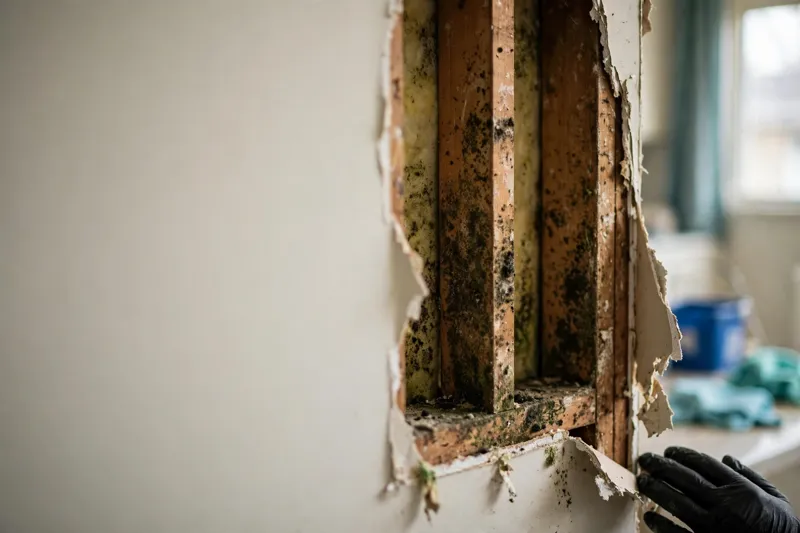
Black mold: clean it yourself, or call a professional?
Black mold follows the same ten-square-foot line as any other mold on this page. A small patch, under about ten square feet, on a hard, non-porous surface such as tile, metal, or glass is a patch a homeowner can usually clean: an N95 mask, gloves, and goggles, the surface scrubbed, and the moisture source fixed first. The color of the mold does not change the line. Black mold is not a different set of rules; it is the same mold, the same line, and the same test, how big is the patch, and what is it growing on.
Call a professional when the patch is larger than about ten square feet, when it is growing on drywall, wood, or insulation, when it is hidden inside a wall, when it is in the ductwork, when sewage or flood water was involved, or when anyone in the home has asthma or breathing trouble. A large patch means the colony behind the surface is larger than the patch in front of it, and a homeowner who scrubs the surface leaves the rest where it was. The professional job adds the containment, the negative air, and the clearance test, the parts that keep the spores inside the work area and prove the job is done.
Is mold remediation really necessary?
Yes, when the mold is growing and the moisture that feeds it is still there. Mold does not stop on its own. A wet surface keeps feeding the growth, the patch spreads through the wall cavity, and the spores travel upstairs through the air and the ductwork. A patch left alone becomes a larger job: more material comes out, more of the house is opened up, and the clearance test is harder to pass. The remediation is necessary because the water is still coming in, not because the patch looks bad.
There are two cases where waiting is the wrong call. The first is a home with anyone who has asthma, allergies, or breathing trouble, they feel the spores first, and the symptoms do not ease while the growth is still there. The second is a home about to be sold: the mold must be disclosed, the buyer will find it at inspection, and a job done after the sale is a job done under pressure. The one case where remediation can wait is a small surface patch with the source already fixed and the area dry, and even then, the patch should be cleaned and watched, not ignored.
Do I have mold in my attic? The signs to look for
The attic is the room Chicago homeowners check last, and it is the room where mold grows longest before anyone looks up. Start with the smell: a musty smell at the top of the stairs, or in the rooms below the attic, is the first sign. Then look at the roof decking and the rafters from the hatch, with a flashlight, dark staining, blotches, or a grey-black film on the wood means growth is already there. Wet or matted insulation is another sign, and so is frost on the underside of the roof deck in winter, or water stains around the vents.
The causes are the same ones this page names for attic jobs: a flat roof that ponds water, a leak that ran for a season, bathroom vents that blow warm, wet air into the attic instead of outside, and ventilation that cannot keep up, warm air from the house meets the cold roof deck and condenses, and the condensation feeds the growth through the winter. If you find any of these signs, do not walk the attic floor and do not disturb the insulation, get an inspection in writing, with moisture readings, before anyone opens anything up.
Chicago: the sewers, the stock, and the law
Chicago's combined sewers are the largest single variable in mold remediation cost chicago. One pipe carries the sewage and the storm water together, and an intense storm pushes sewage back through the floor drains, the TARP deep-tunnel system has cut the overflows from about one hundred days a year to about fifty since 2006, but an intense storm still pushes sewage through the floor drains, and the finished basement is the room that floods first. A finished basement after a sewer backup is the most expensive common job in the city, because the finishes come out and the Category 3 protocol applies, and the backwater valve is the permanent protection: a valve in the sewer line that lets water out and stops it coming back in.
The housing stock is the second multiplier. Bungalows and two-flats with balloon-frame cavities carry one leak the full height of the wall, from the basement to the attic, because the framing runs without the fire blocking that stops the travel in newer construction. Flat roofs pond water instead of shedding it, and a flat roof that ponds feeds the decking for years before anyone looks up. Older brick stock fails at the mortar and the flashing together, and the water enters behind the brick and travels inside the wall. The polar vortex bursts of January 2019 and February 2021 are the third multiplier: pipes burst in the wall cavities, the water ran for hours before anyone found it, and the hidden cavity mold followed.
The law is the third part of the Chicago story. Illinois now registers mold remediation work: the state registration under Part 835 is operational, effective the twenty-third of September 2026, with a grace period for existing workers to the thirtieth of September 2027, this site gives consumer guidance only, and the registration is the thing to check when you choose a company. One Chicago guide still says registration is pending, because its page was written before the rules took effect; the standing fact is that registration is operational.
The tenant's half of the law is the Chicago ordinance, the RLTO, chapter 5-12 of the Municipal Code. Mold that follows a leak the landlord knew about and failed to fix is a habitability violation, and the tenant's remedies run after written notice: the tenant may end the lease if the failure is not fixed within fourteen days, repair and deduct where the reasonable cost does not exceed the greater of five hundred dollars or one-half of one month's rent, withhold rent reflecting the reduced value of the unit, or seek damages and an injunction. The day-fifteen figure for withholding comes from the City's RLTO Summary, the summary the City requires attached to every lease, the ordinance text itself states no start day, and this page attributes the figure correctly.
The tenant's remedies deserve a second paragraph, because the written notice is the part tenants get wrong. The ordinance clock runs from the written notice, not from the first leak, and the notice must name the failure, say what needs fixing, and go in writing, email for the timestamp, certified mail for a serious loss. Keep a copy of everything you send, and a note of every call, with the date and the name of the person you spoke to. The tenant who reports the leak the day it appears, in writing, and keeps the file, is the tenant whose claim runs on the evidence. The tenant who only complains has a story, and a story is not a file.
Buying and selling is the fourth part. Illinois has no mold-specific disclosure statute, and the standard disclosure form asks about flooding and leakage, not mold, but concealing a known defect is fraud, and the Sgariglia case in the next section is the Chicago example. The city's own programs belong here too: the Private Sewer Drain Program repairs breaks under the public way at no cost, after the owner hires a licensed sewer contractor to rod and video-inspect the line, starting through CHI 311, and CHI 311 answers twenty-four hours a day, seven days a week, three hundred and sixty-five days a year.
Bridgeport and Pilsen sit on the sewer corridor, where the combined sewers back up first. Beverly, Portage Park, and Norwood Park are the bungalow belt, where balloon-frame cavities carry one leak the full height of the wall. Rogers Park and Edgewater are the lakefront, where the wind drives the rain against the brick and the flashing fails. The areas are not a ranking, and no area is safe: the moisture source is the building, not the neighborhood, and the building is what the inspector reads.
Winter is the fourth Chicago multiplier, and it arrives every year. The polar vortex bursts of January 2019 and February 2021 are the ones homeowners remember, but the ordinary freeze is the one that fills the remediation crews: a pipe in an exterior wall, a hose bib left open, a vacant unit with the heat turned down. The water runs for hours before anyone finds it, and the hidden cavity mold follows, the wall looks dry on the surface, and the framing behind it is wet. The prevention is unglamorous and it works: keep the heat on, open the cabinet doors under the sinks on the coldest nights, and shut off the outside water before the first freeze.
The backwater valve and the tunnel system deserve a paragraph of their own, because they are the two things the city has done that actually change the risk. The TARP deep-tunnel system has cut the overflows from about one hundred days a year to about fifty since 2006, and the number keeps falling as the tunnels fill, but an intense storm still pushes sewage through the floor drains, and the valve is the protection the homeowner controls. The Private Sewer Drain Program repairs breaks under the public way at no cost, after the owner hires a licensed sewer contractor to rod and video-inspect the line, starting through CHI 311, and the program is the reason to call the city first, before paying for a repair the city would have made.
The Chicago case: what a real remediation payment looks like in court
The Sgariglia case is the only court record in this guide that puts a number on mold remediation cost chicago, and it is not a market price. Melinda Sgariglia v. Nicholas and Kelsey Gonring, decided in the United States District Court for the Northern District of Illinois, case number 19 C 5684, memorandum opinion and order by Judge Robert W. Gettleman, 18 October 2024, is a condominium sale case, not a homeowner-remediation quote, and the remediation payment inside it is an association-paid cost inside a damages award, not a price for any job.
The facts, from the opinion itself: the condominium at 2726 West Cortez Street, Chicago, Illinois. The defendants sold Unit 1 to Sgariglia on 25 July 2018 and fraudulently concealed water-infiltration defects. Mold was discovered on 7 September 2018, about six weeks after the sale. A neighbor, Gorr, had warned on 22 February 2018 that water was in the structure and probably mold as well, and that the infiltration had gone on for five years.
The opinion lists the damages by category, and category A is mold remediation by Mold Solutions of Chicago, for which the Association paid the remediation amount. The plaintiff moved for summary judgment on her forty-four percent share of the costs incurred for mold remediation work, and the court awarded total damages of one hundred seventy-one thousand three hundred fifty-five dollars and seventy-nine cents.
The opinion itself carries two different figures for the remediation payment, and this page prints both, with the caveat, because silently picking one would be inventing a fact. Page six states that the Association paid thirteen thousand four hundred sixty-nine dollars for the mold remediation. Pages nine, twenty-two, and twenty-four compute the forty-four percent share as six thousand five dollars and fifty-six cents on a base of thirteen thousand six hundred forty-nine dollars, and the arithmetic checks: forty-four percent of thirteen thousand six hundred forty-nine dollars is six thousand five dollars and fifty-six cents, while forty-four percent of thirteen thousand four hundred sixty-nine dollars would be five thousand nine hundred twenty-six dollars and thirty-six cents. The opinion carries both numbers, and this page does not choose between them.
The limits, stated plainly. This is a condominium sale and fraudulent-concealment case, not a homeowner-remediation quote. The remediation payment is an association-paid cost inside a damages award, not a market price. It proves a real Chicago remediation payment happened and was documented in court; it does not set a price for any job. The lesson of the case is not the number, it is the concealment: the sellers hid the water infiltration, the buyer found the mold six weeks after the sale, and the court awarded damages that included the remediation payment. The disclosure form asks about flooding and leakage, not mold, but concealing a known defect is fraud, and the Sgariglia case is the Chicago proof.
The language models offered other names for this page, and none of them could be confirmed on any live source page, so none of them is printed here. The case above is the only verified named Chicago case on this page's angle, and it is printed with its limits. A page that prints an unconfirmed name as a case is inventing evidence, and this page does not do that.
What the case means for a buyer is the part worth carrying out of the courtroom. Six weeks passed between the sale and the discovery of the mold, and the warning came five months before the sale, the neighbor knew, the sellers knew, and the buyer did not. The buyer's protection is the inspection before the sale, the disclosure form read line by line, and the questions asked of the seller in writing: has the unit ever flooded, has it ever leaked, has it ever grown mold. The answers go in the file, and the file is the claim. A buyer who skips the inspection saves a day and risks the remediation, and the Sgariglia case is the price of that saving, written in a court opinion.
The timeline is the part of the case worth slowing down for. The neighbor warned in February, the sale closed in July, and the mold was found in September, five months of warning, six weeks of ownership, and a concealment that ran through both. The sellers knew the water was in the structure, and they sold the unit without telling the buyer. The court's award included the remediation payment because the payment was the consequence of the concealment, and the forty-four percent share was the plaintiff's portion of the costs the association had paid. The case is a sale case, and its lesson is a sale lesson: the inspection before the purchase, the disclosure form read line by line, and the questions asked in writing.

The remediation process, in seven steps
Seven steps decide mold remediation cost chicago more than any single line item: the scope, the containment, the removal, the cleaning, the drying, the source repair, and the clearance test. Every step is one the homeowner can check, with no tool but the scope, the readings, and the clearance report.
Independent inspection and moisture mapping
Hire an inspector who will not do the remediation, the inspector defines the scope that every bidder bids against. The inspector maps the moisture with a pin meter and a camera, opens the wall where the readings say the growth is, and writes the scope by room and material. The report is the document the quotes are compared against, and the clearance test is measured against it at the end. Never skip this step: a quote without an inspection is a guess, and a guess is how a small job becomes a large one.
Scope in writing
Get the scope in writing before any work starts: the rooms, the materials to be removed, the materials to be cleaned, the containment type, the equipment, the days, and the moisture-source repair, or its explicit exclusion. A written scope is the only thing that lets you compare three quotes line by line. A quote that says only mold remediation with a single total is not a scope, and it is the quote that grows.
Containment and negative air
The crew seals the work area with plastic sheeting, tapes every seam, and runs a HEPA-filtered air scrubber that pulls the air inside the containment to negative pressure, so spores flow inward, not out into the rest of the house. Limited containment suits a small patch; full containment suits a whole room or a whole floor. The containment stays up until the clearance test passes, never let a crew take it down early.
Removal of porous materials
Drywall, insulation, carpet and carpet pad, and ceiling tiles that grew mold come out, porous materials cannot be cleaned, and scrubbing them spreads the spores. The crew bags the material inside the containment, seals the bags, and carries them out without opening them in the house. What stays, framing, tile, metal, glass, is cleaned, not removed, and the framing is dried to the readings.
Cleaning and drying of what stays
Framing, subfloor, and masonry are HEPA-vacuumed, scrubbed, and dried with air movers and dehumidifiers until the pin-meter readings match the dry standard, the moisture reading of unaffected material of the same type in the same building. Bleach is not the answer on porous surfaces, and fogging or ozone alone is not remediation. The drying stops when the numbers are steady, not when the surface looks dry.
Moisture-source repair
Fix the water before the containment comes down, or the mold returns. A burst pipe is repaired, a roof leak is sealed, a grading problem is re-sloped, a ventilation failure is corrected, and a sewer backup gets a backwater valve, not another coat of paint. The source repair is often a separate trade and a separate line in the quote; a quote that excludes it is not a finished job.
Independent clearance testing before containment comes down
A different company, never the one that remediated, tests the air and the surfaces after the drying, and compares the readings with the inspection that started the job. If the test fails, the containment stays up and the crew goes back in. The clearance report is the document you keep with the sale file, the insurance file, and the disclosure, it is the proof the job is done.
The homeowner's checklist
- Independent inspection first, in writing, from a company that will not do the remediation
- Three itemized quotes, compared line by line, not by the totals
- Containment type and days shown in the quote, with negative air
- Moisture-source repair included or explicitly excluded, in writing
- Rebuild included or excluded, in writing, before you sign
- Clearance tester named by name, with what happens on a failed test
- No fogging, no ozone, no spray-and-leave offered as the whole job
- Readings checked every day against a dry room, drying stops when the numbers match and stay steady
- Walls stay open until the readings are steady, no paint, no new flooring, no closing up
- Every reading, receipt, estimate and message kept in one folder, with the clearance report
Call now, we answer 24/7
If you are still comparing quotes for mold remediation cost chicago, call (773) 570-9869. We will ask what you saw, tell you what to check tonight, and send a crew with a meter when the job needs one.
Frequently asked questions
How much does mold remediation cost in Chicago?
No honest page can give you a number, because the cost follows the size of the affected area, the severity, the location, and whether the moisture source is fixed first. This page explains every driver in order, so you can read a quote line by line and see whether the scope is complete before you sign it.
How much does mold remediation cost per square foot?
This site prints no rates, so no figure here can mislead you. Contractors price by the affected area, not by the stain you can see, and small jobs carry a high effective rate because containment and mobilization cost the same on a small job as on a large one. The affected area is larger than the visible patch.
What drives mold remediation cost up or down?
Size is the biggest driver, then severity, then location. A patch inside a wall costs more than the same patch on a surface, because the wall must come out. Containment, air filtration, testing, and the moisture-source repair each add a line. A finished basement after a sewer backup sits at the top of the range.
How much does black mold removal cost?
This site prints no prices, so no figure here can mislead you. Black mold jobs run higher than ordinary mold jobs, because the same drivers apply with stricter containment, more protective equipment, and more careful disposal. The color of the mold does not set the price, the size, the location, and the moisture source do.
How much does attic mold removal cost?
This site prints no prices, so no figure here can mislead you. Attic jobs depend on the roof deck, the ventilation, and whether the insulation must come out. A flat roof that ponds water pushes the job up, and a leak that ran for years costs more than a fresh one. The moisture source must be fixed first.
How much does basement mold removal cost?
This site prints no prices, so no figure here can mislead you. Basement jobs depend on whether the water came from a sewer backup, a foundation crack, or groundwater, and whether the basement is finished. A finished basement after a sewer backup is the most expensive job in Chicago, because the finishes come out and the Category 3 protocol applies.
Does homeowners insurance cover mold remediation?
Only when the mold followed a sudden, accidental, covered event, a burst pipe, an appliance leak, a water heater that gave way. The policy pays for the water damage and the mold that followed it, up to your limits, minus your deductible. Mold from a slow leak, neglect, or flooding from outside is not covered.
Can I remove mold myself?
Under about ten square feet on a hard, non-porous surface, usually yes, with an N95 mask, gloves, and goggles. Call a professional when the mold is in the HVAC, when sewage or flood water was involved, when the mold is hidden inside a wall, or when anyone in the home has asthma or allergies. Tenants should tell the landlord first.
How long does mold remediation take?
Most residential jobs take two to five days from containment to clearance, and larger jobs take longer. The drying decides the clock, not the calendar, the crew works until the moisture readings are steady, and the clearance test comes last. A job that skips the moisture-source repair is not finished, however fast it was.
Is mold remediation worth it?
Yes, when the moisture source is fixed as part of the job. Remediation that skips the source is money spent twice, because the mold returns. A finished job protects the structure and the air, and it gives you the clearance test that proves the work. A quote that excludes the source repair is not a finished job.
Can I write off mold remediation on my taxes?
Not for a primary residence, as a rule. The cost may be deductible for a rental property or a business, when the mold affected your health and a doctor documented it, or after a federally declared disaster. The rules change, and the amounts depend on your return, so confirm the position with a tax professional before you file.
How much does a mold inspection cost?
This site prints no prices, so no figure here can mislead you. An inspection is a separate job from remediation, and it should be done by a different company, the inspector defines the scope that every bidder bids against. Get the inspection first, in writing, with moisture readings and photographs, before you collect quotes.
What should a mold remediation quote include?
The scope by room and material, the containment type and the number of days, the removal and disposal by material, the cleaning method, the drying equipment and the days, the moisture-source repair or its explicit exclusion, the rebuild included or excluded, the clearance test with the name of the tester, and the warranty in writing.
How much does mold remediation cost in Illinois?
This site prints no prices, so no figure here can mislead you. Illinois costs follow the same drivers as Chicago, size, severity, location, and the moisture source, with Chicago at the top of the range because of the combined sewers, the finished basements, and the older brick stock. The thin Illinois results say the same thing.
Can I stay in my house during mold remediation?
Usually yes, when the work is limited to one room and the containment holds. The crew seals the work area, runs negative air, and keeps the rest of the house clear. Leave the house when the job covers the HVAC, when sewage was involved, or when anyone at home has asthma or a breathing condition. Ask the contractor first.
What is the difference between mold removal and mold remediation?
Removal is taking the mold out. Remediation is the full job: finding and fixing the moisture source, containing the area, removing what cannot be cleaned, cleaning and drying what stays, and proving the work with a clearance test. A quote that only removes the mold is not remediation, and the mold will return.
How much does mold remediation cost for a 1,000 sq ft house?
This site prints no prices, so no figure here can mislead you. A one thousand square foot house is not a one thousand square foot job, the job is the affected area. A small patch is a small job, and a whole-house job is a large one. The scope, not the square footage, sets the cost.
Will mold come back after remediation?
It will, if the moisture source was never fixed. Remediation removes the growth, but the water that fed it decides whether it returns. A finished job fixes the source, dries the structure to the readings, and passes a clearance test. Check the source repair in the quote before you sign, and keep the humidity in the normal range after.
How do I choose a mold remediation company in Chicago?
Start with an independent inspection, in writing, from a company that will not do the remediation. Then collect three itemized quotes and compare the line items, not the totals. Check the state registration, the S520 standard, and the clearance tester by name. A company that will not name its tester is not the company to hire.
How much does mold remediation cost after water damage?
This site prints no prices, so no figure here can mislead you. After water damage the job is two jobs: the drying, and the remediation of what the water fed. The cost follows the size of the wet area, how long it stayed wet, and whether the water was clean or sewage. Category 3 water is the most expensive.
Can black mold be fully remediated?
Yes, to safe, normal levels, but no job removes every spore, because spores are everywhere, indoors and out. Fully remediated means the moisture source is fixed, the growth is removed, the area is cleaned and dried to the readings, and the humidity stays in the normal range. A job that skips the source is not finished.
Can you sell a house with mold?
Yes, but the mold must be disclosed. Illinois has no mold-specific disclosure statute, and the standard disclosure form asks about flooding and leakage, not mold, but concealing a known defect is fraud, as the Sgariglia case on this page shows. Remediate first, keep the clearance test, and disclose the history with the paperwork.
How fast does mold spread?
Mold can start growing within a day or two on a wet surface, and it spreads through a wall cavity faster than the surface stain suggests. The visible patch is the end of the growth, not the start, the colony behind the drywall is larger. Drying fast is the difference between a surface clean and a remediation job.
Does insurance cover basement mold?
Only when the mold followed a sudden, accidental, covered event, a burst pipe or an appliance leak. Mold from a slow leak, a foundation crack, or groundwater is not covered, and flooding from outside is excluded from every standard policy. A sewer backup needs its own endorsement, and that endorsement is the one most Chicago basements are missing.
Can I live with basement mold?
You can, but you should not. Basement mold means the moisture source is still active, and the spores travel upstairs through the air and the ductwork. People with asthma, allergies, or breathing conditions feel it first. Find the water, fix the source, and remediate, a basement that stays damp will keep growing mold however often you clean it.
Can I sue if I bought a house with mold?
Yes, when the seller concealed a known defect. The Sgariglia case on this page is the Chicago example: the sellers hid water infiltration, the buyer found mold six weeks after the sale, and the court awarded damages that included the remediation payment. Keep the inspection report, the disclosure form, and the seller's messages, the claim runs on the file.
What is mold remediation?
Mold remediation is the full job of removing mold growth and fixing the moisture that fed it. The crew contains the area, removes what cannot be cleaned, cleans and dries what stays, repairs the moisture source, and proves the work with an independent clearance test. Removal alone is not remediation, without the source repair, the mold returns.
How much should mold remediation cost?
This site prints no prices, so no figure here can mislead you. The honest answer is a range set by the drivers: the size of the affected area, the severity, the location, the containment, and the moisture-source repair. Get three itemized quotes against one independent inspection, compare the line items, and distrust any total that hides the scope.
Sources
The sources below are the pages this guide read for mold remediation cost chicago.
- LookMold, "Mold Remediation Cost 2026: Averages, Per Sq Ft, by Room" (published 4 September 2026, updated 5 September 2026), the deepest cost-driver guide, with the nine-item quote checklist this page models.
- Floodline Restoration Co. "Mold Remediation in Chicago, IL", the local sales page, with five questions and a four-step call process.
- Justia, Sgariglia v. Gonring, No. 19 C 5684 (18 October 2024), Memorandum Opinion and Order by Judge Robert W. Gettleman, the verified Chicago court case on this page, read in full on the Justia opinion text.
- PushLeads, "How Much Does Mold Remediation Cost? (Real 2026 Pricing)" (YouTube, 12:41), the transcript pulled in full for this page, with the national ranges by size and room.
- LookMold, "Mold Remediation Costs EXPLAINED, Are You Being Overcharged?" (YouTube, one hundred seventeen thousand views), the video that answers the overcharge question the same way this page does: read the scope.
- EPA, "A Brief Guide to Mold, Moisture and Your Home", the ten-square-foot do-it-yourself line and the limited-containment range this page follows.
- Illinois Department of Public Health (IDPH), mold pages, the state registration fact this page follows.
- City of Chicago, CHI311, the 311 line, twenty-four hours a day, seven days a week, three hundred and sixty-five days a year, and the start of the Private Sewer Drain Program.
- People Also Ask questions quoted in this page, with the search record given in the text.
More Restoration Services in Chicago
Every service below is one tap away. Pick the one that matches your problem.

Water Damage Restoration
Fast water extraction, structural drying, and full repair after burst pipes, leaks, and floods.
Learn more →
Water Mitigation
Emergency water removal, structural drying, and mold prevention to stop the damage fast, 24/7.
Learn more →
Mold Remediation
Safe, contained mold remediation that removes contamination and fixes the moisture source.
Learn more →
Sewage Cleanup
Safe removal and disinfection of dangerous sewage backups and black water.
Learn more →
Flood Cleanup
Water pumped out, structure dried, and debris cleared fast after storms and flooding.
Learn more →
Hardwood Floors Water Damage
Cupped, buckled or stained hardwood after a leak? How we dry it, when sanding saves it, and when the boards have to go.
Learn more →