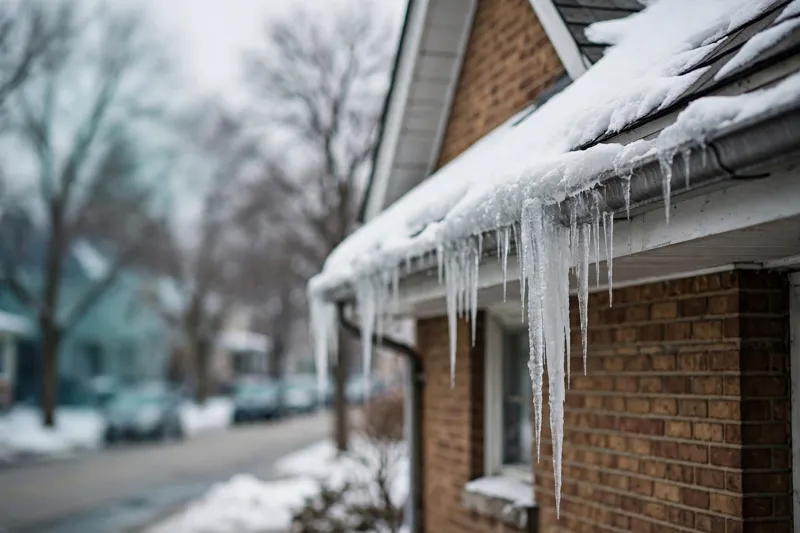
Chicago, IL · A winter guide
Ice Dam Water Damage in Chicago
An ice dam is a ridge of ice at the roof edge, and the damage it does happens inside the house, not on the roof. Meltwater backs up under the shingles, soaks the attic insulation, stains the ceilings, and runs down inside the walls, and by the time the stain shows, the water has been there for days. This guide is the restoration side of the story: what the leak does inside, what to do in the first hour, how the drying works, and how to stop the next dam.
- How a dam forms, and why Chicago gets so many of them
- The signs outside, in the attic, and on the ceiling, and which ones mean act today
- What the water does inside: insulation, ceilings, walls, and the mold clock
- The first hour, the drying, the insurance file, and the prevention that actually works
Written for Chicago homeowners, the bungalows, the two-flats, and the brick homes.
- We answer 24/7
- Local Chicago team
- Insurance documentation help
- Straight answers, no pressure
Have a question? Call us any time
Send the form and we will call you back. Fast response, no obligation.
The short answer: the roof edge freezes
Ice dam water damage is what happens when meltwater backs up behind a ridge of ice at the roof edge and gets under the shingles, then soaks the attic insulation, the ceilings, and the walls. It starts with heat escaping into the attic, which melts the snow on the upper roof; the meltwater runs down to the cold eaves, refreezes into a ridge, and the ridge traps the next melt. The trapped water has nowhere to go but up and under, and that is when the inside of the house starts getting wet.
The gap is the Chicago restoration material, and this page fills it.
One question came up more than any other in those searches: “Are roofers responsible for ice damming?” It appeared ten times across the fourteen searches, and the answer is in the questions section below: a roofer owns the roof, and a restoration crew owns the inside drying, two trades, two halves of the same job. The insurance question came next, four times: “Will homeowners insurance pay for ice dam damage?” The short answer to that one is yes, usually, for the sudden interior damage, and the long answer is the insurance section below.
| What you notice | What it usually means | How urgent |
|---|---|---|
| A thick ridge of ice at the eaves | A dam is holding back meltwater | Watch it daily in a thaw |
| Large icicles in one section | Water is freezing at the edge, not draining | Check the attic the same day |
| Uneven snow melt on the roof | Warm air is escaping into the attic | Fix the air leaks this season |
| A brown stain near an outside wall | Water backed up under the shingles | Check today |
| Damp insulation or frost in the attic | Water or moist air is in the roof space | Check today |
| A ceiling that sags or bows | Water sitting above the ceiling | Leave the room, call now |
| A musty smell after a thaw | Mold growing somewhere out of sight | Find the source this week |
The table is the whole page in one place. The sections that follow explain each row: what the mark means, where to check it in a Chicago house, and how fast to act.
What causes ice dams
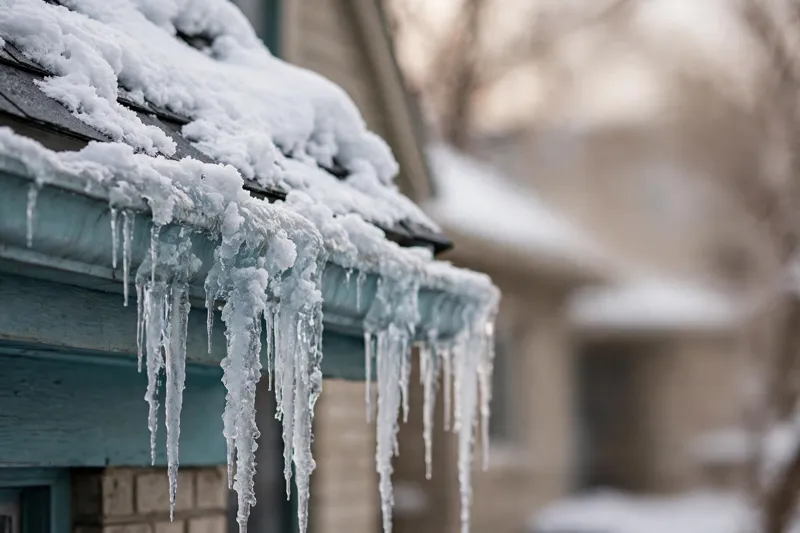
An ice dam needs three things: snow on the roof, freezing air outside, and heat escaping from the house that melts the snow from underneath. The warm air comes from the living space below, through the attic floor, around the hatch, the recessed lights, the plumbing and wiring, the chimney chase, and the ductwork. The snow on the upper roof melts, the meltwater runs down to the eaves, and the eaves are cold because they hang past the warm wall. The water refreezes there, into a ridge, and the ridge grows with every melt.
Chicago gets more of this than most American cities. National weather counts for the thirty years to 2020 put Chicago at about twenty-seven ice-dam setup days per winter, with the typical window running from Christmas Day to the fifth of February and the peak in January. The city crosses the freezing point forty to sixty times in a winter, and each crossing is a melt and a refreeze, the dam grows in the thaw and the leak shows in the next one. A dam can form with as little as two inches of snow on the roof, when the attic is warm enough, and it does not need a blizzard. That is why ice dam water damage in Chicago peaks in January, when the freeze-thaw window is at its widest.
The fix that matters most is the one the roofers agree on: air sealing has to come first. Seal the attic floor, and the warm air stops reaching the roof; fix the insulation gaps at the eaves without blocking the soffit vents, and the roof deck stays closer to the outdoor temperature.
What they do agree on is the order: air seal first, insulation second, ventilation third, and the ice-and-water shield at the eaves when the roof is replaced, extending twenty-four inches past the warm wall.
Two things do not cause a dam, and the confusion costs homeowners a season. Clean gutters alone do not cure a dam, a clean gutter still freezes when the attic is warm, and a cold snap alone does not cause one either, because a dam needs meltwater, and meltwater needs heat from below. The dam is a heat problem with an ice symptom, and the roof is where the symptom shows, not where the problem lives.
Signs of ice dam damage
The signs split into three groups: outside on the roof, inside the attic, and inside the living space. The outside signs come first, the attic signs come second, and the ceiling stain comes last, and a dam can be present before any water is visible inside at all.
Outside, on the roof
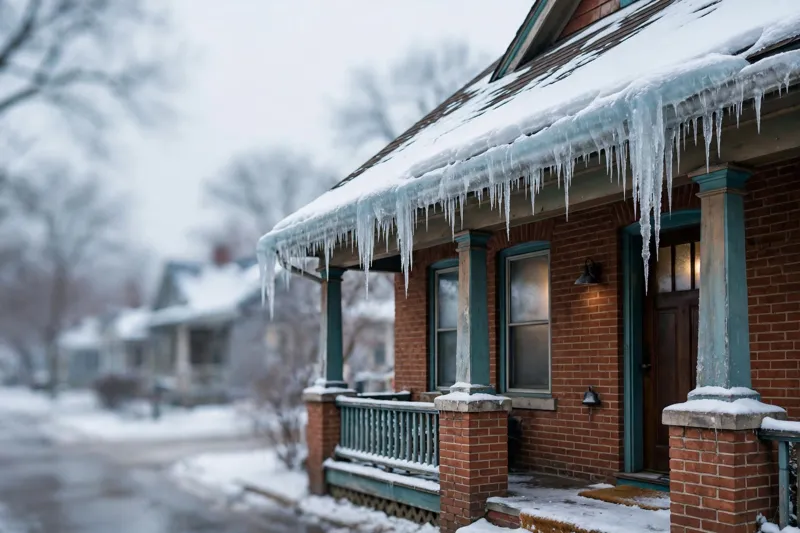
A thick ridge of ice along the eaves or the gutters, holding back meltwater, is the first mark. Large icicles concentrated in one section, not spread evenly along the whole roof, are the second, and uneven snow melting is the third: bare or thin patches higher on the roof while the snow stays at the edge means the upper roof is warm and the edge is cold. Sagging gutters pulled away from the fascia, ice at the soffits, and water or ice on the siding or the exterior walls during a thaw are the later marks, and a dam that re-forms in the same section every winter means the attic heat loss in that section has never been fixed.
Large icicles alone do not prove a dam. Damaged flashing, worn shingles, a plumbing leak, and condensation can all look similar from the ground, and a house can grow long icicles without a dam behind them. The ridge is the mark that matters, not the icicles.
In the attic
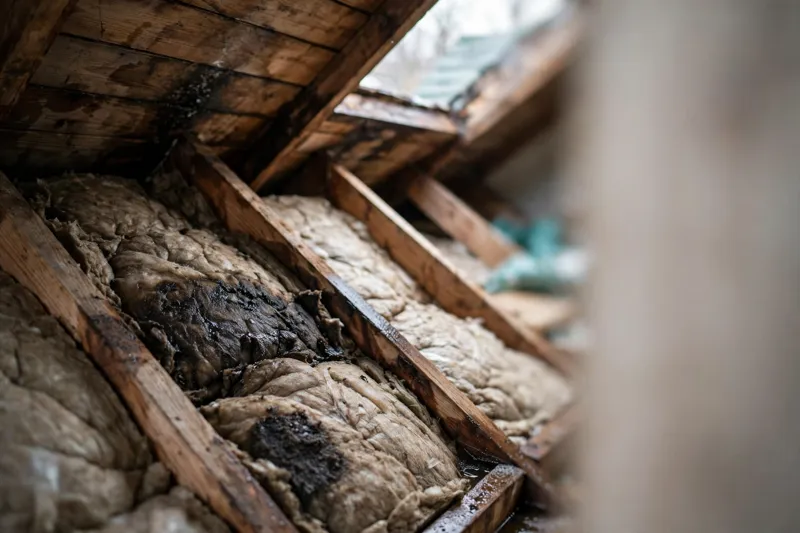
Damp attic insulation is the attic mark, and it matters because wet insulation loses its value, it stops insulating once it is wet, which lets more heat through, which feeds the dam. Frost or water droplets on the underside of the roof deck, damp roof sheathing, rusty nails, and a musty smell in the attic are the other marks.
Inside, on the ceilings and walls
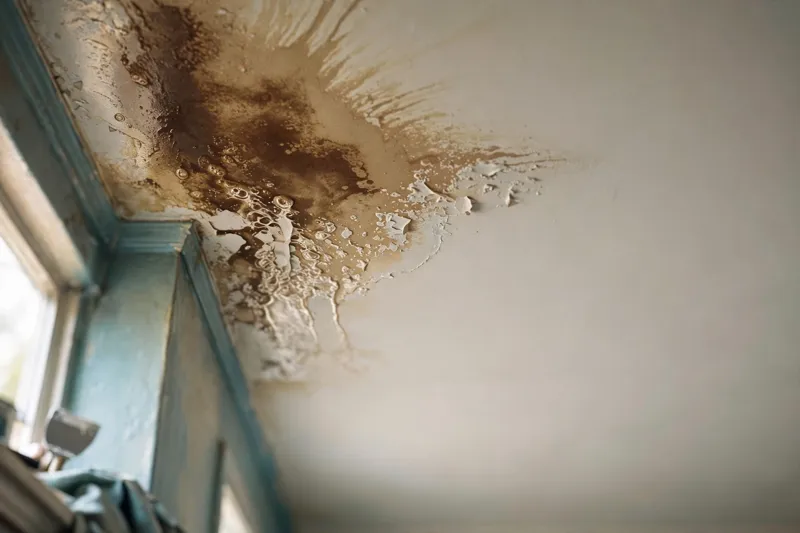
A brown ceiling stain near an exterior wall is the inside mark, and it usually appears after a thaw, not during the freeze. Bubbling or peeling paint near the outside wall, damp drywall, a musty smell before any visible mark, and active dripping near an exterior wall are the later marks. The stain is not necessarily directly below where the water got in, the water travels along the framing and can show up a considerable distance from the entry point, so a stain in the middle of a room points at the wall, not at the ceiling above it.
The question to ask about every mark is the same one a restoration guide from New York puts first: is this a cosmetic mark or an active leak. A stain that stays the same size is the one to watch; a stain that grows, a ceiling that drips, or a wall that feels soft is the one to act on today.
What ice dam water damage does inside the house
Backed-up water travels under the shingles and can run a considerable distance along the framing before it appears, so a ceiling stain is not necessarily directly below the entry point. The water soaks the attic insulation first, then the ceiling drywall, then the wall cavities, and it can reach the flooring below before anyone sees a mark. The damage is a sequence, not a single event, and the sequence runs in the same order in almost every house.
The insulation goes first. Wet insulation loses its value, which lets more heat through the roof, which feeds the dam that caused the leak, the damage makes the cause worse, and the next thaw makes the damage worse again. The ceiling goes second: a brown stain, then bubbling paint, then a sagging board, and a ceiling that sags is holding water and means leave the room. The walls go third: damp drywall, soft spots, trim that pulls away from the wall, and paint that peels near the outside wall. The floor goes last, and by the time a wood floor cups or buckles, the subfloor is usually wet too.
The mold clock runs through all of it. Mold can start within one to two days on a wet surface, and the environmental guidance the restoration field cites is to dry water-damaged materials within twenty-four to forty-eight hours where possible. A ceiling that drips for one afternoon is a drying job; a ceiling that drips on and off for two weeks of freeze and thaw is a much bigger one, because the water has had two weeks to soak the framing. The drying that would have taken days takes weeks once the mold has grown and the structure has soaked.
There are two jobs in every ice-dam leak, and the order matters: fixing the roof, and drying the house. The roof job stops the new water, the dam comes off, the shingles and the flashing get fixed, the underlayment gets checked. The house job dries what is already wet, the insulation, the ceilings, the walls, the framing, and it comes first, because a roof fixed over a wet house leaves the water inside to grow mold. The national restoration guides draw the same line: call a roofer for the roof, and call a restoration crew for the inside, and do the drying before the rebuild.
The wiring is the quiet hazard in the sequence. Water in a light fixture, a wet outlet, or a switch that crackles means the power in that room is wet, and the room is not safe to work in until the circuit is off. Do not touch a wet fixture or a wet switch, and do not reach for the panel through standing water. The electricity comes first in the first-hour section below, and it comes before the buckets.
The attic takes the first hit
Searches for ice dam damage in attic chicago return the same Chicago pages again and again, the Chicago roofing guide, the Chicago restoration blog, and the Chicago service page, and every one of them starts in the attic, because the attic is where the water lands first. The leak may be several feet higher on the roof than it appears on the attic ceiling, so the stain on the attic floor is not the entry point, and the entry point is up the slope from it.
What to look for in the attic: damp or compressed insulation, especially at the eaves, where the water pools first; frost or water droplets on the underside of the roof deck, which means moist air is reaching the cold deck; damp roof sheathing, which darkens as it soaks; rusty nails, which are the slow mark of moisture that has been there for seasons; and a musty smell, which means mold is already growing somewhere out of sight. A Chicago restoration blog watched for this page lists the same marks: water on the attic ceilings, the beams, and the joists, seepage onto the attic floor and the insulation, and signs that may take several days to show after the thaw.
The attic is also where the cause lives, and the cause is the heat. Blocked soffit vents, insulation that stops short of the eaves, a hatch that leaks warm air, and recessed lights that vent into the roof space are the four attic faults the Chicago roofer guides name, and they are the same four in every house. A finished attic makes the problem worse, because the living space sits against the roof deck and the warm air has nowhere else to go.
The roof leak: where the water shows up
An ice dam roof leak chicago search returns the Chicago roofing guide first, and its line is the one every other page repeats: most January attic leaks trace back to ice dams. The leak shows at the joint where the exterior wall meets the ceiling, or above a window, and almost never in the middle of a room, the water runs down the framing and comes out at the joint, which is why the stain sits at the wall and not under the ridge.
The leak is also slow to show. The signs may take several days to appear after the thaw, because the water has to soak through the underlayment, the decking, the insulation, and the drywall before it marks the ceiling. A stain that appears in February may be the January thaw, and a stain that grows in March may be the February thaw, the lag is the reason homeowners miss the first leak and catch the second one, when the ceiling is already soft.
Two things tell a dam leak from other roof leaks. The first is the season: a leak that appears in a thaw and stops in a freeze is a dam leak, and a leak that appears in a rainstorm is a flashing or a shingle leak. The second is the place: a dam leak sits near the outside wall, and a flashing leak sits near a chimney, a valley, or a vent. The distinction decides who comes first, a roofer for the dam, and a restoration crew for the inside, and the drying starts before either of them finishes.
The first hour after an ice dam leak
The first hour after ice dam water damage starts is the hour that decides the claim and the drying. The order is safety first, then the water, then the photographs, then the calls, and the order matters, because a safe house with a paper trail is a different home from a wet house with no record.
Make it safe first
Keep people and pets away from a sagging or bulging ceiling, a water-loaded ceiling can fail, and do not puncture it yourself. Treat electricity as a hazard: do not touch wet fixtures, outlets, or switches, shut off the affected circuit only from a dry location, never enter standing water to reach a panel, and leave the house if there is a gas smell. A ceiling that drips on a light fixture is the one mark that means the power comes off before the buckets come out.
Catch the water, protect what is below
Catch the drips with buckets, tubs, or pots and towels or plastic sheeting on the floor, and move furniture, electronics, rugs, and valuables away from the leak. A box fan aimed at the deck in the attic can help in an emergency, and a bucket-and-hose diversion in the attic can keep the water off the ceiling, but both are stopgaps, and the drying crew still needs to come.
Photograph everything, then call
Photograph the leak, the stains, the walls, the flooring, the attic, and the roof edge before anything moves, note when the leak started, and list the damaged belongings. Contact the insurer the same day and get a claim number, and call an emergency roofer and a restoration crew for the attic inspection, the moisture readings, the safe steam removal, and the drying, not just a cosmetic repair. Keep every receipt, because the file you build in the first hour decides the claim.
What not to do
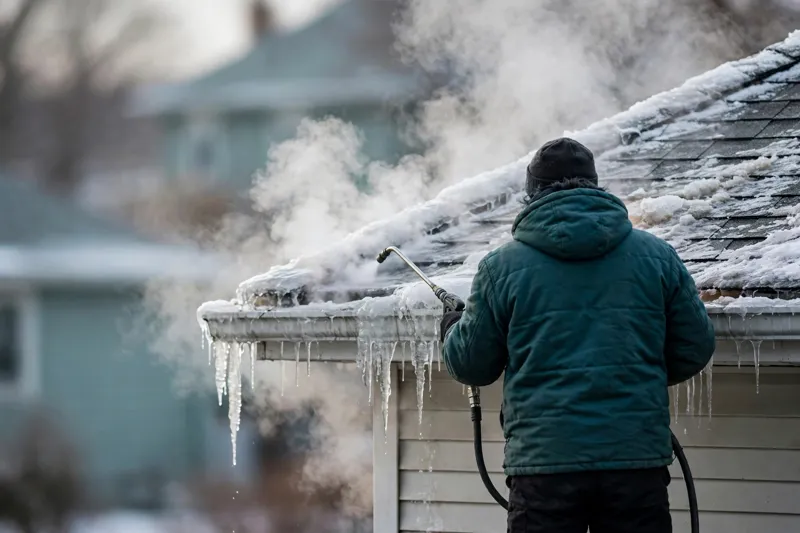
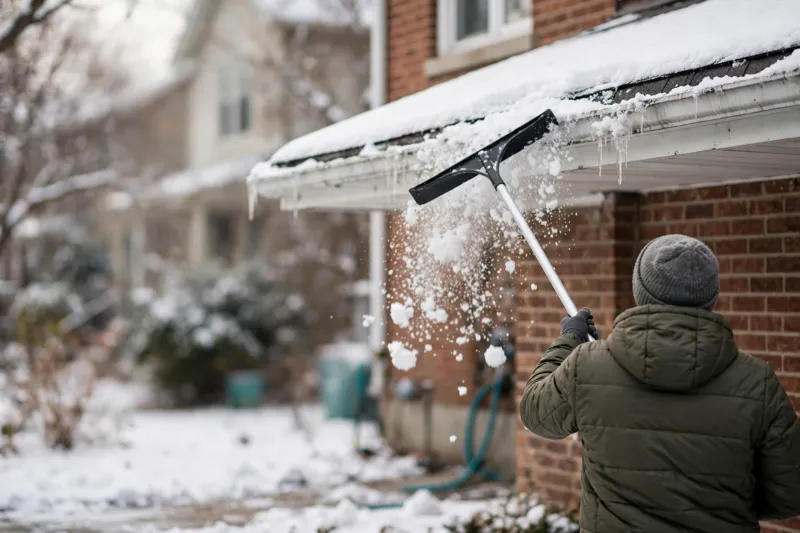
Do not climb onto an icy roof, and do not hammer, chisel, or pressure-wash the dam, or use a torch or an open flame on it. Do not use harsh de-icing salts on the shingles or the gutters, and do not pull at the gutters. A roof rake from the ground only may help with loose snow, and a calcium-chloride stocking across the dam is the one do-it-yourself move the roofer guides allow. Everything else is a crew's job, and the crew that steams the dam off is not the crew that dries the house, the two jobs are separate, and the drying comes first.
Drying comes before rebuilding
Drying comes before rebuilding after ice dam water damage. The ceiling gets repainted only after it is fully dry, the wall gets rebuilt only after the framing reads dry, and the roof edge gets fixed only after the house is dry, the order is the job, and a rebuild over wet framing is a rebuild that grows mold.
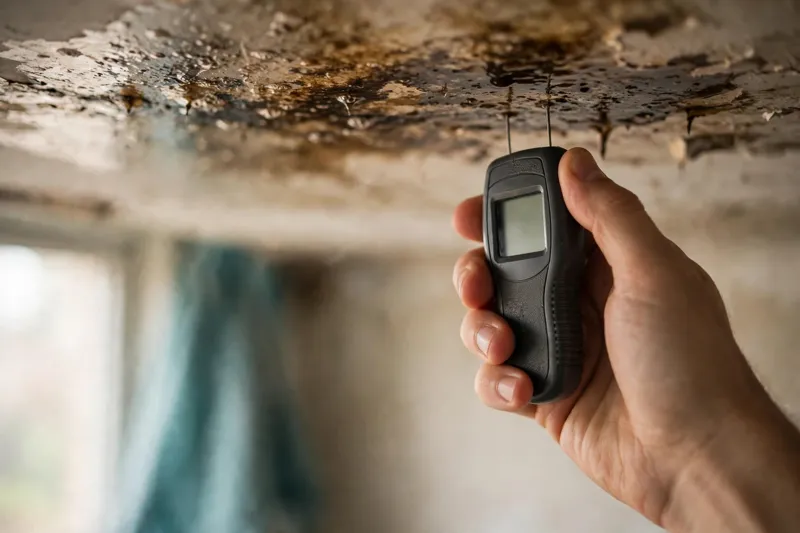
The drying starts with a moisture map. A crew maps the wet area with a pin meter and a thermal camera: a grid of readings across the ceiling, the walls, and the attic insulation, marked on a sketch of the room, so the wet area has edges and the dry area has proof. The map decides what comes out and what stays, and it goes into the claim file with the photographs.
A pin meter gives a number, a thermal camera shows a cold patch where the water sits, and the two together say how far the water went, behind the drywall, under the floor, into the framing. A reading in the safe range means the room recovered; a wet reading after days of drying means the water is still working through the house.
Wet insulation gets pulled back or removed, because it does not dry in place and it does not insulate while it is wet. Air movers and dehumidifiers run until the readings say the materials are dry, not until the surface feels dry, and a wall that feels dry on the surface can still be wet inside, which is why most do-it-yourself dry-outs fail weeks later, when the smell comes back. The drying takes three to five days on most losses, and the job with repairs usually takes one to three weeks, and the reading, not the calendar, decides when the drying is done.
Ask for the readings, and keep them. The claim runs on the file you build in the first day, and a house with a dry attic and a paper trail is a different home from a house with paint over a wet ceiling. A crew that will not show you the readings is a crew that is guessing, and the map is what turns the guess into a number.
How to fix ice dam damage
Fixing ice dam water damage has three layers, and they run in order: stop the water, dry the house, and prevent the next dam. The first layer is the roof, the dam comes off with low-pressure steam, the shingles and the flashing get checked, and the underlayment gets looked at where the water backed up. The second layer is the inside, the moisture map, the drying, the insulation that comes out, and the ceilings and walls that get rebuilt only after the readings are dry. The third layer is the prevention, the air sealing, the insulation, and the ventilation that keep the next dam from forming.
What steam does not do is dry the inside, the removal stops the new water, and the drying is a separate job with separate equipment. A Chicago restoration blog that ranks on these searches gives eight steps when water leaks in, and the order is the same: diagnose in the attic first, call the insurer, call a restoration company, and keep checking the ceiling, because a leak may be several feet higher on the roof than it appears inside.
The stocking is the one do-it-yourself move both sides allow. Everything else is a crew's job.
Getting the dam off the roof
Searches for ice dam removal chicago return the steam crews first: low-pressure steam, same-day or next-day assessment, and no prices shown on the page, because the figure depends on how much ice there is, how high the roof is, and how hard it is to reach.
Who to call depends on which half of the job you need. A roofer or a steam-removal crew owns the roof half: the dam itself, the removal, and the shingles, flashing, and underlayment underneath it. A restoration crew owns the inside half: the moisture map, the drying, the wet insulation, and the ceilings and walls. Searches for ice dam damage repair chicago return the same Chicago restoration pages, and the repair they describe is always the two jobs: the roof and the inside. Both trades work on the same house, and the drying starts before the rebuild, so the two calls happen in the same hour, the roofer for the roof, and the restoration crew for the inside.
What the removal does not fix is the reason the dam formed. A dam removed in January comes back in February if the attic is still warm, and the removal crews say so themselves: the removal stops the leak, and the air sealing stops the dam. The prevention section below is the part of the fix that lasts, and it is the part most homeowners skip, because the leak is gone and the roof looks fine.
Ice dam water damage insurance: what the policy pays for
The policy pays for the drying and the repair, the stained ceiling, the wet insulation, the ruined drywall, less your deductible and up to your limits, under the dwelling coverage of a standard homeowners policy. It does not pay for the dam removal, which insurers class as maintenance, and it does not pay for a leak that ran for months, or for flooding from outside, or for a sewer backup without its own endorsement.
The cause is what the claim turns on. A sudden leak after a dam forms is the covered case; a slow leak that ran for months is classed as wear and tear, and the claim may fail. The contents coverage is weaker than the dwelling coverage, and a claim for the pipe or the appliance that failed is a different claim from the water damage it caused.
The file you build decides the claim. Photograph the roof edge and the inside damage before anything moves, keep the moisture readings with the photos, get a claim number the same day, and keep every receipt, the removal receipt included, because the adjuster may ask what was done and when. Three or more claims in a short span can mean a higher premium or a non-renewal, so the file matters twice: once for the payment, and once for the record.
One program that does not exist is the one homeowners keep asking about: the city's own site carries no fifty-percent basement flooding subsidy, and twenty consecutive checks of the city's pages found no such program. Do not plan a repair around money that is not there. Two programs that do exist are often confused with each other, and neither of them pays for the drying: the Flood Assistance Repair Program helps owner-occupants of single-family or two-unit homes on the West Side only, for basement damage from the 2023 or 2024 floods, with registration from the end of November to the middle of December 2026; and the Disaster Relief Assistance Program pays rent, mortgage, or utilities, not repairs, for households affected between January 2025 and January 2027, under three federal disaster declarations.
How to prevent ice dams
Prevention has a ranked order, and the ranking is the same across the roofer guides: air sealing first, insulation second, ventilation third, and the shield at the eaves when the roof is replaced. The order matters, because insulation over a leaky attic floor is insulation over a warm roof, and a warm roof is a dam.
Air seal the attic floor first
Seal around the hatch, the recessed lights, the plumbing and wiring, the chimney chase, and the ductwork, so warm air stops escaping into the roof. Air sealing has to come first, because it is the heat that melts the snow, and the insulation only slows the heat, it does not stop it. A blower-door test finds the leaks a hand cannot, and the sealing is the cheapest prevention in this section.
Fix the insulation gaps, especially at the eaves
Correct the insulation gaps, especially at the eaves, without blocking the soffit vents, the vents are the air path, and insulation stuffed into them stops the ventilation and rots the deck. What they agree on is the place: the eaves first, then the rest of the attic floor.
Keep the ventilation balanced
Maintain balanced soffit-to-ridge ventilation where the roof design permits, so the roof deck stays close to the outdoor temperature. The vent ratio the guides cite runs from one to one-fifty to one to three-hundred, and the ratio is a guide, not a rule, the test is the deck temperature, and a deck that stays cold is a deck that does not melt snow from underneath.
The shield at the eaves, and the rake
Consider an ice-and-water membrane at the vulnerable eaves and valleys when the roof is replaced, extending twenty-four inches past the warm wall, it is backup protection, not a substitute for air sealing and insulation, and it does not stop a dam, it only keeps the backed-up water out of the house. Heat cables are the backup, not the fix, they melt a channel through the dam, and they do not fix the attic heat that made it.
Clean the gutters, and what not to do
Clean the gutters and the downspouts before the snowfall, because a clogged gutter holds the meltwater at the edge, but clean gutters alone do not cure a dam, and a house with clean gutters and a warm attic still grows one. What not to do is the shorter list, and it is the one that saves the roof: do not use rock salt on the shingles or the gutters, do not chip or hammer at the ice, do not climb onto an icy roof, do not bang at the gutters, do not use a pressure washer, and do not use an open flame or boiling water. Searches for ice dam prevention chicago return the same Chicago roofer guides, and every one of them ends on the same line: the prevention is the attic, not the roof edge.
The Chicago version: bungalows, parapets, and greystones
Searches for ice dams chicago return the same Chicago pages again and again, the Chicago roofer guide, the Chicago restoration blog, and the Chicago service page, and every one of them starts with the same fact: Chicago's repeated freeze-thaw swings, heavy snow, and older housing stock make this a recurring risk, not a rare one. The house tells you where the dam will form, if you know how the house was built.
Bungalows and Cape Cods
The bungalow and the Cape Cod are the houses the dam comes back to: shallow attics, blocked soffits, finished attics that sit against the roof deck, and insulation that stops short of the eaves. The warm air from the living space reaches the roof deck fast, the snow melts up top, and the eaves stay cold because they hang past the warm wall. A Chicago roofer guide names the same stock, bungalows, Cape Cods, and finished attics in Villa Park, Elmhurst, and Chicago, and the fix is the same in all of them: air seal the attic floor, fix the insulation at the eaves, and keep the soffit vents clear.
Flat-roof parapets
A flat roof does not grow a dam on a slope, it grows one behind the parapet wall, where the meltwater ponds and refreezes, and the water finds the seams in the roofing and comes through the ceiling below. A published neighbourhood example from Logan Square describes a twenty-four-year-old roof, twelve inches of snow followed by a warm-up with pouring rain, a dam behind the rear parapet wall, and meltwater through separated seams that came through the second-floor kitchen ceiling and into the first-floor tenant's bedroom below. The example names no homeowner and no street address, and it is printed here as a neighbourhood example only, not as a verified case.
Greystone top floors and older neighbourhoods
A greystone top floor gets its ceiling stains near the outside wall, where meltwater backs up under the roofing and finds its way inside, and the stain grows after a thaw, not after a rainstorm. The older homes in Wicker Park, Rogers Park, and Bronzeville lack modern insulation, and the complex rooflines in Lincoln Park and Bucktown give the meltwater more places to pond. The pattern is the same in all of them: the older the house, the thinner the insulation, and the more the dam comes back to the same section every winter.
The window for all of this is short and it is now. The national weather counts put Chicago's ice-dam window from Christmas Day to the fifth of February, with the peak in January, and the polar-vortex cold that follows the thaw is the same season as the frozen pipes in the two blogs linked at the end of this page. The dam and the frozen pipe are the same winter, and the house that suffers ice dam water damage is usually the house with the frozen pipes as well.
How to respond to an ice dam leak in your Chicago home
Seven steps, in order. The first one that proves a leak decides the job, and the file you build in the first hour decides the claim.
Spot the leak and stay clear
Look for the drip first: a stain near an outside wall, water on a light fixture, or a ceiling that sags. Keep everyone out from under a sagging ceiling, and do not poke it to see what comes out, a ceiling full of water can come down in one piece. The leak, not the ice, is what decides the speed.
Catch the water and protect what is below
Put buckets, tubs, or pots under the drip and towels or plastic sheeting on the floor, and move furniture, electronics, rugs, and valuables out of the way. A leak that drips for one afternoon is a drying job; a leak that drips on and off for two weeks of freeze and thaw is a much bigger one, so start catching it now.
Photograph everything before it moves
Photograph the leak, the stains, the walls, the flooring, the attic, and the roof edge before anything moves, and write down when the leak started. Keep the photos with the moisture readings and the dates. The claim runs on the file you build in the first hour, and a house with a paper trail is a different home from one with paint over a wet wall.
Call the insurer the same day
Call your insurer the same day, get a claim number, and ask what the policy needs from you. Tell them the cause was sudden, an ice dam that formed and leaked, and send the photos you took. Keep every receipt from this point on, because the file you build in the first day decides the claim.
Get the dam steamed off the roof
Call a roofer or a steam-removal crew and ask whether they use low-pressure steam, which melts the ice without lifting the shingles. Do not climb the roof yourself, and do not chip, hammer, torch, or pressure-wash the dam. Steam stops the new water; it does not dry the inside, and that is the next step.
Map the moisture before anything dries
A crew maps the wet area with a pin meter and a thermal camera: a grid of readings across the ceiling, the walls, and the attic insulation, marked on a sketch of the room. The map says how far the water went, behind the drywall, under the floor, into the framing, and it decides what comes out and what stays.
Dry first, rebuild second
Dry the wet materials to the readings with air movers and dehumidifiers, and pull back or remove insulation that stays wet. Repaint the ceiling only after it is fully dry, and fix the roof edge once the house is dry. Drying first and rebuilding second is the order that stops the mold clock.
The ice dam checklist
- Roof edge checked for a thick ridge of ice and large icicles in one section
- Attic checked for damp insulation, frost on the deck, and a musty smell
- Ceilings checked for stains near outside walls and any sagging, a sagging ceiling means leave the room
- Walls checked for bubbling paint, soft spots, and damp drywall
- First hour run in order, safety, buckets, photographs, then the calls
- Insurer called the same day, claim number written down, receipts kept
- Dam steamed off the roof by a crew, never chipped, hammered, or torched
- Moisture map taken with a pin meter and a thermal camera, readings kept
- Drying run to the readings, not to the calendar, repaint only after fully dry
- Attic air sealed first, insulation gaps fixed at the eaves, vents kept clear
- Gutters cleaned before the snow, lower roof raked from the ground after a storm
- First hour handed off to the frozen-pipe guides and the who-to-call guide
Run through the whole list twice a year, and run it again after any big thaw, most ice-dam leaks show up first as a small stain, and the checklist is what turns a small stain into a caught leak.
Call now, we answer 24/7
If you found ice dam water damage in your home, call (773) 570-9869. We will ask what you saw, tell you what to check tonight, and send a crew with a meter when the leak needs one.
Frequently asked questions
What is ice dam water damage?
Water that backs up behind a ridge of ice at the roof edge and gets under the shingles, then soaks the attic insulation, the ceilings, and the walls. It starts with heat escaping into the attic, which melts roof snow that refreezes at the cold eaves. The ridge traps new meltwater, and the trapped water finds its way inside.
Does homeowners insurance cover water damage restoration, or only part of it?
It covers only part of it. The policy pays for the drying and the repair when the cause was sudden and accidental, up to your limits, minus your deductible. It does not pay for the pipe or the appliance that failed, or for flooding from outside. A sewer backup needs its own endorsement.
How long does water damage restoration take?
Drying takes three to five days on most losses, and the job with repairs usually takes one to three weeks. The reading, not the calendar, decides when the drying is done.
What is water damage restoration called?
The full job, stopping the water, drying the structure, cleaning, and rebuilding, is called water damage restoration. The emergency half, stopping the water and drying, is also called mitigation. Removing mold growth is a separate job, called remediation, and it follows the drying, never the other way around.
Does insurance cover water damage restoration?
Yes, when the damage was sudden and accidental, a burst pipe, a failed water heater, an appliance hose that gave way. The claim runs in order: call the insurer, photograph everything, start the drying, and keep the receipts. The adjuster works from the readings and the photos, so the file you build in the first day decides the claim.
What is the water damage restoration process?
The process runs in order: inspection first, to find the source and how far the water spread; then extraction, with pumps and vacuums; then drying, with air movers and dehumidifiers; then cleaning and sanitising; then the repairs. Dry the floors, walls and framing fast to stop mold, and document everything.
Does homeowners insurance cover water damage?
It covers water damage when the cause was sudden and accidental, a burst pipe, a failed appliance, a supply line that gave way. It does not cover a slow leak that ran for months, groundwater seepage, flooding from outside, or wear and tear. Read the declarations page before the storm, not after it.
What should I do when my house floods?
Stop the water and make it safe first. Shut off the main valve, cut the power to any room with standing water, and do not walk through water that may be sewage. Call 311 to report a flooded basement, photograph everything before anything moves, and start the drying within the first day.
How much does homeowners insurance pay for water damage?
No page can give you a number, because the payment depends on your policy, your deductible, the cause, and the limits you bought. The insurer pays the drying and the repair, less your deductible, and it does not pay for the pipe that failed.
Are renters responsible for water damage?
Renters are liable only for damage they caused or failed to report, negligence, misuse, or a leak they never told the landlord about. The building itself, the walls, floors, and pipes, is the landlord's, and so is the plumbing that serves the unit. Renters insurance covers the renter's belongings when the cause was sudden and accidental.
How much does a plumber charge for a burst pipe?
This site prints no prices, so no figure here can mislead you. The charge depends on where the pipe sits, how hard it is to reach, whether the wall or the floor must come out, and whether the call is an emergency at night. The water damage the burst caused is usually the bigger part of the bill.
Does insurance cover burst pipes?
Yes, when the pipe burst suddenly, a freeze split, a joint that failed without warning, a line that gave way all at once. The insurer pays for the water damage the burst caused, not for the pipe itself. A slow leak that ran for months may be classed as wear and tear, and the claim may fail.
How much does it cost to fix a burst pipe?
This site prints no prices, so no figure here can mislead you. The cost depends on the pipe's location, the access, the material, and the water damage the burst caused, the drying and the rebuild are usually the bigger part. A camera or a moisture reading comes first, then a written scope.
How much does mold remediation cost?
This site prints no prices, so no figure here can mislead you. The cost depends on how much mold there is, where it sits, whether the wall must come out, and whether the moisture source is fixed first. Illinois now registers mold remediation work, with a grace period for existing workers, this site gives consumer guidance only.
Can mold be fully remediated?
Mold can be remediated to safe, normal levels, but no job removes every spore, spores are everywhere, indoors and out. Fully remediated means the moisture source is fixed, the growth is removed, the area is cleaned and dried to the readings, and the humidity stays in the normal range. A job that skips the source is not finished.
How do ice dams cause water damage?
Heat escaping into the attic melts the snow on the upper roof, and the meltwater runs down to the cold eaves, where it refreezes into a ridge. The ridge holds back the next melt, and the trapped water backs up under the shingles, through the underlayment, and into the attic. It soaks insulation, stains ceilings, and runs down the walls.
How do I prevent ice dams on my roof?
Air-seal the attic floor first, so warm air stops escaping into the roof, then fix the insulation gaps at the eaves without blocking the soffit vents. Keep the ventilation balanced, clean the gutters before the snow, and rake the roof from the ground after a storm. A roofer adds an ice-and-water shield at the eaves when the roof is replaced.
What should I do if an ice dam is leaking into my house?
Keep people away from any sagging ceiling, catch the drips with buckets, and move furniture and electronics out of the way. Photograph the leak, the stains, and the roof edge, then call your insurer the same day. Call a roofer for the roof and a restoration crew for the inside drying, the drying comes first.
Does homeowners insurance cover ice dam damage?
Usually, when the damage was sudden, the leak that stains the ceiling and soaks the insulation after a dam forms. The policy pays for drying and the repair, less your deductible. It does not pay for removing the dam, or for a leak that ran for months. Keep the photos and the readings, because the file decides the claim.
How do I know if I have an ice dam?
Look for a thick ridge of ice along the eaves, with large icicles in one section and snow melting unevenly above it. Check the attic for damp insulation, frost on the deck underside, and a musty smell. A ceiling stain near an outside wall after a thaw is the inside mark, large icicles alone do not prove a dam.
Are roofers responsible for ice damming?
Partly. A roofer owns the roof: the dam, the removal, and the shingles, flashing, and underlayment underneath it. The inside drying, wet insulation, ceilings, walls, and the mold clock, is a restoration crew's job, not the roofer's. Both trades work on the same house, on different halves of the same job, and the drying starts before the rebuild.
Will homeowners insurance pay for ice dam damage?
Usually, for the sudden interior damage, the stained ceiling, the wet insulation, less your deductible and up to your limits. It does not pay for removing the dam, which insurers class as maintenance, or for a leak that ran for months. Several claims in a short span can mean a higher premium or a non-renewal.
How can I get an ice dam removed in Chicago?
Call a roofer or a steam-removal crew, not a handyman with a hammer, the safe removal is low-pressure steam, which melts the ice without lifting the shingles. Ask whether they steam, how soon they can come, and whether they document the damage for the claim. Do not climb the roof yourself, and do not chip at the ice.
How much does it cost to have someone remove ice dams?
This site prints no prices, so no figure here can mislead you. What they agree on is the direction: steam costs more than a rake, and the cheapest removal is the one that does not damage the roof.
Can I remove an ice dam myself?
You can rake loose snow off the lower roof from the ground, and you can lay a calcium-chloride stocking across the dam. Do not climb onto an icy roof, and do not chip, hammer, torch, or pressure-wash the ice. Steam removal is a crew's job, and so is any leak already inside.
Is an ice dam an emergency?
It is, when water is already coming inside, a leak that drips, a ceiling that sags, or a light fixture with water in it. A dam with no leak is urgent but not an emergency: clear the snow you can reach and book the removal before the next thaw. The leak, not the ice, is what decides the speed.
Do ice dams damage your roof?
Yes, trapped water backs up under the shingles, loosens the flashing, and soaks the decking, and the ice weight pulls at the gutters. Left for a season, a dam can rot the deck and force a partial rebuild of the roof edge. The roof is the second job: the inside drying comes first.
Will insurance pay for ice dam removal?
Almost never. Insurers class removal as maintenance, and the policy pays for the sudden interior damage the dam caused, not for taking the dam off the roof. Photograph the roof edge and the inside damage before anything moves, and keep the removal receipt with the claim file anyway. The adjuster may ask what was done and when.
Sources
- Aegis Construction Group, “How to Prevent Ice Dams: Chicago Roofer's Guide” (published 2 January 2025, updated 19 October 2026), the roofer guide with seven marked-up questions, six ranked prevention methods, and the twenty-four-inch ice barrier rule.
- Aspen Exterior Company, “How to Prevent Ice Dams in Chicagoland” (updated 6 November 2026), the prevention-led Chicago guide.
- ReadiDry, New York restoration guide to a leaking ice dam, the drying-within-one-to-two-days guidance and the two-jobs line: fixing the roof, and drying the house.
- Ice Dam Guys with NBC 5 Chicago, “Ice Dams & Indoor Water Damage in Chicago in 2022” (YouTube, 1:56, 2 February 2022), the video watched in full for this page, with the Fernandez family and the steam removal by Jake Kahnke.
- Ice Dam Guys, “Removing Ice Dams in Chicago” (YouTube, 1:46), the video watched in full for this page, with a Lombard homeowner and the steam removal.
- City of Chicago, CHI311, the 311 line, twenty-four hours a day, seven days a week, three hundred and sixty-five days a year, and the (312) 744-5000 number in the site footer.
- Illinois Department of Public Health, mold questions and answers, the professional line above ten square feet, and the Part 835 registration with its grace period to the end of September 2027.
- City of Chicago, Flood Assistance Repair Program, the West Side only program for basement damage from the 2023 or 2024 floods, with registration from the end of November to the middle of December 2026.
- City of Chicago, Disaster Relief Assistance Program, the rent, mortgage, and utilities program for households affected between January 2025 and January 2027, under three federal disaster declarations.
More Restoration Services in Chicago
Every service below is one tap away. Pick the one that matches your problem.

Water Damage Restoration
Fast water extraction, structural drying, and full repair after burst pipes, leaks, and floods.
Learn more →
Water Mitigation
Emergency water removal, structural drying, and mold prevention to stop the damage fast, 24/7.
Learn more →
Mold Remediation
Safe, contained mold remediation that removes contamination and fixes the moisture source.
Learn more →
Sewage Cleanup
Safe removal and disinfection of dangerous sewage backups and black water.
Learn more →
Flood Cleanup
Water pumped out, structure dried, and debris cleared fast after storms and flooding.
Learn more →
Hardwood Floors Water Damage
Cupped, buckled or stained hardwood after a leak? How we dry it, when sanding saves it, and when the boards have to go.
Learn more →