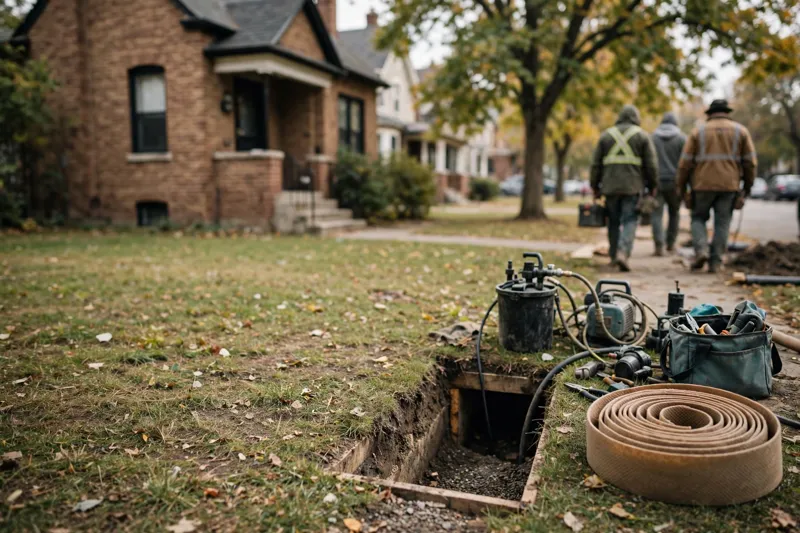
How Much Does Trenchless Sewer Repair Cost in Chicago
Every homeowner with a cracked sewer lateral asks the same question: what will the repair take, and what will it cost to do right? This guide gives the honest answer, what each method does, when each one is right, and what Chicago's clay laterals actually need. No figures, because no figure fits every house.
- The drivers that move the job, length, depth, method, and what sits above the line
- CIPP lining and pipe bursting, side by side, and when each one fits
- The Chicago permit and the licensed drainlayer, the city rules, in plain words
- What no verified Chicago case could prove, and what real homeowners actually asked
Written for Chicago homeowners, the bungalows, the two-flats, and the brick homes.
- We answer 24/7
- Local Chicago team
- Insurance documentation help
- Straight answers, no pressure
Have a question? Call us any time
Tell us what happened. A crew calls back fast, inspects the damage, and gives you a written estimate, line by line, before any work starts. This site restores water damage and cleans up sewer backups; it does not sell sewer repair, and the inspection says plainly which side of the line your problem sits on.
The short answer: drivers, not a price list
Searches for trenchless sewer repair cost chicago spike the morning after a camera inspection shows a cracked lateral. The question behind them is how much does trenchless sewer repair cost, and the honest answer is that no single figure fits every lateral. The ranges conflict because the job is not one job: a forty-foot clay lateral under a front lawn and a seventy-foot line under a driveway and a parkway are different jobs with different drivers, and a page that prints one figure for both has misled one of them.
The short answer to how much does trenchless sewer repair cost is that the job is priced by its drivers, not by a list. Seven drivers move the job: the length of the line, how deep it runs, which method fits, what condition the pipe is in, how the crew gets to it, the permit, and what the yard looks like afterwards. This page takes the drivers one at a time, because a homeowner who understands the drivers can read any quote and see what it covers, and a homeowner who only knows a range cannot tell a good quote from a bad one.
One fact about this site belongs up front, before the comparison begins. This site does not sell sewer repair. The live site has no trenchless page at all, a site-restricted search returns only service and location pages, and this page educates toward a service the site does not offer, because the question is asked by the same homeowners the site serves, and the wrong answer costs them a yard twice. The restoration half of this page links to our own pages, and the sewer-repair half tells the homeowner how to judge it.
| Trenchless repair | Traditional digging | |
|---|---|---|
| How it works | One or two small access pits; the pipe is lined or burst through from inside | An open trench is dug the full length of the line |
| Ground disturbed | Two pits, the rest of the yard stays | The whole line, including driveway, patio, and landscaping above it |
| Cannot do | Cannot correct a bad grade or a belly; cannot line a collapsed pipe | Can do both, at the cost of the digging |
| Restoration after | Two pits to fill and replant | The full trench to fill, repave, and replant |
The table also shows why the two methods cost differently: the trenchless job pays for the lining or the bursting equipment and the small pits, and the digging job pays for the excavation and the restoration of everything above the line. The comparison is the whole job, not the pipe alone, and the next sections take the two trenchless methods one at a time.
What trenchless actually is: lining and bursting
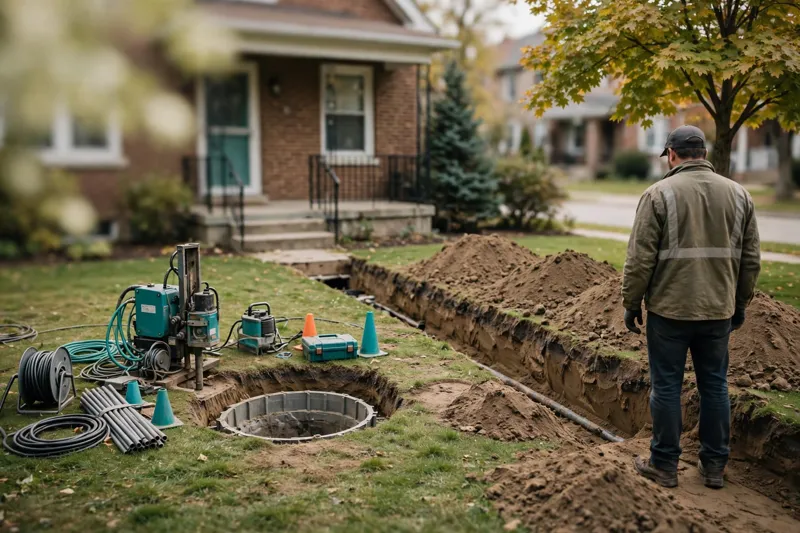
Trenchless sewer repair is a family of methods, not one method, and the family has two members that matter in Chicago. The wider phrase trenchless sewer line replacement cost covers both of them, and the two methods solve different problems. Lining, CIPP, cured-in-place pipe, puts a resin sleeve inside the old pipe and cures it hard, so the old pipe becomes a mold for a new pipe inside it. Bursting, pipe bursting, pulls a new pipe through the old one while a bursting head breaks the old pipe apart around it. Lining keeps the old pipe as a shell. Bursting replaces it.
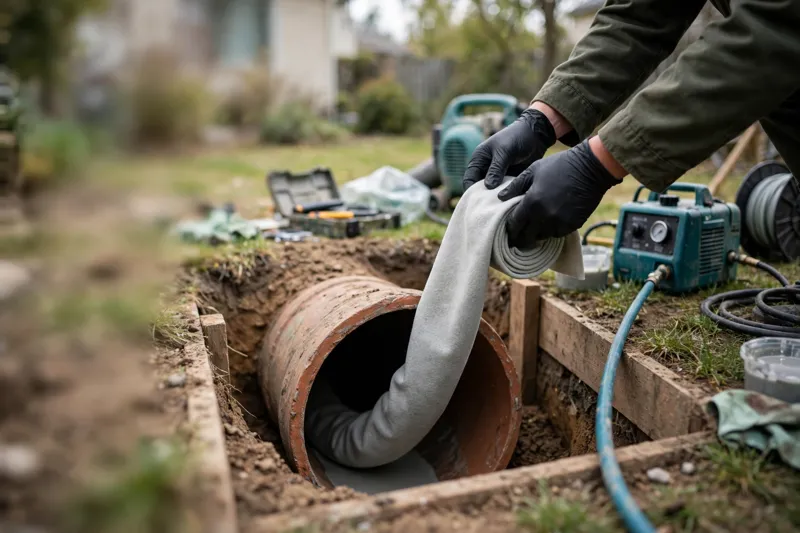
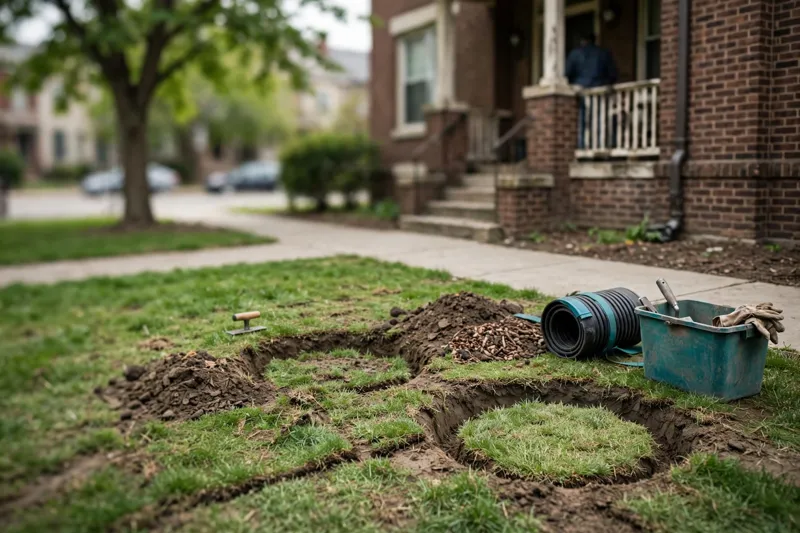
Searches for cipp lining cost chicago come from homeowners who have been told the line can be relined, and the lining half of the job has its own shape. The crew digs one or two small pits, cleans the line, pushes the resin sleeve in, and cures it with hot water, steam, or ultraviolet light. The liner seals the cracks and the joints, and it stops the roots at the joints.
What it cannot do is the limit that matters most: it cannot correct a bad grade, it cannot fix a belly, the low spot where water sits, and it cannot line a pipe that has collapsed, because the liner needs the old pipe as a mold. A liner in a bellied pipe is a smooth pipe with the belly still in it.
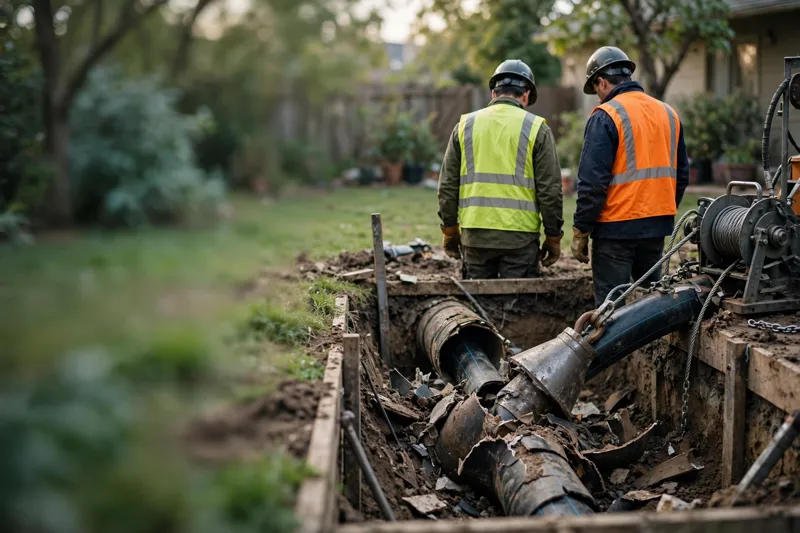
Searches for pipe bursting cost chicago come from homeowners whose line is too far gone to line, and the bursting half has a different shape. The crew digs a pit at each end, pulls the new pipe through while the bursting head breaks the old pipe apart, and the new pipe takes the old pipe's place at the same grade. Bursting can handle a partly crushed pipe, because the new pipe pushes through the old one. It can also upsize the pipe, replace a narrow line with a wider one, which lining cannot do. It needs room for the pits at both ends, and it needs a line whose grade is still right.
That is why how much does trenchless sewer repair cost has no single answer that fits every Chicago lateral. The method follows the condition of the pipe, and the condition is what the camera shows. A line with cracked joints and sound grade is a lining job. A line that is crushed, collapsed in part, or too narrow is a bursting job. A line with a bad belly or a reroute is a digging job.
The Chicago version: clay laterals, roots, and the parkway
Searches for clay sewer pipe replacement chicago come from owners of the oldest houses in the city, and the Chicago parts of this job start with the housing stock. The laterals under the bungalows, the two-flats, and the greystones are mostly clay tile, short sections joined together, laid decades ago, and the joints are where the trouble starts. Clay tile lasts a long time when the joints hold, and the joints are the first thing to fail.
Searches for tree roots sewer line chicago come from homeowners whose drains slow every spring, and the roots are the second Chicago fact. The parkway trees, silver maples, willows, elms, the trees the city planted along the street, send their roots forty to sixty feet to find water, by one suburban guide's account, and the clay joints are the easiest water to find. The roots get in at the joints, grow into a mat, and catch everything the line carries.
It does not repair the joints, and the roots come back.
The third Chicago fact is the soil. The ground under much of the city is Drummer clay, a heavy soil that holds water and moves with the seasons, by one suburban guide's account, and a clay soil that moves is hard on a clay pipe with joints. The fourth Chicago fact is the freeze. A Chicago cost guide puts the frost line at forty-two inches, and a lateral laid above the frost line freezes in January. The fifth Chicago fact is the combined sewer system.
In a heavy rain the sewers carry rainwater and sewage together, and when the system is overwhelmed the water comes back into basements, which is why a Chicago sewer problem so often becomes a basement problem, and why this page links to the sewage backup guide.
The lateral runs from the house to the street, and the cleanout is the door into it. The cleanout is usually a capped pipe near the front of the house, in the basement, or in the front yard, and it is where the rodding cable goes in and where the camera goes in. A homeowner who knows where the cleanout is saves the crew the first half hour of the job, and a homeowner who does not know where it is pays for the crew to find it.
The lateral meets the street main at the connection, and the connection is another joint, and another place for roots to get in. The line from the house to the street is short, usually thirty to eighty feet, and the whole of it is the homeowner's responsibility, from the cleanout to the connection.
The phrase sewer lateral replacement chicago is the permit language for the whole job, and the lateral is the line that matters: the pipe that runs from the house to the street, under the front yard and the parkway. The city owns the main in the street. The homeowner owns the lateral. That line is the one the camera inspects, the one the permit covers, and the one the quote prices. A homeowner who knows where the lateral runs, and where the parkway tree sits over it, knows where the next problem will start.

The seven drivers: what moves the job
Every driver below moves how much does trenchless sewer repair cost for a real Chicago lateral, and a quote that names none of them has not told you what you are paying for. The phrase sewer line replacement cost chicago covers both the trenchless methods and the open trench, and the drivers are the same on both sides, the method changes which driver matters most.
Length. The line is priced by the foot, and a Chicago lateral is usually thirty to eighty feet long, by one cost guide's account. A forty-foot line and a seventy-foot line are different jobs. The camera gives the length, and the written scope should state it.
Depth. A line five to six feet down is a different job from a line three feet down, and the depth decides the size of the pits and the time on site. Depth is the driver homeowners never see, it is underground, and it is the driver that moves the job most after length.
Method. Lining, bursting, and digging are different jobs with different equipment. Bursting usually costs more than lining for the same line, because the new pipe and the pulling equipment cost more, and the pits are bigger. Digging costs more in restoration than either trenchless method, because the whole trench has to be put back.
Condition. A line with cracked joints is a lining job. A line that is crushed in part is a bursting job. A line with a bad belly, a collapse, or a reroute is a digging job. The camera decides the method, and a quote written before the camera has run is selling the method, not the repair.
Access. A line under open lawn is easy to reach. A line under a driveway, a patio, a garage, or a mature tree is not. Access decides where the pits go, and the pits decide how much of the yard is disturbed. A line under a new driveway is a different job from the same line under grass.
Permits. The Chicago sewer permit and the public-way approvals are part of the job, and the permit is issued only to a licensed drainlayer. The next section takes the permit in full, because it is the driver homeowners ask about least and misunderstand most.
Restoration. The yard, the driveway, the sidewalk, and the parkway all have to be put back, and the standard they are put back to is part of the quote. Trenchless work disturbs less ground than digging, but the pits still need filling and the grass still needs replacing. Restoration is part of the job, not an extra.
When trenchless cannot work
The question, is trenchless sewer repair worth it, is the one homeowners ask after the first quote arrives, and the answer depends on what sits above the line and what the camera found below it. Trenchless is worth it where it avoids destroying a driveway, a patio, or a mature tree, and where the line is a good candidate. It is not worth it where the line is not a candidate, and the honest page names the cases where it is not.
A bad grade is the first case. Trenchless cannot correct a slope that runs the wrong way, and it cannot fix a belly, the low spot where water sits and solids settle. A liner in a bellied pipe is a smooth pipe with the belly still in it, and the belly will fill again. A collapsed pipe is the second case: lining cannot fix it, because the liner needs the old pipe as a mold, and bursting can only handle a partial crush. A fully caved-in or separated pipe needs digging.
A reroute is the third case: a line that has to move, around a new structure, away from a tree, to a different connection, cannot be rerouted without digging. The camera inspection is what decides which case yours is, and the written scope should name the case before any work starts.
The permit and the licence: the city rules, in plain words
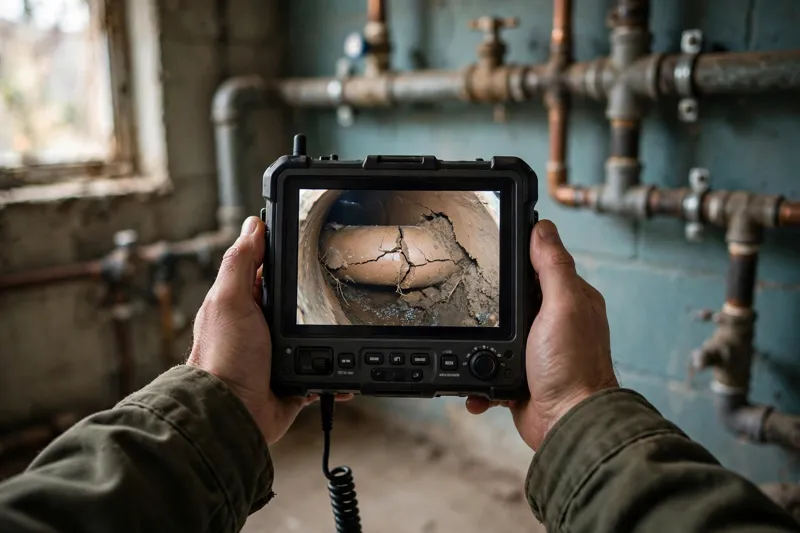
Searches for sewer camera inspection cost chicago come from homeowners at the very start of the job, and the camera is where the city rules begin too. The inspection comes first, before any method is chosen and before any quote is written. The camera shows the material, the breaks, the bellies, and the roots, and it gives the length and the depth. A quote without a camera reading is a guess. The written scope starts from the video, and the homeowner should keep the video, it is the record the permit, the claim, and the warranty all rest on.
A Chicago Department of Buildings sewer permit is generally required for the work, and the work is done by a licensed drainlayer, only licensed drainlayers may do sewer work in the city. A narrow exception covers an in-kind replacement of twenty feet or less, notified to the City rather than permitted in full. The permit line is (312) 744-3155, the Department of Buildings and Department of Water Management permit line. A public-way approval may also be needed where the work reaches the street or the parkway, and the Metropolitan Water Reclamation District may be involved where the work touches the trunk system, the trunk lines are the district's, the lateral is the homeowner's, by one Chicago cost guide's account.
The city's own Private Drain Program belongs here too, because it is the programme homeowners confuse with a permit. The programme repairs a broken sewer drain under the public way at no cost to the owner, but only after the owner hires a licensed sewer contractor to rod and video-inspect the line, and only when the break is in the public way. The programme starts through CHI 311, which is open around the clock, every day of the year. The number (312) 744-5000 appears in the CHI311 site footer. A broken lateral under the front yard is the homeowner's job. A broken drain under the street may be the city's, and the inspection is what tells the two apart.
When the drains back up, the first job is not the lateral. The first job is the cleanup, because a sewer backup in a basement is a health risk, the water carries bacteria, and the room needs to be dried and cleaned before anyone spends time in it. The sewage backup guide takes that half of the job in full: what to do in the first hour, what the cleanup crew does, and what the insurer needs to see.
The lateral repair comes after the cleanup, not before it, and a crew that offers to replace the lateral before the basement is dry is doing the jobs in the wrong order. The service page for the cleanup is the sewage cleanup page, and the guide for the backup itself is the sewage backup blog, both are linked at the foot of this page.
Insurance: sudden and accidental, or maintenance
A standard policy covers sudden, accidental damage from a listed peril, a fire, a vehicle impact, a falling object, and it rarely covers a line that failed because it was old, rusted, or choked with roots. Gradual deterioration, corrosion, and root intrusion are excluded on every engine that answered the question. A service-line endorsement, bought before the failure, is the cover that pays for a lateral, and the endorsement is the thing to check on the declarations page before the storm, not after it.
The same sudden-and-accidental rule governs the water damage a failed lateral causes. The insurer pays for the drying and the repair when the cause was sudden and accidental, up to the limits, minus the deductible. It does not pay for the pipe that failed, or for flooding from outside, and a sewer backup needs its own endorsement. A backup that floods a basement is a separate claim from the lateral repair, and the two claims run on different parts of the policy. The crew that cleans up the backup is not the crew that replaces the lateral, and the page that links the two is the sewage backup guide, not this one.
What actually happened in Chicago: no verified case
This page names a Chicago case only when three things are verified: a named homeowner, an exact Chicago street address, and an incident date. That sentence is the honest result of the sweep, not a gap in the research, and this page invents no case to fill it.
The closest lead was a YouTube video of a three-flat owner on the north side of Chicago, first name only, with no surname, no street address, and no date, so it is not a verified case. It is described here without the first name, because the name itself adds nothing a homeowner can check. The chat engines, asked the same question, could name no private homeowner case either, and said so plainly, in their own words. A standalone trenchless repair with a named homeowner, a street address, and a date has still not been found anywhere, and a page that printed one would be inventing it.
Prevention: what keeps the next job small
The guide ends where the sewer work ends, with prevention, because the cheapest job is the one that never happens. Rod the line when the drains slow, and camera it when the rodding stops working. Keep the trees watered in a dry summer, so the roots do not hunt for the lateral. Do not plant a silver maple, a willow, or an elm over the line. Keep the downspouts and the grading moving water away from the house, and keep the sump pump tested before the storm season.
Keep the video, the scope, and the receipts together, and check the insurer's first scope against the rooms the water reached. A small crack found in a day is a small job, and a small crack found in a year is a big one. The prevention is not a product. It is the same discipline the repair runs on, find the problem fast, name the method honestly, and never let a small problem sit.
How to read a sewer repair quote in Chicago
The seven stages, in order, from the camera inspection to the written scope. A quote that skips a stage has not told you the job.
Get the camera inspection first
Do not accept a quote for a line no one has looked inside. The camera shows the material, the breaks, the bellies, and the roots, and it gives the length and the depth. A quote without a camera reading is a guess, and the written scope starts from the video.
Ask which method, and why
The quote should name the method, lining, bursting, or open trench, and say why that method fits your line. Lining needs a pipe that holds its shape. Bursting needs room for the pits. Digging is the answer when the grade is wrong or the pipe has caved in.
Check the permit and the licence
The quote should name the Chicago sewer permit and the licensed drainlayer who will do the work. Only licensed drainlayers may do sewer work in the city. A narrow exception covers an in-kind replacement of twenty feet or less, notified to the City.
Read the length, the depth, and the access
The quote should state the length of the line, how deep it runs, and where the access pits go, the front yard, the parkway, or the street. Length and depth are the two drivers that move the job most, and a quote that hides them has not told you the job.
Ask what the restoration covers
The quote should say who puts the yard, the driveway, and the sidewalk back, and to what standard. Trenchless work disturbs less ground than digging, but the pits still need filling and the grass still needs replacing. Restoration is part of the job, not an extra.
Ask what happens if the line cannot be lined
The quote should say what happens when the camera finds a collapse, a bad belly, or a reroute, the point at which the method changes and the job becomes a dig. A quote that promises trenchless before the camera has run is selling the method, not the repair.
Get it in writing, line by line
The written scope should list the method, the length, the permit, the restoration, and the warranty, each on its own line, before any work starts. Keep the video, the scope, and the receipts together. The file you build before the work is what the claim and the warranty rest on.
Before the crew arrives: the homeowner's checklist
- Get the camera inspection in writing, and keep the video.
- Ask which method, and why that method fits your line.
- Confirm the permit and the licensed drainlayer by name.
- Read the length, the depth, and where the pits go.
- Ask what the restoration covers, and to what standard.
- Ask what happens if the line cannot be lined.
- Get the scope in writing, line by line, before any work starts.
Call now, we answer 24/7
Water in the basement? A drain that keeps coming back? Call now, a crew answers around the clock, inspects the damage, and gives you a written estimate before any work starts.
Questions Chicago homeowners ask about trenchless sewer repair
How much does trenchless sewer repair cost?
This site prints no prices, so no figure here can mislead you. The cost depends on the length of the line, how deep it runs, whether the pipe is lined or burst through, and what sits above it, a driveway, a patio, or a street. A camera inspection comes first, then a written scope.
Does homeowners insurance cover water damage restoration, or only part of it?
It covers only part of it. The policy pays for the drying and the repair when the cause was sudden and accidental, up to your limits, minus your deductible. It does not pay for the pipe or the appliance that failed, or for flooding from outside. A sewer backup needs its own endorsement.
How long does water damage restoration take?
Drying takes three to seven days on most losses, and the job with repairs usually takes one to three weeks. A small leak in one room can finish in days.
What is water damage restoration called?
The full job, stopping the water, drying the structure, cleaning, and rebuilding, is called water damage restoration. The emergency half, stopping the water and drying, is also called mitigation. Removing mold growth is a separate job, called remediation, and it follows the drying, never the other way around.
Does insurance cover water damage restoration?
Yes, when the damage was sudden and accidental, a burst pipe, a failed water heater, an appliance hose that gave way. The claim runs in order: call the insurer, photograph everything, start the drying, and keep the receipts. The adjuster works from the readings and the photos, so the file you build in the first day decides the claim.
What is the water damage restoration process?
The process runs in order: inspection first, to find the source and how far the water spread; then extraction, with pumps and vacuums; then drying, with air movers and dehumidifiers; then cleaning and sanitising; then the repairs. Dry the floors, walls and framing fast to stop mold, and document everything.
Does homeowners insurance cover water damage?
It covers water damage when the cause was sudden and accidental, a burst pipe, a failed appliance, a supply line that gave way. It does not cover a slow leak that ran for months, groundwater seepage, flooding from outside, or wear and tear. Read the declarations page before the storm, not after it.
What should I do when my house floods?
Stop the water and make it safe first. Shut off the main valve, cut the power to any room with standing water, and do not walk through water that may be sewage. Call 311 to report a flooded basement, photograph everything before anything moves, and start the drying within the first day.
How much does homeowners insurance pay for water damage?
No page can give you a number, because the payment depends on your policy, your deductible, the cause, and the limits you bought. The insurer pays the drying and the repair, less your deductible, and it does not pay for the pipe that failed.
Are renters responsible for water damage?
Renters are liable only for damage they caused or failed to report, negligence, misuse, or a leak they never told the landlord about. The building itself, the walls, floors, and pipes, is the landlord's, and so is the plumbing that serves the unit. Renters insurance covers the renter's belongings when the cause was sudden and accidental.
How much does a plumber charge for a burst pipe?
This site prints no prices, so no figure here can mislead you. The charge depends on where the pipe sits, how hard it is to reach, whether the wall or the floor must come out, and whether the call is an emergency at night. The water damage the burst caused is usually the bigger part of the bill.
Does insurance cover burst pipes?
Yes, when the pipe burst suddenly, a freeze split, a joint that failed without warning, a line that gave way all at once. The insurer pays for the water damage the burst caused, not for the pipe itself. A slow leak that ran for months may be classed as wear and tear, and the claim may fail.
How much does it cost to fix a burst pipe?
This site prints no prices, so no figure here can mislead you. The cost depends on the pipe's location, the access, the material, and the water damage the burst caused, the drying and the rebuild are usually the bigger part. A camera or a moisture reading comes first, then a written scope.
How much does mold remediation cost?
This site prints no prices, so no figure here can mislead you. The cost depends on how much mold there is, where it sits, whether the wall must come out, and whether the moisture source is fixed first. Illinois now registers mold remediation work, with a grace period for existing workers, this site gives consumer guidance only.
Can mold be fully remediated?
Mold can be remediated to safe, normal levels, but no job removes every spore, spores are everywhere, indoors and out. Fully remediated means the moisture source is fixed, the growth is removed, the area is cleaned and dried to the readings, and the humidity stays in the normal range. A job that skips the source is not finished.
What is trenchless sewer repair?
Trenchless sewer repair fixes a buried sewer line through one or two small access pits, without digging an open trench across the yard. The two methods are lining, a resin sleeve cured inside the old pipe, and bursting, a new pipe pulled through while the old one breaks apart. Most jobs finish in about a day.
Is trenchless sewer repair cheaper than digging up the yard?
The trenchless method usually costs more per foot up front, and often costs less overall, because the digging option also pays for the driveway, the patio, and the landscaping to be put back. For a shallow, short line under open lawn, digging is usually the cheaper job. The comparison is the whole job, not the pipe alone.
How long does trenchless sewer repair last?
The real life of the repair depends on the soil, the installation, and whether the grade was right. A liner in a bellied pipe does not last, because the belly is still there.
Can trenchless sewer repair fix a collapsed pipe?
Sometimes. Pipe bursting can handle a partly crushed pipe, because the new pipe pushes through the old one. Lining cannot fix a collapsed pipe, because the liner needs the old pipe as a mold. A fully caved-in or separated pipe needs digging, and the camera inspection is what decides which case yours is.
Do I need a permit for trenchless sewer repair in Chicago?
Yes, a Chicago Department of Buildings sewer permit is generally required, and the work is done by a licensed drainlayer, only licensed drainlayers may do sewer work in the city. A narrow exception covers an in-kind replacement of twenty feet or less, notified to the City. The permit line is (312) 744-3155.
What are the disadvantages of trenchless pipe lining?
Lining cannot correct a bad grade or a belly, it narrows the pipe slightly, and it makes a future spot repair harder, because the liner covers the joints. It also needs a pipe that still holds its shape, a collapsed pipe cannot be lined. The camera inspection is what shows whether any of these apply to your line.
How much does CIPP pipe lining cost?
This site prints no prices, so no figure here can mislead you. The cost depends on the length and diameter of the line, how deep it runs, how many bends it has, and what sits above it. A camera inspection comes first, then a written scope with the method named.
How expensive is pipe bursting?
This site prints no prices, so no figure here can mislead you. Bursting usually costs more than lining for the same line, because the new pipe and the pulling equipment cost more, and the pits are bigger. It is the method for a pipe that is too far gone to line, and the scope names the method first.
How much does it cost to rod a sewer line in Chicago?
This site prints no prices, so no figure here can mislead you. Rodding is the cheapest first step, a cable clears the blockage, and its cost depends on the access, the length, and whether the blockage is roots or a break. Rodding clears a blockage; it does not repair a broken pipe.
What are the most common problems with CIPP liners?
The common problems are a liner that wrinkles or folds at a bend, a liner that does not cure fully, a connection left sealed where a branch line joins, and a liner installed in a pipe with a bad grade. The camera inspection after the cure is what catches them, and the written scope should name who fixes them.
How long do clay sewer lines last?
A clay line with sound joints and no roots can outlast the figure, and one under a parkway maple may not reach it.
How deep does a sewer lateral need to be?
It depends on the frost line and the grade from the house to the street. One Chicago cost guide puts typical laterals three to eight feet deep, and the permit sets the depth for your street. A line laid too shallow freezes in January; a line laid too deep costs more to reach when it fails.
What is the average lifespan of a sewer line?
The real life depends on the material, the soil, the roots, and the grade. The camera inspection tells you where your line sits in that range.
Sources
- Suburban Plumbing Experts, trenchless sewer repair, Chicago. Trenchless-dedicated Chicago post, published April 2026, updated August 2026.
- VanDerBosch, trenchless versus traditional, a cost breakdown for sewer repair, Chicago. Published March 2026.
- TradesProHub, trenchless sewer repair cost, Chicago. Published March 2026.
- Memaso, trenchless sewer repair cost, Schaumburg and Evanston. Not Chicago-proper.
- City of Chicago, Chicago Department of Water Management, chicago.gov/city/en/depts/water.html. Private Drain Program, sewer permits, and drainlayer licence rules.
- City of Chicago, CHI311, chicago.gov. Hours 24/7/365; sewer permit line (312) 744-3155.
- City of Chicago, Department of Buildings, sewer permit requirements and the licensed-drainlayer rule.
- Illinois Department of Public Health, mold remediation registration, Part 835, operational September 2026, grace to September 30, 2027.
More from the blog
- What to Do After a Sewage Backup Cleanup in Chicago?, what a backup costs you, and what the cleanup actually takes.
- How Much Does Water Damage Restoration Cost in Chicago, the drivers, not a price list, and what a quote should name.
- Basement Flooding in Chicago: Who to Call, the first hours, the first calls, and the mistakes to avoid.
- Sewage Cleanup Chicago, the service page for sewer backups and the cleanup that follows them.
More Restoration Services in Chicago
Every service below is one tap away. Pick the one that matches your problem.

Water Damage Restoration
Fast water extraction, structural drying, and full repair after burst pipes, leaks, and floods.
Learn more →
Water Mitigation
Emergency water removal, structural drying, and mold prevention to stop the damage fast, 24/7.
Learn more →
Mold Remediation
Safe, contained mold remediation that removes contamination and fixes the moisture source.
Learn more →
Sewage Cleanup
Safe removal and disinfection of dangerous sewage backups and black water.
Learn more →
Flood Cleanup
Water pumped out, structure dried, and debris cleared fast after storms and flooding.
Learn more →
Hardwood Floors Water Damage
Cupped, buckled or stained hardwood after a leak? How we dry it, when sanding saves it, and when the boards have to go.
Learn more →