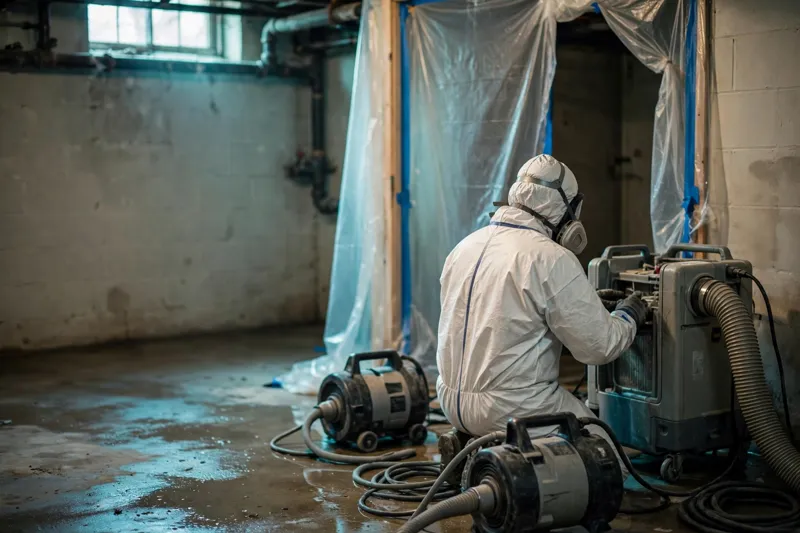
How Long Does Water Damage Restoration Take in Chicago
Your basement is wet, or your kitchen floor is, and the question every flooded homeowner asks first is how long does water damage restoration take, and the honest answer is a range, not a number. Drying takes three to five days on a small, contained loss. The full job, drying plus repairs, takes one to four weeks. This post gives you the timeline, day by day, and the drivers that stretch it.
- Drying takes three to five days on a contained clean-water loss
- The full job takes one to four weeks, longer with a rebuild
- How the drying is judged, a moisture meter, not a calendar
- What stretches the job: water category, materials, hardwood, insurance
Written for Chicago homeowners, the combined sewer, the finished basements, the hardwood floors, and the insurance delay, checked against the research.
- We answer 24/7
- Local Chicago team
- Insurance documentation help
- Straight answers, no pressure
How long does restoration take? Call us
Tell us where the water is and we will call you back. We answer 24/7.
The short answer: drying takes three to five days
The short answer is two numbers, not one, because drying and rebuilding are two different jobs. Drying, getting the water out and the structure dry to a meter reading, takes three to five days on a small, contained clean-water loss in one room. The full job, drying plus the repairs that put the room back, usually takes one to four weeks. A job with a rebuild runs two to six weeks, and a severe job with mold and structural damage can run up to three to six months.
No honest page can give you a date, because the time depends on how much water there is, what kind of water it is, what got wet, and whether the insurer has approved the work.
| Job | Drying | Full job, repairs included |
|---|---|---|
| Small, contained clean-water loss, one room | Three to five days | One to two weeks |
| Finished basement, drywall and flooring wet | Seven to fourteen days | Two to four weeks |
| Hardwood floors wet through | Seven to ten days or longer | Two to six weeks |
| Water sat a day or more; mold present | One to two weeks | Three to four weeks |
| Severe job, structural damage, full rebuild | Two weeks or more | Up to three to six months |
The table above is the whole answer in one place, and the rest of this post is the evidence for it: the day-by-day timeline, the drivers that stretch each row, how the drying is judged, and what Chicago homes teach about time. The service page for the work itself is our water damage restoration Chicago page, and the basement guide is our basement flooding Chicago who to call post.
The day-by-day timeline, from the first call to a dry room
The Chicago version of the question, how long does water damage restoration take in chicago, has one page that owns it: the Dry Bros day-by-day timeline, published September 23, 2026. It is the only Chicago page that answers the question end to end, and it is short, about fourteen hundred to fifteen hundred words. This post keeps its day-by-day shape and fills in what it leaves out.
Day one: emergency response and extraction
Day one starts with the call and the stop. The crew arrives, finds the source, and turns the water off. A truck-mounted extractor pulls the standing water out, most of the water comes out in hours, and every hour of standing water is an hour of deeper soaking. Then comes moisture mapping: the crew reads the walls, floors and framing with a meter and marks how far the water spread.
Water travels further than it looks: a leak can show up two rooms away from where it entered, and the water wicks up inside the wall. The first day also decides the category: clean water from a supply pipe, grey water from an appliance, or black water from sewage. The category decides how much material comes out and how long the job runs.
Days two and three: active structural drying
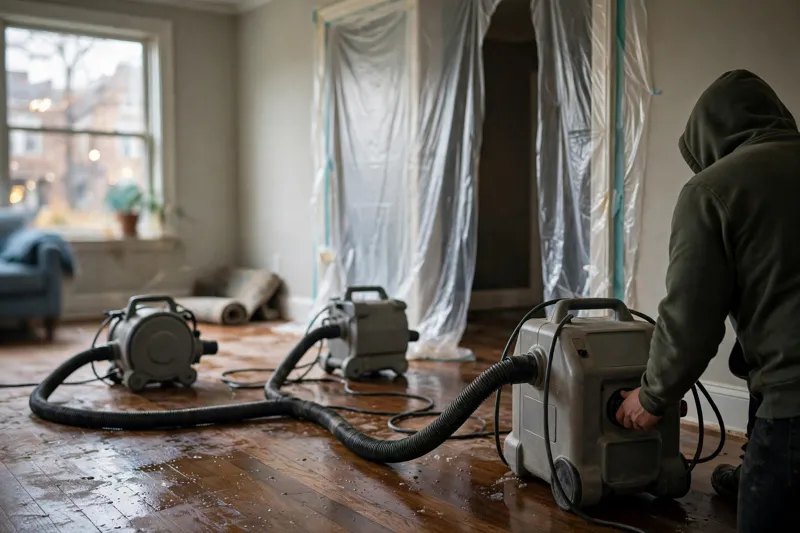
Days two and three are the drying days. Air movers and dehumidifiers run around the clock, day and night, pushing dry air across the wet surfaces and pulling the moisture out of the air. The equipment stays on, turning it off early is the most common way a three-day dry becomes a two-week job. On a small, contained loss the surfaces start to feel dry by day three, and that is exactly when homeowners make the mistake: the surfaces feel dry long before the framing behind them is dry.
Days three to five: monitoring and the drying log
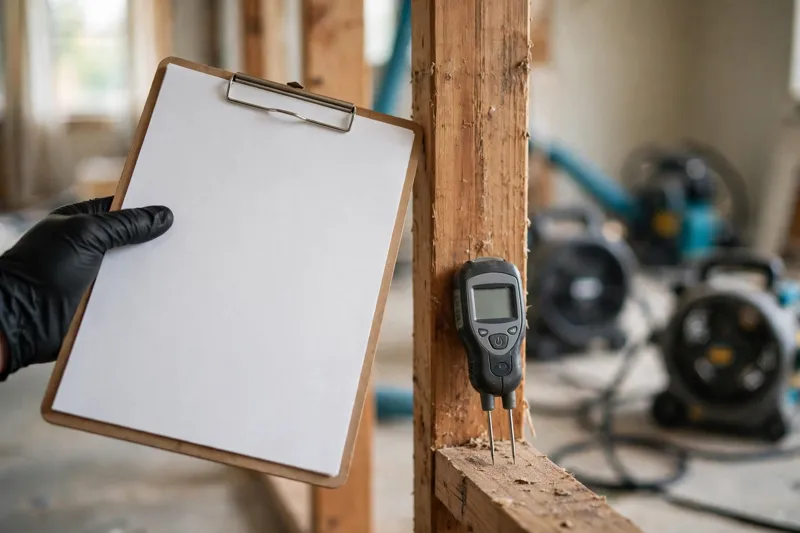
Days three to five are the monitoring days. The crew reads the moisture every day and writes the readings into a drying log. Most contained single-room losses reach their target readings in this window, and then the equipment comes out and the drying log closes. The log matters for two reasons: it proves the drying is done, and it is the key document for the insurance claim. A job with no drying log is a job with no proof.
After day five: what runs longer, and why
Past day five, the job is no longer a drying job, it is a materials job, an insurance job, or a mold job. Wet drywall that cannot dry fast enough comes out, and the cavity behind it is dried and rebuilt. Hardwood floors take seven to ten days or longer, and a finished basement with several layers of material takes longer still. Water that sat for twelve to twenty-four hours or more soaks deeper and dries slower, and Chicago's fall humidity slows the drying too. The water damage drying time chicago homeowners search for is usually the three-to-five-day number, but the number that matters for their home is the one the meter gives, not the one the search gives.
What slows the job down the most
The number one delayer is a late start. Water that sits for a day soaks deeper into drywall, wood and insulation, and a three-day dry becomes a multi-week job. The drying itself is the fast half of the job. The slow half is everything around it.
The five delayers, in order
First, the water category. Clean water from a supply pipe dries fastest. Grey water from an appliance needs more cleaning. Black water from sewage means material comes out, not dries, and the job runs longer because the removal, the cleaning and the sanitizing all take time. Second, the materials. Drywall wicks water up inside the wall within minutes, and wet drywall rarely dries fast enough in the cavity, it usually comes out. Hardwood floors cup and buckle, and they dry slowly. Concrete takes one to three weeks to dry through to the target reading.
Third, the shape of the room. A finished basement with drywall, insulation, flooring and baseboards has several layers to dry through, and each layer slows the next. An unfinished basement dries in three to five days; a finished one takes seven to fourteen. Fourth, the wait for approval. Insurance approval, permits and materials are the main delay on the rebuild half of the job, the drying runs while the paperwork waits, but the repairs cannot start until the approval lands. Fifth, the weather. Chicago's humid summer slows the drying, and a cold snap freezes the discharge line and sends the water back in.
The insurance wait, and the materials wait
The adjuster does not delay the drying, and you should not wait for the adjuster, your policy asks you to stop the damage from getting worse, so the drying starts the same day. What the adjuster can delay is the rebuild: the repairs wait for the approval, and an adjuster who takes weeks to visit stretches the repairs by weeks. Materials wait too, a hardwood floor waits for the refinisher, a custom vanity waits for the order, a permit waits for the city. None of these stretch the drying; they stretch the full job, and they are the reason a job that dried in four days can take six weeks to finish.
How drying works, and how you know it is done
Drying is not waiting. It is a process with equipment, readings and a log, and the process is the same whether the water came from a burst pipe, a sewer backup or a storm. Homeowners ask how long does water damage take to dry, and the honest answer is that the drying takes as long as the meter says it takes. The water damage restoration timeline chicago homeowners actually need is not a calendar, it is a meter reading, taken every day, written into a log.
Extraction, then equipment
Extraction comes first: pumps and a truck-mounted extractor pull the standing water out. Then the equipment goes in: air movers push dry air across the wet surfaces, and dehumidifiers pull the moisture out of the air and drain it away. The two work together, movers without a dehumidifier push wet air around the room. The equipment runs around the clock, day and night, until the readings say dry. A homeowner asked how long does it take to dry out water damage, and the crew's answer was the same every day: until the meter says so.
The meter, not the calendar
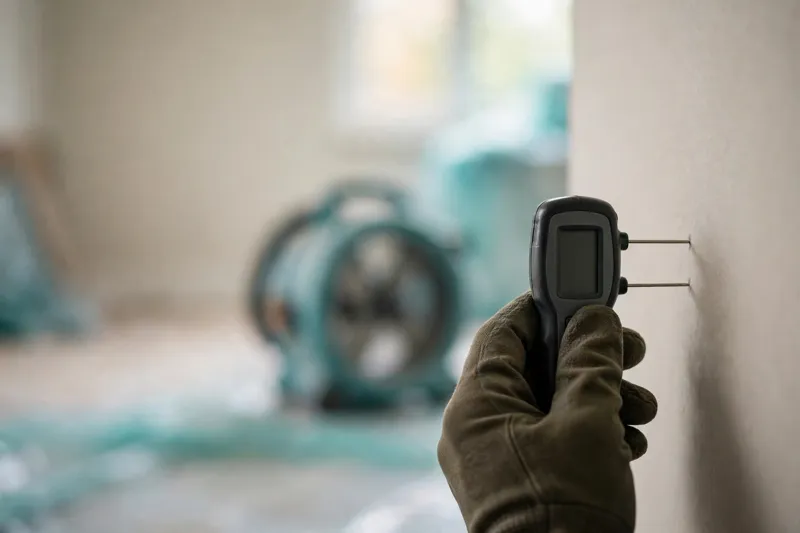
The drying is judged by a moisture meter, not by touch and not by the calendar. Wood framing is dry at twelve to sixteen percent moisture, drywall below half a percent, concrete below four percent, and the air below forty-five percent relative humidity. The crew reads the wood, the drywall and the concrete every day and writes the readings into a drying log. When the readings hold steady at the dry standard for two days running, the equipment comes out.
Visual dryness is not reliable: a wall can look dry and still hold water behind the paint.
Why the equipment keeps running after the floor feels dry
Homeowners ask why the air movers and dehumidifiers keep running after the floors feel dry. The answer is that the surfaces dry first and the framing dries last: the floor you walk on is dry in a day or two, and the wood framing behind the drywall takes days longer. Turning the equipment off when the floor feels dry leaves the framing wet, and wet framing grows mold where you cannot see it.
Drying out a basement after flooding
The basement version of the question, how long does water damage restoration take for a basement, depends on whether the basement is finished. An unfinished basement, concrete floor and bare block walls, dries in three to five days with professional equipment. A finished basement, with drywall, insulation, flooring and baseboards, takes seven to fourteen days, and a deep finished basement can take ten to fourteen days or longer. The layers are the reason: each layer has to dry through before the next one can, and the insulation behind the drywall holds water longest.
The fastest way to dry a flooded basement is extraction first, then professional equipment running around the clock: a truck-mounted extractor pulls the standing water out, then air movers and dehumidifiers run until the meter says dry. Household fans alone stretch the job to weeks, one homeowner reported plywood still reading seventeen percent moisture after seven days open with fans. A flooded basement will not dry on its own, and a dehumidifier cannot do it alone, it pulls moisture from the air, not the water standing on the floor or soaked into the walls.
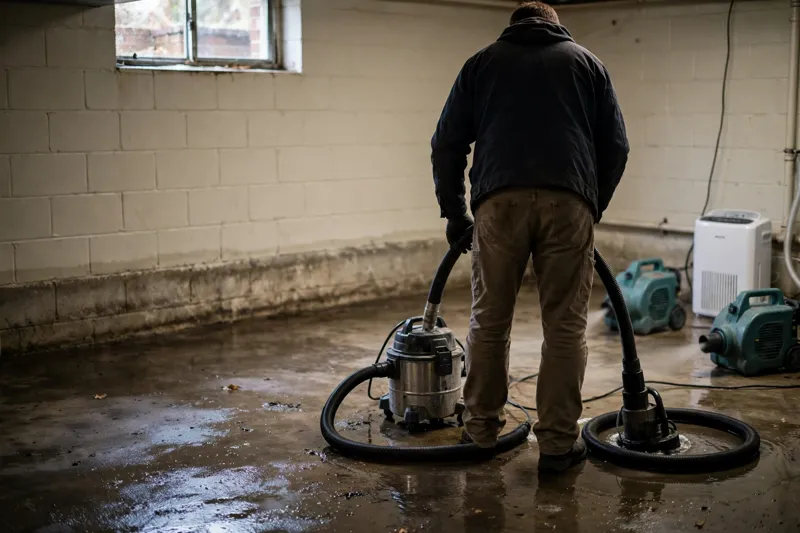
Chicago basements flood for a Chicago reason: the city has a combined sewer system, and one pipe carries both sewage and stormwater. In a hard storm the combined sewer surcharges, and the water comes back up through the lowest opening in the building, usually the floor drain. That is why a Chicago basement floods when it is barely raining: the rain does not have to be heavy, the sewer only has to be full. The fix is the same for every cause: find the entry point, stop the water, dry to a number, and repair what is left.
After a flood: a different timeline
The question changes after a flood: how long does water damage restoration take after a flood is a different job from a burst pipe, because flood water is black water, it carries sewage, chemicals and bacteria, and the material it touches comes out instead of drying. How long does flood damage restoration take depends on how much came out: a straightforward flood job takes one to two weeks with drywall removed, and three to four weeks when mold is present. A homeowner who asks how long does it take to dry out a house after a flood chicago should expect the same answer the meter gives every other job: three to five days for the drying, and longer for the rebuild.
Flood water means flood cutting: wet drywall is cut out above the waterline, usually twelve to eighteen inches above it, and the cavity behind it is dried and cleaned before anything goes back. The cutting is not guesswork, the crew cuts to where the meter says the wall is dry, and the cut line is where the drying starts. Sewer backup is the same job in a smaller room: the lower drywall likely comes out rather than drying, because sewage water soaks into the paper facing and the cavity behind it. The crew removes what cannot be dried, cleans and sanitizes what stays, and dries the space before the rebuild starts.
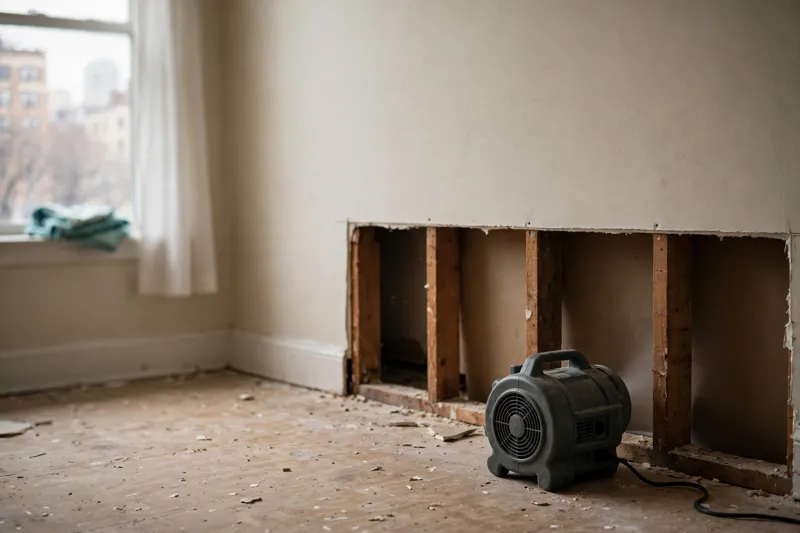
After a flood, the first hour decides the timeline. Shut off the utilities if you can do it safely, take twenty to fifty photographs of the water line and every damaged item, and call the insurer and a restoration crew within one to four hours. Do not wait for the adjuster, your policy asks you to stop the damage from getting worse, and the drying starts the same day. The rebuild waits for the approval, and that wait is the longest part of a flood job: the drying takes days, and the approval takes weeks.
Hardwood floors: the slowest material in the house
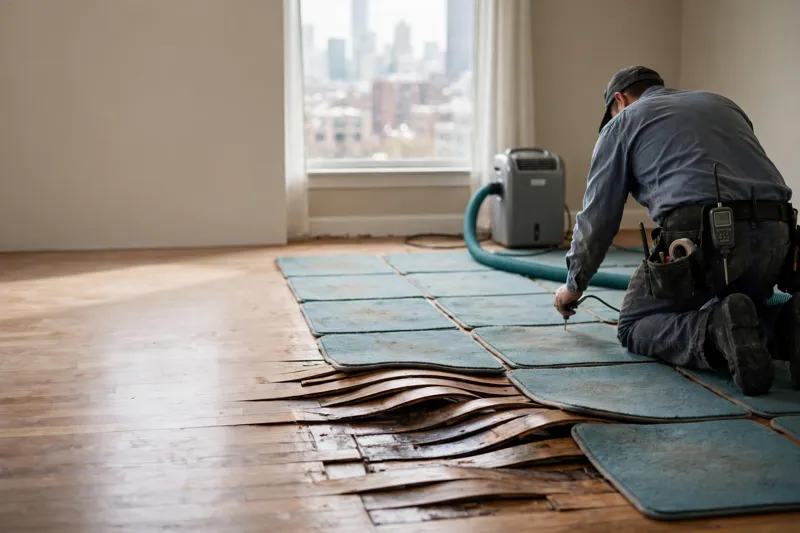
Hardwood floors are the slowest material in a Chicago home to dry, and the most common reason a short job runs long. Wet hardwood cups and buckles as it absorbs water, and it takes seven to ten days or longer to dry through, longer than drywall, longer than carpet, longer than the walls around it. The national guides agree: one puts hardwood at five to seven days, another at seven to ten days or longer, and the Chicago timeline page puts it past day five with the finished basement. The drying standard is the same, twelve to sixteen percent moisture in the wood, but hardwood reaches it slowly, because the water has to come out through the finish and the subfloor underneath.
A hardwood floor that is still wet after two weeks is not coming back on its own, and a floor that has buckled and will not lie flat is a permanent loss. The crew dries the floor with air movers and dehumidifiers, reads it every day, and sands and refinishes it only after the meter says dry, sanding a wet floor seals the water in. The refinishing waits for the drying, and the drying waits for the meter.
Mold after water damage, how fast, and what to do
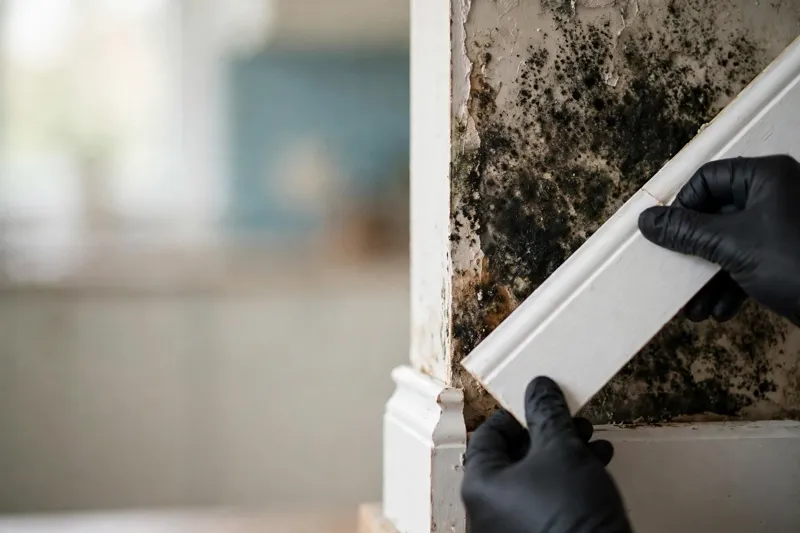
Wet drywall and insulation grow mold within twenty-four to forty-eight hours, it is visible within forty-eight to seventy-two hours, and colonies form on drywall in five to ten days. A basement that sits wet for a week is a mold job, not a drying job.
Remediation means removing the mold growth and the wet material it sits on, cleaning what stays, and drying the space so it cannot grow back. It cannot work if the leak keeps feeding the wall, so the source comes first. And the honest answer to the question every homeowner asks, can mold be fully remediated, is yes for the active growth, and no for the spores: no home is ever one hundred percent free of mold spores, and remediation returns the levels to a safe, natural baseline.
Illinois has a mold registration, and pages that say it has none are wrong: the Illinois Department of Public Health's Part 835 registration is operational, effective September 23, 2026, with a grace period to September 30, 2027. This site claims no registration itself. Our mold remediation Chicago page covers the work itself.
Insurance and the adjuster: who waits, and who does not
Insurance pays for the drying and the repair when the damage was sudden and accidental, such as a burst pipe or an appliance failure. It does not cover flooding from outside, which needs separate flood insurance, and a sewer backup is usually covered only if you hold the endorsement for it. A slow leak may be classed as wear and tear, and the insurer may pay nothing for it. The only 50 percent rule that counts is the FEMA rule: if repairs cost half or more of what the home is worth, the home must be brought up to flood standards. No other 50 percent rule exists, the informal split that some pages print is not a rule at all.
Do not wait for the adjuster. Your policy asks you to stop the damage from getting worse, so start the drying, take twenty to fifty photographs, and keep every receipt. The adjuster visits, the claim is filed, and the rebuild waits for the approval. Homeowners ask how long does water damage repair take, and the answer is the rebuild's, not the drying's: one to three weeks after the drying is done, longer when the approval or the materials wait. Renters are not responsible for the building: the landlord owns the building and its pipes, so the landlord pays for the building repair, and a renter pays only when the renter caused the damage.
Two other programmes exist, and neither pays for the repair itself. The Disaster Relief Assistance Program pays up to fifteen thousand dollars per household, but it covers rent, mortgage and utilities only, not repair, and it runs from January 21, 2025 to January 21, 2027, for households at or below eighty percent of area median income. Its priority ZIP codes are 60644, 60651, 60639, 60641 and 60624.
The Flood Assistance Repair Program pays up to twenty-five thousand dollars for basement damage from the 2023 or 2024 floods, but it is west-side only, for owner-occupied single-family or two-unit homes, with registration from November 30 to December 11, 2026.
What Chicago homes teach about time
No news case on any platform gives a Chicago water-damage job with a company, a property address and a date, and this post does not invent one. What the verified Chicago cases do teach is why Chicago jobs run long: the water comes back.
Chrislin Flanagan, on the 107th block of South Emerald, bought her home in 2019, and her basement flooded in 2021, 2022, 2023, and again in 2026, every February to April, including sewage. She spent more than twenty-six thousand dollars on plumbers, losses, and re-grassing. The plumbers blamed city-side pipes more than a century old. Who she called, in order: plumbers first, then an extraction company, then the City and the Private Drain Program.
A Chicago Lawn homeowner named Ishmael had nearly three feet of water rush into his basement in a weekend storm, the second time in three weeks, with costs of around ten thousand dollars. He made an official 311 complaint to the city. Dwayne Baxter, also in Chicago Lawn, had his basement flooded for the second time that summer, when up to five inches of rain overwhelmed the sewers and the water backed up from his drain.
Elizabeth Belinga, in Jefferson Park, found her basement flooded with sewage water when her dryer alarm went off, the second time her basement had flooded, the first in May 2020.
On September 11, 2022, seven inches of rain fell in one hour in Rogers Park, and an entire block had water in their basements, for residents who had lived there a decade, the fourth or fifth flood. Over nine hundred calls to 311 for water in basements and on roads came from six neighbourhoods alone from Sunday to Monday morning, most from Portage Park and Edgewater. And the scale of it: two thousand five hundred basement-flooding reports across five neighbourhoods, cited by Borderless Magazine on December 20, 2022. The pattern in every case is the same, the water comes back, and the total time is measured in years, not days. Each single job still dries in three to five days. The years come from the repeats.
The closest thing to a timed Chicago-area job is a video, not a news case.
The homeowner reports say the same thing from the other side: one homeowner's burst-pipe ceiling job took a couple of months, with insurance and refinishing named as the cause of most of the delay; another had fans running since October and the ceiling still had not dried completely after almost two months; a third, whose toilet pipe burst while she was on vacation, waited close to ten days and was afraid mold would grow.
One suburban example belongs here, with its limits stated plainly. In La Grange, the Village's 50th Street Relief Storm Sewer, a trunk storm sewer from Stone Avenue to East Avenue, priced at thirty-seven point eight million dollars, is not built: the Illinois Supreme Court denied the appeal on September 30, 2026, and the Village's next steps are an agreement with the water reclamation district, then bids. That is a suburban project, not a Chicago-city fact, and it is here only to show what the long end of the timeline looks like: a storm sewer takes years, and a basement takes days.
The drying process, step by step
The water damage restoration process timeline runs in seven steps, from stopping the water to a dry, rebuilt room. The steps are the same whether the water came from a burst pipe, a sewer backup or a storm, and the time each one takes is in the section above.
Stop the water at the source.
Turn off the main water valve if the water is coming from a pipe, or shut off the appliance that failed. A crew cannot dry a basement while water is still coming in, so the source comes first, before any equipment.
Call a restoration crew the same day.
Call (773) 570-9869 any time, day or night. Tell us where the water is, how deep it looks, and whether it smells of sewage. We answer 24/7 and talk you through the first hour while a crew is on the way.
Extract the standing water.
Pumps and truck-mounted extractors pull the standing water out of the basement and the rooms. Extraction is the fastest step, most of the water comes out in hours, and every hour of standing water is an hour of deeper soaking.
Remove what cannot be dried.
Wet drywall is cut out above the waterline, and soaked carpet padding, insulation and swollen baseboards come out with it. What stays must be able to dry through; what cannot dry is removed, not left to grow mold behind the wall.
Set the drying equipment and let it run.
Air movers and dehumidifiers run around the clock, day and night, until the meter readings say the walls and floors are dry. Do not turn the equipment off early, the surfaces feel dry long before the framing behind them is dry.
Read the moisture every day.
A moisture meter reads the wood framing, the drywall and the concrete every day, and the readings go into a drying log. When the readings hold steady at the dry standard for two days running, the drying is done.
Clean, sanitize and rebuild.
The crew cleans and sanitizes the surfaces, then the repairs start: new drywall, new flooring, new baseboards. The rebuild is the last step, and it starts only after the drying log says dry, never before.
When the timeline is lying to you
A timeline is lying to you when it gives you a date instead of a reading. Watch for four signs. First, the equipment comes out early, the crew pulls the air movers on day two because the floor feels dry, with no meter reading and no drying log. Second, there is no log at all, no readings, no dates, nothing to show the insurer. Third, the walls close wet, new drywall goes up over framing that was never read. Fourth, the job is sold on a fixed number of days, with no mention of the water category, the materials, or the insurance wait. A crew that gives you a date before it has read your walls is guessing.
Your checklist, before, during and after
Before the next storm: test the sump pump, clear the discharge line, check the outlet, check the gutters and downspouts, and ask a licensed sewer contractor to televise the lateral. Keep 311's number and ours, (773) 570-9869, on the fridge. During the flood: stop the water at the source if you can do it safely, stay out of the water while the power is on, lift what you can save, and photograph everything before you move it. After the flood: keep the drying running until the meter says dry, keep the log and every receipt, call the insurer the same day, and call 311 if the sewer or the street flooded.
Call now, a crew is on the way
If your basement is wet now, you already know the answer is a range. The drying takes three to five days on a small, contained loss, and the full job takes one to four weeks. The call to make is (773) 570-9869. We answer 24/7, and we talk you through the first hour while a crew is on the way. The water comes out the same day, the drying runs until the meter says dry, and the room goes back the way it was.
Water damage in your Chicago home?
We answer 24/7. Call now and a crew is on the way.
Call (773) 570-9869Frequently asked questions
How long does water damage restoration take?
Drying takes three to five days on a clean-water loss in one room, and the full job, drying plus repairs, usually takes one to four weeks. The time depends on how much water there is, what kind of water it is, what got wet, and whether the insurer has approved the work.
Does homeowners insurance cover water damage restoration, or only part of it?
It covers drying and repair when the damage was sudden and accidental, such as a burst pipe or an appliance failure. It does not cover flooding from outside, and a sewer backup needs the endorsement. The only 50 percent rule that counts is the FEMA rule: repairs costing half or more of the home's value must meet flood standards.
How long does it take to dry out a house after water damage?
Three to five days for a small, contained clean-water loss in one room. A finished basement takes seven to fourteen days, and hardwood floors can take seven to ten days or longer. The drying is done when a moisture meter says the wood and drywall are dry, not when the surfaces feel dry to the touch.
What is water damage restoration called?
The full job, stopping the water, drying the structure, cleaning, and rebuilding, is called water damage restoration. The emergency half, stopping the water and drying, is also called mitigation. Removing mold growth is a separate job, called remediation, and it follows the drying, never the other way around.
Does insurance cover water damage restoration?
It usually does when the damage was sudden and accidental, such as a burst pipe or an appliance failure. It does not cover flooding from outside, which needs separate flood insurance. A sewer backup is usually covered only if you hold the endorsement for it, so ask your insurer before the next storm.
What is the water damage restoration process?
The process runs in order: inspection first, to find the source and measure how far the water spread; then extraction, with pumps and vacuums; then drying, with air movers and dehumidifiers; then cleaning and sanitizing; then the repairs that put the room back.
Does homeowners insurance cover water damage?
It usually does when the damage was sudden and accidental, such as a burst pipe or an appliance failure. It does not cover flooding from outside. A sewer backup needs the endorsement. A slow leak may be classed as wear and tear, and the insurer may pay nothing for it.
What should I do when my house floods?
Call us first at (773) 570-9869, then stop the water if you can do it safely. Stay out of a flooded basement while the power is on. Lift what you can save, and photograph the water line and every damaged item before you move it.
How much does homeowners insurance pay for water damage?
No page can give you a number, because the payment depends on your policy, your deductible, the cause of the loss, and the limits you bought. The insurer pays the drying and the repair, less your deductible, and it does not pay for the pipe that failed.
Are renters responsible for water damage?
It depends on who caused the water and what the lease says. The landlord usually owns the building and its pipes, so the landlord pays for the building repair. A renter pays when the renter caused the damage, such as an overflowing tub left running.
How much does a plumber charge for a burst pipe?
This site prints no prices. The charge depends on where the pipe is, how hard it is to reach, whether the wall or ceiling must be opened, and whether the call is an emergency at night. We inspect first, then give you a written scope.
Does insurance cover burst pipes?
It usually does when the pipe burst suddenly, such as a pipe that froze and split in a cold snap. The insurer pays for the water damage the burst caused, not for the pipe itself. A pipe that leaked slowly for months may be classed as wear and tear.
How much does it cost to fix a burst pipe?
This site prints no prices for either job, because pipe bursting means two different things. Trenchless pipe bursting replaces a broken sewer line by pulling a new pipe through the old one. A burst pipe is a supply pipe that split open, usually from freezing.
How much does mold remediation cost?
This site prints no prices, so no figure here can mislead you. The cost depends on how much mold there is, how far it spread, what material it sits on, and whether the water source is fixed. We inspect first, then give you a written scope.
Can mold be fully remediated?
Yes, when the water source is fixed first and the drying is finished to moisture readings. Remediation means removing the mold growth, cleaning what stays, and drying the space so it cannot grow back. No home is ever one hundred percent free of mold spores.
How long to dry out basement after flooding?
Three to five days with professional equipment for an unfinished basement, and seven to fourteen days for a finished basement with drywall, insulation and flooring to dry through. Household fans alone stretch the job to weeks, and a basement that still reads wet after two weeks needs a crew, not more fans.
What slows down water damage restoration the most?
A late start slows it most. Water that sits for a day soaks deeper into drywall, wood and insulation, and a three-day dry becomes a two-week job. After that, the delayers are the water category, the materials, a finished basement, hardwood floors, and waiting on the insurer to approve the work.
How do I know when the drying is done?
A moisture meter says so, not your hand and not the calendar. Wood framing is dry at twelve to sixteen percent moisture, and the readings are taken every day and written into a drying log. When the readings hold steady at the dry standard for two days running, the equipment comes out.
How long after water damage can mold start?
Mold can start growing on wet drywall, wood framing and carpet backing within twenty-four to forty-eight hours, and it is visible within forty-eight to seventy-two hours. That is why the drying starts the same day, not after the weekend. A wall that stays wet for a week is a mold job.
Does the insurance adjuster delay the drying?
The adjuster should not delay it, and you should not wait for the adjuster. Your policy asks you to stop the damage from getting worse, so start the drying, take twenty to fifty photographs, and keep every receipt. An adjuster who takes weeks to visit stretches the repairs, not the drying.
How to tell if water damage is permanent?
Water damage is permanent when the material cannot be dried back to its dry standard: drywall that has gone soft and crumbly, wood that has warped or rotted, flooring that has buckled and will not lie flat. A moisture meter tells you, a wall that still reads wet after two weeks of drying is not coming back.
Can you live in a house with water damage?
It depends on how much water there is and what kind it is. A small clean-water leak in one room is livable while the drying runs. Sewage water, water near power, or a whole house that is wet means staying elsewhere until the drying is done and the air is clear.
What is the fastest way to dry a flooded basement?
Extraction first, then professional drying equipment: a truck-mounted extractor pulls the standing water out, then air movers and dehumidifiers run around the clock until the meter says dry. Fans alone are the slowest way, they move air but they do not pull the water out of the walls.
Will a flooded basement dry on its own?
No. A flooded basement left alone stays wet behind the walls and under the floor, and mold starts within twenty-four to forty-eight hours. The surfaces may look dry in a few days, but the framing and the drywall behind them hold water for weeks. Drying needs extraction and equipment, not time.
Will a dehumidifier dry out a flooded basement?
A dehumidifier helps, but it cannot dry a flooded basement on its own. It pulls moisture from the air, not the water standing on the floor or soaked into the walls. You need extraction first, then air movers plus a dehumidifier running together until the meter readings say dry.
How long can wood be wet before it starts to rot?
Wood starts to change within days of staying wet, and rot sets in when wood stays wet for weeks. Hardwood floors cup and buckle first, and framing rots where water sits against it. The drying standard for wood framing is twelve to sixteen percent moisture, below that, rot does not take hold.
What helps draw moisture out of a house?
Air movers and dehumidifiers together do the work: the movers push dry air across wet surfaces, and the dehumidifier pulls the moisture out of the air and drains it away. Open windows help on a dry day, but in a Chicago summer the humid air outside slows the drying, so the equipment stays on.
How long does it take for water damage to show on drywall?
Stains can show within hours, and bubbling or soft spots usually appear within a day or two. The worse sign is what you cannot see: water wicks up inside the wall, and the back of the drywall can be soaked while the front still looks fine. A meter reading finds it.
Sources
- Dry Bros, Chicago timeline page, September 23, 2026 (Amin Mashouf, 3918 W 63rd St, Chicago, IL 60629), day-by-day timeline; three to five days for a small, contained clean-water loss; hardwood seven to ten days or longer; S500 dry standard twelve to sixteen percent wood framing. Its Logan Square two-flat and Roscoe Village finished-basement examples are hypothetical, not real jobs.
- DryOut Inc, Florida timeline page, October 19, 2026, three to five days drying, one to three weeks full job.
- RestoreNearMe timeline page, minor two to four weeks, moderate six to ten weeks, major sixteen to thirty-six weeks; drying three to seven days; five phases with tables.
- Raging Bull Contracting, San Antonio timeline page, November 11, 2026, "two clocks": drying two to four days, rebuild two to six weeks; meter readings; twenty-four to forty-eight hour mold window.
- NARESTCO, Federal Way timeline page, three to five days drying, one to four weeks full job; Category 1/2/3; hardwood five to seven days.
- Flood-Fixers timeline page, three to five days straightforward, one to two weeks with drywall, three to four weeks with mold; four phases.
- ProRestoration, California timeline page, three to five days drying; small leak seventy-two hours; slow leak seven to ten days drying.
- WikiHow, "How to Clean Up Water Damage: Proper Restoration Procedures" (Ryan Owsiany, updated May 2, 2025), the closest live article; the "Dry Out a House After Water Damage" page does not exist.
- CBS Chicago, July 28-29, 2021, Ginneh Strickland, Bronzeville sewer backup. https://www.youtube.com/watch?v=ZITppxSdU9c
- FOX 32 Chicago, ~April 2026, Chrislin Flanagan, 107th block of South Emerald: basement flooded 2021, 2022, 2023 and 2026.
- CBS Chicago, August 18, 2025, Dwayne Baxter, Chicago Lawn: second basement flood of the summer. https://www.youtube.com/watch?v=C7C0u2e7ieU
- CBS Chicago, August 19, 2025, Ishmael, Chicago Lawn: nearly three feet of water, second flood in three weeks, official 311 complaint. https://www.youtube.com/watch?v=Exl4lrN6D_k
- CBS Chicago, September 13, 2022, Rogers Park and Portage Park: seven inches of rain in one hour, over nine hundred 311 calls. https://www.youtube.com/watch?v=TIbCmSG5QtU
- CBS Chicago, July 3, 2023, Elizabeth Belinga, Jefferson Park: second sewer backup after May 2020. https://www.youtube.com/watch?v=9GcbByiHG8w
- Borderless Magazine, December 20, 2022, two thousand five hundred basement-flooding reports across five neighbourhoods.
- CHI 311, "Private drains program overview", December 12, 2018, 311.chicago.gov. https://311.chicago.gov/s/article/Private-drains-program-overview
- City of Chicago, Department of Water Management home page, What We Do page, Our Structure page and Leadership page, chicago.gov, November 17, 2026.
- City of Chicago, Sewer Permits page and "Drainlayer License Changes for 2026" notice, January 2, 2026, chicago.gov, November 17, 2026.
- City of Chicago, Stormwater Management Regulations, March 2026, page sixty-three, plan-review fees, variance, amendment fee and fine.
- City of Chicago, Private Drain Repair programme page and Department of Water Management flyer, chicago.gov.
- City of Chicago, 311 Call Center Operations page, chicago.gov, staffing twenty-four hours a day, seven days a week.
- City of Chicago, Flood Assistance Repair Program and Disaster Relief Assistance Program pages, chicago.gov.
- Illinois Department of Public Health, Part 835 mold remediation registration, dph.illinois.gov, November 13, 2026.
- Village of La Grange, press release, September 30, 2026, Illinois Supreme Court denies the petition for leave to appeal; 50th Street Relief Storm Sewer, Stone Avenue to East Avenue; project not built.
- Metropolitan Water Reclamation District of Greater Chicago, extreme-rainfall page, mwrd.org.
More on water damage in Chicago
The service pages and guides behind this timeline, the work itself, after the drying is done.
More Restoration Services in Chicago
Every service below is one tap away. Pick the one that matches your problem.

Water Damage Restoration
Fast water extraction, structural drying, and full repair after burst pipes, leaks, and floods.
Learn more →
Water Mitigation
Emergency water removal, structural drying, and mold prevention to stop the damage fast, 24/7.
Learn more →
Mold Remediation
Safe, contained mold remediation that removes contamination and fixes the moisture source.
Learn more →
Sewage Cleanup
Safe removal and disinfection of dangerous sewage backups and black water.
Learn more →
Flood Cleanup
Water pumped out, structure dried, and debris cleared fast after storms and flooding.
Learn more →
Hardwood Floors Water Damage
Cupped, buckled or stained hardwood after a leak? How we dry it, when sanding saves it, and when the boards have to go.
Learn more →