Chicago, IL · A decision guide
Can I Do Water Damage Restoration Myself in Chicago
Some water damage is a weekend job with a wet vacuum and a rented dehumidifier. Most of it is not, and the difference is not how handy you are, it is how much water there is, what kind it is, and how long it has been sitting. This guide is an honest decision framework, not a sales pitch: four conditions that say the job is yours, the twelve mistakes that turn a small job into a mold job, and the test that tells you when to stop and call a professional.
- The four-condition test that decides DIY or professional in five minutes
- The hidden-moisture trap, why a wall that feels dry is usually still wet inside
- Ten square feet and one hundred square feet: two different limits, and why they get confused
- The equipment that actually dries a house, and how to know when the drying worked
Written for Chicago homeowners, the bungalows, the two-flats, and the finished basements.
- We answer 24/7
- Local Chicago team
- Insurance documentation help
- Straight answers, no pressure
Can I restore water damage myself? Call us
Send the form and we will call you back. Fast response, no obligation.
The short answer: sometimes, and only when four things are true
Can I do water damage restoration myself? The honest answer is: sometimes, and only when four things are true. The water is clean, the area is small, you caught it fast, and nothing soaked into the drywall, the baseboards, or the pad. When all four hold, the job is yours, and this page shows you how to do it right. When any one of them fails, the job belongs to a professional, and the cheapest professional job is the one you hand over early, not the one you hand over after three weeks of drying that did not work.
None of the fourteen answers named our site. This page is roughly three times that, and it is the first Chicago version written as a decision framework instead of a sales pitch.
The most repeated question in those searches was not about drying at all. It was “What not to say to insurance adjuster water damage?”, eight times across the fourteen searches, and the answer is in the questions section below: do not call the damage minor before anyone has measured it, and let the photos and the readings speak. The second most repeated question was about cost, and this site prints no prices, so the cost section below talks about drivers, not figures.
| What you have | What it usually means | DIY or professional |
|---|---|---|
| Clean water, small spill, hard floor, caught in hours | A weekend job with a wet vacuum and a dehumidifier | DIY, if all four conditions hold |
| Water in the drywall, the baseboards, or the pad | Hidden moisture that a fan cannot reach | Professional |
| Water from a sewer, a flood, or a drain backup | Contaminated water, Category 2 or 3 | Professional, always |
| Water that sat for more than a day | Mold has had its window, and the framing is wet | Professional |
| A finished basement with wet carpet and pad | The most common DIY trap in Chicago | Professional |
| A ceiling that sags, or power that is wet | A safety job, not a drying job | Professional, today |
| A stain that grows, or a smell that stays | The water is still working through the house | Stop and call |
The table is the whole page in one place. The question behind the table is the one homeowners type first, can I clean up water damage myself, and the table answers it row by row. The sections that follow explain each row: the four conditions, the trap that catches most do-it-yourself jobs, the two limits that get confused, and the equipment that actually dries a house.
The four-condition test: can I do water damage restoration myself
A do-it-yourself job passes all four; a job that fails any one of them belongs to a professional. Run the test before you start, and run it again at the end of the first day, a job that passed in the morning can fail by the evening, when the wall reads wet.
Condition one: the water is clean
Clean water means a supply line, a sink, or a tub, water that came from a tap, not from a drain, a sewer, or the street. Water from a sewer backup, a flooded basement, a drain, or a toilet is contaminated, and contaminated water is never a do-it-yourself job: it carries bacteria, it soaks into everything it touches, and the cleaning is a professional job with professional protection.
Condition two: one small area, on a hard surface
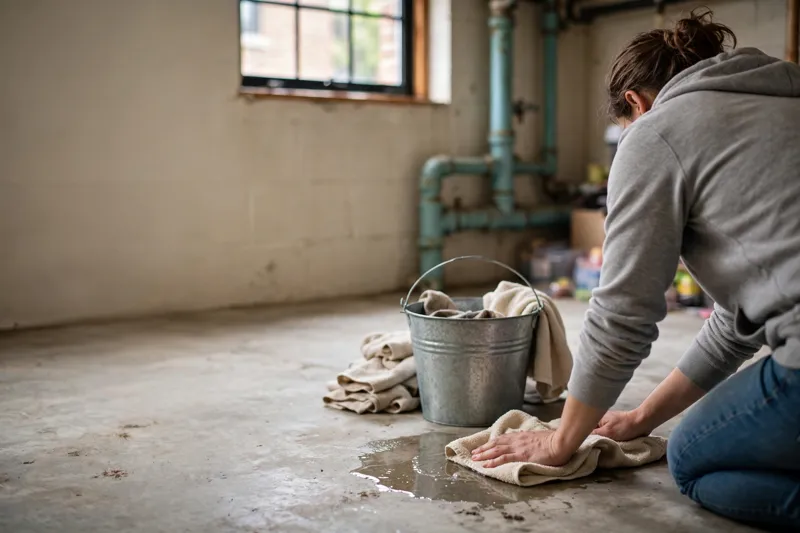
One small area on a hard surface, tile, concrete, sealed wood, that you can see all of, and reach all of, without moving a wall. A spill on a tile floor is the classic pass. A spill that ran under a cabinet, behind a wall, or under a floor fails the condition, because the water you cannot see is the water you cannot dry. A finished basement fails it too, because the carpet and the pad hide the water and hold it.
Condition three: caught within a day
Caught within a day, hours, not days. Mold can start within one to two days on a wet surface, and the drying that would have taken a weekend takes weeks once the mold has grown and the framing has soaked. A leak you found this morning is a different job from a leak you found on Monday that started on Friday, and the second one has already used up its window.
Condition four: nothing soaked into the drywall, the baseboards, or the pad
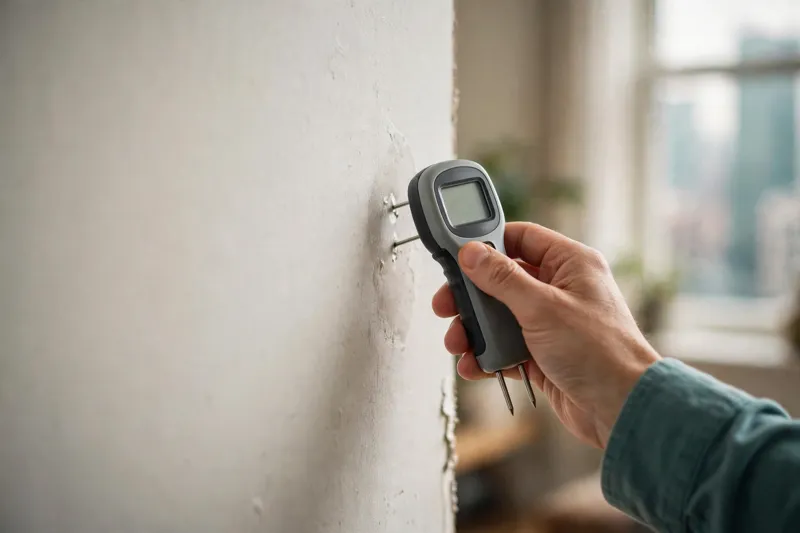
Nothing soaked into the drywall, the baseboards, or the pad. Push the meter into the baseboard and the wall above it: if either reads wet, the water is inside the wall, and the wall has to come open. A wall that reads wet is not a surface job, and a pad that stayed wet does not dry in place. The screwdriver test from the video watched for this page does the same job without a meter: push a screwdriver into the drywall, and if it sinks in, the drywall is wet and it comes out.
The two tests agree, and they agree for the same reason, a claim-sized job has spread further than a homeowner can see, and the adjuster will want readings, photographs, and a file, which is the same file a professional builds as part of the job. The test also answers should I hire a professional for water damage: yes, the moment any one of the four conditions fails.
Twelve mistakes that turn a small job into a mold job
They are the spine of this page, because each one is a job that started small and ended as a mold job a few weeks later.
1. Stopping when the surface feels dry
The biggest mistake, and the one every guide names first. The surface dries in a day; the framing, the subfloor, and the pad take days longer, and a homeowner who stops at the surface leaves the water inside. Dry to the readings, not to the touch, the meter is the test, and the dry room is the reference.
2. Household fans instead of a dehumidifier
A household fan moves air; it does not remove moisture. A wet house needs commercial air movers and a dehumidifier that drains itself, running together, because the air has to carry the moisture out of the materials and the dehumidifier has to take it out of the air. Fans alone leave the humidity high, and high humidity is mold weather.
3. Waiting too long to start
A day of waiting is a day of mold growing. The drying that starts within hours takes days; the drying that starts after a weekend takes weeks, and the framing has soaked by then. Start the extraction the same day, even if the full drying has to wait for rented equipment.
4. Ignoring the source
Drying a house while the leak still runs is drying a house that keeps getting wet. Stop the source first, the main valve, the appliance shutoff, the heater valve, and note the time you stopped it. A job you cannot stop at the source is not a do-it-yourself job.
5. No documentation before the cleanup
Photograph everything before anything moves, and take moisture readings with the dates. The claim runs on the file you build in the first hour, and a cleanup with no photographs is a cleanup with no proof. The most repeated question behind this page was what not to say to an adjuster, and the answer is to let the file speak, which needs a file.
6. Leaving wet materials and pad in place
Wet pad does not dry in place, wet insulation does not dry in place, and wet drywall does not dry in place. Pull the pad, pull back the carpet, cut out the wet drywall, and take out the wet insulation, the materials that stay wet are the materials that grow mold, and no amount of fanning dries them where they sit.
7. Bleach on porous surfaces
Bleach on a hard surface helps. Bleach on drywall does not, because the mold sits below the surface and the bleach stays on top. A video watched for this page sprays a bleach-water solution on bare wood and waits about a week until it no longer smells, on wood, after the wet drywall is already out. On drywall, the answer is to cut it out, not to spray it.
8. Running the HVAC, or opening windows on a humid day
Running the heating and cooling system through a wet house spreads the moisture and the spores through the ducts, and opening the windows on a humid Chicago day brings wet air in faster than the dehumidifier takes it out. Keep the system off until the house is dry, and keep the windows shut while the dehumidifier runs.
9. Doing major extraction yourself
A wet vacuum handles a spill. It does not handle a flooded basement, a soaked subfloor, or water under a floor, that is extraction equipment, and it is a professional's job. A basement pumped dry in one go can push the walls in, and the staged pumping in the steps section below is the safe way to take the water out.
10. No moisture meter at all
A job with no meter is a job that guesses, and a house that is guessed dry is a house that grows mold. The meter is the cheapest tool in the whole job, and it is the only one that tells you when to stop. Rent the big pieces and buy the meter, it is the tool that decides the job.
11. Turning up the heat
Heat does not dry a house, it warms the water, feeds the mold, and pushes the moisture deeper into the framing. The drying runs on air movement and dehumidification, not on temperature, and a hot wet house grows mold faster than a cool wet house. Keep the heat at its normal setting and let the dehumidifier do the work.
12. Scrubbing the carpet instead of blotting
Scrubbing pushes the water deeper into the carpet and the pad, and spreads whatever the water carried with it. Blot, extract, and lift, and when the pad is wet, lift the carpet and take the pad out. A carpet that was scrubbed is a carpet that stays wet longer, and a carpet that stays wet is a carpet that grows mold.
Ten square feet and one hundred square feet: two different limits
The most confusing numbers in this whole subject are ten square feet and one hundred square feet, and the confusion is that they sound like two versions of the same limit.
Ten square feet is the mold limit
Ten square feet is the mold line. The ten-square-foot line is about mold growth, how much of it there is, and who should remove it. It says nothing about how much water there was, or how far the water spread, or whether the framing is wet. A mold patch under ten square feet on a dry wall is a different job from a mold patch under ten square feet on a wall that is still wet inside.
One hundred square feet is the water-damage area limit
One hundred square feet is the water-damage area limit. The hundred-square-foot line is about the water: how much of it, how far it spread, and whether a homeowner can see all of it and dry all of it.
Why the two get confused, and how to keep them apart
One engine's follow-up says to call a professional when the mold is over ten square feet; another engine's answer says to call one when the damage is over fifty to one hundred square feet, and a reader who does not know which is which takes the smaller number for the bigger job, or the bigger number for the smaller one.
The way to keep them apart is to ask two questions, not one: how much mold is there, and how much water was there. The mold question answers with ten square feet. The water question answers with about one hundred. A job that fails either limit is a professional job, and a job that passes both is still only a do-it-yourself job if the water is clean, the area is small, it was caught fast, and nothing soaked in.
The timing has the same confusion, and it deserves the same separation. Starting and becoming visible are not the same moment, and one engine's answer says both in the same paragraph: visible mold in forty-eight to seventy-two hours, and mold forming in twenty-four to forty-eight. The start is the one that matters, because the drying that stops the start is the drying that starts within the first day. The same confusion is why can I do water damage restoration myself has no single-number answer: the answer is two numbers, and the job fails if it breaks either one.
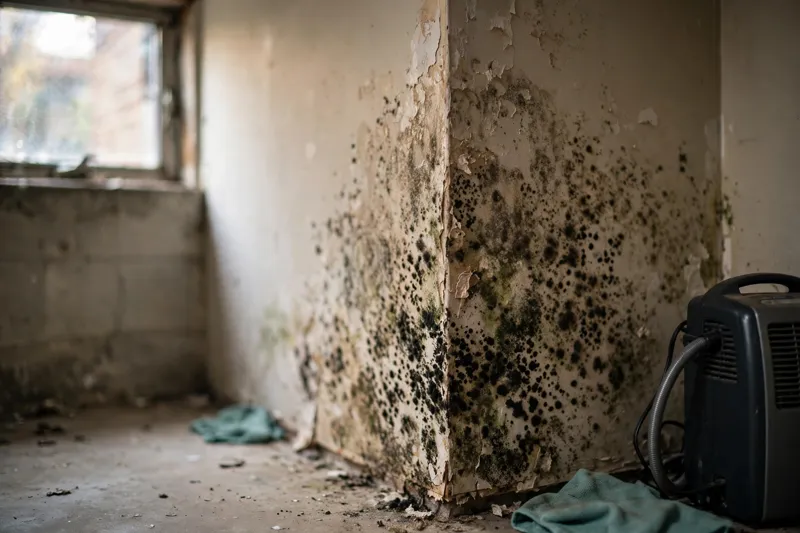
The equipment that actually dries a house
Extraction: the wet vacuum and the pump
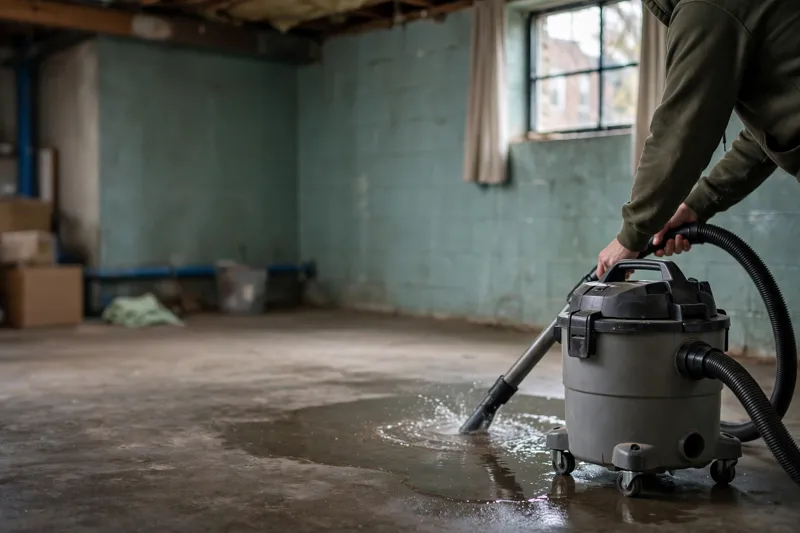
Extraction is the first category, and it is the one a homeowner usually owns already: a wet vacuum for a spill, a pump for standing water. A wet vacuum is for water; a household vacuum is not, and using one on water is dangerous. A pump takes the standing water out of a basement, in stages, about a foot, then a pause for a day, then more only if the level has not risen again. The extraction is the fastest part of the job, and it is also the part where a homeowner is most likely to stop too soon, because the water they can see is gone and the water they cannot see is still there.
Air movers: not household fans
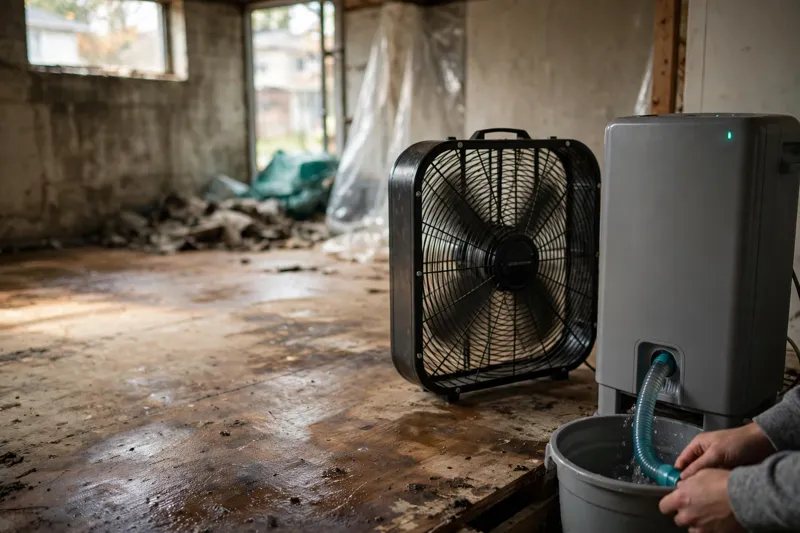
Air movers are the second category, and they are not household fans. A commercial air mover pushes a fast, focused stream of air across a wet surface and into the wall cavity; a household fan stirs the room. The guides agree on the difference, and the videos agree with them: a box fan aimed at a wet wall is the emergency stopgap, not the drying. Rent the air movers for the weekend job, and run them with the dehumidifier, not instead of it.
Dehumidifier: the one that does the work
The dehumidifier is the third category, and it is the one that does the work. It pulls the moisture out of the air that the air movers pushed out of the materials, and it drains itself, so it runs while you sleep. A household dehumidifier is too small for a wet room; the rental unit is the size that matters. Keep the windows shut and the heating and cooling system off while it runs, because wet air coming in through a window is work the dehumidifier has to do twice.
Moisture meter and hygrometer: the proof
The moisture meter is the fourth category, and it is the cheapest tool in the whole job. A pin meter gives a number, and the number is compared with a dry room that never got wet. A hygrometer measures the humidity in the air, and the drying is done when the humidity holds steady between thirty and fifty percent and the readings stop falling over a full day of checks. Rent the big pieces, and buy the meter, it is the tool that tells you when to stop, and a job with no meter is a job that guesses.
The rental question comes up in every guide, and the answer is the same in all of them: renting the big pieces for a weekend job makes sense, and the rental cost on a small job can run close to the cost of a professional mitigation visit, which is why the decision is not about the rental, it is about the four conditions. Searches for diy water damage cleanup cost return the same rental question in different words. A job that passes the test is worth the rental. A job that fails the test is not worth the rental, because the rental does not fix the hidden moisture, and the hidden moisture is the job.
The first hour: what to do, and in what order
The first hour decides the claim and the drying, and the order is safety first, then the water, then the photographs, then the calls. The order matters, because a safe house with a paper trail is a different home from a wet house with no record, and the most repeated question behind this page was what not to say to an adjuster, which is a question about the file, and the file starts here.
Make the house safe first
Keep people and pets away from a sagging ceiling, and do not poke it to see what comes out, a ceiling full of water can come down in one piece. Treat electricity as a hazard: do not touch wet fixtures, outlets, or switches, shut off the affected circuit only from a dry location, never enter standing water to reach a panel, and leave the house if there is a gas smell. If the water may be sewage, leave the house and call for help, sewage is not a do-it-yourself job at any size.
Stop the water, then photograph everything
Stop the source, the main valve, the appliance shutoff, the heater valve, and note the time you stopped it. Photograph the water, the stains, the walls, the flooring, and the source before anything moves, and take moisture readings in the wet area and in a dry room, with the dates. List the damaged belongings before they are moved, because the list is part of the claim, and a list written after the cleanup is a list the adjuster has to take on trust.
Call the insurer the same day
Call your insurer the same day, get a claim number, and ask what the policy needs from you. Tell them the cause was sudden, and send the photographs you took. Keep every receipt from this point on, the rental receipt included, because the adjuster may ask what was done and when. The claim runs on the file you build in the first day, and a house with a paper trail is a different home from a house with paint over a wet wall.
The warning does not mean a homeowner cannot touch anything, it means the documentation matters twice, once for the drying and once for the claim. Photograph first, dry second, and keep the readings.
DIY and insurance: what the policy pays for, and what it does not
A burst pipe, a failed water heater, an appliance hose that gave way, those are the covered cases, and the policy pays for the drying and the repair, less the deductible and up to the limits. A slow leak that ran for months, groundwater seepage, flooding from outside, and wear and tear are not covered, and the failed pipe or appliance itself is usually not paid for, only the resulting damage.
The cause is what the claim turns on, and the documentation is what proves the cause. A sudden leak with photographs, moisture readings, and dates is a sudden leak. A leak with no photographs and no readings is a story, and the adjuster works from the file, not from the story. The contents coverage is weaker than the dwelling coverage, and a sewer backup needs its own endorsement, without it, the backup is not covered at all, however sudden it was.
It is the same answer this page gives to can I do water damage restoration myself when the damage is big enough to claim: hand it over early.
The two tests in this page agree, and they agree for the same reason, a claim-sized job has spread further than a homeowner can see, and the adjuster will want readings, photographs, and a file, which is the same file a professional builds as part of the job. The question of when to call a professional for water damage is answered by the same test: the moment any one of the four conditions fails.
The warning behind the line is the Illinois Insurance Fact Sheet: improper homeowner remediation may not be covered, so a do-it-yourself job that makes the damage worse can cost the claim as well as the repair.
Two programs that homeowners confuse with insurance do not pay for the drying, and neither of them is a substitute for a claim. The Flood Assistance Repair Program helps owner-occupants of single-family or two-unit homes on the West Side only, for basement damage from the 2023 or 2024 floods, with registration from the end of November to the middle of December 2026. The Disaster Relief Assistance Program pays rent, mortgage, or utilities, not repairs, for households affected between January 2025 and January 2027, under three federal disaster declarations. And the program homeowners keep asking about, a city subsidy for basement flooding, does not exist: the city's own site carries no fifty-percent subsidy, and twenty consecutive checks of the city's pages found no such program.
Renters have a different split, and it belongs in this section because the do-it-yourself question comes up most in rentals. Renters are liable only for damage they caused or failed to report, negligence, misuse, or a leak they never told the landlord about. The building itself, the walls, floors, and pipes, is the landlord's, and so is the plumbing that serves the unit. Renters insurance covers the renter's belongings when the cause was sudden and accidental, and a renter who dries a landlord's wall without telling the landlord is a renter who owns the mold that follows.
The Chicago version: finished basements
Chicago's housing stock makes the do-it-yourself question harder than it is in most American cities, and the reason is the basement. The finished basement is the most common DIY trap in the city: carpet and pad over concrete, drywall over framing, and a homeowner who dries the carpet and calls the job done, while the pad below it stays wet, the drywall behind it stays wet, and the framing stays wet for weeks.
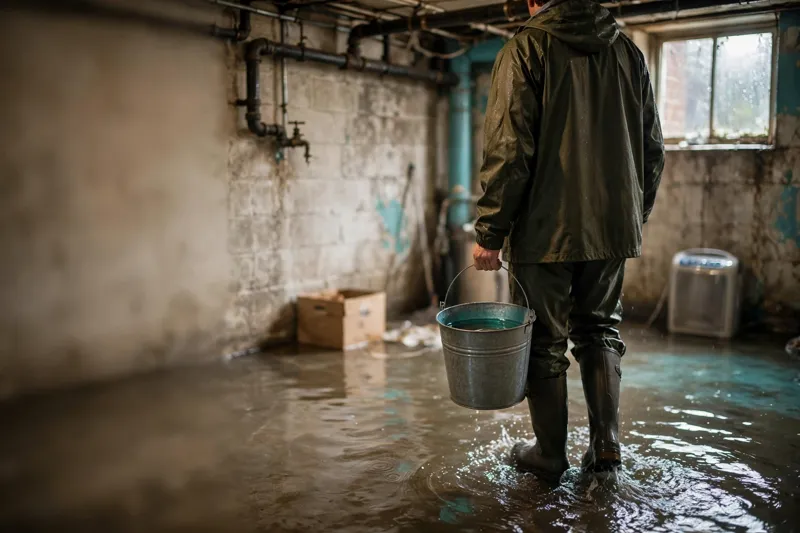
The combined sewer is the reason the Category 3 rule matters more here than anywhere else. Water that came back through a drain or a sewer is contaminated, and contaminated water is never a do-it-yourself job, not at any size, and not even when it looks clean. A basement flood after a storm is a professional job, and the first call is not to a rental shop, it is to 311, to report the flooded basement, and to the insurer, to start the claim. The staged pumping in the steps section below is the safe way to take the water out: about a foot, then a pause for a day, then more only if the level has not risen again.
The plaster walls in the older homes are the second trap. Plaster holds water longer than drywall, it hides the moisture behind a hard surface, and it cracks and pulls away from the lath when it dries unevenly. A screwdriver pushed into wet plaster sinks in, and the wall that reads wet behind the plaster has to come open, the plaster is not the surface to dry, it is the surface to remove. The hardwood floors are the third trap, and they belong to the next blog in this series: a cupped or buckled floor means the subfloor is wet, and the subfloor is the job, not the floor.
The bungalows and the Cape Cods are the houses the finished basement comes with: shallow lots, low basements, and insulation that stops short of the eaves, and the greystone top floors get their ceiling stains near the outside wall, where the water finds its way inside after a thaw. The pattern is the same in all of them: the older the house, the more the water hides, and the more the do-it-yourself job misses. That is the moment most Chicago homeowners stop asking can I do water damage restoration myself and start asking who to call.
How to dry out water damage yourself in your Chicago home
Seven steps, in order. The first one that proves a leak decides the job, and the file you build in the first hour decides the claim.
Make it safe first
Shut off the power to any room with standing water, from a dry location, never walk through water to reach the panel. If the water may be sewage, or if there is a gas smell, leave the house and call for help. A safe house with a paper trail is a different home from a wet house with no record, and safety comes before the buckets.
Stop the water at the source
Find the source and stop it: the main valve for a supply line, the shutoff for an appliance, the water heater valve for a heater leak. A job you cannot stop at the source is not a do-it-yourself job, because the water keeps coming while you dry. Note the time you stopped it, and photograph the valve and the leak before anything moves.
Photograph and measure before anything moves
Photograph the water, the stains, the walls, the flooring, and the source, and write down when it started. Take moisture readings in the wet area and in a dry room that never got wet, and keep both sets of numbers with the dates. The claim runs on the file you build in the first hour, and a house with readings is a different home from one with paint over a wet wall.
Get the standing water out
Remove the standing water with a wet vacuum or a pump, and mop up what is left. In a basement, pump in stages: take out about a foot, pause for a day, and take more only if the level has not risen again, pumping a flooded basement dry in one go can push the walls in. A wet vacuum is for water; a household vacuum is not, and using one on water is dangerous.
Pull what stays wet
Pull back the carpet and lift out any pad that stayed wet, because wet pad does not dry in place. Remove baseboards and cut out drywall that reads wet, about forty-eight inches up, to doorknob height, so the framing behind it can dry. Wet insulation comes out too, because it does not dry in place and it does not insulate while it is wet.
Dry to the readings, not to the touch
Run commercial air movers and a dehumidifier until the pin-meter readings match the dry room, not until the surface feels dry, a wall that feels dry on the surface can still be wet inside. Check the readings every day, and keep the dehumidifier running until the numbers stop falling. The reading, not the calendar, decides when the drying is done.
Decide: keep going or call a professional
Run the four-condition test again at the end of the first day: clean water, one small area, caught fast, nothing soaked into the drywall, the baseboards, or the pad. If the job still passes all four, finish it and keep the readings with the claim file. If it fails any one of them, stop, photograph what you did, and call a professional, a job handed over early costs less than a job handed over late.
The do-it-yourself checklist
- Four-condition test run before starting, clean water, one small area, caught fast, nothing soaked in
- Power off from a dry location, never walk through standing water to reach the panel
- Source stopped and the time noted, before any drying starts
- Photographs and moisture readings taken before anything moves, with the dates
- Standing water out with a wet vacuum or a pump, basement pumped in stages, a foot at a time
- Wet pad, wet insulation, and wet drywall pulled, cut at doorknob height where the wall reads wet
- Air movers and a dehumidifier running together, windows shut, heating and cooling system off
- Readings checked every day against a dry room, drying stops when the numbers match, not when the surface feels dry
- Four-condition test run again at the end of the first day, any failure means stop and call
- Insurer called the same day, claim number written down, receipts kept
- Ten square feet and one hundred square feet kept apart, the mold limit and the water limit are two different numbers
- First hour handed off to the frozen-pipe guides and the who-to-call guide
Run through the whole list before you start, and run it again at the end of the first day, most do-it-yourself jobs fail on the second run, when the wall reads wet.
Call now, we answer 24/7
If you are still asking can I do water damage restoration myself after running the test, call (773) 570-9869. We will ask what you saw, tell you what to check tonight, and send a crew with a meter when the job needs one.
Frequently asked questions
Can I do water damage restoration myself?
Yes, sometimes, when the water is clean, the area is small, you caught it fast, and nothing soaked into the drywall, the baseboards, or the pad. That is the whole test. Anything bigger, dirtier, slower, or hidden belongs to a professional, and this page walks you through the four conditions one by one.
Does homeowners insurance cover water damage restoration, or only part of it?
It covers only part of it. The policy pays for the drying and the repair when the cause was sudden and accidental, up to your limits, minus your deductible. It does not pay for the pipe or the appliance that failed, or for flooding from outside. A sewer backup needs its own endorsement.
How long does water damage restoration take?
Drying takes three to five days on most losses, and the job with repairs usually takes one to three weeks. The reading, not the calendar, decides when the drying is done.
What is water damage restoration called?
The full job, stopping the water, drying the structure, cleaning, and rebuilding, is called water damage restoration. The emergency half, stopping the water and drying, is also called mitigation. Removing mold growth is a separate job, called remediation, and it follows the drying, never the other way around.
Does insurance cover water damage restoration?
Yes, when the damage was sudden and accidental, a burst pipe, a failed water heater, an appliance hose that gave way. The claim runs in order: call the insurer, photograph everything, start the drying, and keep the receipts. The adjuster works from the readings and the photos, so the file you build in the first day decides the claim.
What is the water damage restoration process?
The process runs in order: inspection first, to find the source and how far the water spread; then extraction, with pumps and vacuums; then drying, with air movers and dehumidifiers; then cleaning and sanitising; then the repairs. Dry the floors, walls and framing fast to stop mold, and document everything.
Does homeowners insurance cover water damage?
It covers water damage when the cause was sudden and accidental, a burst pipe, a failed appliance, a supply line that gave way. It does not cover a slow leak that ran for months, groundwater seepage, flooding from outside, or wear and tear. Read the declarations page before the storm, not after it.
What should I do when my house floods?
Stop the water and make it safe first. Shut off the main valve, cut the power to any room with standing water, and do not walk through water that may be sewage. Call 311 to report a flooded basement, photograph everything before anything moves, and start the drying within the first day.
How much does homeowners insurance pay for water damage?
No page can give you a number, because the payment depends on your policy, your deductible, the cause, and the limits you bought. The insurer pays the drying and the repair, less your deductible, and it does not pay for the pipe that failed.
Are renters responsible for water damage?
Renters are liable only for damage they caused or failed to report, negligence, misuse, or a leak they never told the landlord about. The building itself, the walls, floors, and pipes, is the landlord's, and so is the plumbing that serves the unit. Renters insurance covers the renter's belongings when the cause was sudden and accidental.
How much does a plumber charge for a burst pipe?
This site prints no prices, so no figure here can mislead you. The charge depends on where the pipe sits, how hard it is to reach, whether the wall or the floor must come out, and whether the call is an emergency at night. The water damage the burst caused is usually the bigger part of the bill.
Does insurance cover burst pipes?
Yes, when the pipe burst suddenly, a freeze split, a joint that failed without warning, a line that gave way all at once. The insurer pays for the water damage the burst caused, not for the pipe itself. A slow leak that ran for months may be classed as wear and tear, and the claim may fail.
How much does it cost to fix a burst pipe?
This site prints no prices, so no figure here can mislead you. The cost depends on the pipe's location, the access, the material, and the water damage the burst caused, the drying and the rebuild are usually the bigger part. A camera or a moisture reading comes first, then a written scope.
How much does mold remediation cost?
This site prints no prices, so no figure here can mislead you. The cost depends on how much mold there is, where it sits, whether the wall must come out, and whether the moisture source is fixed first. Illinois now registers mold remediation work, with a grace period for existing workers, this site gives consumer guidance only.
Can mold be fully remediated?
Mold can be remediated to safe, normal levels, but no job removes every spore, spores are everywhere, indoors and out. Fully remediated means the moisture source is fixed, the growth is removed, the area is cleaned and dried to the readings, and the humidity stays in the normal range. A job that skips the source is not finished.
When should I call a professional instead of doing water damage restoration myself?
Call one when the water is not clean, when it reached the walls, the subfloor, or more than one room, when it sat for more than a day, or when anyone in the house has asthma or a weak immune system. A job big enough to claim on insurance is a professional-sized job.
Is DIY water damage cleanup safe?
It is safe only for a small, recent, clean-water spill on a hard surface you can dry in a day, with the power off and no one in the house who is vulnerable. Sewage, floodwater, a soaked wall, or a wet ceiling is never a do-it-yourself job. Treat water you cannot identify as sewage and call a professional.
What are the biggest mistakes people make drying water damage themselves?
The biggest is stopping when the surface feels dry, while the framing and the subfloor are still wet. Next come household fans instead of a dehumidifier, no moisture meter at all, waiting a day to start, and never photographing anything before the cleanup. Each one turns a small job into a mold job a few weeks later.
What equipment do I need to dry water damage myself?
Four things: something to extract the water, such as a wet vacuum or a pump; commercial air movers, not household fans; a dehumidifier that drains itself; and a pin moisture meter to prove the materials are dry. Rent the big pieces, and buy the meter, it is the tool that tells you when to stop.
How do I know if my DIY drying actually worked?
Take pin-meter readings in the wet area and in a dry room that never got wet. The drying worked when the wet readings match the dry ones, the humidity holds between thirty and fifty percent, the readings stop falling over a full day, and there is no damp smell, no soft spot, and no condensation. Touch alone proves nothing.
What not to say to insurance adjuster water damage?
Do not call the damage minor before anyone has measured it, do not say you waited days to start drying, and do not admit the leak had been running for months. Say what happened, when it started, and what you did, and show the photos and the readings. The file you hand over is the claim.
Can water damage be restored?
Yes, in almost every case, when the source is stopped and the structure is dried properly. Clean water caught early usually leaves the house as good as before. Sewage, a long slow leak, or months of wet framing costs more to fix, and some materials, soaked pad, swollen particle board, moldy drywall, are removed rather than restored.
Will water damage go away on its own?
No. Water never dries itself out of drywall, framing, and subfloor, it sits there, wicks further in, and grows mold within one to two days. A small spill on tile dries on its own. A wet wall, a wet ceiling, or a wet basement does not, and every day you wait turns a drying job into a rebuild.
How do you know if water damage is serious?
It is serious when the water is not clean, when it reached a wall, a ceiling, or more than one room, when the floor or the ceiling sags, or when the power is wet. A stain that grows, a smell that stays, and a wall that feels soft are the three marks that mean call a professional today.
What kills mold from water damage?
Drying kills it, in the practical sense: mold cannot grow without moisture, so a dry house stops it. A crew removes the growth, cleans the area, and dries it to the readings, then fixes the leak that fed it. Bleach on a hard surface helps; bleach on drywall does not, because the mold sits below the surface.
Can I repair water damage myself?
You can repair the small, clean, early kind: a spill on tile, a damp baseboard that dries in a day, a surface that never soaked through. You cannot repair sewage damage, a soaked wall cavity, or a ceiling that sags, those are professional jobs, and starting them yourself usually means paying twice.
How long does it take for black mold to appear after water damage?
Growth can start within one to two days on a wet surface, and it becomes visible within about two to three days, depending on the warmth and the material. The two numbers are often confused: starting and becoming visible are not the same moment. Dry the materials within the first day and the question never comes up.
How expensive is it to fix water damage in a house?
This site prints no prices, so no figure here can mislead you. The cost depends on how much water there was, whether it was clean or contaminated, how far it spread, and how long it sat. The drying is usually the smaller half of the job; the rebuild, drywall, flooring, trim, is the bigger half.
Sources
- DRI Gulf Coast, “DIY vs. Professional Water Damage Repair: When to Call the Experts” (18 October 2024, updated 10 November 2026), the drying-is-the-part-DIY-gets-wrong guide, five visible questions.
- Texas Certified Restoration, “Water Damage Cleanup: When to DIY vs Hire Professionals” (updated 5 May 2026), the quick-decision table guide, four visible questions.
- Keystone and RestoreAdvisor, restoration guides, the four-condition test, the fifteen-percent moisture-meter dry standard, and the line that touch is not a dryness test.
- Home RenoVision DIY, “Water Damage? Do This BEFORE Mold Takes Over” (YouTube, 10:38, seventy-eight thousand views), the video watched in full for this page, with the screwdriver wet test and the drywall cut at doorknob height.
- All Dry Services of Miami, “DIY Water Damage Restoration: Can You Do It Yourself?” (YouTube, 5:25, a hundred and thirty-one views), the video watched in full for this page, with the three water categories and the wet vacuum.
- Illinois Department of Public Health, mold questions and answers, the professional line above ten square feet, and the Part 835 registration with its grace period to the end of September 2027.
- City of Chicago, CHI311, the 311 line, twenty-four hours a day, seven days a week, three hundred and sixty-five days a year, and the (312) 744-5000 number in the site footer.
- City of Chicago, Flood Assistance Repair Program, the West Side only program for basement damage from the 2023 or 2024 floods, with registration from the end of November to the middle of December 2026.
- City of Chicago, Disaster Relief Assistance Program, the rent, mortgage, and utilities program for households affected between January 2025 and January 2027, under three federal disaster declarations.
- People Also Ask questions quoted in this page, with the search record given in the text.
More Restoration Services in Chicago
Every service below is one tap away. Pick the one that matches your problem.

Water Damage Restoration
Fast water extraction, structural drying, and full repair after burst pipes, leaks, and floods.
Learn more →
Water Mitigation
Emergency water removal, structural drying, and mold prevention to stop the damage fast, 24/7.
Learn more →
Mold Remediation
Safe, contained mold remediation that removes contamination and fixes the moisture source.
Learn more →
Sewage Cleanup
Safe removal and disinfection of dangerous sewage backups and black water.
Learn more →
Flood Cleanup
Water pumped out, structure dried, and debris cleared fast after storms and flooding.
Learn more →
Hardwood Floors Water Damage
Cupped, buckled or stained hardwood after a leak? How we dry it, when sanding saves it, and when the boards have to go.
Learn more →