Basement Flooding Chicago Who to Call First
Your basement is flooding in Chicago, and the question is basement flooding Chicago who to call first: 311, a plumber, a drainlayer, or a restoration crew? The answer depends on where the water came from, and the wrong first call costs you time, money, and in one Bronzeville case, a reimbursement. This post gives you the order, cause by cause.
- 311, plumber, drainlayer or restoration crew, the order for each cause
- The Chicago 311 "Water in Basement" process, step by step
- What to tell each caller, and what to photograph first
- Real Chicago cases, with the call each homeowner actually made
Written for Chicago homeowners, the combined sewer, the 311 process, the drainlayer licence, and the city programmes, checked against the city site.
- We answer 24/7
- Local Chicago team
- Insurance documentation help
- Straight answers, no pressure
Have a question? Call us any time
Tell us where the water is and we will call you back. We answer 24/7.
Basement flooding Chicago who to call, the short answer
The short answer is that there is no single first call, and any page that gives you one is guessing. The first call depends on the cause, and the cause is usually obvious within a minute: water still running from a pipe, sewage coming up through a floor drain, a sump pump that stopped, or storm water from outside. Each cause has its own first call, and the table below is the whole answer to basement flooding Chicago who to call, in one place.
Two rules hold for every cause. First, danger comes before everything: gas smell, sparking, or water at the electrical panel means 911 from outside, before any other call. Second, the water must stop before the drying can start. That is why the order matters: the plumber stops the water, the crew dries the house, and 311 records the flood so the city knows the sewer surcharged. For emergency basement flooding Chicago homeowners face at night, the order does not change, only the urgency does.
| What is happening | First call | Second call | Also do this |
|---|---|---|---|
| Burst pipe, water still running | Plumber | Restoration crew | Turn off the main valve; photograph everything |
| Sewer backup, city main suspect | 311 | Plumber, then a crew | Stay out of sewage water; keep the report number |
| Sewer backup, your line only | Plumber | Restoration crew | Call 311 anyway, for the record |
| Sump pump failed | Plumber or sump pro | Restoration crew | Check the discharge line for ice |
| Storm water, no sewage | Restoration crew | 311 report | Waterproofing comes later, after drying |
| Gas smell, sparking, water at the panel | 911 from outside | Electrician or gas utility | Do not go in to flip a breaker |
Flooded basement help starts with the first call, not with the mop. Who to call for a flooded basement is the question this post answers, and the rest of the post is the evidence for the table: the Chicago cases that prove the order, the 311 process, the drainlayer's job, and what each caller needs to hear. The service page for the work itself is our flooded basement Chicago page, and the sewage page is our sewage cleanup Chicago page.
What to do in the first hour after your basement floods in Chicago
What you do in the first hour decides how much of the house is saved. The seven steps below are the whole of it, and they are the same whether the water came from a burst pipe, a sewer backup or a storm. The national guides give you a first-hour list, but none of them is a Chicago list: none mentions 311, and none mentions the drainlayer. This one does both.
Call us first.
Call (773) 570-9869 any time, day or night. Tell us where the water is and whether it smells of sewage. We answer 24/7 and talk you through the first hour while a crew is on the way.
Stop the water at the source.
Turn off the main water valve if the water is coming from a pipe. If you cannot see the source, say so, a leak can travel ten feet or more from where it enters.
Stay out of the water while the power is on.
Water carries current from a panel, a socket or an appliance. Keep clear of the flooded area until the power is off at the main breaker or a technician has cleared it.
Do not touch the water with bare hands.
Flood water is not clean tap water. It can carry sewage, chemicals and bacteria. Wear rubber boots and gloves, wash your hands well, and keep children and pets clear until the water is gone.
Lift what you can save and photograph everything.
Move rugs, boxes and furniture to dry ground. Photograph the water line and every damaged item before you move it.
Call 311 if the sewer or street flooded.
Call 311 when the water came up through a floor drain, when the street filled, or when several houses on the block flooded at once. A 311 report is how the city learns a sewer surcharged.
Let the drying run until the readings say dry.
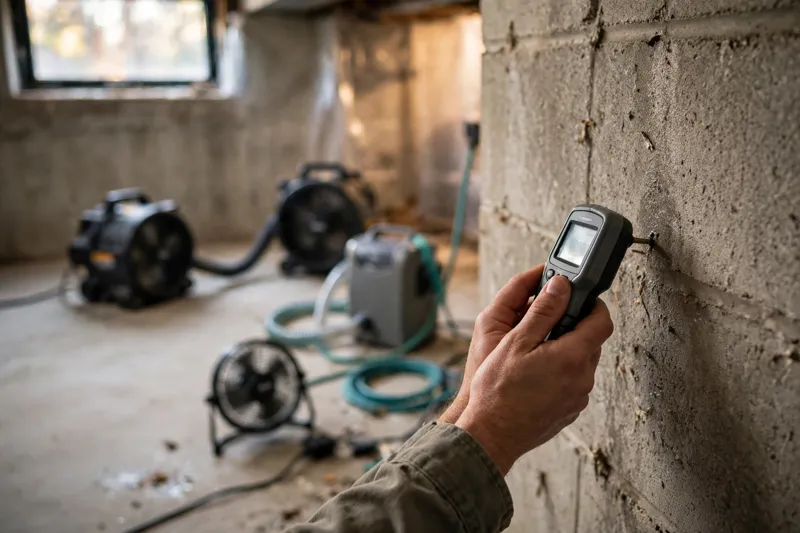
Keep the air movers and dehumidifiers running, and do not close the walls until a moisture meter says they are dry. We read every wall and floor and write the readings into a drying log.
Who to call for basement flooding Chicago: the call map
The question this post answers is simple: basement flooding Chicago who to call, and in what order. The answer is a map, not a single name, because the water in a Chicago basement comes from five different places, and each one has its own first call. Read the cause that matches your basement.
Burst pipe who to call
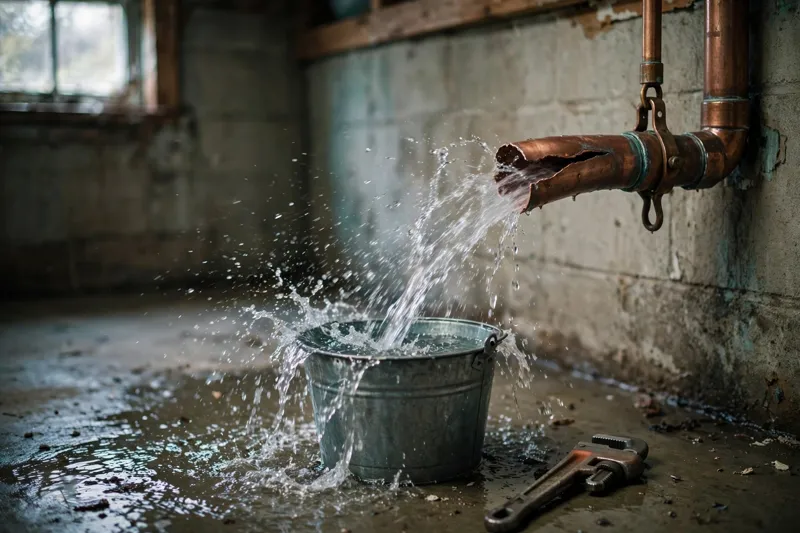
A burst pipe is the one cause where the plumber comes first and there is no argument about it. The pipe split, usually from freezing, and the water is still running. Turn off the main water valve if you can reach it safely, then call a plumber. The plumber cuts out the split section and puts in a new one. Then call a restoration crew: the plumber stops the water, but the plumber does not dry the house, and a wall that stays wet grows mold.
Who to call for a flooded basement after a burst pipe is therefore two people, in order: the plumber, then the crew. In the first thirty minutes: stop the water, stay out of the water while the power is on, lift what you can save, and photograph everything before you move it.
Sewer backup Chicago who to call
Who to call for sewer backup is the question Chicago homeowners ask most after a storm, and the answer starts with a judgement call: is the main suspect, or is it your line? Call 311 first when the main is suspect, the street flooded, the neighbours flooded too, or the water surged up through the floor drain. Then call a plumber for your private line, then a restoration crew for the cleanup.
If the backup is plainly your line alone, one drain backing up on a dry day, no street water, no neighbours affected, call the plumber first, then the crew, and call 311 anyway so the report exists. Sewage is black water: stay out of it, and do not try to mop it yourself. The crew takes the wet material out, cleans and sanitizes the surfaces, and dries the room before anything goes back. Our sewage cleanup Chicago page covers that half of the work in full.
Sump pump failed, who to call
A sump pump stops for three reasons: the power goes out, the float switch sticks, or the discharge line freezes. In a cold snap the water in the discharge line freezes solid, the pump runs, and the water comes back into the pit. Call a plumber or a sump pump pro first, they fix the pump, clear the line, and fit a battery backup. Then call a restoration crew to extract the water and dry the basement to a meter reading. Check the discharge line after the first hard freeze: keep it clear of leaves and ice, and keep the outlet above the ground. A battery backup is the cheapest insurance a Chicago basement has.
Basement flood who to call, storm water and groundwater
Storm water is the cause with the simplest order: call a restoration crew first, then file a 311 report. The crew extracts the water and starts the drying the same day. Do not call a waterproofing company first: a basement that is still wet cannot be sealed, and a company that offers to waterproof a wet basement is selling you a job that will fail. The crew dries first, and the backwater valve, the defence that stops the next surcharge, is fitted once the basement is dry.
Water in basement who to call
Sometimes the cause is not clear, and that is normal: a leak travels ten feet or more from where it enters, and the water shows up two rooms away from where it started. Who to call for water in basement when you cannot see the source is still the same order, call us first at (773) 570-9869 and describe what you see: where the water is, how deep it looks, whether it smells of sewage, whether the street is flooded. We talk you through the first hour while a crew is on the way. Do not wait for the water to stop on its own. A basement that waits a night is a mold job.
Danger first, gas, sparking, water at the panel
Danger comes before every other call. If you smell gas, hear sparking, or see water at the electrical panel, stay out of the basement and call 911 from outside. Do not go in to flip a breaker while standing in water, water carries current, and a panel in a flooded basement is a live panel. Once the danger is cleared, the order starts again, plumber, crew, 311.
When NOT to call a restoration company first
A restoration company is the wrong first call in three cases. First, when the water is still running: call the plumber, the crew cannot dry a basement while water is still coming in. Second, when the backup is sewage and the main is suspect: call 311 first, the inspection decides whose pipe it is, and the city repairs a break in the public way at no cost. Third, when what you need is waterproofing: call the crew for drying first, and the waterproofing company after the basement is dry.
Does 311 fix a basement flood?
No. 311 does not physically pump out, clean, or repair a flooded basement. The pumping, the cleanup and the repair are your job, and a restoration crew does them.
What 311 does do is worth the call. File a Chicago 311 water in basement complaint and the report goes into the planning record for your block, it is how the city learns a sewer surcharged. A Department of Water Management crew can inspect the public mains, and if the break is in the public way, the city's Private Sewer Drain Program may repair it at no cost. From outside Chicago, the CHI311 site footer lists the number in dotted form, 312.744.5000, it does not appear on the Call Tips page. Keep the report number, and say whether the water came through a floor drain, whether the street flooded, and whether the neighbours flooded too.
311 basement flooding Chicago, what happens after you report
After you report, the city logs the complaint and can send a crew to inspect the public side: the street main, the catch basin, the sewer under the road. What the city does not do is enter your home and pump it out, and no inspector will dry your basement. The Metropolitan Water Reclamation District runs the deep tunnels and the treatment plants, and it issues overflow action alerts when the system is full. The alderman's page for the 47th Ward says an inspector typically visits within forty-eight hours, that is the alderman's page, not the city's, and this post prints it as the alderman's claim, not as a city fact. The city's own pages do not promise a time.
Is it your sewer line or the city's?
That is the question the inspection answers, and it is the question that decides who pays. Your line runs from your house to the street main. The city's line is the main under the street, and the public way between them. If the break is in the public way, the Private Sewer Drain Program may repair it at no cost, but you first hire a licensed sewer contractor to rod and video-inspect the drain. Start the process through CHI 311.
The 311 article from December 12, 2018 lays out the steps, and it carries a homeowner-cost figure of five thousand to ten thousand dollars for a repair the owner pays for himself. The department's two-page flyer says the programme can save on average between ten thousand and twenty thousand dollars, and that figure conflicts with the 311 article's figure, so this post cites neither as settled.
Drainlayer vs plumber vs restoration company, who does what?
The drainlayer is the caller no Chicago page names.
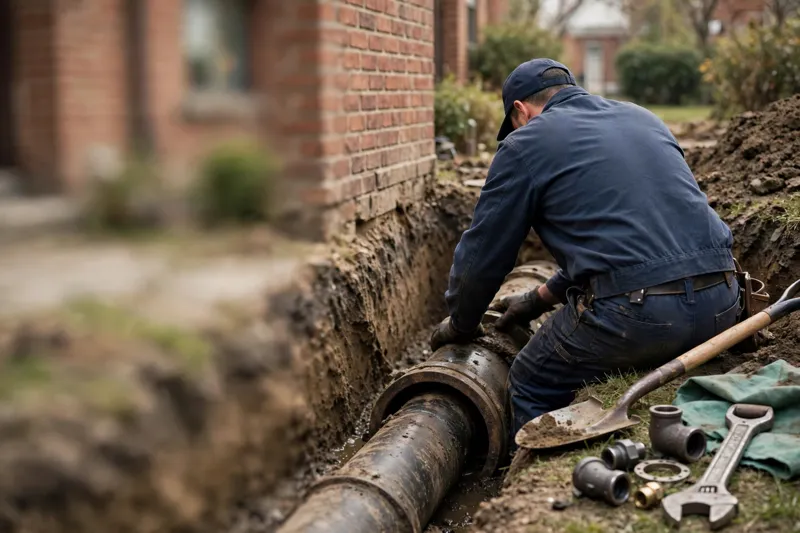
A plumber works inside the house: stops the source, replaces the split pipe, fixes the fixture, clears the drain inside the building. A plumber does not extract a flooded basement, does not dry walls to a meter reading, and does not work on the sewer under the street. A drainlayer works underground and outside: the main sewer line, the lateral under the yard and the public way, the pipe that connects your house to the street main.
Only a licensed drainlayer may work on a sewer in Chicago, and any work on the sewer lateral in the public way needs a permit. A restoration company extracts the water, dries the structure to moisture readings, documents the loss for the insurer, and repairs the rooms. The order is: plumber to stop the water, drainlayer to fix the underground line, restoration crew to dry and repair the house.
The drainlayer licence has been a courtesy licence from the Department of Buildings since January 1, 2022, and the calendar year 2026 fee is one hundred and fifty dollars, confirmed live in the January 2, 2026 notice, effective January 6, 2026. The classes are not in that notice, and the 2026 application form is still not retrievable, so this post prints the fee and nothing more from the notice.
The 2020 form carries a fee of one hundred and twenty-five dollars, classes A, B1, B2 and C, a fifty thousand dollar bond, and a three hundred thousand dollar insurance minimum, never merge the two years. Work of twenty feet or less, done in kind, is the exception. Contacts: the Department of Buildings, 312-744-3155,; the Department of Water Management Permit Section, 312-744-3155 or 312-744-3020; inspections, up to six inches 312-744-5503, eight inches and over 312-744-5502.
Ask the drainlayer to televise the lateral with a camera before the next storm: clay tile and cast iron laterals crack, shift and let tree roots in, and the roots block the line until sewage backs up into the basement.
When do you need a drainlayer instead of a plumber? When the problem is outside the house: a broken lateral under the yard, a collapsed line under the public way, a sewer that backs up every storm, a line that needs replacing rather than clearing. A plumber rods a drain. A drainlayer replaces a line. A trenchless pipe bursting job, replacing a broken sewer line by pulling a new pipe through the old one, with no open trench, needs a licensed drainlayer and a permit for the work in the public way. The two jobs are different jobs, with different licences, and the post that confuses them sends you to the wrong caller.
What happened to Chicago homeowners, and who they called
The cases below are the verified Chicago cases. Each one says who was called, or says plainly that the source does not say. No case here invents a call sequence. Taken together, they teach the lesson of this post: the order of the calls decides what the homeowner keeps.
Ginneh Strickland, Bronzeville, 2021, call the city first
Ginneh Strickland, a Bronzeville brownstone owner, had raw sewage seeping into her home for months, toilet paper and sanitary products coming in, a terrible smell in the basement and the garden units. She hired a plumber first, who replaced her pipes with underground digging in the backyard, at a cost of about six thousand five hundred dollars. Only afterwards was it determined that the problem was on the City of Chicago's end, not hers.
Chicago has a Private Drain Program that can reimburse homeowners up to twenty thousand dollars, but the homeowner must first pay a plumber to determine whether the backup is on the city side, and the city must witness the work. Because she had already fixed it, she was ineligible. Her warning: call the city first, and sign up for the program before any work starts. The call order itself cost her the reimbursement. CBS Chicago reported it on July 28 and 29, 2021.
Chrislin Flanagan, South Side, 2021-2026, plumbers, then the city
Chrislin Flanagan, on the 107th block of South Emerald, bought her home in 2019, and her basement flooded in 2021, 2022, 2023, and again in 2026, every February to April, including sewage. She spent more than twenty-six thousand dollars on plumbers, losses, and re-grassing. The plumbers blamed city-side pipes more than a century old. Her home has no direct drain to the street, so an extraction company must pump the water out. Who she called, in order: plumbers first, then an extraction company, then the City and the Private Drain Program. FOX 32 reported it.
Dwayne Baxter, Chicago Lawn, 2025, the insurer, then the city
Dwayne Baxter, a homeowner in Chicago Lawn, had his basement flooded for the second time that summer, when up to five inches of rain overwhelmed the sewers and the water backed up from his drain. He had just claimed for the first flood and had to claim again. He wants the city to do a better job managing the sewer system on the South Side. Who he called is not stated, the insurer, for the claim, and an appeal to the city. No plumber or restoration company is named. CBS Chicago reported it on August 18, 2025.
Ishmael, Chicago Lawn, 2025, 311
A Chicago Lawn homeowner named Ishmael had nearly three feet of water rush into his basement in a weekend storm, the second time in three weeks, with costs of around ten thousand dollars. He made an official 311 complaint to the city. The broadcaster's data team found nearly four thousand eight hundred water-in-basement complaints and two hundred and eighty-seven for water blocking streets since Sunday night, and the four communities most impacted were Chicago Lawn, Gage Park, West Lawn and Garfield Ridge.
Alderman Ray Lopez of the 15th Ward and five other Southwest Side councilmembers wrote to Mayor Brandon Johnson demanding a government-funded backflow-valve installation programme, saying there is enough money in the water and sewer funds. Who he called: 311, the City of Chicago. CBS Chicago reported it on August 19, 2025.
Rogers Park and Portage Park, September 2022, 311, nine hundred times
On September 11, 2022, seven inches of rain fell in one hour in Rogers Park, and an entire block had water in their basements, for residents who had lived there a decade, the fourth or fifth flood. One resident of twenty-five years said it was not just rainwater but sewage coming up from the floor drain and the toilet, which he had never seen before. Street water rose to almost mid-hubcap.
Over nine hundred calls to 311 for water in basements and on roads came from six neighbourhoods alone from Sunday to Monday morning, most from Portage Park and Edgewater. The storm ranked eighth for flooding calls; the worst was July 24, 2010. Who was called: 311. CBS Chicago reported it on September 13, 2022. The same storm flooded basements in North Center and West Ridge, the Friend family in North Center, water at calf height bubbling from the floor drains, and Nichole Vidal in a West Ridge garden flat. Neither report records who they called.
Elizabeth Belinga, Jefferson Park, 2023, second sewer backup
Elizabeth Belinga, in Jefferson Park, found her basement flooded with sewage water when her dryer alarm went off, though she was not doing laundry. It was the second time her basement had flooded, the first was in May 2020, when the sewer backed up while the family slept, and this time felt worse. Who she called is not stated in the report. Her next step was to clean the mess and look into digging up the basement. CBS Chicago reported it on July 3, 2023.
An unnamed Navy veteran, 2026, the city threatens, the community answers
A US Navy veteran, in his home for more than fifty years, says the city is telling him that if he does not fix the flooding problem they will take the house. Princess Shaw, founder of Light Up Lawndale, answers that he came to the right place, that he will not lose his home, and that she will walk alongside him. Who he called is not stated, the help offered is community support, not a contractor. The clip comes from the Sun-Times and WBEZ "SOAKED" panel of November 12, 2026, posted as a short around November 16, 2026.
The 311 record, 4228 North Leavitt Street
One more record belongs here, with its limits stated plainly. A 311 "Water in Basement Complaint" record exists for 4228 North Leavitt Street, second floor, in North Center, from the September 11, 2022 storm. It proves a 311 report was filed. It does not prove that 311 was the homeowner's first call, and it does not name a resident or confirm a depth or a cause. This post prints it as a complaint record, not as a call sequence.
The cases above show why the order matters, and why basement flooding Chicago who to call is a question with a different answer for each cause. Strickland called the plumber first and lost a reimbursement. Flanagan called plumbers first, then an extraction company, then the city. Ishmael called 311, and the city heard him. No news case on any platform names a restoration company as the answer to flooded basement Chicago who to call, the only call the cases name is the city, and the only warning they give is to call the city before hiring anyone.
Who pays for a flooded basement?
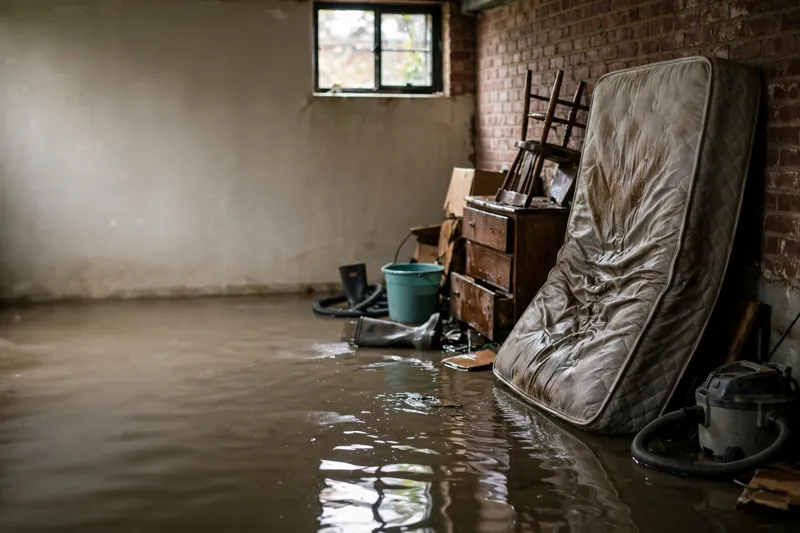
Who pays depends on the source of the water, and the source is the first thing the insurer asks about. A sudden pipe or appliance failure is usually covered by homeowners insurance, less your deductible: the insurer pays for the drying and the repair, not for the pipe that failed. A sewer backup is usually covered only if you hold the endorsement for it, ask your insurer before the next storm, not after it. Flooding from outside needs separate flood insurance. A slow leak may be classed as wear and tear, and the insurer may pay nothing for it. Report water the day you find it, and photograph everything: the claim turns on when the water started and where it came from.
If the break is in the public way, the city's Private Sewer Drain Program may repair it at no cost, see the 311 section above for how it works. Two other programmes exist. The Disaster Relief Assistance Program pays up to fifteen thousand dollars per household, but it covers rent, mortgage and utilities only, not repair, and it runs from January 21, 2025 to January 21, 2027, for households at or below eighty percent of area median income. Its priority ZIP codes are 60644, 60651, 60639, 60641 and 60624.
The Flood Assistance Repair Program pays up to twenty-five thousand dollars for basement damage from the 2023 or 2024 floods, but it is west-side only, for owner-occupied single-family or two-unit homes at or below one hundred percent of area median income, with registration from November 30 to December 11, 2026.
What to tell each caller
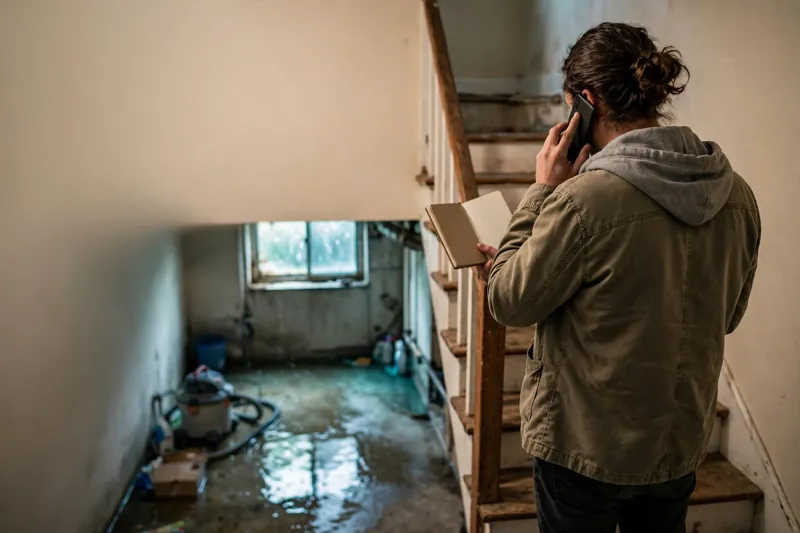
Each caller needs different facts. To 311, say: the water came through a floor drain, whether the street flooded, whether the neighbours flooded too, and your address, then keep the report number. To the plumber, say: where the water is, whether it is still running, whether it smells of sewage, and whether you turned off the main valve. To the drainlayer, say: whether the backup repeats every storm, whether the line has been televised, and whether the break may be under the public way. To the restoration crew, say: where the water is, how deep it looks, whether it smells of sewage, and whether the power is on. Photograph the water line and every damaged item before you move anything, and keep every receipt.
What a job costs, and why this site prints no prices
This site prints no prices, and this post prints none either. A price on a page is a price for a job the page has never seen. The cost depends on how much water there is, what kind of water it is, how many rooms got wet, how long the water sat, and what material it soaked. We inspect first, then give you a written scope of work with the cost in it before any repair starts. No page can give you a number for your home, and this post does not try.
Why do Chicago basements flood?
Chicago basements flood because Chicago has a combined sewer system, and one pipe carries both sewage and stormwater. In a hard storm the combined sewer surcharges, and the water comes back up through the lowest opening in the building, usually the floor drain. That is why a Chicago basement floods when it is barely raining: the rain does not have to be heavy, the sewer only has to be full.
The Metropolitan Water Reclamation District says its sewers handle about two inches of rain before flooding becomes likely, and its overflow action alerts warn when the system is full. The laterals are old too: clay tile and cast iron crack, shift and let tree roots in, and the roots block the line until sewage backs up. The fix is the same for every cause: find the entry point, stop the water, dry to a number, and repair what is left.
Mold after a flood, how fast, and what to do
Mold starts fast. Wet drywall and insulation grow mold within 24 to 48 hours, and a basement that sits wet for a week is a mold job, not a drying job. A wall can look dry and still hold water behind the paint, and a wall that holds water grows mold behind it. Remediation means removing the mold growth and the wet material it sits on, cleaning what stays, and drying the space so it cannot grow back. It cannot work if the leak keeps feeding the wall, so the source comes first.
And the honest answer to the question every homeowner asks, can mold be fully remediated, is yes for the active growth, and no for the spores: no home is ever one hundred percent free of mold spores, and remediation returns the levels to a safe, natural baseline.
The Illinois Department of Public Health's Part 835 registration is operational, effective September 23, 2026, with a grace period to September 30, 2027. This site claims no registration itself. The guidance here is consumer guidance only: ask a company for its Illinois Part 835 registration if mold work is involved, and ask to see it. Our mold remediation Chicago page covers the work itself.
Your checklist, before, during and after
Before the next storm: test the sump pump, clear the discharge line, check the outlet, check the gutters and downspouts, and ask a licensed sewer contractor to televise the lateral. Keep 311's number and ours, (773) 570-9869, on the fridge. During the flood: stop the water at the source if you can do it safely, stay out of the water while the power is on, do not touch the water bare-handed, lift what you can save, and photograph everything before you move it. After the flood: keep the drying running until the meter says dry, keep the log and every receipt, call the insurer the same day, and call 311 if the sewer or the street flooded.
Call now, a crew is on the way
If your basement is flooding now, you already know the question: basement flooding Chicago who to call first. The answer is above, cause by cause, and the call to make is (773) 570-9869. We answer 24/7, and we talk you through the first hour while a crew is on the way. The water comes out the same day, the drying runs until the meter says dry, and the room goes back the way it was.
Frequently asked questions
Who do I call first when my basement floods in Chicago?
It depends on the cause. Water still running means a plumber first. Sewage coming up means 311 first, then a plumber. Storm water means a restoration crew, plus a 311 report. Danger, gas smell, sparking, water at the panel, means 911 from outside.
What is the 50/50 rule for water damage?
The 50 percent rule is a FEMA rule, and it is the only 50 percent rule that counts. If repairs cost half or more of what the home is worth, the home must be brought up to flood standards. No other 50 percent rule exists.
How long does water damage restoration take?
Drying takes three to five days on a clean-water loss in one room, and repairs take one to two weeks after that. The time depends on how much damage there is, what kind of water it is, what materials got wet, and whether mold is growing.
What is water damage restoration called?
Water damage restoration is the full job of getting a home dry and rebuilt after water gets in. It starts with extraction, then drying to moisture readings, then cleaning, then repair. The emergency half, stopping the water and drying, is also called mitigation.
Does homeowners insurance cover water damage restoration?
It usually does if the damage was sudden and accidental, such as a burst pipe or an appliance failure. A sewer backup is usually covered only if you hold the endorsement for it. Flooding from outside needs separate flood insurance.
What is the process of water damage restoration?
The process runs in order: inspection first, to find the source and measure how far the water spread; then extraction, with pumps and vacuums; then drying, with air movers and dehumidifiers; then cleaning and sanitizing; then the repairs that put the room back.
Does homeowners insurance cover water damage?
It usually does when the damage was sudden and accidental, such as a burst pipe or an appliance failure. It does not cover flooding from outside. A sewer backup needs the endorsement. A slow leak may be classed as wear and tear.
What to do when your house floods with water?
Call us first at (773) 570-9869, then stop the water if you can do it safely. Stay out of a flooded basement while the power is on. Lift what you can save, and photograph the water line and every damaged item before you move it.
How much does insurance pay for water damage?
No page can give you a number, because the payment depends on your policy, your deductible, the cause of the loss, and the limits you bought. The insurer pays the drying and the repair, less your deductible, and it does not pay for the pipe that failed.
Are renters responsible for water damage?
It depends on who caused the water and what the lease says. The landlord usually owns the building and its pipes, so the landlord pays for the building repair. A renter pays when the renter caused the damage, such as an overflowing tub left running.
How much does a plumber charge to fix a burst pipe?
This site prints no prices. The charge depends on where the pipe is, how hard it is to reach, whether the wall or ceiling must be opened, and whether the call is an emergency at night. We inspect first, then give you a written scope.
Does homeowners insurance cover burst pipes?
It usually does when the pipe burst suddenly, such as a pipe that froze and split in a cold snap. The insurer pays for the water damage the burst caused, not for the pipe itself. A pipe that leaked slowly for months may be classed as wear and tear.
How much does pipe bursting cost?
Pipe bursting means two different things. Trenchless pipe bursting replaces a broken sewer line by pulling a new pipe through the old one. A burst pipe is a supply pipe that split open, usually from freezing. This site prints no prices for either job.
How much does mold remediation cost?
This site prints no prices, so no figure here can mislead you. The cost depends on how much mold there is, how far it spread, what material it sits on, and whether the water source is fixed. We inspect first, then give you a written scope.
Can mold be fully remediated?
Yes, when the water source is fixed first and the drying is finished to moisture readings. Remediation means removing the mold growth, cleaning what stays, and drying the space so it cannot grow back. No home is ever one hundred percent free of mold spores.
Who to call first for a sewer backup?
Call 311 first, the street flooded, the neighbours flooded too, or the water came up through the floor drain during a storm. Then call a plumber for the private line, then a restoration crew for the cleanup. Do not call the crew first while sewage is still coming in.
Does 311 fix a basement flood?
No. 311 does not pump out, clean, or repair a flooded basement. 311 takes the report and can inspect the public mains. The report goes into the planning record for your block. The pumping, the cleanup and the repair are your job, a restoration crew does them.
Who pays for a flooded basement?
It depends on the source. A sudden pipe or appliance failure is usually covered by homeowners insurance. A sewer backup needs the endorsement. Flooding from outside needs a flood policy. If the break is in the public way, the city's Private Drain Program may repair it at no cost.
Drainlayer vs plumber vs restoration company, who does what?
A plumber works inside the house: stops the source, replaces the split pipe, fixes the fixture. A drainlayer works underground and outside: the main sewer line, the lateral and the public way. A restoration company extracts the water, dries the structure to readings, and repairs the rooms.
Who do you call for water damage in Chicago?
Water still running means a plumber first, then a restoration crew. Sewage means 311 first, then a plumber, then a crew. Storm water means a restoration crew, plus a 311 report. Gas smell, sparking or water at the panel means 911 from outside.
Who do I call for a sewage backup?
Call 311 first, the street flooded, the neighbours flooded too, or the water surged during a storm. Then call a plumber for your private line, then a restoration crew. Stay out of sewage water: it is black water, and it needs a crew the same day.
Should I call the city or a plumber for a sewer backup?
Call the city first, 311, when the main, the street or the neighbours point city-side. Then call a plumber. The inspection decides whose pipe it is: the city repairs a break in the public way at no cost, and the owner pays for the private line.
Is a flooded basement an emergency?
Yes, when the water is still coming in, when sewage is present, or when water is near power. Call now, a basement that waits a night is a mold job. A small clean-water leak found fast, with the source stopped, can wait for a daytime call.
How do I report basement flooding to Chicago 311?
Call 311 any time, the center is staffed twenty-four hours a day, seven days a week, or file a Water in Basement Complaint on the 311 site. Say whether the water came through a floor drain, whether the street flooded, and whether the neighbours flooded too.
Can I clean up a flooded basement myself, or when do I need a professional?
A small clean-water spill you can mop up and dry fast, with fans and a dehumidifier, if the source is stopped. Call a crew when sewage is present, when the water is deep, when power is at risk, or when drywall and flooring are wet.
Who do I call if water is near the electrical panel or I smell gas?
Stay out of the basement. Call 911 from outside if you smell gas, hear sparking, or see arcing. Call an electrician if the panel itself is wet. Call the gas utility if the smell is gas. Do not go in to flip a breaker while standing in water.
What counts as a flooded basement?
A basement counts as flooded when water is standing on the floor or coming up through a floor drain or a toilet. A damp floor after a storm is a warning, not a flood, but standing water is. If the water is still rising, or it smells of sewage, treat it as a flood and start the first-hour steps.
Does Chicago have a basement level?
Yes. Most Chicago houses have a basement level below the street, and the combined sewer runs in the street above it. That is why a surcharged sewer can push water up through a floor drain. A garden flat counts as a basement level too, and it floods first because it sits lowest.
Sources
- CBS Chicago, July 28-29, 2021, Ginneh Strickland, Bronzeville sewer backup. https://www.youtube.com/watch?v=ZITppxSdU9c
- FOX 32 Chicago, ~April 2026, Chrislin Flanagan, 107th block of South Emerald: basement flooded 2021, 2022, 2023 and 2026.
- CBS Chicago, August 18, 2025, Dwayne Baxter, Chicago Lawn: second basement flood of the summer. https://www.youtube.com/watch?v=C7C0u2e7ieU
- CBS Chicago, August 19, 2025, Ishmael, Chicago Lawn: nearly three feet of water, second flood in three weeks, official 311 complaint. https://www.youtube.com/watch?v=Exl4lrN6D_k
- CBS Chicago, September 13, 2022, Rogers Park and Portage Park: seven inches of rain in one hour, over nine hundred 311 calls. https://www.youtube.com/watch?v=TIbCmSG5QtU
- CBS Chicago, July 3, 2023, Elizabeth Belinga, Jefferson Park: second sewer backup after May 2020. https://www.youtube.com/watch?v=9GcbByiHG8w
- Chicago Sun-Times and WBEZ, "SOAKED" panel, November 12, 2026, and Sun-Times Short, ~November 16, 2026, unnamed US Navy veteran. https://www.youtube.com/shorts/-2R_FjHNX2A
- Chicago 311, "Water in Basement Complaint" record, 4228 North Leavitt Street, 2nd, North Center, September 11, 2022 (Augrented, City of Chicago 311 data), a complaint record, not proof of a first call.
- Claire Hoy, Johns Hopkins MA thesis, May 2023, Friend family, North Center, September 11, 2022: water at calf height bubbling from floor drains.
- ABC7 Chicago, September 12, 2022, Nichole Vidal, West Ridge garden flat, September 11, 2022.
- ABC7 Chicago, February 1, 2023, Jessika Cutts, 4900 block of North Glenwood: street water-line break, January 31-February 1, 2023.
- DNAinfo, June 15, 2015, Josh Atterberry, Argyle Avenue west of Broadway: street flooding.
- CHI 311, "Private drains program overview", December 12, 2018, 311.chicago.gov. https://311.chicago.gov/s/article/Private-drains-program-overview
- City of Chicago, Department of Water Management home page, What We Do page, Our Structure page and Leadership page, chicago.gov, November 17, 2026.
- City of Chicago, Sewer Permits page and "Drainlayer License Changes for 2026" notice, January 2, 2026, chicago.gov, November 17, 2026.
- City of Chicago, Stormwater Management Regulations, March 2026, page sixty-three, plan-review fees, variance, amendment fee and fine.
- City of Chicago, Private Drain Repair programme page and Department of Water Management flyer, chicago.gov.
- City of Chicago, 311 Call Center Operations page, chicago.gov, staffing twenty-four hours a day, seven days a week.
- City of Chicago, Flood Assistance Repair Program and Disaster Relief Assistance Program pages, chicago.gov.
- Illinois Department of Public Health, Part 835 mold remediation registration, dph.illinois.gov, November 13, 2026.
- Borderless Magazine, December 20, 2022, two thousand five hundred basement-flooding reports across five neighbourhoods.
- Metropolitan Water Reclamation District of Greater Chicago, extreme-rainfall page, mwrd.org.
More on flooded basements
The service pages behind this guide, the work itself, after the calls are made.
More Restoration Services in Chicago
Every service below is one tap away. Pick the one that matches your problem.

Water Damage Restoration
Fast water extraction, structural drying, and full repair after burst pipes, leaks, and floods.
Learn more →
Water Mitigation
Emergency water removal, structural drying, and mold prevention to stop the damage fast, 24/7.
Learn more →
Mold Remediation
Safe, contained mold remediation that removes contamination and fixes the moisture source.
Learn more →
Sewage Cleanup
Safe removal and disinfection of dangerous sewage backups and black water.
Learn more →
Flood Cleanup
Water pumped out, structure dried, and debris cleared fast after storms and flooding.
Learn more →
Hardwood Floors Water Damage
Cupped, buckled or stained hardwood after a leak? How we dry it, when sanding saves it, and when the boards have to go.
Learn more →